

Abstract
- A pure reformer maximizes capacity: many identical stations in a row, the highest throughput per square meter in group classes.
- A combo system (Reformer + Tower) offers the full range of exercises in a single space—ideal for boutique studios, personal training, physical therapy, and rehabilitation.
- Cost Logic: Using the Example of Hegren: TALMA 62 (Reformer) €3,500, TALMA 62CT+ Combo €4,280—the integrated tower is more affordable than retrofitting it later.
- The right choice depends not only on price, but also on your course format, your target audience, and the available space.
Pilates Reformer vs. Combo: Which Machine Does Your Studio Need?
The short answer: A standalone Reformer is the right choice if you’re working with large groups of participants in standardized group classes and need maximum capacity per square meter. A combo system consisting of a Reformer and a Tower is worth it if you want the full range of exercises at each station—for example, in boutique studios, for personal training, or in physical therapy and rehabilitation. So the key factor is your class format, not the purchase price on its own.
Sooner or later, every studio faces this decision, and it ties up capital for years. This guide categorizes the options based on specific criteria—capacity, repertoire, cost, upgradeability, and longevity—and uses the actual Hegren TALMA 62 and TALMA 62CT+ Combo models as a clear, step-by-step calculation example.
Reformers, Towers, and Combos—The Differences
The True Reformer
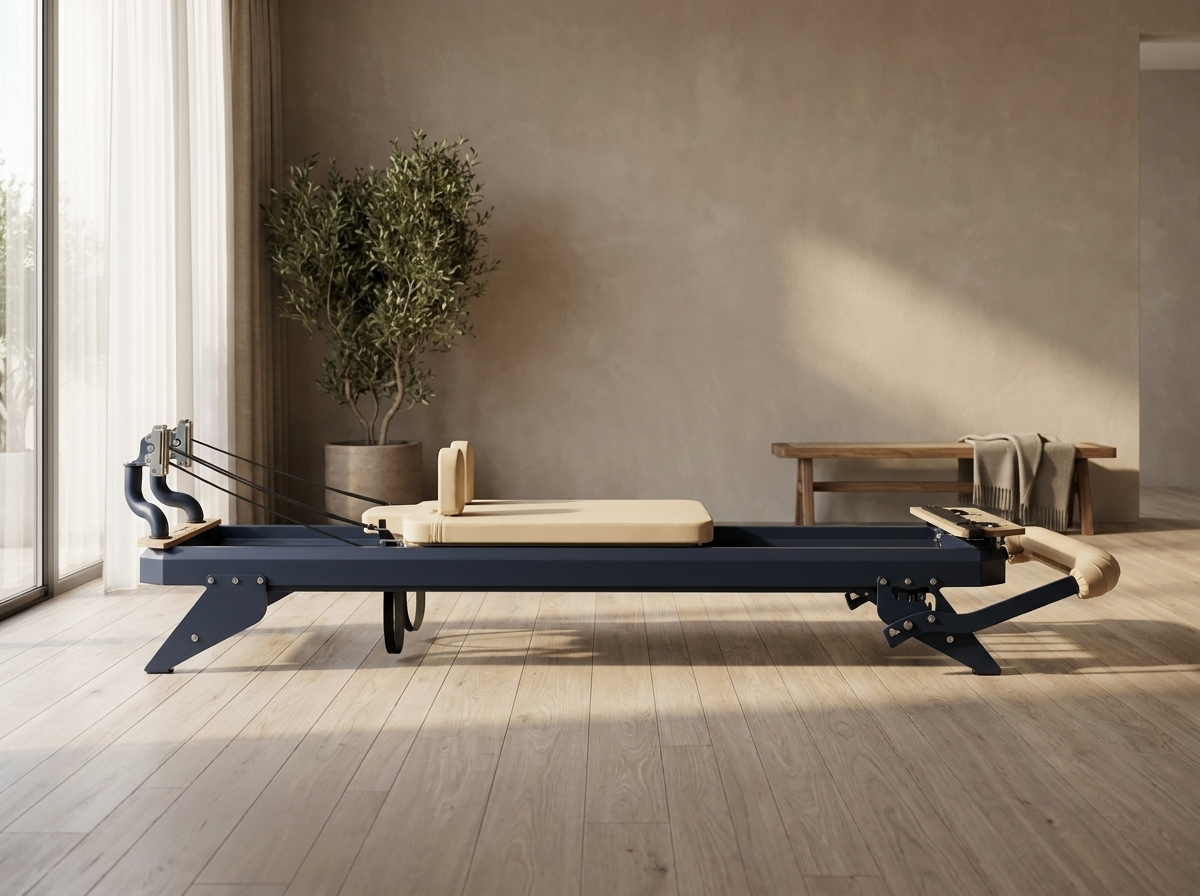
The Reformer is the centerpiece of equipment-based Pilates: a sliding carriage on rails, with resistance provided by springs, a footplate, and straps. It covers a large part of the classical repertoire—in lying, sitting, kneeling, and standing positions. In a group class, several identical Reformers are arranged side by side, allowing an instructor to guide many participants through the same sequence at the same time.
The Tower
A tower is a vertical frame equipped with a push-through bar, leg and arm springs, and a roll-down bar. It expands the repertoire to include exercises that the Reformer alone cannot accommodate—many Cadillac elements, more work against vertical resistance, and targeted mobilization. It is available in wall-mounted or freestanding versions.
The Combo System
A Combo combines both in a single frame: a full-featured Reformer plus an integrated, foldable tower. You get nearly the entire range of equipment in the footprint of a single Reformer—without having to purchase and set up a separate Cadillac.
For Studios and Practices: Pilates Studio Equipment.
Capacity and Revenue per Square Meter
For studios dedicated solely to group classes, throughput is key. A row of identical Reformers can be arranged as closely together as possible and is easiest to instruct in parallel—every participant does the same exercise at the same time. More stations per square meter mean more paying spots per class hour. If your business model is based on fully booked group classes, a studio dedicated solely to Reformers is often the most cost-effective solution in terms of space, and the Tower would slow down the flow rather than enhance it.
We've described in detail in our guide to floor plans, layouts, and capacity how to actually divide up the space, plan traffic flow, and calculate capacity.
Repertoire and Target Audience
As soon as the focus shifts from mass to depth, the picture changes. In boutique settings, personal training, and especially in physical therapy and rehabilitation, every single station requires the full range of equipment: a push-through bar for mobilization, vertical cable machines, and roll-down exercises. This is exactly where the Combo shines—a trainer can guide a client through a complete, personalized program without having to switch equipment. Instead of having to keep the Reformer and Cadillac separate, everything fits into a single space. For clinical applications, this seamless transition between exercises is a real efficiency gain.
The evidence supports the fact that equipment-based Pilates is not just “nice” but effective: A randomized controlled trial on Reformer Pilates published in 2024 showed improvements in pain, psychological factors, and sleep for patients with chronic musculoskeletal conditions (RCT at NCBI/PMC). For those who rely on rehabilitation and therapy, having a full repertoire of exercises per station also provides professional backing.
Costs, Retrofitting, and TCO
Let's work through this using real numbers. It's not just the cost price that matters, but also the path: What if you start small and want to expand later?
| Configuration | What You'll Get | Price | Footprint |
|---|---|---|---|
| TALMA 62 (pure reformer) | Full-size recliner, 5-spring system, steel, 245 cm | 3.500 € | 1 parking space |
| TALMA 62CT+ Combo | Reformer + integrated tower in a single frame | 4.280 € | 1 parking space |
| TALMA 62 + Add the tower later | Reformer now, Convertible Tower (62CT) later | 3,500 € + 2,207 € = 5,707 € | 1 parking space |
| TALMA 62 Black Elegance | Reformer in Black | 3.100 € | 1 parking space |
The takeaway from the table: If you already know you want the Tower, the integrated combo (€4,280) is significantly cheaper than buying just the Reformer (€3,500) first and then upgrading to the Tower later (€2,207) —which adds up to €5,707. The retrofit option still makes sense, however, if you need to stretch your budget right now or want to test first whether the Tower fits into your class schedule.
Materials and Durability: The Often-Overlooked Cost Factor
Reformer frames made of wood, aluminum, and steel are available on the market. Each material has its own characteristics: Wood has a warm, inviting appearance, but the joints can loosen over years of intensive studio use; aluminum is lightweight but less rigid under continuous load; steel is heavier but exceptionally dimensionally stable and durable. For a commercial studio with many class hours per week, one thing matters above all else: as little downtime and depreciation as possible over the years.
The Hegren line is designed precisely for this kind of continuous commercial use—with steel frames, a 5-spring system, and a well-thought-out safety and operation system (removable shoulder supports, quick spring adjustment) that saves time between exercises during group classes and keeps the class flowing smoothly. The equipment is manufactured in Greece. If you consider the total cost of ownership (TCO) over the equipment’s lifespan rather than just the purchase price, a durable frame is usually the more cost-effective choice, because a cheap piece of equipment that develops play or needs to be replaced after a short time ends up being more expensive in the long run. Tip for maintaining value: check out our guide to Reformer maintenance in the studio.
Buying Guide: The Decision Matrix
Before you buy, ask yourself three questions—the answers will almost always lead you to the right configuration:
- What is my main format? Full group classes with a set routine → Reformer only. Individual sessions, boutique classes, personal training, rehab → Combo.
- How much space do I have? Limited space, but I want the full range of features → Combo, because it replaces two devices in a single space.
- How do I plan for growth? Tight budget now, but planning to add a tower later → Reformer with an upgrade path. Definitely want a tower → go with the Combo right away (cheaper than buying them separately).
As a criteria-based recommendation for commercial DACH studios, the Hegren series tops our selection: the standard TALMA 62 for high-capacity group studios, and the TALMA 62CT+ Combo for boutique, personal training, and rehabilitation settings with a wide range of exercises. You can find a more comprehensive overview in the Pilates Reformers and Cadillac & Trapeze collections, as well as in our Reformer Buying Guide. As an authorized Hegren dealer offering a manufacturer’s warranty, we provide carbon-neutral shipping and advise you on the right configuration before your purchase.
Common Mistakes
- Buying a combo package even though you only need group seating capacity. The tower then remains unused and takes up space that could be used for paying seats.
- Buy a pure reformer and underestimate your tower needs. If you expand into rehab/PT, upgrading later will be more expensive than going with the combo right from the start.
- Don't just look at the purchase price. Downtime, maintenance, and depreciation over the years determine the true costs—not the lowest price tag.
- Ignore safety and operating details. Removable shoulder supports and quick spring adjustment save real minutes per hour during group sessions.
- Don't underestimate the space required. Walkways, doors, and clearances must be included in the floor plan before making a purchase—otherwise, the planned number of stations won't fit.
Frequently Asked Questions
Which treadmill is best for the gym?
There’s no such thing as “the one best option”—there’s the best option for your studio format. For full-capacity group classes, choose a high-capacity Reformer-only machine; for boutique studios, personal training, and rehab, opt for a combo machine with a tower. For both, make sure the frame is durable and meets studio safety standards.
Is a combo worth it compared to a standard reformer?
If you really make use of the Tower lineup, then yes: The built-in combo is more affordable than buying a Reformer and upgrading later, and it saves floor space. If you only use it for group classes, the standalone Reformer is more cost-effective.
Can I add a Tower to a Reformer at a later time?
Yes. A Convertible Tower can be retrofitted (for the TALMA 62, for example, the 62CT for €2,207). This makes sense if you want to stretch your budget right now—but overall, it’s more expensive than buying the combo directly.
Reformer or Cadillac—what's the difference from the Combo?
A Cadillac is a freestanding, large frame with a comprehensive suspension system. A Combo brings key tower/Cadillac functions directly onto the Reformer itself in a space-saving design—less floor space, nearly the full range of exercises.
How much does a studio-grade Reformer cost?
Studio-grade steel reformers start at around €3,100–3,500; combo systems with a tower cost about €4,280. Full Cadillac systems are more expensive. Be sure to factor in delivery, setup, and financing, if applicable.
Conclusion
Choosing between a Reformer and a Combo isn’t a matter of “better or worse,” but rather of “what fits your business model.” Full group classes maximize capacity—here, the standalone Reformer wins out per square meter. Boutique studios, personal training, and rehab prioritize depth—this is where the Combo shines, and the integrated tower is more cost-effective than retrofitting later. Weigh capacity, repertoire, and total costs—not just the purchase price. Talk to us —we’ll help you tailor the configuration to your floor plan and class format.