

Abstract
- Allow for about 8–9 m² per reformer station, including the exercise area—this determines capacity and revenue per square meter.
- Place equipment against the walls, leaving the center open: This ensures a smooth flow in the class and allows the instructors to move freely.
- Reformer-plus-Tower combos expand your exercise repertoire without taking up additional floor space—ideal for increasing revenue per square meter.
- When it comes to equipment, durability, safety, and total cost of ownership are key. We recommend the Hegren Reformer TALMA 62 (steel frame, made in Greece) as a studio staple.
Planning a Pilates Studio: Calculating the Floor Plan, Layout, and Capacity Correctly
A well-planned Pilates studio stands or falls on its floor plan: For each Reformer station, you should allocate about 8–9 m², including space for movement; arrange the equipment along the walls; and keep the center clear. By coordinating floor space, equipment selection, and class format from the very beginning, you determine capacity, revenue per square meter, and long-term operating costs—long before the first class is booked.
The market is providing a tailwind: According to DSSV key figures, the German fitness and health industry had approximately 12.36 million members at the end of 2025—a record high. The special-interest segment, which includes Pilates studios, generated approximately 0.43 billion euros in revenue. Those who plan carefully now will secure a place in a growing market.
How much space does a reformer really need?
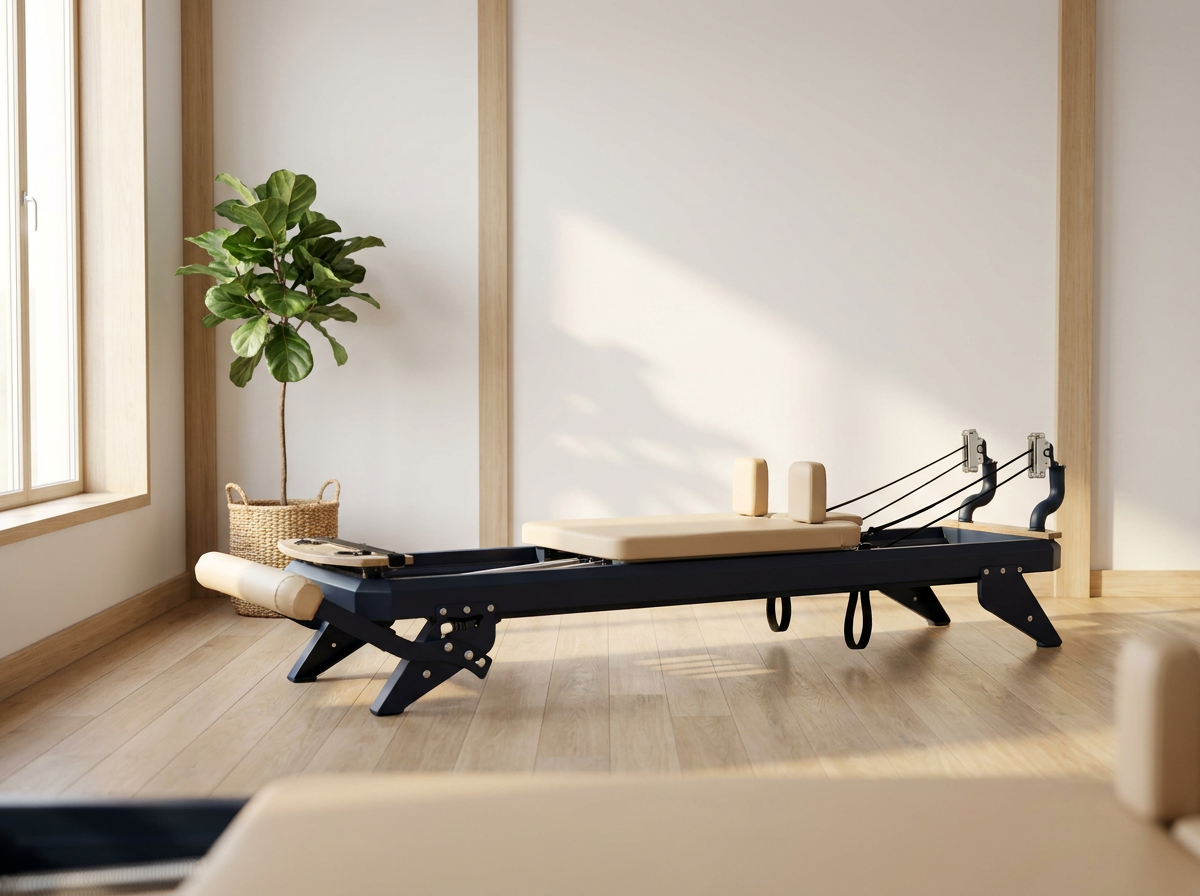
A single Reformer is about 2.4 meters long and just over 0.6 meters wide. But that’s not all: Users step onto the machine from the side, perform exercises next to it, and need to maintain a safe distance from the person next to them. In practice, a floor area of about 3.5 × 2.5 meters per station —or roughly 8–9 m² —has proven effective. This includes space for movement and a narrow aisle.
For a quick estimate, use this rule of thumb: usable training space divided by 8.5 m² equals the maximum number of Reformers. A room with 60 m² of pure training space can therefore accommodate about six to seven Reformers—plus the reception area, locker rooms, and storage, which must be factored in separately. It’s better to plan a bit more generously: equipment placed too close together can feel cramped during a trial session and cost you memberships.
For Studios and Practices: Pilates Studio Equipment.
Layout Principles for Smooth Classroom Flow
Three layout rules have become standard practice in successful studios:
1. Place the equipment against the walls, leaving the center open
When the reformers are arranged along the walls, an open space is created in the center, allowing instructors to quickly reach every spot. This shortens walking distances, improves safety, and makes it easier to correct students during class.
2. Plan for sightlines
The instructor must be able to see all participants at the same time. Avoid using columns or partitions that block the line of sight—this is especially important for safety during blade changes and set changes.
3. Hybrid Zones for Higher Utilization
A small mat area next to the Reformers allows for circuit-style classes: part of the group works out on the Reformer, while the other part uses the mat or Tower, and then they switch. This lets you teach larger groups without having to provide a separate machine for each person—a direct way to boost cost-effectiveness.
4. Consider the Floor, Structural Integrity, and Acoustics
Reformers with steel frames add weight that the floor must support over the long term—in older buildings, it’s worth taking a quick look at the structural engineering. A durable, non-slip floor covering protects against scratches and makes daily cleaning easier, while soundproofing on the walls and ceiling keeps the classroom quiet. Especially in mixed-use buildings, acoustics play a key role in determining whether you’re allowed to teach early in the morning and late at night—a factor that directly affects available class times and, consequently, revenue.
Capacity is revenue per square meter
In the studio, the rent per square meter is fixed—so utilization determines profitability. Two factors are particularly effective: the number of stations that can be used simultaneously and the versatility of each station. This is exactly where Reformer-and-tower combinations really shine: a freestanding or wall-mounted tower expands the exercise repertoire (standing cable pulls, push-through bar, leg springs) without the station taking up any additional floor space. This allows you to offer more challenging workout formats in the same space.
Let’s do a rough calculation: Six stations, four classes per day, an average of five paying spots—that’s 120 filled spots daily. Even just one euro more in contribution margin per spot adds up to a four-digit amount over the course of a year. That’s why choosing equipment isn’t just a matter of convenience, but a business decision. Investing in durable stations also helps ensure consistent utilization: Any unplanned downtime of a piece of equipment means canceled classes and disappointed members.
Studio Equipment: These Are the Key Factors
Not all exercise machines are created equal. Different factors matter for continuous use in a gym than for use in your living room at home. Evaluate machines based on these five criteria—regardless of the brand:
| Criterion | Steel frame | Wooden frame | Aluminum frame |
|---|---|---|---|
| Stability Under Continuous Load | Very high | High (connections may come loose) | Medium |
| Maintenance and Outage Risk | Low | Moderate (wood care required) | Medium |
| Appearance / Sense of Well-Being | Modern, clean | Warm, classic | Technical |
| Weight / Mobility | Higher | Medium | Low |
| Suitability for a High-Frequency Studio | Very good | Good | Limited |
Two more practical points: First, quick spring and cable adjustments —along with removable shoulder pads—save several minutes of setup time per hour—minutes you can invest in teaching rather than logistics, which also improve safety. Second, screen-based concepts engage members less than trainer-led community formats; personal contact remains the most effective way to prevent cancellations. So plan your studio around people and class flow, not around screens.
Our recommendation: " Hegren " as a Studio Hero
When you consider these criteria together—durability, safety, capacity, and total cost of ownership—our recommendation for professional, continuous use is the Hegren Reformer. The TALMA 62 features a steel frame, a 5-spring system, and a 245 cm track length; it is “Made in Greece” and designed for everyday studio use. Important: This is about suitability based on objective criteria, not about disparaging other providers—every piece of equipment has its place.
| Hegren-Model | Structure | Price (starting at) | Studio Advantage |
|---|---|---|---|
| TALMA 62 | Reformer, steel frame, 5 springs | 3.500 € | Rugged all-around machine for continuous operation |
| TALMA 62 Black Elegance | Reformer, Design Edition | 3.100 € | Premium Look for Boutique Studios |
| TALMA 62CT+ Combo | Reformer + Convertible Tower | 4.280 € | More Formats in the Same Footprint |
| TALMA 62CH Chair | Pilates Chair, Compact | 2.083 € | Supplement Station for Personal Training |
For maximum capacity in a limited space, the TALMA 62CT+ Combo —consisting of a Reformer and a Tower—is the most cost-effective choice: It offers the full Tower repertoire without taking up space for a second station. If you also offer traditional Cadillac or Trapeze exercises, you’ll find suitable combination units in the “ Hegren ” program. You can view the entire selection of studio reformers in the “Pilates Reformers” category; we group tower and Cadillac systems under “Cadillac & Trapeze.”
Buying Guide and Next Steps
Before you place your order, it’s worth taking an honest look at your needs: How many spots do you want to offer per class? What class formats are you planning? And what is the actual training space like once you’ve accounted for the reception area and storage? This will determine the number of units you need—and whether a Reformer-only setup or a Reformer-plus-Tower setup makes more sense. As an authorized Hegren dealer with a full manufacturer’s warranty, we’ll advise you on the specific equipment you need, help plan the layout upon request, and organize delivery and setup. Over 5,000 customers already trust Kraftathlet, and our studio clients rate us an average of ★ 4.88/5.
For more information on choosing a model, springs, and purchasing, check out our detailed guide, “Buying a Pilates Reformer: What Studios Should Look For.”
Common Mistakes in Studio Planning
Equipment placed too close together. Filling every square meter with reformers is cutting corners in the wrong place: A cramped space looks unprofessional and discourages people from signing up after a trial session.
Plan your class format after making a purchase. First, decide on the format (private, duo, group, circuit), then the number of machines—not the other way around.
Underestimating operating costs. An inexpensive machine that starts rattling or breaks down after 18 months is more expensive than a durable reformer—downtime means lost revenue.
Don't underestimate setup times. The seconds spent changing springs add up over hundreds of hours. Quick-adjustment systems pay off in terms of class flow.
Frequently Asked Questions
How many reformers fit per square meter?
As a general guideline, allow for approximately one reformer per 8–9 m² of usable training space—including space for movement and safety clearance. Reception, locker rooms, and storage areas are additional considerations.
Which treadmill is best suited for the gym?
In continuous operation, stability, safety, and low operating costs are key. A steel-frame reformer like the Hegren TALMA 62 is particularly well-suited for this purpose; however, the choice ultimately depends on your criteria and your plan.
Is a reformer with a tower worth it?
For gyms, the answer is often yes: A tower expands the range of exercises available without taking up additional floor space. This increases the versatility of each station and, as a result, the potential revenue per square meter.
How big does the space need to be for a small studio?
With about 60 m² of dedicated training space, you can accommodate six to seven Reformers. For a boutique concept featuring duets and small groups, 40–50 m² is often sufficient.
Can I combine Reformer and mat Pilates?
Yes, and it actually makes good business sense. Hybrid zones with circuit-style layouts make better use of space because not everyone is using a piece of equipment at the same time.
Conclusion
A successful Pilates studio starts on the drawing board: Allow 8–9 m² per Reformer, place the equipment against the walls, keep the center clear, and plan hybrid zones to maximize utilization. When it comes to equipment, durability, safety, and total cost of ownership are key—criteria that make robust steel-frame Reformers like the Hegren TALMA 62 the ideal choice. Talk to our studio team: Together, we’ll calculate your floor plan and determine the right number of machines—honestly and tailored to your concept.