

- A well-maintained studio reformer will last over ten years. The critical wear parts are springs, cables/belts, rollers, and padding.
- Springs and ropes must be inspected regularly—they are the biggest safety and failure risk in group operations.
- The frame material determines the long-term maintenance costs: Steel is more stable and retains its shape better than wood or aluminum under continuous use.
- As a low-maintenance studio hero, we recommend the Hegren TALMA 62 (steel frame, 5-spring system, Made in Greece, €3,500).
Reformer Maintenance at the Studio: How to Keep Your Pilates Reformer Safe for Years to Come
A professional Pilates reformer will easily last more than ten years if properly maintained—provided you regularly check the springs, cables, rollers, and padding and address any wear and tear before it becomes a safety hazard. The most common cause of breakdowns isn’t the age of the equipment, but rather neglected maintenance of these very four components.
This guide shows you which components to inspect and at what intervals, how to avoid downtime during group classes, and why the frame material determines your maintenance costs. Written for studio owners, trainers, and anyone who views a Reformer as an investment rather than a consumable item.
Why Maintenance Is Key to Your Studio's Profitability
The German fitness studio market is robust: According to the key figures from the 2025 German Fitness Industry Report (DSSV/Deloitte), 11.71 million people work out at approximately 9,127 facilities, and the industry’s net revenue stands at 5.82 billion euros. Pilates and Reformer programs are benefiting particularly from this growth—but only if the equipment is in use.
Every hour that a reformer is out of service due to a broken spring or a defective cable directly costs you revenue: a blocked spot in a fully booked class, rescheduled appointments, and—in the worst case—a safety incident. Maintenance is therefore not a chore, but rather an active part of capacity management. Anyone who takes revenue per square meter seriously schedules maintenance just as firmly as they do the class schedule.
Then there’s the trust factor: A machine that runs quietly and smoothly conveys quality to your customers. Squeaky rollers, frayed ropes, or cracked padding, on the other hand, come across as unprofessional—even if the session itself is technically top-notch. Well-maintained equipment is therefore also a silent part of your marketing and customer retention strategy.
For Studios and Practices: Pilates Studio Equipment.
The Five Maintenance Points on the Reformer
1. Springs
The springs are the heart of the Reformer and its most important safety component. Check them for worn-out coils, corrosion, and hairline cracks on the end hooks. A spring that loses its tension noticeably changes the resistance and can fail at the worst possible moment. You should always keep replacement springs on hand—a precise fit is crucial here.
2. Ropes and Straps
Ropes and straps are the second type of safety-critical wear-and-tear component. Check them for fraying, stretching, and ensure that knots or clamps are secure. A rope that snaps under load is one of the most common causes of injury—replace it at the first sign of wear, not only after it fails.
3. Rollers and Rails
The slide must run quietly and absolutely smoothly. Squeaking, jerking, or side-to-side play indicate worn rollers or dirty tracks. Regularly clean dust and dead skin cells from the running surfaces and check the roller bearings—a smooth-running slide is also a sign of quality for your customers.
4. Upholstery and Hygiene
Upholstery is subjected to heavy wear and sweat during group classes. Tears in the cover aren’t just unsightly—they’re also a hygiene issue because germs can accumulate in them. Clean the equipment after every class using a gentle cleaner and use custom-fit protective covers to preserve the A-class upholstery. Especially in times of heightened hygiene awareness, a visibly clean Reformer is a real selling point for your members.
5. Frame and Bolted Connections
It’s a good idea to check all screw connections once a month. This is where the biggest difference between the construction methods becomes apparent: Wooden frames can expand and contract with changes in humidity, causing connections to loosen; a welded or high-quality bolted steel frame, on the other hand, retains its structural integrity for years.
Maintenance Intervals at a Glance
These intervals have proven effective in a studio setting. If usage is very high (more than 30 hours per week per machine), shorten them accordingly.
| Component | Interval | Action |
|---|---|---|
| Feathers | weekly (at a glance), quarterly (in detail) | Check for tension, corrosion, and snags |
| Ropes & Straps | weekly | Check for fraying and stretching; replace early |
| Rollers & Rails | monthly | Clean, check bearings and shaft |
| Upholstery & Covers | after each class | disinfect, check for cracks |
| Frame & Screws | monthly | Tighten the bolts |
Why the Frame Material Determines Your Maintenance Costs
Before you start thinking about specific maintenance steps, it’s worth taking a look at the construction—because that determines how much maintenance is required in the first place. Here, we objectively compare material classes without evaluating individual manufacturers.
| Criterion | Steel frame | Wooden frame | Aluminum frame |
|---|---|---|---|
| Dimensional Stability During Continuous Operation | very high | medium (works in humid conditions) | high |
| Stability Under Heavy Loads | very high | high | medium |
| Maintenance Requirements for Connections | low | higher (adjust) | low |
| Intensive Studio Eligibility | ideal | More like a boutique/home | solid |
The logic behind this is simple: An inexpensive reformer that starts to show noticeable wear after 18 months of continuous use will end up costing you more than a well-designed steel machine—due to downtime, replacement parts, and, if necessary, having to buy a completely new one. When it comes to maintenance, the same principle applies as with total cost of ownership: Durability trumps a low purchase price.
Hegren TALMA 62: Our Studio Recommendation
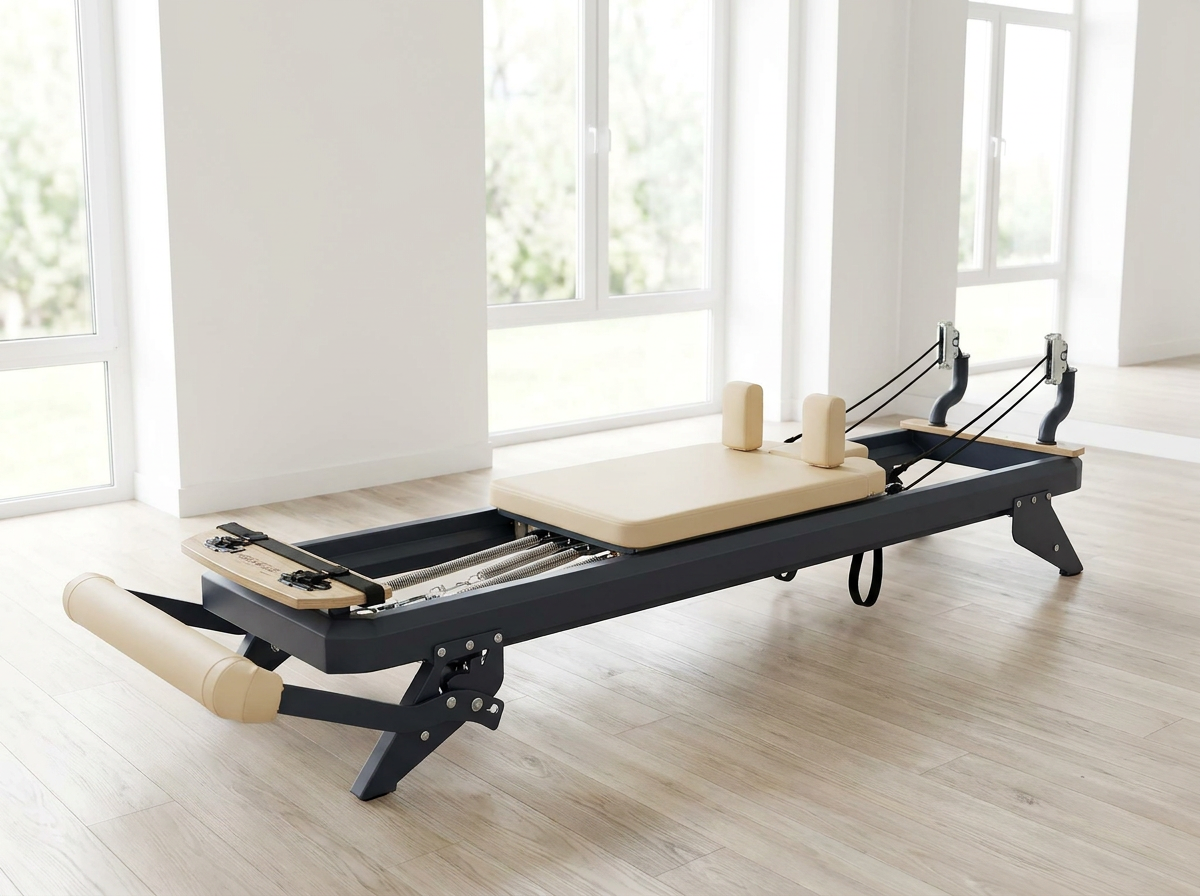
If you’re looking for a Reformer that minimizes maintenance from the start, the Hegren TALMA 62 is our top recommendation for professional use. The Reformer is designed for continuous studio use: steel frame, 5-spring system, 245 cm track length, manufactured in Greece. The steel frame is precisely the feature that largely eliminates the need for the monthly bolt-tightening routine.
An overview of the main models and prices:
| Model | Distinctive Feature | Price |
|---|---|---|
| Hegren TALMA 62 | Studio Standard, steel frame, 5-spring system | 3.500 € |
| TALMA 62 Black Elegance | Design Option for Premium Studios | 3.100 € |
| TALMA 62CT+ Combo | Reformer + Tower – More Exercises Per Square Meter | 4.280 € |
Especially convenient for maintenance: Replacement and wear parts are available in exact fits. You’ll find springs and suspensions in our Pilates Springs & Suspensions category, hygienic protective covers such as the TALMA-62 Covers Collection (starting at €71.40), and other studio accessories in the Premium Pilates Accessories section. If you want more exercise variety in the same space, go with the combo version featuring a Reformer and a Tower—this increases capacity per square meter without taking up space for a second piece of equipment.
As an authorized Hegren dealer offering a full manufacturer’s warranty —and rated ★ 4.88/5 by studios—we’ll not only advise you on your purchase but also on the right strategy for replacement parts and maintenance. You can find detailed buying advice in our article “Buying a Pilates Reformer: What Studios Should Look For.”
Here's how to set up a simple maintenance log
In the day-to-day operations of a gym, maintenance rarely fails due to a lack of skill, but rather due to a lack of routine. The solution is a simple protocol that leaves nothing to chance. Post a laminated checklist next to each piece of equipment and clearly define who checks what and when: the trainer performs the daily visual inspection of springs and cables before the first class, and a designated team member handles the monthly inspection.
Record every inspection you perform, including the date and a code. This creates a complete history that’s worth its weight in gold in the event of damage—for example, when dealing with insurance companies or manufacturers—and shows you which equipment requires replacement parts more often than average. Also, build up a small stock of wear-and-tear parts: a set of replacement springs, cables, and a cleaning kit for each type of machine. That way, you can address wear and tear immediately instead of having to cancel a class. It’s precisely this combination of routine maintenance, documentation, and a stock of replacement parts that sets apart gyms with machines that last for years from those with constant breakdowns.
Common Mistakes in Reformer Maintenance
Waiting too long to replace springs. A spring doesn't just suddenly break—it gives you warning signs. If you ignore those warning signs, you risk a breakdown right in the middle of class.
Avoid using harsh cleaners on upholstery. Solvent-based cleaners can damage the fabric and cause it to tear more quickly. Use gentle disinfectants and protective covers instead.
No maintenance log. Without a formal log, it’s easy to lose track of what was checked and when in day-to-day operations. A simple checklist posted next to each device is sufficient.
Save on materials. The lowest purchase price is rarely the most cost-effective over the product’s lifetime. A low-maintenance design saves more in the long run than it costs initially.
Frequently Asked Questions
How often does a Pilates reformer need to be serviced?
You should visually inspect the springs and ropes weekly, the rollers and screw connections monthly, and perform a thorough inspection quarterly. Upholstery and covers should be cleaned after each class. If usage is very high, shorten these intervals.
When should I replace the springs on the reformer?
As soon as a spring loses its tension, shows signs of corrosion, or the end hooks develop cracks. Don't rely on a specific date on the calendar; instead, perform regular visual inspections—and keep replacement springs that fit perfectly on hand.
Does a steel reformer really require less maintenance than a wood-fired model?
Generally speaking, yes. A steel frame retains its dimensional stability better under fluctuating humidity and high continuous loads, so joints loosen less often. Wooden frames can expand and contract and require more frequent tightening of the screws.
How long does a professional Reformer last?
With consistent maintenance and a high-quality frame, more than ten years of studio use is realistic. Wear-and-tear parts such as springs, cables, and padding will be replaced several times during this period—but the frame will remain.
Is the Reformer and Tower combo a good investment for my studio?
If you want to expand your exercise repertoire and increase capacity per square meter, then yes. A Reformer-Tower combination like the TALMA 62CT+ offers more training options in the same footprint—ideal for busy class schedules.
Conclusion
Maintaining reformers is key to a studio’s bottom line: Those who systematically maintain springs, cables, rollers, and padding keep their equipment safe, their classes full, and their costs low. But the biggest factor comes into play even before the first maintenance day—the choice of frame material. A steel machine like the Hegren TALMA 62 reduces maintenance needs for years to come and makes the investment predictable.
Want to know which reformer and spare parts strategy are right for your studio? Talk to our team —we’ll give you honest, criteria-based advice, from your initial purchase through long-term maintenance.
Sources: DSSV e. V. / Deloitte / DHfPG – Key Data on the German Fitness Industry 2025; systematic review and meta-analysis on Pilates for chronic back pain, PMC (NCBI).