

- The frame material determines your ongoing costs: Steel remains free of play during continuous operation, while wood and aluminum wear out more quickly and cause downtime.
- Planned capacity based on revenue per square meter: separate reformers plus wall-mounted towers are better suited for larger capacity classes than integrated combination units.
- Studio reformers typically cost €1,500–4,500 per unit. The Hegren TALMA 62 (steel frame, 5-spring system, made in Greece) costs around €3,500.
- Safety is all about the flow of class: removable shoulder pads and a quick rope adjustment system save time in every class.
Buying a Pilates Reformer: What Studios Look For—and Why Steel Wins Out
The most costly decision when buying a Pilates Reformer isn’t the price per machine, but the frame material. Based on over forty consultations with studio owners in Germany, Austria, and Switzerland, we see the same pattern: Those who focus first on the purchase price of a Reformer end up paying more after 18 months of studio operation—due to wobbly carriages, weakened spring tension, and machines that break down in the middle of peak hours. This guide shows you what really matters when it comes to a studio Reformer: materials, capacity, costs, and safety—and why the Hegren TALMA 62 consistently comes out on top among studio operators.
The Most Expensive Decision: Steel, Wood, or Aluminum?
The short answer: For professional, continuous use, steel comes out on top. Wood looks elegant and is popular among those just starting out in the studio, and aluminum is lightweight—but both wear out faster when used by hundreds of people per week. That’s exactly the point at which most people change their minds during our consultations.
Steel frame
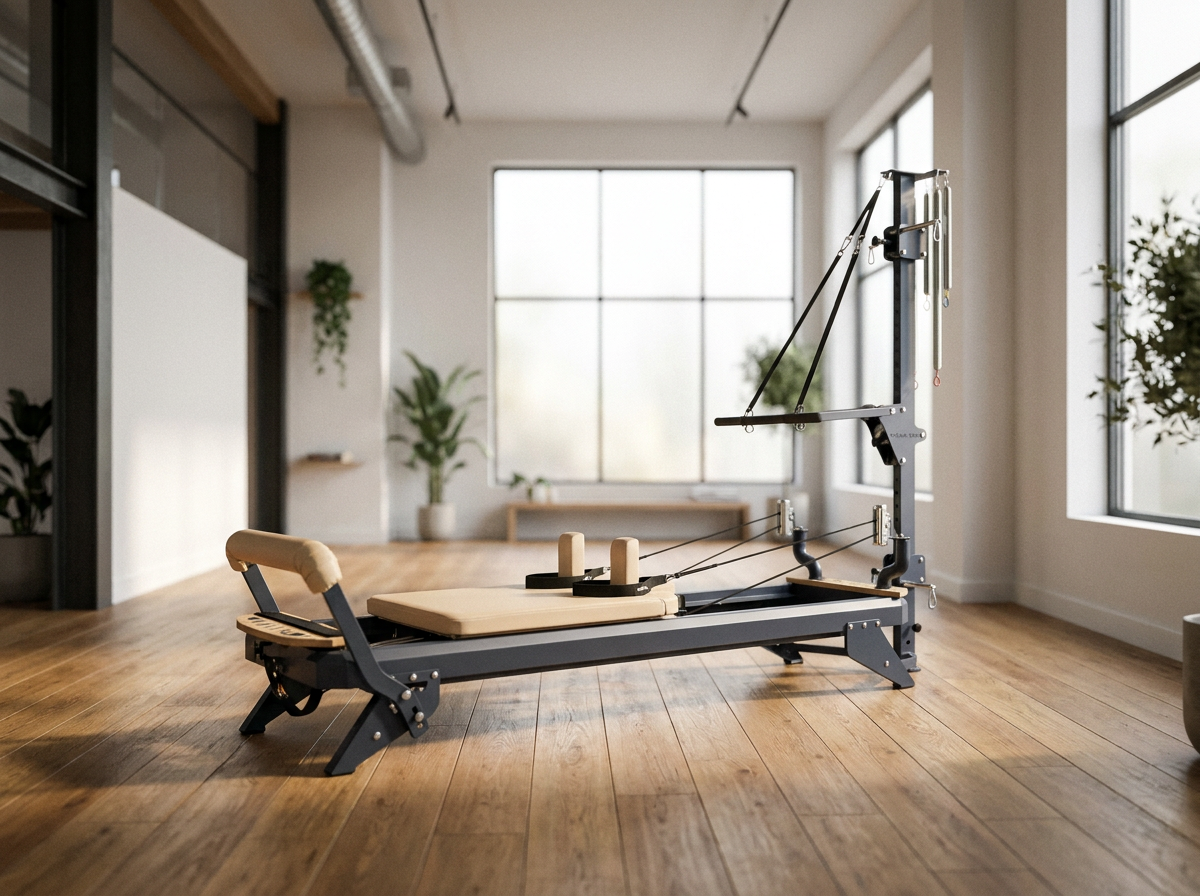
A steel frame —weighing about 105 kg on the Hegren TALMA 62—remains wobble-free for years. No wobbling, no loosening of the slide rail, no fluctuating spring tension. The weight is not a disadvantage in the gym, but rather a key feature: it ensures stability during dynamic exercises and jump training.
Wood and Aluminum Frames
Wooden reformers are common in home and boutique settings and have a warm, inviting look. However, in the demanding day-to-day environment of a studio, the wooden joints are put to the test, and the tracks wear out. Aluminum is lightweight and portable, but less dimensionally stable under load. Both materials can be the right choice for a small home studio—but in a multi-shift operation, they pose a risk of failure.
| Criterion | Steel (e.g., Hegren , TALMA 62) | Wood | Aluminum |
|---|---|---|---|
| Continuous operation | very high | medium | medium |
| Dimensional Stability Under Load | very high | medium | low–medium |
| Maintenance costs | low | higher | medium |
| Weight / Mobility | severe (inpatient) | medium | slightly |
| Ideal for | Studio, Continuous Operation | Boutique, Home Studio | mobile use |
For Studios and Practices: Pilates Studio Equipment.
How many reformers does your studio need?
Don't plan based on gut feeling, but rather on revenue per square meter. In our discussions, the range extends from compact 8-machine studios to large spaces with 30+ Reformers. The rule of thumb: Each Reformer is one seat in your class—and thus one unit of revenue per hour.
Reformer Plus Tower Instead of a Combination Machine
A piece of practical advice that comes up time and again: Opt for separate reformers plus wall-mounted or freestanding towers instead of integrated tower-reformer monoblocks. This way, you can accommodate larger classes, keep the space flexible, and maximize revenue per square meter. The Hegren TALMA 62CT+ Combo combines both in a space-saving system if you want to incorporate both reformer and tower training.
Class Size and Enrollment
Calculate your capacity based on peak times: How many participants do you want to accommodate at the same time in the evenings and on weekends? This number—not just the floor space—determines how many Reformers you can realistically accommodate. It’s better to plan for one more spot than to turn members away.
How much does a Studio Reformer really cost?
Reformers suitable for studio use typically cost between €1,500 and €4,500 per unit—depending on the frame, spring system, and features. Here are three options from the Hegren lineup:
| Model | Price (Approximate) | For whom |
|---|---|---|
| Hegren TALMA 62 Black Elegance | starting at €3,100 | Premium, design-oriented reformer with a steel frame |
| Hegren TALMA 62 | 3.500 € | Premium Studio Standard: Steel frame, 5-spring system, 245 cm |
| Hegren TALMA 62CT+ Combo | starting at €4,280 | Reformer + Tower in a Single System |
What matters isn’t the unit price, but the total cost over the equipment’s lifespan. A reformer that breaks down after 18 months will cost you in downtime, repairs, and disappointed members—ultimately more than a steel machine that lasts ten years. That’s exactly why durable studio reformers pay off over time, even if the initial investment is higher.
Safety Is Class Flow
Safety may sound like a mandatory topic—but in day-to-day studio operations, it’s a factor in efficiency. Two practical details make all the difference:
- Removable shoulder pads: They enhance safety during dynamic exercises and can be quickly adjusted for different exercises.
- Quick Rope Adjustment System: When each participant can adjust the rope length in seconds, you won’t lose any valuable minutes in a 50-minute class—and the class will run smoothly and professionally.
The Hegren TALMA 62 is designed specifically for this type of flying: precise line adjustment, well-designed pads, and A-class padding. Small details that add up over hundreds of hours a year.
Hegren 's TALMA 62 at a Glance
Hegren ' TALMA 62 is the premium standard for professional studios and is deliberately positioned in the middle: higher quality than budget entry-level brands, yet more affordable than the most expensive high-end manufacturers. Key specifications:
- Steel frame (~105 kg) for maximum stability and minimal downtime
- 5-spring system for precise resistance adjustment, from rehabilitation training to performance-level training
- 245 cm running surface, A-Class upholstery
- Made in Greece – European manufacturing, reliable supply of replacement parts
- Expandable with Tower, Jumpboard, Stability Bar, and Cadillac attachments
Here at Kraftathlet , we’re an authorized dealer offering a manufacturer’s warranty, and we’ll work with you to plan your entire studio setup—from the number of units to delivery—with installment payments via PayPal or leasing options for business customers, if desired. Over 5,000 satisfied customers and a rating of ★ 4.88/5 speak to the quality of our advice. You can find a complete overview in the “Hegren ” Pilates collection and in our comparison of all Pilates reformers.
Common Mistakes When Buying a Reformer
- Don't just look at the unit price: The cheapest reformer is rarely the cheapest over a five-year period. Calculate the life-cycle costs.
- Don't underestimate space and weight: Steel Reformers are stationary and cannot be folded. In a very small room (e.g., 40 m²), a foldable machine is the better choice—plan your space accordingly.
- Focus on screen-based concepts: Screen-guided 24/7 models seem cost-effective, but often lead to higher dropout rates. Instructor-led community classes foster stronger member engagement—and require reliable equipment.
- Underestimating capacity: If you turn away participants during peak hours, you’re giving away the very revenue that covers the investment.
Frequently Asked Questions
Which Pilates Reformer is best for a studio?
For professional, continuous use, a steel-frame Reformer is the safest choice. The Hegren TALMA 62 (steel frame, 5-spring system, Made in Greece) is a proven studio standard that combines durability with a mid-range premium price.
Wood or Steel Reformers—Which Is Better?
Wood is popular in home and boutique settings and has a warm, inviting look. For continuous studio use with hundreds of users per week, steel is superior: it retains its shape, requires little maintenance, and is durable.
How many Reformers do I need for my studio?
Plan based on peak-hour capacity, not just floor space. Each Reformer represents one revenue unit per class—compact studios often start with 8–10 machines, while larger spaces have 20 or more.
How much does a studio reformer cost?
Usually €1,500–4,500 per unit. The Hegren TALMA 62 costs €3,500, the design-oriented TALMA 62 Black Elegance costs €3,100, and the reformer-tower combo costs around €4,280.
Reformer or reformer-tower combination?
Separate reformers paired with freestanding or wall-mounted towers offer more flexibility for larger classes than integrated monoblock units. If you want both in one system, the TALMA 62CT+ Combo is a great choice.
Conclusion
When buying a Pilates Reformer, the choice of materials determines your ongoing costs, capacity planning affects your revenue, and safety features influence the flow of your classes. A steel-frame Reformer like the Hegren TALMA 62 combines all three: durability, high capacity, and a design optimized for smooth classes—at a price that falls between entry-level and high-end. Tell us how many machines you’re planning to purchase and how large your space is—we’ll quickly narrow down the right equipment for you. For a free studio planning consultation, reach out to us via WhatsApp or our contact form.