

Abstract
- Pilates is well-supported by scientific evidence: A meta-analysis of 19 randomized studies involving 1,108 patients (2023) shows significant improvements in chronic back pain and function.
- The effect is achieved through targeted core and deep muscles, as well as controlled movements that are gentle on the joints—not through esoteric practices.
- For gyms, the choice of equipment is crucial: the steel frame, spring system, and upgradeability determine durability, class size, and revenue per square meter.
- Our recommendation for professional studios is the Hegren TALMA 62 (steel frame, 5-spring system, made in Greece)—durable and suitable for studio use.
The Science of Pilates: What Studies Really Show—and What Studios Should Keep in Mind
Pilates is not just a wellness trend without substance: A 2023 meta-analysis that evaluated 19 randomized controlled trials involving 1,108 patients found significant improvements in pain and physical function among people with chronic back pain. This makes Pilates one of the most thoroughly studied forms of exercise for core stability and back health. In this article, we separate the evidence from the myths—and show why choosing the Reformer is a business decision for studios.
The method was developed by Joseph Pilates, who created it in the 1920s under the name “Contrology.” His approach: movement originating from the body’s core, precisely controlled, and coordinated with the breath. Today, there is a growing body of research supporting this method. Let’s take a look at what this research actually says.
What the research shows
Back Pain and Function
The strongest evidence is available in the area of chronic nonspecific low back pain. Several systematic reviews—including the meta-analysis mentioned above, which is available via PubMed —conclude that Pilates significantly reduces pain and functional impairment compared to standard care. Pilates is at least as effective as other exercise programs of comparable intensity and more effective than no exercise at all.
Core Strength and Deep Muscles
Pilates specifically targets the deep abdominal and back muscles—the so-called “powerhouse.” Studies using ultrasound to measure muscle thickness show that Pilates effectively strengthens the core muscles. It is precisely these deep muscles that stabilize the spine in everyday life and during sports, acting like a natural corset.
Posture, Balance, and Flexibility
Other studies suggest improvements in balance, mobility, and posture—which are particularly relevant for older adults and in rehabilitation. The Reformer, with its resistance and spring system, allows for a precisely adjustable level of resistance that is gentle on the joints—something that is not possible on a mat.
Fascia and Mobility
A term that is often mentioned is “Fascia Pilates.” Fascia is the network of connective tissue that surrounds muscles and organs. Slow, stretching, and springy movements—such as those made possible by the Reformer—can support the gliding ability of this tissue and improve body awareness. Research on fascia is more recent than that on back pain, but Pilates’ controlled, three-dimensional approach to movement aligns well with what is considered fascia-friendly.
Myths vs. Evidence
| Claim | What Science Says |
|---|---|
| "Pilates burns a lot of calories" | Moderate – the benefits lie in strength, stability, and posture, not primarily in calorie burn. |
| "Pilates Replaces Strength Training" | Add to that. Progressive strength training is superior for maximizing muscle growth. |
| "Pilates helps with back pain" | Well-documented—significant reduction in pain and disability. |
| "Reformer is only for professionals" | No—thanks to its adjustable resistance, it’s actually particularly well-suited for beginners and those in rehabilitation. |
Who is Pilates particularly suitable for?
Precisely because the intensity can be adjusted so precisely, Pilates appeals to a wide audience. People with back problems benefit from the targeted stabilization of the deep muscles. Office workers with muscle tension and poor posture find it a great way to counterbalance their sedentary lifestyle. In post-injury rehabilitation, the Reformer enables controlled, supported movements long before independent training is possible. Pregnant women and older adults appreciate the low-impact nature of the exercises. And even elite athletes use Pilates as a complementary practice to improve core stability, body control, and flexibility. This broad appeal makes Pilates economically attractive for studios because it caters to many target groups at once.
From the Stage to the Studio: Why Equipment Is the Key to Success
Once the effectiveness has been scientifically established, the key question for gym owners shifts: Which reformer allows this benefit to be offered reliably, safely, and cost-effectively? From hundreds of conversations with gym and physical therapy practice owners, five criteria have emerged—deliberately phrased in a brand-neutral manner.
1. Frame material: steel, wood, or aluminum
A reformer is subjected to heavy use many times a day in a studio setting. Steel frames retain their shape for years. Wooden frames are visually appealing, but their joints can loosen under constant stress; aluminum is lightweight but less stable under heavy loads. For intensive group classes, a steel frame is the most durable choice.
2. Capacity & Revenue per Square Meter
A studio’s profitability is directly tied to the number of stations per square meter. Separate Reformers combined with wall-mounted or freestanding towers can be arranged more flexibly than integrated monoblock solutions—this increases the potential class size and, consequently, revenue per square meter.
3. Safety = Class Flow
Removable shoulder pads and quick cable and spring adjustments save seconds per transition—and minutes over the course of an entire class. This keeps the flow going and reduces the risk of injury during quick transitions.
4. Screen-Guided vs. Instructor-Led
Fully automated, screen-guided 24/7 programs sound efficient, but they’re often associated with higher cancellation rates. Instructor-led classes build community and loyalty—the most effective way to combat member churn.
5. Total Cost of Ownership (TCO)
An inexpensive reformer that breaks down after 18 months ends up costing more than a durable steel reformer. Don't just factor in the purchase price—also consider downtime, repairs, and replacement costs.
Buying Guide: Our Recommendation for Professional Studios
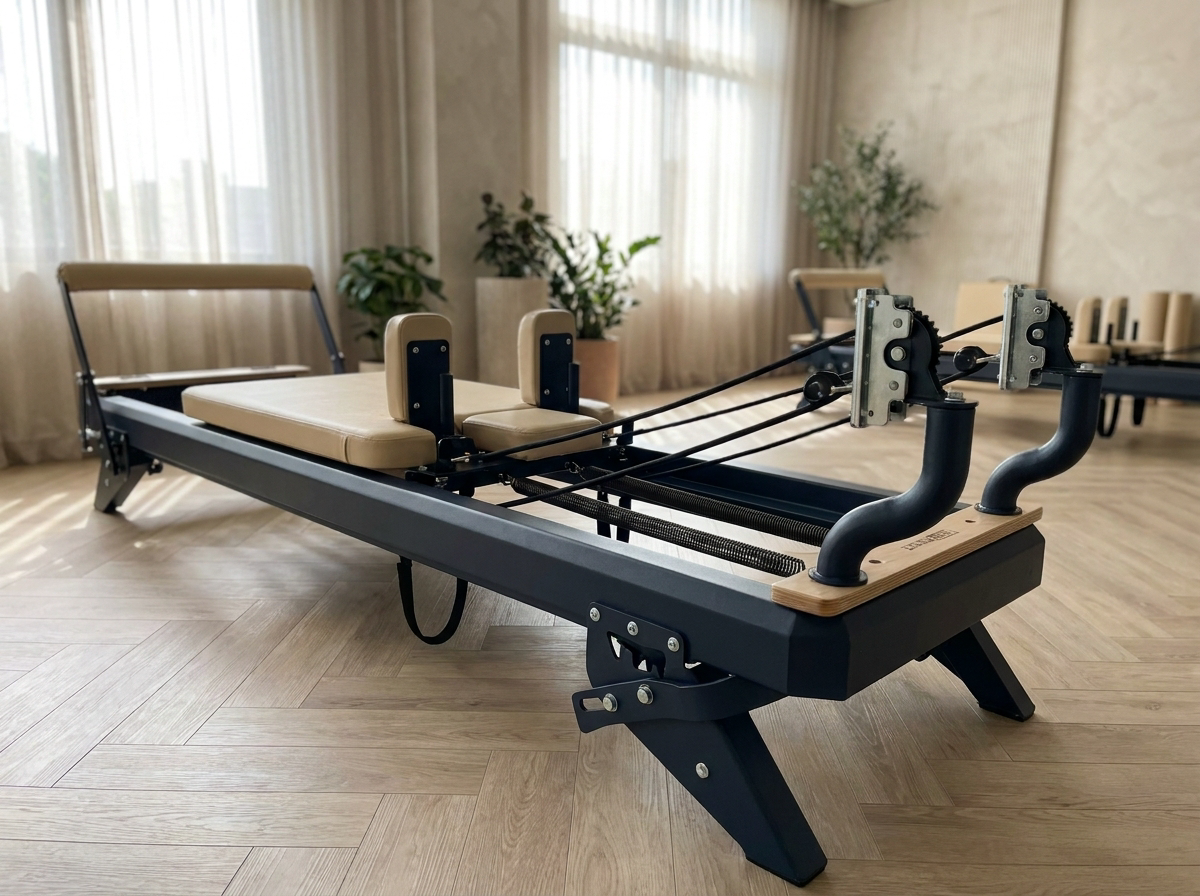
Based on these criteria, we recommend the Hegren TALMA 62 for demanding studio use: steel frame, 5-spring system, 245 cm long, A-class upholstery, made in Greece. It is designed for continuous use and can be expanded modularly.
| Model | Distinctive Feature | Price | Ideal for |
|---|---|---|---|
| Hegren TALMA 62 | Steel frame, 5-spring system, 245 cm | 3.500 € | Studio Standard, Continuous Operation |
| TALMA 62 Black Elegance | Black design option | 3.100 € | Boutique & Luxury Studios |
| TALMA 62CT+ Combo | Reformer + Convertible Tower | 4.280 € | Maximum variety of exercises in a single space |
You can find the complete selection in our "Hegren " Pilates collection. If you'd like to compare models from different manufacturers, check out the overview of all Pilates reformers; matching boxes, straps, and springs are available in the Premium Pilates Accessories section. As an authorized dealer, we deliver all equipment with a full manufacturer's warranty —currently with an average customer rating of ★ 4.88/5.
Finding the Right Balance in Reformer Training
The biggest advantage of the Reformer over mat training is the finely tuned resistance control provided by the spring system. But this is precisely where the art lies: More springs do not automatically mean a harder workout. In some exercises, higher resistance supports the movement and makes it easier; in others, it makes it harder. Good instructors therefore adjust the spring configuration for each exercise and each participant—another argument in favor of a precise, quickly adjustable system like the one on the TALMA 62. For beginners, the rule is: start with controlled, proper form at moderate resistance and gradually increase the intensity. This keeps the strain on the joints low, ensures the workout targets the deep muscles, and minimizes the risk of injury. For gyms, this means that a machine that can be adjusted in seconds keeps mixed-ability classes running smoothly and safely.
Common Mistakes When Choosing Pilates and Reformer Equipment
Don't just look at the price. The cheapest reformer often ends up being the most expensive choice in a group setting. Lifespan and downtime matter more.
Don't neglect your breathing and control. Pilates works through controlled, conscious movement. If you rush, you'll lose the actual effect on your deep muscles.
Market the reformer as a “substitute for strength training.” The two complement each other—honest communication leads to more satisfied members.
Don't underestimate the space required. Plan for enough room to move around each piece of equipment; otherwise, safety and class size will suffer.
Frequently Asked Questions
Is Pilates scientifically proven?
Yes. The evidence is particularly strong for chronic back pain: A meta-analysis of 19 randomized trials involving 1,108 patients showed significant improvements in pain and function. There are also positive findings regarding core strength and balance.
Which treadmill is best for the gym?
For continuous operation, we recommend a steel-frame reformer with a precise spring system and expansion options. The Hegren TALMA 62 (€3,500) meets these criteria and is designed for heavy use.
What is the difference between Reformer and mat training?
The Reformer provides adjustable resistance and support through its spring and carriage system. This makes exercises gentler on the joints, easier to control with precision, and often more suitable for rehabilitation than mat-based training alone.
Is a reformer with a tower worth it?
For studios that need maximum training variety in a limited space, yes. A combo solution like the TALMA 62CT+ (€4,280) combines a Reformer and a Tower, increasing the variety of exercises per square meter.
How much space does a reformer take up?
A TALMA 62 is 245 cm long. Allow enough space all around it—as a rule of thumb, at least just under one meter on each side for safe entry and exit, as well as for moving between sections.
Conclusion
Pilates is more than just a trend: The evidence supporting its benefits for back health and core stability is robust, and its broad applicability—from rehabilitation to office posture to competitive sports—makes it financially attractive for studios. When it comes to implementation, the key question then shifts to choosing the right equipment—and here, the steel frame, spring system, expandability, and total cost of ownership over the equipment’s lifespan matter more than the initial purchase price alone. With a durable reformer like the Hegren TALMA 62, you can build a program that your members will feel the benefits of and that will support your business financially.
Are you planning to open a studio or looking to upgrade your equipment? Talk to our team —we’ll provide you with criteria-based advice on the right equipment for your space and your concept.