

Abstract
- To get started, all you need are two 20–30-minute sessions per week, a non-slip mat, and six basic poses—that’s all you’ll need for the first four weeks.
- Yoga has long been a popular activity in Germany: About 16 million people practice yoga or want to start (BDY study)—and its effects have been examined in over 300 randomized studies.
- The effects are best documented for back pain, stress, and cardiovascular issues; gentle styles such as Hatha or Yin are ideal for beginners.
- The most common beginner mistakes: trying to do poses that are too advanced, stretching beyond the point of pain, and a slippery, cheap mat that makes every pose a wobbly affair.
Yoga for Beginners: Your Complete Guide to Getting Started—Exercises, Equipment, and a 4-Week Plan
Getting started with yoga is easier than the Instagram aesthetic might lead you to believe: You need two set times per week, each lasting 20–30 minutes, a non-slip mat, and six basic poses—flexibility isn’t a prerequisite, but rather the result. According to a representative study commissioned by the Professional Association of Yoga Teachers (BDY), around 16 million people in Germany already practice yoga or would like to start. This guide walks you through everything you really need to get started: the right style, the most important exercises, practical equipment without any frills, and a realistic 4-week plan.
Why Yoga? What the Research Actually Shows
Yoga is one of the most extensively studied forms of exercise: The research consortium led by PD Dr. Holger Cramer has analyzed over 300 randomized controlled trials —all showing consistently positive effects on chronic pain, cardiovascular diseases, and mental health issues such as stress and anxiety. The evidence is particularly strong for chronic back pain: About two-thirds of patients with back pain benefit from a yoga class, and in the studies analyzed, the likelihood of a noticeable improvement was about three times higher with yoga than without it. International guidelines, such as those from the American College of Physicians, now list yoga as a recommended first-line treatment for chronic nonspecific back pain.
Just as important is what yoga is not: it is not a substitute for strength training with progressive resistance, nor is it a miracle cure. It is a practice that focuses on flexibility, body control, breathing, and stress management—and it is precisely this combination that makes it so valuable, especially as a counterbalance to work, a desk job, and intense exercise.
Which style of yoga is right for you?
The most common beginner's mistake happens before the first exercise: choosing the wrong style. Anyone who, as an unathletic beginner, ends up in a Power Vinyasa class will think of yoga as a competitive sport afterward. Here's an overview of the main styles:
| Style | Character | Tempo | Suitability for Beginners |
|---|---|---|---|
| Hatha | Classic poses, performed calmly, with plenty of explanation | Slowly | ★★★★★ – The Standard Introduction |
| Yin / Restorative | Passive stretching, poses held for 2–5 minutes, very relaxing | Very slowly | ★★★★★ – Ideal for stress and tension |
| Vinyasa / Flow | Flowing, breath-guided transitions | Moderate–fast | ★★★ – best starting in months 2–3 |
| Ashtanga / Power | Intense, challenging workouts that really make you sweat | Fast | ★★ – for advanced athletes |
Our clear recommendation for the first few weeks: Hatha or Yin. Both give you time to learn alignment and breathing—the foundation for everything that comes later.
The 6 Most Important Yoga Poses for Beginners
These six poses cover mobility, strength, and relaxation—and they appear in practically every beginner's class:
1. Mountain Pose (Tadasana)
Stand upright, feet hip-width apart, weight evenly distributed, shoulders away from your ears. It sounds simple, but it trains the very body awareness that gives you stability in all other poses.
2. Cat-Cow (Marjaryasana–Bitilasana)
While on all fours, alternately round and straighten your spine as you breathe. This is the best way to loosen up your back after a day spent at a desk.
3. Downward-Facing Dog (Adho Mukha Svanasana)
From a hands-and-knees position, push your pelvis back and up; your legs can remain bent, and your heels don't have to be on the floor. This stretches the entire back of your body and strengthens your shoulders and arms.
4. Warrior II (Virabhadrasana II)
Take a long lunge, with your front knee over your ankle and your arms parallel to the floor. This exercise strengthens your legs and core and improves your balance—including your mental balance.
5. Child's Pose (Balasana)
Knees on the floor, upper body leaning forward, arms extended or at your sides. Your "pause" button: This is where you return whenever you need a break.
6. Final Relaxation (Shavasana)
Lie flat on your back, close your eyes, and breathe mindfully for 3–5 minutes. This is the part that beginners most often skip—and yet it’s the part that provides the stress-regulating effect.
Breathing: The Underrated Core of Every Yoga Practice
What sets yoga apart from simple stretching is breathing—known in yoga as “pranayama.” To get started, you don’t need any complicated techniques—just one: deep abdominal breathing. Place one hand on your abdomen and breathe in through your nose so that your abdomen rises first, followed by your chest; exhale for longer than one count (for example, 4 seconds in, 6 seconds out). This prolonged exhalation activates the parasympathetic nervous system—the part of your nervous system responsible for rest and relaxation. That’s exactly why a calm yoga class feels so different from a workout in front of the TV.
In practice, this means that every movement is paired with a specific breathing direction. Opening movements (expanding the chest, stretching) occur as you inhale, while closing movements (bending, rounding) occur as you exhale—as in Cat-Cow, where the stretch corresponds to the inhale and the rounding to the exhale. If you notice in a pose that your breath is catching or becoming shallow, that’s your most reliable signal: take a step back, simplify the pose, and keep breathing. In yoga, the breath isn’t background music—it’s the metronome—and, incidentally, the best anti-stress tool you have with you at all times, free of charge.
Equipment: What You Really Need—and What You Don't
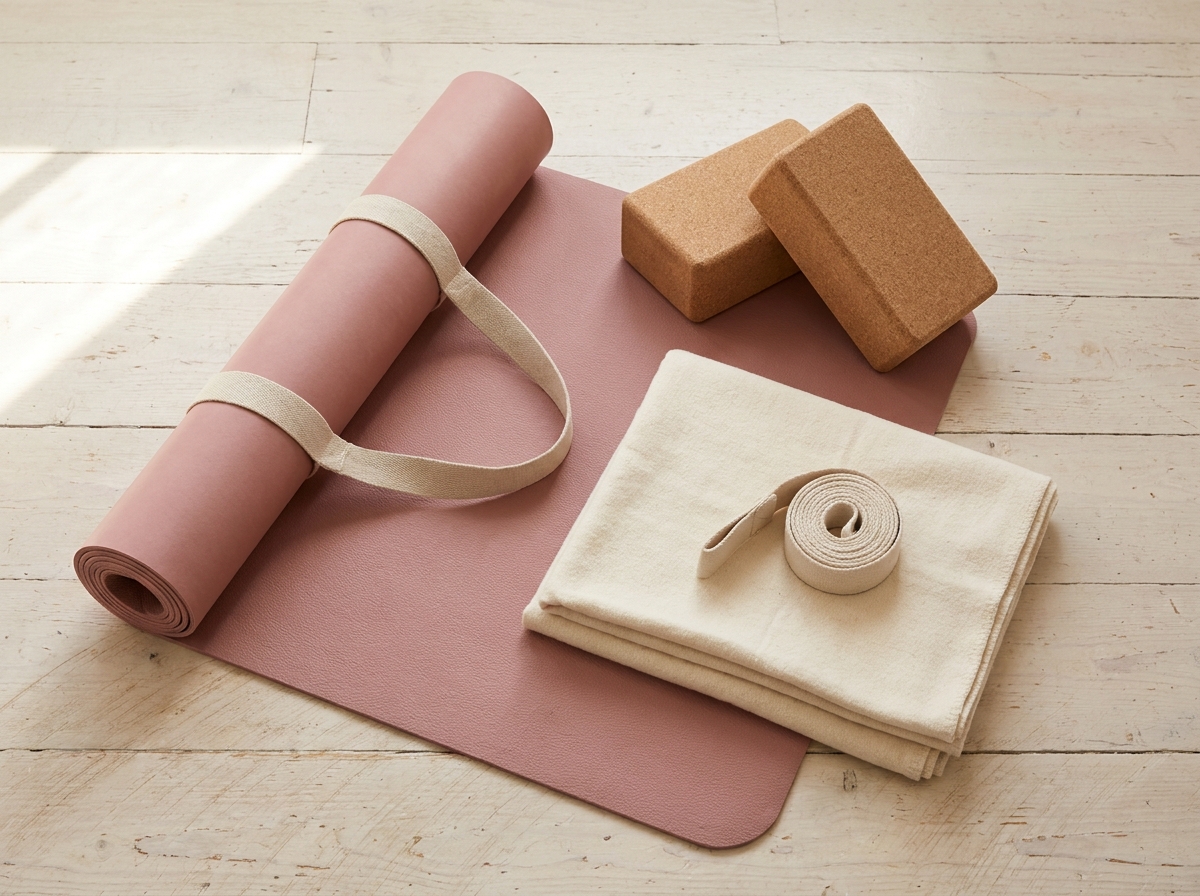
The honest answer: surprisingly little. A good mat is essential, because it’s your entire “equipment set.” What matters most: slip resistance (your hands and feet need to stay secure in Downward-Facing Dog—the biggest drawback of cheap mats), cushioning (4–6 mm is the best balance between joint protection and stability), material (natural rubber and cork offer the best grip; TPE is lightweight and affordable; PVC ages quickly and has an odor), and a size that suits you—if you’re 1.80 m or taller, an XL mat is worth considering. You’ll find premium, non-slip, studio-quality mats in our Training Mats & Floor Protection collection.
Useful but optional additions: two cork blocks (to help you reach the floor when you lack flexibility), a strap for stretching poses, and a blanket for Shavasana. When you’re starting out, you can consciously do without yoga wheels, towel mats, and special clothing—comfortable workout clothes are perfectly sufficient. A quick reality check to put things in perspective: A solid beginner’s setup consisting of a premium mat and blocks costs less than two months’ membership at a studio—available at Kraftathlet with a ★4.88/5 customer rating, a 30-day return policy, and personalized advice if you’re unsure.
Your 4-Week Beginner's Plan
This plan is intentionally conservative—the goal of the first four weeks is not to make progress in the poses, but to establish the habit itself:
| Week | Units | Focus |
|---|---|---|
| 1 | 2 × 15–20 min | Cat-Cow, Child's Pose, Mountain Pose + 3-Minute Shavasana – Getting to Know Your Breath |
| 2 | 2 × 20 min | + Downward-Facing Dog (Legs Bent) – Practice Transitions |
| 3 | 2–3 × 20–25 min | + Warrior II – Postures, Using Blocks |
| 4 | 3 × 25–30 min | All 6 poses as a short sequence, 5 minutes of Shavasana |
Starting in Week 5, you can add a guided beginner’s class (in-studio or online) and slowly start exploring Vinyasa—or stick with gentle Hatha. Both are fine. Three simple tricks will help you stick to your routine: Keep your mat in plain sight (a rolled-out mat dramatically lowers the barrier to getting started), tie your practice to a fixed routine (“after getting up,” “right after work”), and keep a mini log—a check mark in your calendar for each session is enough to keep the streak going.
Yoga at home or at the studio?
The low barrier to entry and the flexibility in scheduling are arguments in favor of starting at home; the guidance from experienced instructors is a plus for the studio—especially when it comes to alignment in poses, where a second set of eyes is worth its weight in gold. The pragmatic approach for most people: practice at home and take a guided class every few weeks to check your technique. By the way, more and more studios in the DACH region are combining yoga with Reformer Pilates because the two formats complement each other perfectly in terms of target audience and space utilization—you can read about how this works from a business and space perspective in our Studio Guide to Yoga & Pilates; you’ll find the right studio equipment, from Reformers to accessories, in the “Hegren Pilates” collection.
Common Mistakes When Starting Yoga
Starting with the wrong style: Power Yoga in Week 1 leads to sore muscles and frustration—start with Hatha or Yin. Stretching past the pain threshold: A slight pull is okay, but pain is a stop sign; flexibility develops over months, not in an hour. Forgetting to breathe: If you hold your breath in poses, you’re missing half the benefit—breathing guides the movement, not the other way around. Practicing on a slippery mat: Slipping hands make every pose unstable and are the most common reason beginners feel “too inflexible for yoga.” Comparing yourself to others: The pose in the picture next to you is that person’s fifth year of practice, not your fifth day. Inconsistency: Two fixed, short sessions per week beat a spontaneous 90-minute session once a month—every time.
Frequently Asked Questions
As a beginner, how often should I practice yoga?
Two to three times a week for 20–30 minutes is the ideal way to get started. More important than the length of each session is consistency over several weeks—schedule these sessions just like any other appointment.
Do I need to be flexible to start doing yoga?
No—that’s the most persistent misconception about yoga. Flexibility is the result of practice, not a prerequisite for it. Blocks and bent knees make every pose accessible to every body.
Does yoga really help with back pain?
The research evidence on this topic is unusually clear: In the randomized trials analyzed by the BDY, about two-thirds of patients with chronic back pain benefit from regular yoga. However, in cases of acute, severe pain, a doctor should be consulted first.
Which yoga mat is best for beginners?
A non-slip mat that’s 4–6 mm thick, made of natural rubber, cork, or high-quality TPE. What really matters is the grip under your hands and feet—that’s exactly where most cheap mats under €20 fall short.
Can I combine yoga with strength training?
In fact, it’s very good: Yoga on non-training days improves flexibility and recovery without compromising strength performance. Many strength athletes incorporate 1–2 gentle Yin yoga sessions per week as an active form of balance.
Conclusion
Yoga for beginners means: start small, stay calm, and stick with it. With two regular sessions a week, six basic poses, guided breathing, and a mat that keeps you steady, you’ll have built a habit in four weeks that will measurably benefit your back, mind, and recovery. If you want to play it safe when it comes to equipment or have questions about gear—from buying your first mat to setting up a complete studio— get in touch with us; we’ll give you honest advice without any sales pressure.