

Abstract
- Yes, Pilates helps with chronic nonspecific back pain: The Cochrane review (Yamato et al. 2015) shows reduced pain and improved function in the short and medium term compared to no active exercise.
- According to the WHO, back pain is the most common cause of impaired daily functioning, affecting 619 million people worldwide—about 90% of chronic cases are “nonspecific” and can therefore be effectively managed through exercise.
- For clients with back issues, the Reformer is often a better starting point than the mat: the lying position, guided movements, and finely adjustable spring resistance lower the barrier to entry.
- If you experience warning signs such as numbness, paralysis, or radiating pain, you should first see a doctor for an evaluation—after that, structured exercise is usually part of the solution.
Pilates for Back Pain: What Really Helps Clinically—Studies, Exercises, Equipment
Does Pilates help with back pain? Yes—for chronic nonspecific back pain, the Cochrane review by Yamato et al. (2015) shows reduced pain and improved function in the short- and medium-term compared to minimal intervention. The problem is enormous: According to the WHO, 619 million people worldwide were living with back pain (lumbago) in 2020—the most common cause of limited daily functioning—with projections indicating 843 million people will be affected by 2050. This guide summarizes the current research, shows you the most effective exercises for the mat and Reformer, explains when you shouldn’t train (on your own)—and what studios and physical therapy practices look for when selecting equipment.
What the Research Really Shows
The Cochrane Evidence: Better Than Doing Nothing—By Far
The Cochrane review by Yamato et al. evaluated randomized trials on Pilates for chronic nonspecific low back pain. Result: Compared to minimal intervention (counseling, watchful waiting, daily activities), Pilates reduces pain in the short and medium term with a moderate effect size and improves function. However, Pilates was not clearly superior to other forms of active exercise—so the honest takeaway is: exercise beats inactivity, and Pilates is one of the well-documented ways to put that into practice.
Network Meta-Analysis: Pilates Among the Most Effective Forms of Exercise
A network meta-analysis published in the *Journal of Orthopaedic & Sports Physical Therapy* (2022) compared the most important exercise approaches for chronic low back pain—including strength training, core training, and mind-body exercises. Pilates was found to be among the most effective options for pain and functional limitations. Here, too, the following observation applies: The difference between the active interventions is smaller than the difference between exercising and not exercising.
| Source | Type | Key message |
|---|---|---|
| Yamato et al. 2015 (Cochrane) | Systematic Review | Pilates reduces pain and improves function compared to minimal intervention (short- to medium-term); not clearly superior to other forms of exercise |
| JOSPT 2022 | Network Meta-Analysis | Pilates is one of the most effective forms of exercise for chronic back pain |
| WHO Fact Sheet | Epidemiology | 619 million people affected worldwide (2020); approximately 90% of chronic cases are nonspecific; exercise is a key component of treatment |
Why Pilates Helps Your Back
Three mechanisms explain its effects. First, the deep muscles: Pilates specifically activates the “powerhouse”—the deep abdominal, back, and pelvic floor muscles that stabilize the spine segmentally. It is precisely this control that is often impaired in cases of chronic back pain. Second, movement control: Slow, precise movements combined with conscious breathing train your awareness of neutral spinal positions in everyday life. Third, the psychological effect: When you experience that controlled movement doesn’t cause pain, you overcome your fear of movement—one of the most important factors that keep pain chronic. To learn how Pilates differs from yoga in this regard, read the comparison “Yoga or Pilates for the Back.”
Mat or Reformer—which is better for back pain?
Both are effective—but it’s often easier to get started on the Reformer, especially for people with pain and little exercise experience:
| Criterion | Mat | Reformer |
|---|---|---|
| Barriers to Participation When Experiencing Pain | Higher – Dead weight must be controlled | Lower—reclining, guided, relieved |
| Resistance | Bodyweight Only + Small Equipment | Spring resistance can be finely adjusted—providing support rather than adding resistance |
| Movement Guidance | Free (more control needed) | The sled leads the movement—fewer evasive maneuvers |
| Progression | About Exercise Selection | About Springs, Levers, and Positions—in Very Small Steps |
| Costs / Access | Minimal (a mat is sufficient) | Studio, practice, or your own equipment |
To get started at home, all you need is a non-slip mat and some small equipment, such as a ball and a ring from the Pilates accessory set. If you want to train regularly on the Reformer, you can get professional instruction at the studio—or go ahead and plan to get your own machine.
The 6 Best Pilates Exercises for Back Pain
This routine has proven effective for nonspecific back pain; it starts off gently and gradually increases in intensity. Rule number one: Move within a pain-free or low-pain range—a pulling sensation is okay, but a stabbing pain is a stop signal.
1. Pelvic Tilt
Lie on your back with your legs bent. Slowly tilt your pelvis so that your lower back gently sinks toward the mat and then releases. 10–12 slow repetitions. This exercise trains the core’s basic control.
2. Shoulder Bridge (Pelvic Curl)
From a supine position, lift the pelvis vertebra by vertebra, hold briefly at the top, and lower it in a controlled manner. 8–10 repetitions. Strengthens the glutes and back extensors and improves segmental mobility of the spine.
3. Toe Taps (Knee Folds)
Lie on your back with your legs raised at a 90-degree angle and your lower back in a neutral position. Alternately lower the tip of one foot toward the floor without tilting your pelvis. 8–10 repetitions per side. This exercise targets the deep abdominal muscles to improve stability.
4. Spine Stretch
Sit upright with your legs hip-width apart. Roll your upper body forward vertebra by vertebra, and return to an upright position in the same controlled manner. 6–8 repetitions. This exercise mobilizes the entire spine and helps you maintain good posture.
5. Swan Prep (Prepared Back Extension)
Lie on your stomach with your hands under your shoulders. Lift your sternum and gaze a few centimeters off the floor; keep your shoulders away from your ears, and keep your pelvis on the floor. 6–8 repetitions. Gentle extension to counteract the effects of sitting throughout the day—only within a pain-free range.
6. Footwork on the Reformer
Lying on the sled, push off the footbar with your feet—this keeps the pressure off your spine, and your legs work against the spring resistance. 10–12 repetitions per foot position. The classic way to start every Reformer class: challenging, guided, and adjustable.
When You Shouldn't Work Out (Alone)
Pilates is no substitute for a medical diagnosis. See a doctor first if you experience pain radiating down your leg accompanied by numbness or tingling, if you have symptoms of paralysis, after a fall or accident, if you have a fever, unintentional weight loss, or pain at rest during the night. Bladder or bowel dysfunction is a medical emergency. Even during an acute flare-up, the rule is: get a medical evaluation first, then resume exercise under supervision—ideally at a physical therapy practice or a gym with trainers experienced in rehabilitation. The good news: About 90 percent of chronic cases are “nonspecific,” meaning they have no dangerous underlying cause—and that’s exactly where structured training is the treatment of choice.
For Gyms and Physical Therapy Practices: What Matters When It Comes to Equipment
Those who work with clients with back issues on the Reformer have different requirements for the equipment than a fitness class. In practice, four criteria are key:
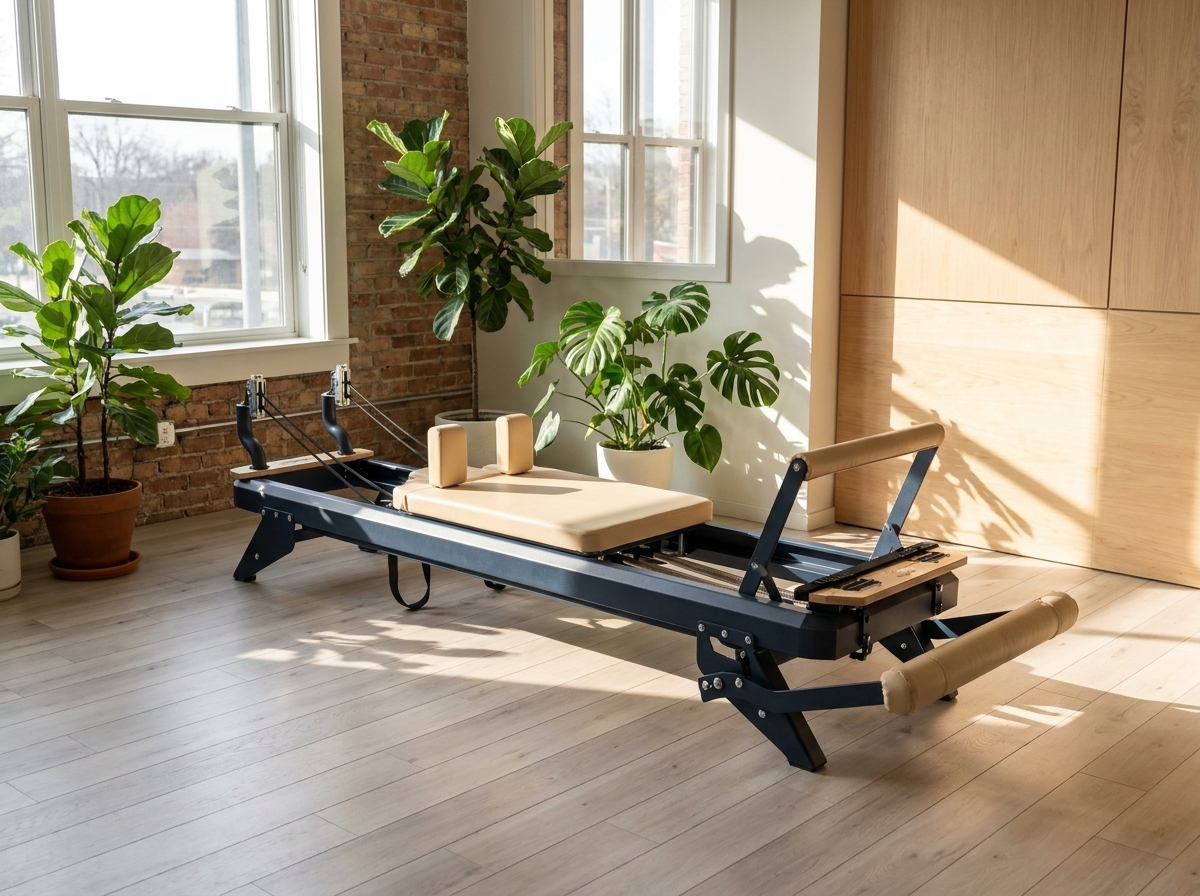
Frame Stability. Therapeutic work involves clients carefully getting on and off the equipment, bracing themselves, and applying asymmetrical pressure. A steel frame remains torsionally rigid for years—whereas wooden joints can loosen under continuous use, and lightweight aluminum structures become less stable under varying loads. Precise Resistance Adjustment. A 5-spring system allows for very fine-grained adjustments—crucial when resistance is meant to support a movement rather than hinder it. Safety and class flow. Removable shoulder pads make it easier for clients with limited mobility to get on and off the machine, and quick rope adjustment saves minutes in every class—a real factor in capacity when classes are held multiple times a day. Total cost. A Reformer that develops play in the frame after 18 months of practice use costs more than the sturdy machine when downtime and repairs are factored in—Total Cost of Ownership outweighs the purchase price.
For this specific profile, we recommend the Hegren TALMA 62: steel frame, 5-spring system, 245 cm long, manufactured in Greece—designed for continuous professional use in studios and clinics:
| Model | Features | Price |
|---|---|---|
| Hegren TALMA 62 | Steel frame, 5-spring system, 245 cm, Class A upholstery | 3.500 € |
| Hegren TALMA 62 Black Elegance | Like TALMA 62, in black | 3.100 € |
| Hegren TALMA 62CT+ Combo | Reformer + Tower – Expands the Exercise Repertoire to Include Cadillac Work | 4.280 € |
For physical therapy practices, the Combo model with Tower is particularly appealing because it complements stretching and strengthening exercises in standing, sitting, and lying positions—one machine, two worlds of therapy. You can find the complete line in the “Hegren ” Pilates collection; for an overview of other models, see Pilates Reformers. Our guide to physical therapy practice design shows you how to plan a practice around it.
Buying Guide: How to Get Off to a Good Start
For home use, a good mat and some small equipment are enough to start with—clear instruction is more important than equipment in the beginning, whether in a studio or through a qualified online course. Studios and practices take the opposite approach: first, the clientele (what percentage is rehab? Group size?), then the number and model of equipment, and finally the space. At Kraftathlet , you get both from a single source—with a ★4.88/5 customer rating and a 30-day return policy, you can plan at your own pace. Not sure which setup suits your clientele? Our team will advise you for free.
Common Mistakes
Too much, too soon. If you jump right into advanced exercises after years of taking a break due to pain, you’re setting yourself up for setbacks. Two to three short sessions a week are better than one grueling one.
Ignore the pain. “Grit your teeth and push through” is the wrong strategy for back pain—exercise within your pain-free range and take warning signs seriously.
Focus only on training your back. Stability comes from the interaction of the abs, glutes, pelvic floor, and back extensors—one-sided “back training” isn’t enough.
Breathing while pushing. Breathing leads the movement—if you push, you lose the very deep core tension that is essential.
Equipment comes before technique. Even the best equipment is no substitute for proper technique. Learn proper form first, then upgrade your equipment.
Frequently Asked Questions
Does Pilates really help with back pain?
Yes—its effectiveness for chronic nonspecific back pain is well documented: The Cochrane review (Yamato et al. 2015) shows reduced pain and improved function compared to minimal intervention. Pilates is not the only effective form of exercise, but it is one of the most thoroughly studied.
How often should I do Pilates if I have back pain?
Two to three sessions per week over at least six to eight weeks have proven effective. Consistency beats intensity—three short sessions are more effective than one long session on the weekend.
Is the Reformer better than the mat for back pain?
For beginners, the answer is often yes: The supine, guided position with finely adjustable spring resistance lowers the barrier to entry and reduces evasive movements. In the long run, the two complement each other—the mat for use anywhere, the Reformer for gradual progression.
Can Pilates make back pain worse?
Yes, if you use the wrong dosage or ignore warning signs. Exercise within a pain-free range, increase the intensity slowly, and have any unclear or radiating pain checked by a doctor before you start.
Does health insurance cover Pilates classes?
In some cases: Certified prevention courses may be subsidized under Section 20 of SGB V—you can find out whether a specific course is recognized by contacting the provider or your health insurance company directly. Purely equipment-based training at a gym is generally not covered.
Conclusion
Back pain is the world’s most common ailment—and exercise is the most well-documented solution. Pilates offers a system for this: deep stabilization, controlled mobility, and adjustable progression, whether on the mat or on the Reformer. Start gently, stay consistent, and take warning signs seriously. Are you planning to offer Reformer training at your studio, your practice—or for yourself? Talk to us; we’ll find the setup that’s right for your clientele.