

Abstract
- The springs provide resistance on the reformer—and determine which muscles an exercise targets.
- Studies show that simply changing the spring tension results in a measurable shift in muscle activation (heavy springs → more glutes/core; light springs → more adductors).
- "More springs = heavier" isn't always true: Depending on the type of exercise, springs can act as resistance or as support.
- For the studio, key features include steel suspension, graduated springs, and secure hooks—the Hegren TALMA 62 features a 5-spring steel system.
Reformer Springs & Spring Resistance: The Complete Guide for Gyms
The springs are the heart of every Reformer: They create resistance—and help determine which muscles an exercise actually targets. An EMG study published in 2024 showed that simply changing the spring tension measurably shifts muscle activation: With heavy springs, the gluteus medius, internal obliques, and deep back muscles (multifidus) worked harder, while with light springs, the adductors were more active (Healthcare/MDPI, 2024).
For instructors and studios, this means that choosing the right springs isn’t just a minor detail—it’s an integral part of the exercise. This guide explains how Reformer springs work, why “more springs” doesn’t automatically mean “harder,” how many springs a Reformer needs—and what you should look for in a spring system when a machine is in daily use at the studio.
What the Springs on the Reformer Actually Do
At its core, a Reformer consists of a movable carriage that is connected via springs to a spring bar at the end of the machine. When you move the carriage, the springs extend or compress—and that’s what creates the resistance. Unlike a fixed weight, a spring provides progressive resistance: the further it is stretched, the more force it returns. This is exactly what makes Reformer training so gentle on the joints and, at the same time, so precisely controllable.
The springs provide two things at once: resistance (muscles must work against the spring’s force) and control (the spring guides the carriage and requires precise, stable movement). That’s why Reformer Pilates isn’t just a strength exercise, but rather a workout that builds coordination and core stability under load.
Spring Resistance and Muscle Activation: What the Research Shows
The EMG study mentioned above compared three conditions—a fixed platform, a sled with moderate spring tension, and a sled with low spring tension—and measured the activity of six muscles. The result: Spring load alters muscle recruitment. Higher spring tension increased the activation of the hip extensors (e.g., biceps femoris), while lower spring tension increased that of the hip flexors (rectus femoris). In other words, the spring lets you control not only “how heavy” the load is, but also “which muscle” is engaged.
Reformer training itself is well-documented—a randomized controlled trial conducted in 2024 confirmed measurable effects on core strength and flexibility (Reformer Pilates RCT, NCBI). The springs act as the lever that allows you to tailor the intensity of this workout to your individual needs.
The Reformer Paradox: More Springs Don't Always Mean Heavier
A common misconception: “More springs = harder.” This is true only for some of the exercises. What matters is the direction of the movement relative to the spring suspension:
- The spring acts as resistance: When you push the sled away from the spring bar (e.g., Footwork), more springs apply greater resistance—it gets harder.
- Springs provide support: In many exercises involving pulling or holding a sled, the springs support your body weight. In these cases, more springs make the exercise easier and more stable—and fewer springs make it more challenging, because you have to control more of the movement yourself.
That’s why there’s no one-size-fits-all “hard/easy” rule. Experienced instructors select the springs for each exercise based on the direction of force, body position, and training goal. This is exactly where solid gym knowledge differs from superficial equipment marketing.
Which spring for which exercise?
A few examples will help illustrate the principle—intended as a guide, not as a rigid rule, since the correct number of springs always depends on your height, strength level, and how you’re feeling that day:
- Footwork (lying down, pushing with your legs): Here, you push the sled away—more springs mean more resistance. For powerful legwork, often three to four springs.
- Long Stretch / Plank: The sled is held in a supported position—fewer springs make the exercise more challenging because you have to stabilize yourself more. Here, “light” does not mean “easy.”
- Feet in Straps: Moderate spring provides guidance for the movement and protects the joints; too little spring causes the legs to “fall” uncontrollably.
- Rowing & Arm Work While Seated: Use relatively light to moderate resistance, because the arm muscles are weaker than the leg muscles.
The rule of thumb for instructors is therefore: First determine the direction of movement and the goal of the exercise, then select the spring—and provide beginners with more stability, while giving advanced users targeted control challenges. A well-graded spring system makes this differentiation possible in a matter of seconds.
How many springs does a reformer need—and what do the colors mean?
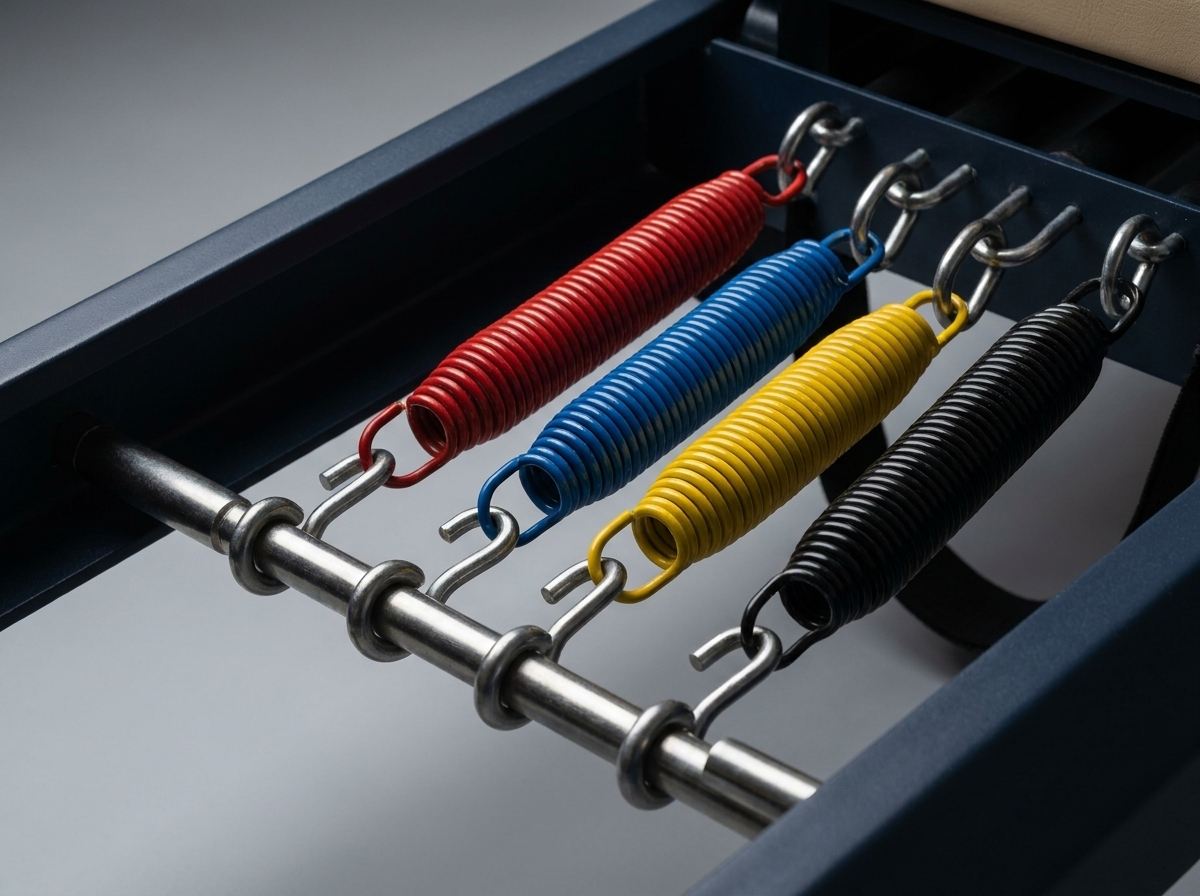
Most professional studio Reformers use four to five springs of varying resistance levels (light, medium, heavy), often supplemented by a very light “half” spring for precise adjustment. This range of resistance levels makes it possible to do everything—from gentle rehabilitation exercises to high-intensity athletic workouts—all on the same machine.
Important: Spring colors are not standardized across manufacturers. For one brand, a certain color might mean “heavy,” while for another it might mean “light.” So never rely on the color alone; instead, rely on the spring system of your specific machine. The Hegren Reformer TALMA 62, for example, features a graduated 5-spring system mounted on a steel frame—five clearly defined resistance levels that allow instructors to scale exercises precisely.
A Comparison of Spring Systems: What Studios Should Look For
In day-to-day studio operations, it’s not the color of the springs that matters, but the quality of the entire system: suspension, hooks, adjustability, and durability. The following checklist is intentionally formulated based on criteria—it helps you evaluate each piece of equipment objectively.
| Criterion | What to Look For | Why It Matters at the Gym |
|---|---|---|
| Suspension Material | Steel Instead of Plastic on Spring Beams and Hooks | Withstands thousands of load cycles per week without any play |
| Spring Rating | 4–5 clearly defined levels + subtle intermediate levels | A class that can be tailored to any level, from rehabilitation to athletic training |
| Hooks & Adjustment | Quick, clear, and secure repositioning | Saves seconds per exercise — adds up to a smooth class flow |
| Security | Secure attachment; cannot come loose accidentally | Protects participants and reduces liability risk |
| Spare Parts Availability | Springs can be purchased separately | Replace wear parts instead of replacing the entire unit |
When you choose a seamless steel system with a defined spring rating, you’re primarily investing in operational reliability: fewer breakdowns, predictable class flow, and lower follow-up costs. The Hegren TALMA 62 (steel frame, 5-spring system, 245 cm, Made in Greece, €3,500) is designed precisely for this purpose; you’ll find the matching springs and accessories in the Pilates Springs & Hangers collection, and the complete product line at Hegren Pilates.
Maintain Springs and Keep Them Secure
Springs are wear parts. Over time, they can lose tension, and the hooks and suspension must be checked regularly—especially during periods of heavy use. We’ve described in detail in the Reformer Maintenance Guide how to properly care for springs, carriages, and cables in the studio, and when it’s time to replace the springs. In short: Perform a visual inspection before every class, replace springs according to the manufacturer’s schedule, and use only original replacement springs.
Buying Guide: Nib System vs. Nib Color
When buying a Reformer for your studio, remember: Focus on the system, not the color. A sturdy steel frame, a well-designed spring system, and secure, quick-release hooks pay off every day—in safety, class flow, and durability. Kraftathlet is an authorized Hegren dealer, and our studio customers rate us ★ 4.88/5 based on over 5,000 reviews. For help selecting equipment, setting up spring configurations, or planning an entire studio setup, contact us via our contact form.
Common Problems with Reformer Springs
- Choose springs based on feel alone: If you choose springs based solely on “heavy/light,” you’re ignoring the fact that they provide support or resistance depending on the exercise.
- Generalizing pen colors: Colors are not standardized—you must know the color system used by your own device.
- Too difficult for beginners: In support exercises, too little spring can make the equipment dangerously unstable; in resistance exercises, too much spring can make the technique too challenging.
- Putting off maintenance: Worn springs and loose hooks are a safety hazard.
- Cheap replacement springs: Springs that don't fit properly can cause uncontrolled changes in resistance and safety.
Frequently Asked Questions
How many springs does a Reformer have?
Professional studio reformers typically have four to five springs of varying strengths, often supplemented by a very light spring for precise adjustment. The Hegren TALMA 62 uses a 5-spring system.
Do more springs always mean more resistance?
No. When you push the sled away, more springs increase the resistance. In support exercises, however, more springs make the movement easier and more stable—it depends on the direction.
Are the pen colors the same for all Reformers?
No, color coding is not standardized across manufacturers. The same color can indicate different line weights for different brands. The spring system of your specific device is always the determining factor.
What should a studio look for in a spring system?
A sturdy steel suspension system, clearly graded springs, secure and quickly adjustable hooks, and the option to purchase replacement springs individually. This ensures smooth class operations, safety, and low ongoing costs.
How often do Reformer springs need to be replaced?
That depends on usage and the manufacturer. It’s important to perform regular visual inspections and replace the springs at the intervals specified by the manufacturer using original replacement springs. You can find details in the Reformer Maintenance Guide.
Conclusion
Reformer springs are more than just accessories—they’re the steering wheel of your workout. Understanding that springs provide resistance or support depending on the direction allows you to adjust exercises more safely and precisely. For the studio, the system is what ultimately matters: steel, clear weight increments, secure hooks, and replaceable springs. The TALMA 62 from Hegren combines all these features in a 5-spring steel system.
Get advice on spring systems now → We can help you choose equipment, configure springs, and set up your entire studio.