

Abstract
- The purchase price is only part of the equation. What really matters for your studio is the total cost of ownership (TCO) over the entire useful life.
- Three options: Purchase (full control, best long-term value), leasing (predictable payments, preserves cash flow), and rental (maximum flexibility, highest unit costs).
- A durable steel reformer like the Hegren TALMA 62 (€3,500) can be more cost-effective over an 8-year period than a cheaper model that needs to be replaced sooner—less downtime, fewer follow-up costs.
- Calculate revenue per square meter and capacity utilization for each reformer, not based on purchase price.
Financing a Pilates Reformer: Leasing, Purchase, and Total Cost of Ownership (TCO) for Your Studio
The most important figure when purchasing a reformer isn’t the purchase price, but the total cost over its useful life—that is, the purchase price plus maintenance, downtime, and lifespan divided by the number of years the machine reliably generates revenue. Those who focus solely on the price often end up paying more.
This guide shows you the three financing options (purchase, lease, rental), how to calculate the true total cost, a specific 8-year example, and which Hegren reformer is right for which studio. The German fitness market is growing—according to the DSSV key figures, it will reach 12.36 million members and 9,647 facilities by 2026, with specialty and boutique studios charging an average monthly fee of €80.02. It is precisely in this premium segment that Pilates Reformers really shine.
Buy, lease, or rent? An overview of the three options
| Way | Advantage | Disadvantage | Fits |
|---|---|---|---|
| Purchase | Full control, best long-term value, fixed assets | ties up capital at the outset | Established studios with equity capital |
| Leasing | Predictable monthly payments, preserves cash flow, tax-deductible | More expensive overall than a cash purchase; contract commitment | Start-ups & Growth |
| Rent | Maximum flexibility; can be canceled on short notice | Highest unit costs, no wealth accumulation | Pop-ups, Tests, Season |
Leasing and rent-to-own are common options in Germany for studio equipment: The payments are tax-deductible as business expenses, and you retain liquidity for marketing and staff. Buying is worth it if the equipment will last for many years—and that’s exactly where the quality of the materials comes into play.
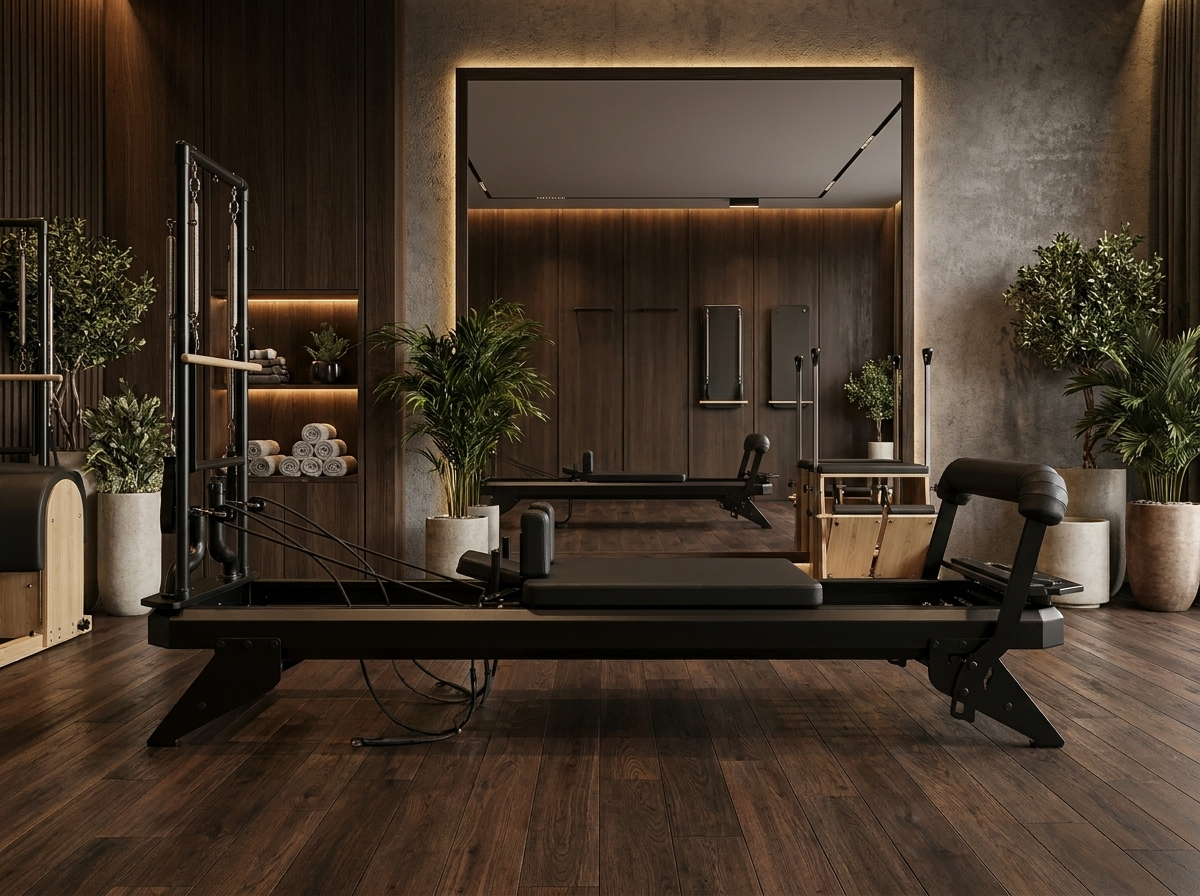
For Studios and Practices: Leasing and Rent-to-Own Options for Studio Equipment.
For Studios and Practices: Pilates Studio Equipment.
The True Cost of a Reformer: Total Cost of Ownership (TCO)
The total cost of ownership consists of several items that are not reflected in the purchase price alone:
- Purchase: the one-time purchase price per reformer.
- Maintenance & Wear Parts: Springs, Cables, Rollers, Padding—How Often Do They Need to Be Replaced?
- Downtime: Every day a Reformer is in for repairs is a day when that machine isn't generating class enrollment or revenue.
- Lifespan: Will the frame last 10+ years, or will it need to be replaced after just a few years?
- Resale value: High-quality devices retain their residual value.
The frame determines the machine’s lifespan. A reformer made of powder-coated steel is significantly more resistant to twisting and maintains its stability over the long term under continuous load compared to inexpensive wooden or aluminum designs, where joints can loosen over the years. This is exactly where the Hegren TALMA 62 comes in: a steel frame, a 5-spring system, and a 245 cm slide length—built for continuous use in the gym. That’s why a slightly higher initial purchase price can actually work out cheaper over the machine’s entire lifespan.
Sample Calculation: TCO Over 8 Years (for illustrative purposes)
The following calculation is a simplified example for illustrative purposes—not market statistics. It compares, based on specific criteria, a long-lasting steel reformer with a less expensive model that must be replaced once during the period.
| Position (8 years) | Durable Steel Reformer | Affordable entry-level model |
|---|---|---|
| Purchase | a one-time payment (e.g., €3,500) | cheaper, but twice during the period |
| Replacement / New Purchase | none | a complete repeat purchase |
| Downtime / Repairs | low | higher, more class cancellations |
| Residual value after 8 years | available | close to zero |
| Trend in Total Costs | lower per year | higher per year |
The exact figures depend on your gym. The basic principle remains the same: A piece of equipment that lasts twice as long and breaks down less often is often the more cost-effective choice per year of training—even if the sticker price is higher.
Be sure to factor in soft factors as well: A high-quality reformer gives your studio a more professional look, builds trust with discerning clients, and reduces the risk of a class being canceled due to a malfunctioning machine. These benefits don’t show up on any purchase invoice, but they influence member retention and word-of-mouth referrals—and thus have a greater long-term impact on your revenue than a small price difference at the time of purchase.
Which " Hegren" reformer is right for which studio?
Hegren-Reformers are made in Greece, with steel frames and a 5-spring system. The selection depends on the class format and space available:
| Model | Suggested Price | Ideal for |
|---|---|---|
| TALMA 62 (steel, 5-spring, 245 cm) | 3.500 € | The all-around studio solution for group classes |
| TALMA 62 Black Elegance | 3.100 € | Boutique Studios with a Focus on Design |
| TALMA 62CT+ Combo (Reformer + Tower) | 4.280 € | More variety in exercises within the same space |
As an authorized Hegren dealer with a ★ 4.88/5 rating based on over 5,000 reviews, we’ll guide you through everything from choosing a model to financing. Check out the complete Hegren Pilates collection and all Pilates reformers. For the basics, read our Reformer Buying Guide for Studios; for choosing between a reformer and a combo machine, see our Reformer vs. Combo guide; and for space planning, see our Floor Plan & Capacity guide.
Calculating Revenue Per Reformer Correctly
A Reformer isn’t a cost center—it’s a source of revenue—and that’s exactly how you should view it. The key metric is revenue per machine: class price per spot × occupied spots × classes per week × active weeks per year. A Reformer that’s well-utilized during peak hours often pays for itself faster than the sticker price suggests.
That’s exactly why reliability counts twice as much: Every day of downtime isn’t just a repair—it’s also lost class revenue. In the premium segment—where, according to the DSSV, members at specialty and boutique studios pay an average of €80.02 per month—members’ willingness to pay justifies investing in high-quality equipment. It’s better to plan for enough reformers from the start so you can run full classes during peak hours instead of turning away customers.
Leasing in Detail: Term, Residual Value, Lease-to-Own
When you lease, keep three things in mind. The lease term should match the expected useful life—for durable equipment, longer terms with lower rates are attractive. The residual value at the end of the contract determines whether you’ll purchase the equipment at a low price or return it. And with a lease-to-own arrangement, the equipment becomes your property at the end of the term, combining asset accumulation with the liquidity benefits of leasing.
Always calculate the total cost over the entire term, not just the monthly payment. A low monthly payment with a high final payment can end up being more expensive than a slightly higher monthly payment with no final payment. Before signing, ask for a complete breakdown and check what happens if you return the item early or extend the term.
Plan for Wear Parts and Maintenance
Springs, ropes, pulleys, and padding are wear-and-tear parts. Before purchasing, check availability and price—a piece of equipment with hard-to-find replacement parts will result in longer downtime. Plan for regular visual inspections and keep a small supply of maintenance parts on hand. High-quality manufacturers keep replacement parts in stock for a long time; this is an often-underestimated part of the total cost.
Buying or Leasing: A Simple Decision Guide
As a rule of thumb: If you have the capital and plan to stay at the same location long-term, buying is usually the most cost-effective solution over the years—you build equity and benefit from the residual value. If you’re in the midst of starting up or growing your business and need your cash flow for marketing, staff, and rent, leasing gives you peace of mind and makes your costs predictable. Many studios combine both approaches: buying the core equipment and leasing additional equipment for expansion. In both cases, it’s important that the equipment operates reliably and is utilized to its full capacity—that’s what determines profitability, not the financing method alone.
Common Mistakes in Reformer Financing
- Don't just look at the price: The cheapest device is rarely the best value over eight years.
- Don't ignore downtime: A reformer in for repairs costs class spots—plan for reliability.
- Buying too few units: If you start with too few devices, you'll limit capacity utilization during peak hours.
- Don't forget the wear-and-tear parts: Before you buy, ask about the availability and price of springs, ropes, and padding.
- Don't just crunch the numbers on a lease agreement: The effective costs, term, and residual value should be determined before signing.
Frequently Asked Questions
Should I buy or lease my first Reformer?
When starting a new business, leasing preserves cash flow and makes costs predictable. If you have equity and are planning for the long term, purchasing is usually more cost-effective over the years—especially for durable equipment with a high residual value.
How long does a professional studio Reformer last?
A high-quality reformer with a steel frame is designed for continuous use over many years. Its actual service life depends on usage, maintenance, and material quality—steel clearly has the advantage here over inexpensive wooden or aluminum constructions.
How many reformers do I need for a group studio?
That depends on the floor space and class size. Plan for about 2.5 to 3 m² per Reformer, including space for movement, and calculate the number of Reformers based on your planned class size and occupancy during peak hours. Our floor plan guide will help you with the exact calculations.
Is a combo unit with a tower worth it?
If you want to offer a wider variety of exercises in a limited space, then yes. A Reformer with a tower significantly expands your repertoire without requiring you to purchase a second category of equipment. For group classes using only Reformers, the classic Reformer is often sufficient.
Conclusion
Finance your Reformer based on the total cost, not the list price: A durable, highly reliable steel machine pays for itself over the years through less downtime, lower ongoing costs, and a higher resale value. Whether you buy or lease—the key is that the machine reliably generates revenue. Talk to our studio team —we’ll work out the right solution for your studio.