

In short:
- A trap bar (hex bar, trapezoidal bar) shifts the weight to your core. This reduces the strain on your lower back and allows you to generate more strength and power than with a straight barbell.
- When purchasing, pay attention to the weight capacity (at least 300 kg), two handle heights, handle diameter, sleeve length (Ø 50 mm for Olympic discs), and the design: open or closed.
- For beginners and home gyms, a sturdy, closed hex bar costing around €220–290 is sufficient. Gyms and performance athletes benefit from an open trap bar, which offers greater range of motion.
- The trapeze bar is easier on the joints during deadlifts and is ideal for squat alternatives, farmer's walks, and jumps with added weight.
Buy a Trap Bar: The Hex Bar Buying Guide for Deadlifts, Strength, and the Gym
If you’re looking for a bar that lets you perform heavy deadlifts while still being easy on your back, the trap bar is the best choice: In the classic biomechanical study by Swinton and colleagues (2011, Journal of Strength & Conditioning Research), strength athletes generated significantly higher peak force, velocity, and power with the hex bar than with the straight barbell—while simultaneously experiencing lower torque on the lumbar spine. In other words: more power, less strain on the lower back. In this guide, you’ll learn which trap bar is right for you, what to look for when buying one, and where the trap bar is superior to the barbell—and where it isn’t.
What is a trap bar (hex bar)?
The trap bar is a hexagonal bar that you stand inside. Instead of holding the weight in front of your body as you would with a straight barbell, you grip it from the sides using a neutral grip—this places the weight exactly in the center of your body, directly above the arch of your foot. This centered line of load is the whole trick: the lever arm to the spine becomes shorter, the movement resembles more of a mix between a deadlift and a squat, and you stay more upright.
The names “trap bar,” “hex bar,” and “trapeze bar” all refer to the same piece of equipment. It was invented in the 1980s by powerlifter Al Gerard, who was looking for a back-friendly alternative to the conventional deadlift. Today, it’s a staple in every well-equipped gym and is found in more and more home gyms.
Trap Bar vs. Barbell: Which Is Better?
Both are excellent tools—but they serve different purposes. The straight barbell is the standard for competitive deadlifts, heavy rowing, and squats. The trap bar excels in any situation where back protection, strength development, and simple technique are important.
| Criterion | Trap Bar (Hex Bar) | Straight Barbell |
|---|---|---|
| Stress on the Lumbar Spine | Low (load centered) | Higher (weight in front of the body) |
| Power & Performance (Peak Power) | Höher (Swinton 2011) | A little lower |
| Technology Learning Curve | Simpler, more forgiving | More challenging |
| Handle | Neutral (easy on the wrist) | Pronated grip (overhand/alternating grip) |
| Competition-Ready (Powerlifting) | No | Yes |
| Versatility (Farmer's Walk, Jumps, Shrugs) | Very high | Medium |
The bottom line of this comparison: If you compete in powerlifting, you need a barbell. If you prioritize strength, athleticism, and a healthy back—or if conventional deadlifts cause you back problems—you’re often better off using a trap bar. Many athletes simply use both. If you want to deepen your understanding of the fundamentals of the pulling movement, be sure to read our deadlift technique guide and the article on the Romanian deadlift (RDL) at the same time.
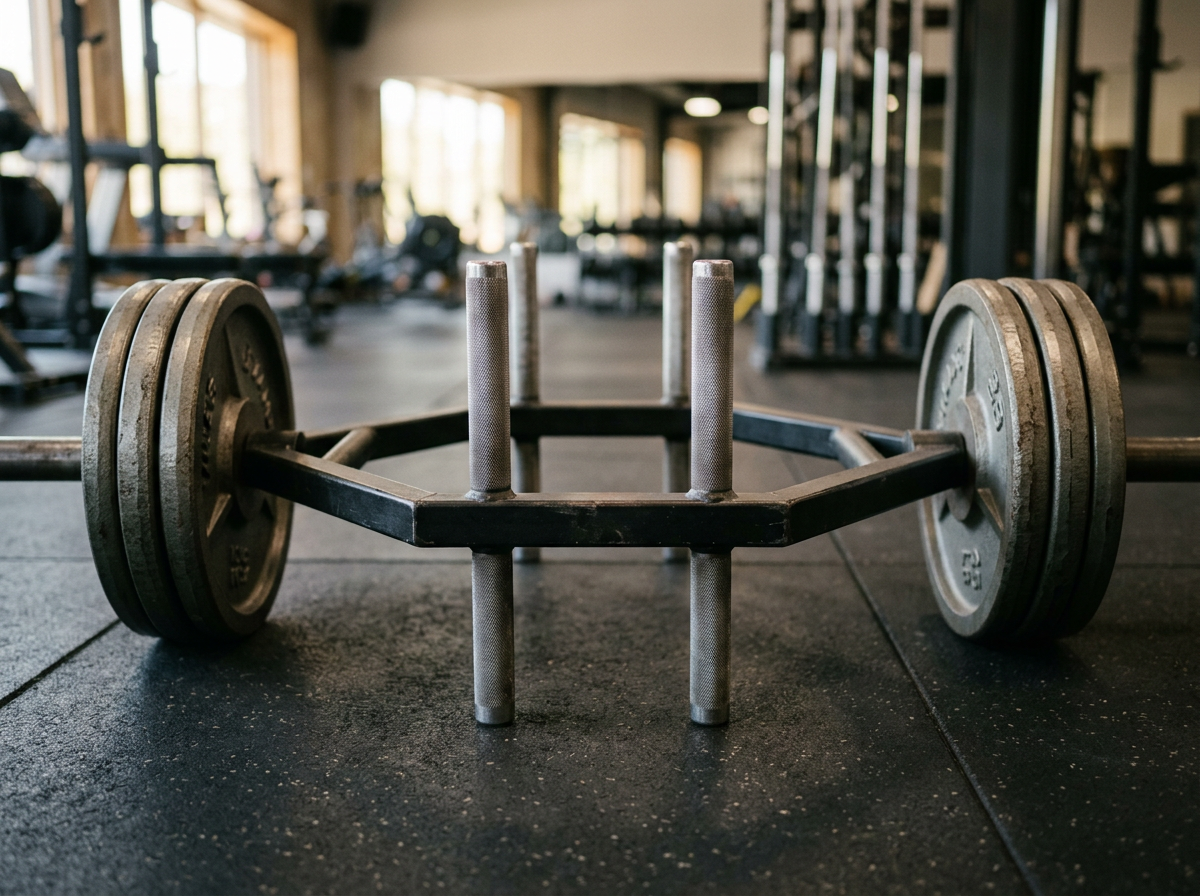
Open vs. Closed Trap Bar
There are two basic types of design—and the choice you make will have a noticeable impact on your workout:
Closed Trap Bar
The classic, fully enclosed hexagonal frame. It’s sturdy, more affordable, and ideal for deadlifts, shrugs, and farmer’s walks. The downside: You have to step into the center of the frame, which makes rowing or exercises at the rack a bit more awkward.
Open Trap Bar
One end of the frame is open. This allows you to step in easily from the front, work at the multi-press or on the rack, and perform exercises like the bent-over trap bar row or landmine movements with greater precision. Open models are usually a bit more expensive and heavier, but they offer significantly more freedom of movement—which is a real advantage, especially in everyday gym use.
What to Look for When Buying a Trap Bar
Not all trapeze bars are the same. These criteria determine safety, durability, and the quality of your workout:
| Characteristic | What to Look For |
|---|---|
| Load capacity | At least 300 kg for home gyms, 400 kg+ for gym use. |
| Handle Heights | Two levels (high/low): high = a shorter route for beginners; low = a greater range of motion. |
| Handle diameter | Approx. 30–34 mm; knurled for a secure grip without straps. |
| Sleeves | 50 mm diameter for Olympic discs, long enough for heavy sets. |
| Dead weight | Usually 20–30 kg—important for correctly calculating the total load. |
| Processing | Neatly welded steel frame with a durable rust-resistant coating. |
Trap Bar for Gyms & Clubs (B2B)
Commercial gyms have different priorities than home gyms. A trap bar in a gym is used daily by many members of varying fitness levels—so it must be sturdy, stable, and intuitive to use. This is exactly where the trap bar shines: It lowers the barrier to entry for deadlifts because beginners almost automatically find a more upright, stable position. This takes the pressure off your training staff and reduces the risk of improper form.
For gyms, rehabilitation centers, and sports clubs, we recommend an open, heavy-duty model with long sleeves. It allows for rowing, landmine exercises, and farmer’s walks without the hassle of stepping in, and can withstand even the most intense use. If you’re planning a complete strength training area, our guide to planning a gym strength training area will help you.
Buying Guide: Which Trap Bar Is Right for You?
At Kraftathlet , you'll find certified trapeze bars for every skill level:
- For Beginners & Home Gyms: A closed hex bar with two grip heights and 50-mm sleeves provides a solid foundation for deadlifts, shrugs, and farmer's walks—starting in the low three-digit range.
- For ambitious athletes: The tiguar Hex Bar features high-quality craftsmanship and a non-slip knurled grip—ideal if you want to build strength and performance in a targeted way.
- For Studios & Performance: The tiguar Open Trap Bar, with its open design, gives you maximum freedom of movement for rowing, landmine exercises, and heavy pulling movements.
You can find all models in our Dumbbells & Kettlebells and Strength Training collections. And since a trap bar is often used in combination with a rack, it’s worth taking a look at our power rack buying guide as well.
Warum bei Kraftathlet kaufen? ★ 4,88/5 aus über 5.000 Bewertungen, autorisierter Händler mit Herstellergarantie und Ratenzahlung über PayPal oder Leasing für Geschäftskunden. So investierst du sicher in Ausrüstung, die hält.
Common Mistakes in Trap Bar Training
- A Rounded Back Despite the Trap Bar: Even this joint-friendly bar requires a neutral back. Engage your core, stick your chest out, and look straight ahead.
- Wrong grip height: If you switch to the low grips too early, you'll lose your position when your range of motion is limited. Start with the high grips.
- Don't extend too far (hyperextension): At the end of the movement, extend only your hips—do not arch your back excessively.
- Don't forget the bar's own weight: It weighs 20–30 kg. Factor that into your working load, or you'll overestimate your numbers.
- The bar is too light for the gym: A home bar with a 250-kg limit will quickly be overwhelmed under continuous use. For commercial use, opt for one rated at 400 kg or more.
Frequently Asked Questions
Is the trap bar better than the barbell for deadlifts?
For most people who work out, yes—it’s easier on the back and allows you to generate more strength (Swinton 2011). For competitive deadlifts in powerlifting, however, you need the straight barbell, because it’s the only one permitted by the rules.
How much does a trap bar weigh?
Most models weigh between 20 and 30 kg. Check the manufacturer's specifications and always include the unit's weight in your total load.
What exercises can I do with the trap bar?
Trap-bar deadlifts, farmer's walks, shrugs, jump shrugs, overhead presses, and—with an open design—bent-over rows and landmine exercises.
Which weight plates fit on a trap bar?
Olympic discs with an inner diameter of 50 mm are standard. Make sure your sleeves are long enough if you're doing heavy training.
Is a trap bar worth it for a home gym?
If deadlifts and leg workouts are central components of your plan: absolutely. It’s versatile, more forgiving in terms of form, and easy on the back—a strong argument, especially if you’re working out without a trainer.
Conclusion
The trap bar is one of the best investments for back-friendly strength training: more power, less strain on the spine, and a wide range of exercises. For home use, a sturdy, closed hex bar is sufficient; at the gym, an open, heavy-duty trap bar really shows its advantages. Look for a high weight capacity, two grip heights, and 50-mm sleeves—then you’ll be able to train safely for years to come.
Not sure which bar is right for your setup? Contact our team —we'll give you personalized advice on equipment for home gyms, fitness centers, and clubs.
Sources: Swinton PA et al. (2011), “A Biomechanical Analysis of Straight and Hexagonal Barbell Deadlifts Using Submaximal Loads,” Journal of Strength & Conditioning Research; for further reading: Stronger by Science – Trap Bar Deadlifts.