

Abstract
- Compound exercises (such as squats, deadlifts, and bench presses) work multiple muscles across two or more joints—maximizing muscle mass per unit of time.
- Isolation exercises (e.g., bicep curls, lateral raises) specifically target a muscle through a joint—ideal for strengthening weak areas.
- For maximum muscle growth, you need both: 70–80% compound exercises as a foundation and 20–30% isolation exercises for fine-tuning.
- Studies show that for building specific muscle groups (e.g., biceps), isolation exercises may even be superior—but for overall muscle mass and time efficiency, compound exercises are more effective.
For maximum muscle growth, you need both—but in the right order: Compound exercises efficiently build overall muscle mass and strength as a foundation, while isolation exercises then specifically target individual muscles. If you focus on just one category, you’re wasting your potential. In this guide, you’ll learn how the two differ, what the research says about them, and how to combine them into a smart training plan.
What are basic exercises and isolation exercises?
The difference lies in the number of joints involved—and thus in the number of muscles working simultaneously. This classification determines how much of a challenge an exercise provides, how much weight you can lift, and how precisely you can target a single muscle.
Basic Exercises (Combined Exercises) Explained
Compound exercises—also known as multi-joint exercises—engage two or more joints at the same time and recruit large muscle chains. The squat flexes the hips and knees, while the bench press flexes the shoulders and elbows. Because many muscles work together, you can lift heavy weights, burn a lot of energy, and trigger a strong systemic growth response. The classic “big exercises” are the deadlift, squat, bench press, shoulder press, row, and pull-up.
Isolation Exercises Explained
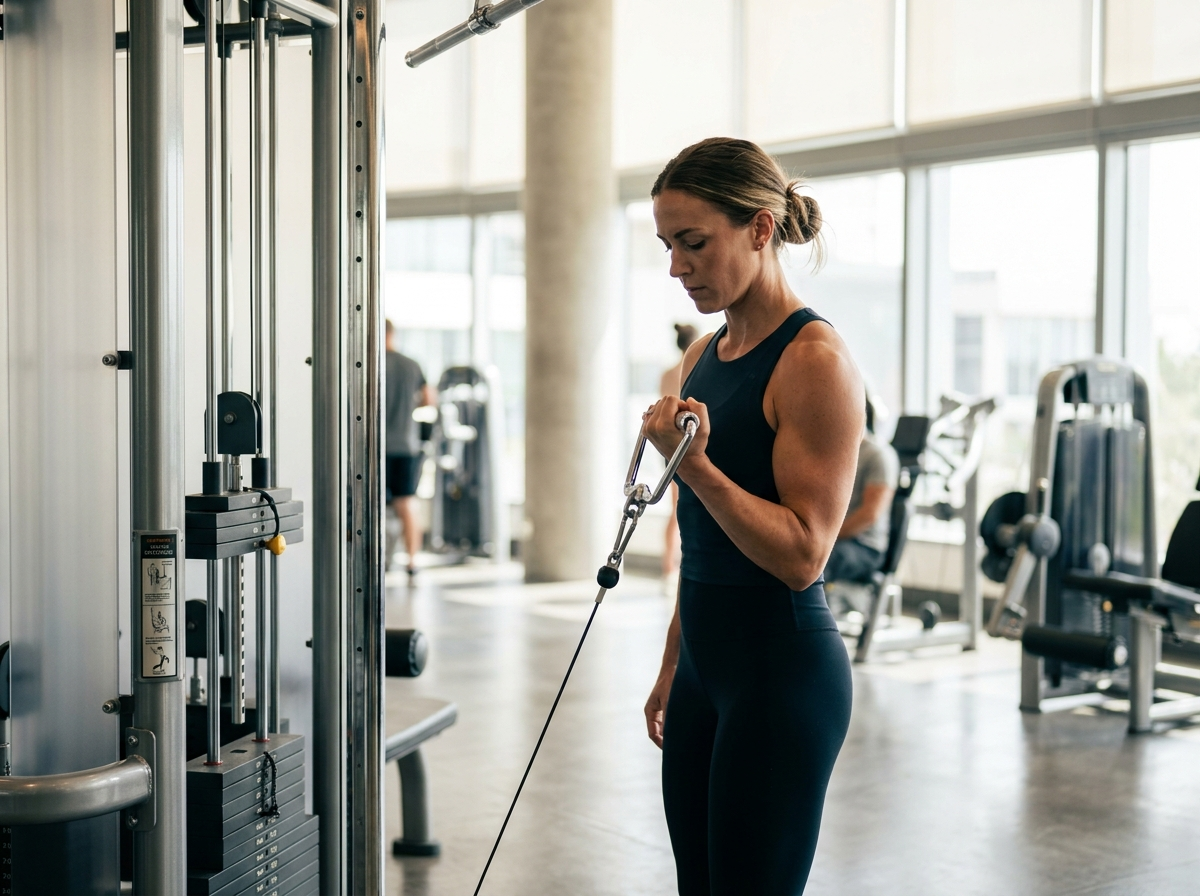
Isolation exercises move only one joint and primarily target a single muscle. The bicep curl flexes only the elbow; the lateral raise elevates only the shoulder joint; and leg extensions and leg curls work the knee joint in isolation. The advantage: You can precisely target a specific muscle without your hips, back, or legs limiting your movement. The downside: You lift less weight and train significantly less muscle mass per exercise.
Compound Exercises vs. Isolation Exercises: A Direct Comparison
Both categories have clear strengths. The following overview shows where each type of exercise excels—and why a good plan makes use of both.
| Criterion | Basic Exercises | Isolation Exercises |
|---|---|---|
| Joints Involved | Two or more | One |
| Trained Muscle Mass | High (entire chains) | Low (one target muscle) |
| Moving Load | High | Low to medium |
| Time Efficiency | Very high | Low |
| Targeted Muscle Activation | Limited | Very precise |
| Technical Requirements | Higher | Lower, adjustable to reduce strain on the joints |
| Best Role in the Plan | Foundation, Force, Total Mass | Fine-tuning, weaknesses, details |
Which builds more muscle? Here's what the research says
The honest answer: It depends on what you're focusing on. When it comes to total muscle mass and workout time, compound exercises are hard to beat—they provide the greatest stimulus per set. For individual small muscles, however, an isolation exercise can actually lead to more muscle growth.
A study by Mannarino and colleagues (Journal of Strength and Conditioning Research, 2021) compared one-arm dumbbell rows (compound exercise) with biceps curls (isolation exercise) in the same trainee over an eight-week period. Result: The biceps curl increased the thickness of the elbow flexors by about 11%, while the row increased it by only about 5%. For targeted arm development, the isolation exercise was thus clearly superior. Conversely, an earlier study by Gentil and colleagues (Applied Physiology, Nutrition, and Metabolism, 2013) involving untrained men showed that adding isolation exercises to a program consisting of compound exercises did not result in additional muscle growth in the arms—the compound exercises alone were sufficient to build a solid foundation.
The conclusion drawn from the research is practical, not dogmatic: basic exercises form an effective foundation. Isolation exercises are especially worthwhile if a specific muscle is lagging behind or if you're specifically working on your physique and symmetry.
When to do compound exercises, and when to do isolation exercises?
Focus on basic exercises if …
… you don’t have much time, want to build strength and muscle mass, or are a beginner. If you work out two to three times a week, you’ll make the most progress with squats, deadlifts, and push and pull exercises. They are the backbone of any effective workout plan.
Incorporate isolation exercises when …
… a muscle remains visible (typically: biceps, lateral deltoids, calves), you’re at an advanced level and working on the finer details, or a joint simply won’t allow you to perform a heavy compound exercise. An isolation exercise can often be adjusted to be easier on the joints and is well-suited for building muscle mass without putting additional strain on the nervous system.
The Ideal Combination in a Training Plan
The tried-and-true order is: compound exercises first, followed by isolation exercises. Start the session with one or two compound exercises while you’re still full of energy, and finish with targeted isolation exercises. A rough rule of thumb for building muscle: 70–80% of your workout volume should consist of compound exercises, and 20–30% of isolation exercises.
| Training Day | Basic Exercise (First) | Isolation (afterward) |
|---|---|---|
| Push (Pressure) | Bench press, shoulder press | Lateral Raises, Triceps Presses |
| Pull | Pull-ups, Rowing | Bicep Curl, Face Pull |
| Legs | Squats, Deadlifts | Calf Raises, Leg Curls |
Buying Guide: The Right Equipment for Both Types of Exercise
Basic exercises require a stable, sturdy foundation: a power rack or rig setup with a barbell and weight plates is the ideal setting for squats, deadlifts, and bench presses. Free weights from the dumbbells and kettlebells section cover the majority of compound exercises. A cable machine or functional trainer ensures clean, joint-friendly isolation and constant tension throughout the entire range of motion—ideal for lateral raises, curls, triceps exercises, and face pulls. You can find an overview of the entire product line in the Strength Training category.
As an authorized dealer offering a manufacturer’s warranty, we provide honest, brand-agnostic advice—so you can invest in equipment that will last for years, rather than having to buy it twice. Over 5,000 customers already trust Kraftathlet.
Common Mistakes
Only do isolation exercises. If you build your workout around curls, lateral raises, and machines, you’re missing out on the biggest benefits. Without heavy compound exercises, you’ll lack the foundation for building muscle mass.
Avoid basic exercises entirely. On the other hand, many people neglect certain small muscles (calves, lateral deltoids, rear deltoids) and then wonder why their physique looks unbalanced—isolation exercises are necessary here.
Wrong order. If you pre-fatigue your muscles with isolation exercises, you’ll be less effective during the basic exercises and lose the stimulus and potential for strength gains.
Too much isolation training. Twenty sets of curls per week rarely yield more than six to ten well-executed reps—the rest just takes time to recover from.
Frequently Asked Questions
Are compound exercises or isolation exercises better for beginners?
For beginners, basic exercises are the clear priority. They provide the greatest progress per unit of time, improve coordination, and lay the foundation for strength. One or two isolation exercises per session are more than enough to round out the workout.
Can I build muscle just by doing basic exercises?
Yes—especially in the beginning, you can get a long way just with basic compound exercises. Studies show that compound exercises alone are sufficient to build a solid foundation. Isolation exercises only become important when you want to specifically target individual muscles.
How many core and isolation exercises per workout?
A good structure consists of one or two basic exercises and two or three isolation exercises per session. This keeps the volume within a reasonable range and allows you to focus your training first on the areas that matter most.
Are machines considered basic or isolation exercises?
Both. A leg press is a compound exercise performed on a machine, while a leg extension is an isolation exercise. Whether an exercise is compound or isolation is determined by the number of joints involved, not by the equipment. The question of “free weights or machines” is a separate issue entirely and independent of this.
Do isolation exercises really make a difference in terms of appearance?
For definition, yes. The lateral deltoids, calves, rear deltoids, and biceps benefit measurably from targeted isolation exercises. For pure muscle mass, compound exercises remain the key.
Conclusion
Compound exercises and isolation exercises aren’t rivals—they’re two tools with different purposes. Build your workout around heavy compound exercises, then strategically supplement them with isolation exercises to target weak spots and refine your form—and aim for a rough ratio of 70–80% to 20–30%. That’s how you’ll get the most out of every session.
Want to know which equipment is right for your goals and your space? Contact our team —we’ll give you honest, manufacturer-neutral advice.
Sources: Mannarino et al., Journal of Strength and Conditioning Research 2021 (PubMed); Gentil et al., Applied Physiology, Nutrition, and Metabolism 2013 (CDN Science Pub).