

Abstract
- The strength training area is the most important space in your gym from a business perspective: Plan it in the following order: target audience → equipment mix → space → budget—not the other way around.
- The industry is booming: 12.36 million members, €6.25 billion in revenue, and an average of €83,000 in investment per facility per year (DSSV Key Figures 2026)—anyone planning now is investing in a growth market.
- As a rule of thumb, you'll need 4–6 m² per plate-loaded machine, including the user area, and 8–10 m² per power rack station—plus aisles at least 1.5 m wide.
- For commercial use, you need Class S equipment in accordance with DIN EN ISO 20957—home-use equipment is neither permitted nor suitable for use in the studio.
Planning Your Gym's Strength Training Area: Space, Equipment, and Cost-Effectiveness for Your Fitness Center
You plan a strength training area in four steps: First, you define the target audience and positioning; then, you determine the mix of free weights, plate-loaded machines, and adjustable-weight machines; this determines the space requirements—and only at the end do you set the budget. The market for this is stronger than ever: According to the DSSV’s key figures for the German fitness industry in 2026, 12.36 million members are working out at 9,647 German facilities, and industry revenue rose by 7.4 percent to 6.25 billion euros. This guide walks you through all four steps—with space-planning rules of thumb, equipment comparisons, budget guidelines, and the mistakes that end up costing the most in practice.
Why Strength Training Is Key to Your Success at the Gym
Strength training is no longer just a niche activity for bodybuilders, but rather the core of the membership business. According to the DSSV, the fitness industry’s market penetration now stands at 14.8 percent of the total population—and a growing proportion of these members join specifically for heavy compound exercises, guided machines, and structured training plans. At the same time, the industry is investing heavily: In 2025, approximately 798 million euros net were invested in facilities and infrastructure—an average of 83,000 euros per facility. About 80 percent of operators also plan to invest in 2026.
Here’s what that means for you: Your members aren’t comparing your strength training area to how it was in 2020—they’re comparing it to the newly equipped competitor two blocks down. A well-designed strength training area directly impacts the two most important metrics—member acquisition (visible quality during trial workouts) and member retention (no wait times, no broken equipment). With an average monthly membership fee of 48.55 euros, every member you retain accounts for nearly 600 euros in annual revenue.
Step 1: Define the Target Audience and Positioning
Before you choose a single device, you need a clear answer to the question: Who is this power range intended for? The DSSV figures show just how differently the segments are priced—and thus how different the expectations regarding features are:
| Segment | Average Monthly Premium (DSSV 2026) | Expectations for the strength range |
|---|---|---|
| Chain Stores (Discount to Mid-Range) | 40,54 € | High equipment density, rugged standard machines, intuitive operation |
| Individual facilities (owner-operated) | 59,24 € | Quality and support, a mix of machines and a well-equipped free-weight area |
| Special-Interest Studios | 80,02 € | Specialization: Plate-loaded machines, powerlifting area, premium brands |
The rule here is: The higher your membership fee, the more your strength training area needs to be your unique selling point. A premium gym with two old multi-press machines will lose exactly the members who would be willing to pay 80 euros a month.
Step 2: Space Planning—How Much Space Do You Really Need?
The Four Zones of a Strength Training Range
A well-organized strength training area is divided into four zones that you should deliberately separate: the free-weight area (racks, benches, dumbbells), the plate-loaded zone for guided heavy training, the adjustable-weight zone for beginners and circuit training—and an open functional area for warm-ups and accessory exercises. This separation isn’t an end in itself: it manages traffic flow, reduces the risk of accidents, and ensures that beginners don’t feel lost among the heavy weights.
Area Rules of Thumb from Interior Design Practice
Exact values depend on the device—these practical values, including the user area and safety distance, have proven effective in planning:
| Station | Space requirements (including user area) | Note |
|---|---|---|
| Power Rack with Barbell Station | approx. 8–10 m² | Plan for a dumbbell rack and weight plate rack; ceiling height of at least 2.6 m for overhead presses |
| Plate-Loaded Machine | approx. 4–6 m² | Plus, keep your discs within reach—otherwise they'll end up scattered all over the studio |
| Plug-in weighing machine | approx. 3–5 m² | More compact, since no disc handling is required |
| Dumbbell Station (Bench + Mirror) | approx. 6–8 m² | Move the dumbbell rack at least 50 cm away from the workout area |
| Walking routes | at least 1.5 m wide | Make the main pathways wider; never have them run through the free-weight area |
Then there’s the structural engineering: A loaded power rack with weight plates can quickly concentrate several hundred kilograms within just a few square meters. On the ground floor with a concrete slab, this is rarely a problem—but starting on the first floor or in older buildings, you’ll need to consult a structural engineer before placing your order. High-quality floor protection made of rubber granules is mandatory in any case, with a thickness of 20–40 mm in the free-weight area.
Step 3: The Right Mix of Devices
The most important strategic decision in the strength training area is the balance between free weights, plate-loaded machines, and adjustable-weight machines. All three have clear strengths:
| Criterion | Free Weight Area | Plate-Loaded | Plug-in weights |
|---|---|---|---|
| Target Audience | Advanced learners, athletes | Ambitious + Rehabilitation Following Admission | Beginners, Circuit Training |
| Durability / Maintenance | Very high / minimal | Very high – few cable pulls, few wear parts | Equipment – Ropes, pulleys, and padding wear out |
| Beginner-friendly | Low (training required) | Medium | Very high |
| Space requirements per station | High | Medium to high | Medium |
| Purchases per station | Medium | Medium | Medium to high |
| Market Differentiation | High | Very high – a visible sign of quality | Low (standard everywhere) |
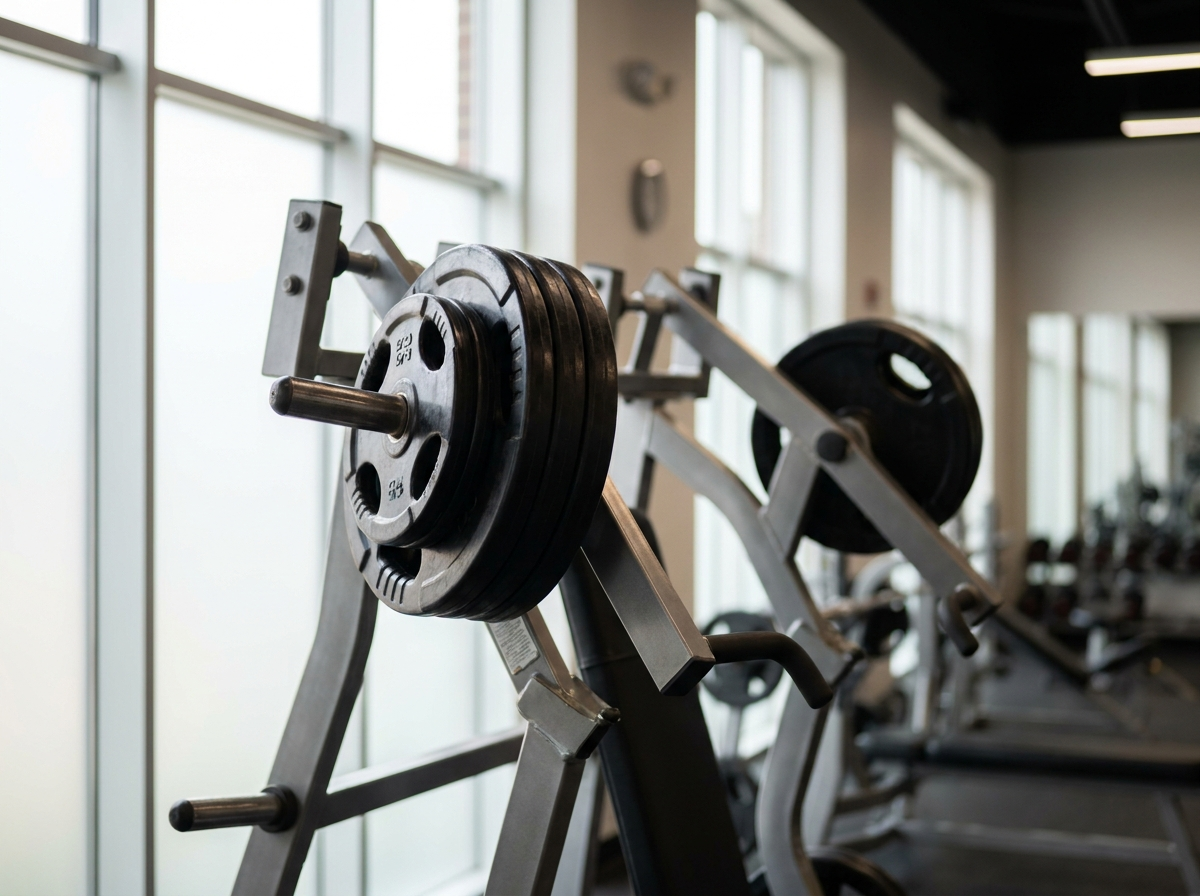
In practice, a mix of roughly one-third per zone—adjusted depending on the facility’s focus—works well for individual gyms: A performance-oriented gym places greater emphasis on free weights and plate-loaded machines, while a health-oriented gym focuses more on guided plug-in weight machines. Plate-loaded stations are the strongest differentiator here: They combine the feel of free weights with the safety of a guided system, require almost no wear-and-tear parts, and represent serious training—exactly what high-paying members are looking for.
Step 4: Budget and Cost-Effectiveness
For reference: In 2025, the industry invested an average of 83,000 euros net per facility (DSSV)—across all facility types and investment purposes. For the initial setup of a power generation area, these figures have proven to be a realistic range:
| Expansion Phase | Scope (Example) | Budget Allocation (net) |
|---|---|---|
| Compact (Boutique/Micro Studio) | 2 racks, set of dumbbells, 4–6 machines | approx. 30,000–60,000 € |
| Medium-sized standalone system | 3–4 racks, full free-weight area, 10–15 machines | approx. €60,000–150,000 |
| Premium / Performance | Complete plate-loaded line, powerlifting zone, specialty equipment | starting at €150,000 |
Always weigh the investment against the value of a membership: With an average membership fee of 48.55 euros, each member generates approximately 583 euros in revenue per year. A strength training area costing 100,000 euros therefore doesn’t have to pay for itself over decades—it will pay for itself if it consistently retains or attracts 60–70 additional members over a three-year period. The total cost of ownership is the key factor: A cheap piece of equipment that breaks down after 18 months of continuous operation costs more—in terms of downtime, repairs, and member frustration—than a reliable, high-end machine. Downtime is a revenue killer in the gym because it affects the most active members the most.
Safety and Standards: What Applies in Commercial Operations
For gyms, the following applies: Exercise equipment must be designed for commercial use. The DIN EN ISO 20957 standard distinguishes between equipment classes—Class S (professional/commercial use) is intended for gym use, while home equipment (Class H) has no place in a membership-based facility. In addition, there are operator responsibilities: regular, documented maintenance and visual inspections, training for new members, and flooring that absorbs impact and keeps equipment from slipping. By maintaining proper documentation, operators not only protect their members but also themselves in the event of a liability claim.
Buying Guide: How to Put Together Your Strength Training Routine
Start with the anchor equipment that supports your setup—racks and the plate-loaded line—and then systematically add to it. A proven sequence: first, the basic exercise stations (squats, bench press, deadlifts, pull-ups); then the major muscle groups using plate-loaded machines (leg press, rowing machine, chest press, lat pulldown); and finally, isolation and comfort machines. You’ll find the complete range of commercial equipment in our strength training collection —and guidance on how to approach your entire gym project in our comprehensive guide to gym equipment setup.
As an authorized dealer offering a manufacturer’s warranty, we at Kraftathlet support studio projects from space planning through delivery—over 5,000 customers trust our expertise. To help with cash flow planning, we offer flexible financing options for purchases; just contact us to learn more.
Common Mistakes in Power Range Planning
Buy equipment before finalizing the design. If you order first and plan later, you’ll end up with a patchwork of equipment instead of a space with a clear design language—and realize too late that the floor space or structural capacity isn’t sufficient.
Don't underestimate the space needed for movement. On paper, 25 pieces of equipment might fit, but in practice, members end up jostling past each other. Plan the pathways first, then the equipment.
Save money on flooring. A damaged subfloor or sagging flooring will end up costing many times more than a rubber floor—not to mention the noise disputes with neighbors.
Using home-use equipment in the gym. Class H equipment cannot withstand continuous operation and is not intended for commercial use—this poses a risk regarding warranty and liability.
Do not factor maintenance costs into the price. Cables, padding, and pulleys are wear-and-tear parts. If you don't plan for routine maintenance, you're planning for downtime.
Frequently Asked Questions
How much space does a strength training area in a gym need?
As a rule of thumb: 4–6 m² per plate-loaded machine, 8–10 m² per power rack station, and 3–5 m² per free-weight machine—each figure includes the user area, plus walkways at least 1.5 m wide. A strength training area with 15 stations would therefore realistically require 100–150 m².
How much does it cost to equip a studio weight training area?
Compact systems start at around 30,000–60,000 euros net; mid-range individual systems range from 60,000 to 150,000 euros; and premium configurations are priced higher. For context: According to the DSSV, the industry invested an average of 83,000 euros net per system in 2025.
Plate-loaded or free weights—which is better for the gym?
Both have their place: free weights are beginner-friendly and suitable for circuit training, while plate-loaded machines are more durable, require less maintenance, and convey a stronger sense of quality to ambitious members. Your gym’s positioning determines the balance—it’s not an either/or situation.
What standard applies to commercial fitness equipment?
DIN EN ISO 20957 applies: For studio use, you need Class S equipment (commercial use). In addition, there are operator responsibilities such as documented maintenance and training for members.
Is it worth buying used weight training equipment?
In some cases, yes—such as with weight plates or benches. With machines, however, caution is advised: without a warranty, with an unclear maintenance history, and with potential spare-part issues, what seems like a bargain price can quickly turn into the most expensive option. Always factor in the total cost over five years.
Conclusion
A strength training area isn’t a cost center—it’s your most important selling point on the floor. Plan in this order: target audience, equipment mix, floor space, and budget—with commercial-grade equipment, realistically calculated walking distances, and a plate-loaded zone as a visible symbol of quality. The market is growing, and so are members’ expectations. Are you planning a strength training area or looking to modernize an existing one? Talk to our B2B team —we’ll work with you to plan the floor space, equipment mix, and budget.