

- A well-maintained studio reformer lasts over ten years. Critical wear parts are springs, ropes/straps, rollers, and upholstery.
- Springs and ropes should be checked regularly – they are the biggest safety and failure factor in group operation.
- The frame material determines long-term maintenance costs: steel is more stable and dimensionally accurate than wood or aluminum in continuous operation.
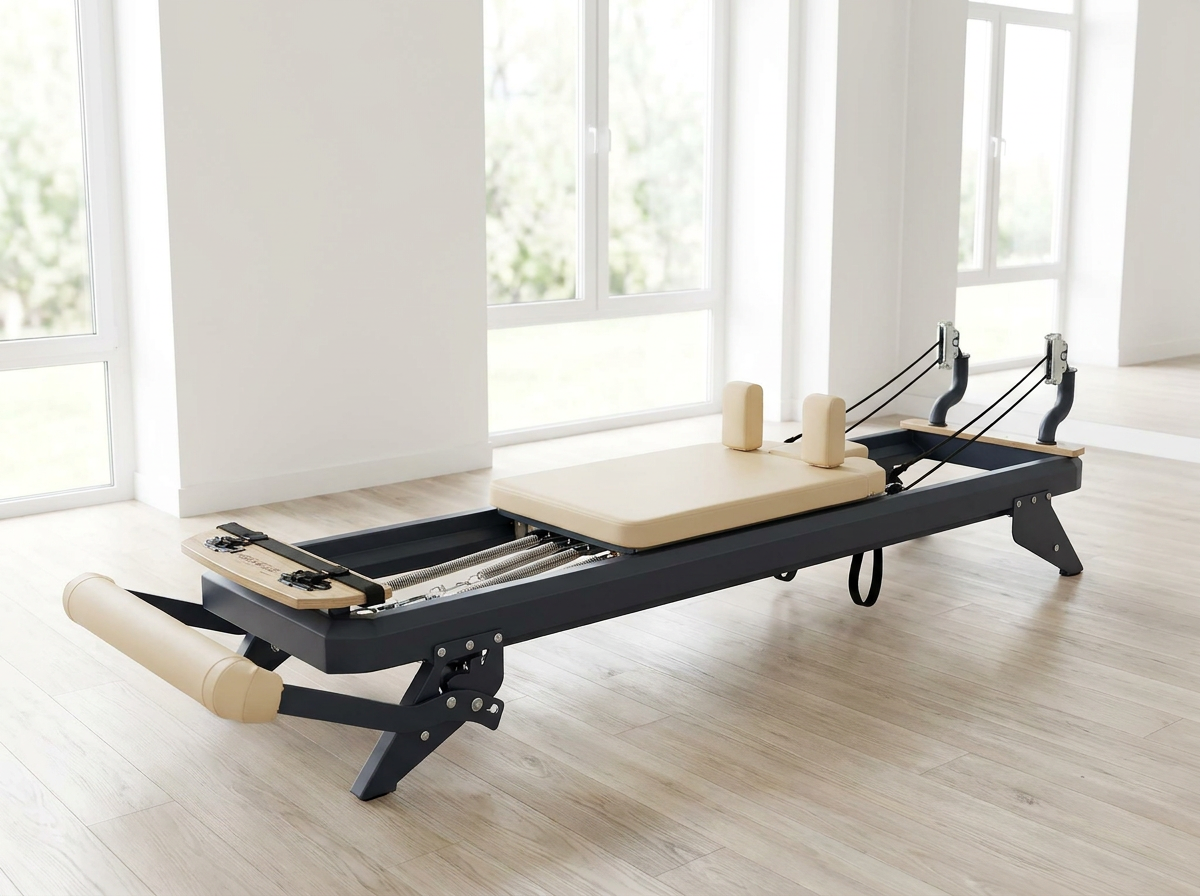
- As a low-maintenance studio hero, we recommend the Hegren TALMA 62 (steel frame, 5-spring system, Made in Greece, €3,500).
Reformer Maintenance in the Studio: How to Keep Your Pilates Reformer Safe for Years
A professional Pilates reformer, with correct maintenance, can easily last over ten years – provided you regularly check springs, ropes, rollers, and upholstery and address wear before it becomes a safety risk. The most common cause of failures is not the age of the equipment, but neglected maintenance at precisely these four points.
This guide shows you which components to inspect at what intervals, how to avoid downtime in group operation, and why the frame material determines your maintenance costs. Written for studio owners, trainers, and anyone who sees a reformer as an investment rather than a consumable item.
Why Maintenance Determines Your Studio's Profitability
The German studio market is robust: according to the key figures for the German fitness industry 2025 (DSSV/Deloitte), 11.71 million people train in around 9,127 facilities, with an industry turnover of 5.82 billion euros net. Pilates and reformer formats particularly benefit from this growth – but only if the equipment is operational.
Every hour a reformer is out of service due to a broken spring or faulty rope directly costs you revenue: a blocked spot in a fully booked class, rescheduled appointments, and in the worst case, a safety incident. Maintenance is therefore not an annoying duty, but active capacity management. Anyone serious about revenue per square meter plans maintenance as strictly as the class schedule.
Added to this is the trust factor: a quiet and smoothly running machine signals quality to your customers. Squeaking rollers, frayed ropes, or cracked upholstery, on the other hand, appear unprofessional – even if the class instruction is first-class. Well-maintained equipment is therefore also a silent part of your marketing and customer loyalty.
The Five Maintenance Points on the Reformer
1. Springs
The springs are the heart of the reformer and the most important safety component. Check them for stretched coils, corrosion, and hairline cracks on the end hooks. A spring that loses its tension noticeably changes the resistance and can fail at the most inopportune moment. You should always have spare springs in stock – precise fit is crucial here.
2. Ropes and Straps
Ropes and straps are the second wear part with safety relevance. Check them for fraying, stretching, and a secure fit of knots or clamps. A snapped rope under load is one of the most common sources of injury – replace it at the first sign of wear, not only when it breaks.
3. Rollers and Rails
The carriage must run quietly and absolutely smoothly. Squeaking, jerking, or lateral play indicates worn rollers or dirty rails. Regularly clean the running surfaces of dust and skin particles and check the roller bearings – a smoothly running carriage is also a quality signal to your customers.
4. Upholstery and Hygiene
Upholstery in group settings is exposed to high stress and sweat. Tears in the cover layer are not only unsightly, they are hygienically problematic because germs can accumulate in them. Clean after each class with a material-friendly agent and use custom-fit protective covers to preserve the A-class upholstery. Especially in times of increased hygiene sensitivity, a visibly clean reformer is a real selling point to your members.
5. Frame and Fastenings
Once a month, it's worth checking all screw connections. Here lies the biggest difference between constructions: wooden frames can warp with changing humidity, causing connections to loosen; a welded or high-quality bolted steel frame, however, remains dimensionally stable for years.
Maintenance Intervals at a Glance
These intervals have proven effective in studio operation. For very high utilization (more than 30 hours per week per machine), shorten them accordingly.
| Component | Interval | Action |
|---|---|---|
| Springs | weekly (visual), quarterly (detailed) | check for tension, corrosion, and hooks |
| Ropes & Straps | weekly | check for fraying and stretching, replace early |
| Rollers & Rails | monthly | clean, check bearings and operation |
| Upholstery & Covers | after each class | disinfect, check for tears |
| Frame & Screws | monthly | tighten fastenings |
Why Frame Material Determines Your Maintenance Costs
Before you consider individual maintenance steps, it's worth looking at the construction – because it determines how much maintenance is even required. We compare the material classes objectively here, without evaluating individual manufacturers.
| Criterion | Steel Frame | Wood Frame | Aluminum Frame |
|---|---|---|---|
| Dimensional stability in continuous operation | very high | medium (works with humidity) | high |
| Stability under high load | very high | high | medium |
| Maintenance effort for connections | low | higher (retighten) | low |
| Suitability for intensive studio use | ideal | more for boutique/home | solid |
The logic behind it is simple: a cheap reformer that noticeably yields after 18 months of continuous operation ends up costing you more than a well-designed steel unit – through downtime, spare parts, and in doubt, a complete new purchase. The same principle applies to maintenance as to total cost of ownership: durability beats a low purchase price.
Hegren TALMA 62: Our Studio Recommendation
If you are looking for a reformer that keeps maintenance costs low from the outset, the Hegren TALMA 62 is our clear recommendation for professional use. The reformer is designed for continuous studio load: steel frame, 5-spring system, 245 cm running length, manufactured in Greece. The steel frame is precisely the factor that largely eliminates the need for monthly screw-tightening routines.
An overview of the most important models and prices:
| Model | Feature | Price |
|---|---|---|
| Hegren TALMA 62 | Studio standard, steel frame, 5-spring system | €3,500 |
| TALMA 62 Black Elegance | Design variant for premium studios | €3,100 |
| TALMA 62CT+ Combo | Reformer + Tower – more exercises per m² | €4,280 |
Particularly practical for maintenance: spare and wear parts are available with a precise fit. Springs and suspensions can be found in our Pilates Springs & Hangers category, hygienic protective covers like the TALMA-62-Covers-Collection (from €71.40) and other studio accessories in Premium Pilates Accessories. For those who want more exercise variety in the same space, the combo variant of reformer and tower is ideal – it increases capacity per square meter without requiring a second equipment space.
As an authorized Hegren dealer with full manufacturer's warranty – rated ★ 4.88/5 by studios – we advise you not only on purchasing but also on the appropriate spare parts and maintenance strategy. You can find detailed buying advice in our article Buying a Pilates Reformer: What Studios Should Look For.
How to Set Up a Simple Maintenance Log
Maintenance in daily studio life rarely fails due to lack of skill, but rather due to a lack of routine. The solution is a simple log that leaves nothing to chance. Hang a laminated checklist for each machine and clearly define who checks what and when: the daily visual inspection of springs and ropes is done by the trainer before the first class, the monthly inspection by a designated team member.
Record every completed check with date and initials. This creates a complete history that is invaluable in case of damage – for example, for insurance or the manufacturer – and shows you which machine requires spare parts more frequently. Also, keep a small stock of wear parts: a set of spare springs, ropes, and a cleaning kit for each type of equipment. Then you can fix wear immediately, instead of canceling a class. This combination of routine, documentation, and spare parts stock is what separates studios with long-running equipment from those with constant breakdowns.
Common Mistakes in Reformer Maintenance
Replacing springs too late. A spring doesn't suddenly break – it gives warning signs. Ignoring warning signs risks a breakdown in the middle of a class.
Aggressive cleaners on upholstery. Solvent-based agents attack the covers and accelerate tears. Use material-friendly disinfectants and protective covers.
No maintenance log. Without a fixed log, what was checked when gets lost in daily business. A simple checklist hung on each machine is enough.
Skimping on material. The lowest purchase price is rarely the cheapest over the lifespan. Low-maintenance construction saves more in the long run than it costs initially.
Frequently Asked Questions
How often does a Pilates reformer need to be serviced?
You should visually inspect springs and ropes weekly, rollers and fastenings monthly, and conduct a thorough inspection quarterly. Upholstery and covers should be cleaned after each class. For very high usage, shorten the intervals.
When do I need to change the springs on the reformer?
As soon as a spring loses its tension, shows corrosion, or the end hooks show cracks. Don't rely on a fixed calendar date, but on regular visual inspection – and keep suitable spare springs in stock.
Is a steel reformer really lower maintenance than a wooden model?
Generally, yes. A steel frame remains more dimensionally stable under changing humidity and high continuous load, so connections loosen less frequently. Wooden frames can warp and require more frequent tightening of screws.
How long does a professional reformer last?
With consistent maintenance and a high-quality frame, over ten years of studio operation is realistic. Wear parts like springs, ropes, and upholstery will be replaced multiple times during this period – the frame remains.
Is the reformer and tower combo worth it for my studio?
If you want to expand your exercise repertoire and increase capacity per square meter, yes. A reformer-tower combination like the TALMA 62CT+ offers more training options in the same footprint – ideal for full class schedules.
Conclusion
Reformer maintenance is studio economics: systematically caring for springs, ropes, rollers, and upholstery keeps your equipment safe, your classes full, and your costs low. However, the biggest leverage point is already before the first maintenance day – in the choice of frame material. A steel unit like the Hegren TALMA 62 reduces maintenance effort over years and makes the investment predictable.
Do you want to know which reformer and spare parts strategy suits your studio? Talk to our team – we will advise you based on criteria and honestly, from initial purchase to long-term maintenance.
Sources: DSSV e. V. / Deloitte / DHfPG – Key figures for the German fitness industry 2025; systematic review & meta-analysis on Pilates for chronic back pain, PMC (NCBI).