

Summary
- Plan around 8–9 m² per reformer station, including movement space – this determines capacity and revenue per square meter.
- Place equipment against the walls, keep the center clear: This ensures smooth class flow and allows instructors to move freely.
- Reformer-plus-tower combos expand the exercise repertoire without requiring additional floor space – ideal for increasing revenue in the same area.
- When it comes to equipment, durability, safety, and total cost of ownership are key. We recommend the Hegren Reformer TALMA 62 (steel frame, Made in Greece) as a studio hero.
Planning a Pilates Studio: Correctly Calculating Floor Plan, Layout, and Capacity
A well-planned Pilates studio lives and dies by its floor plan: For each reformer station, you should allocate approximately 8–9 m², including movement space, arrange the equipment along the walls, and keep the center clear. Those who coordinate space, equipment selection, and class format from the outset determine capacity, revenue per square meter, and long-term operating costs – long before the first class is booked.
The market is booming: According to DSSV key figures, the German fitness and health industry had approximately 12.36 million members by the end of 2025 – a record. The special interest segment, which includes Pilates studios, generated about 0.43 billion euros in revenue. Those who plan carefully now will secure a place in a growing market.
How much space does a reformer actually need?
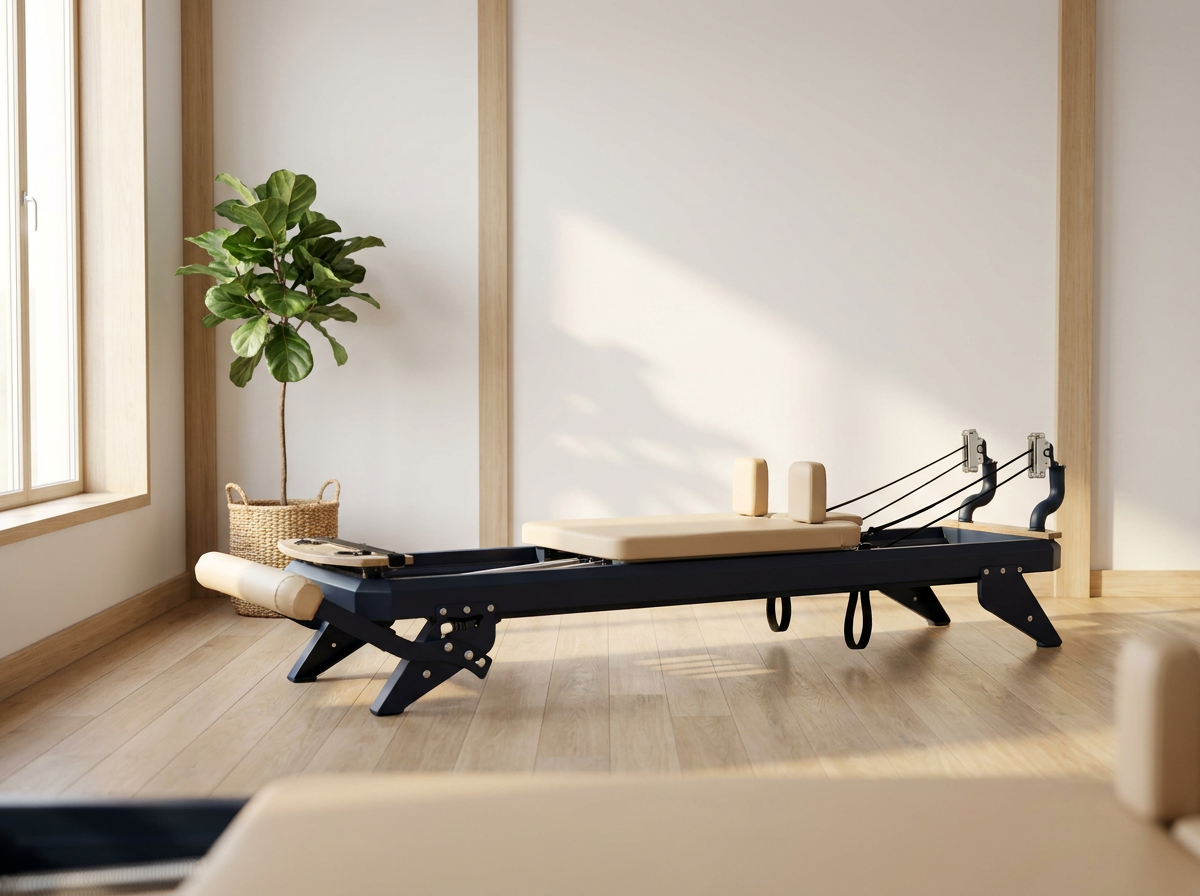
A single reformer is approximately 2.4 meters long and just over 0.6 meters wide. However, that's not all: Trainees step onto it from the side, perform exercises next to the machine, and need safety distance from their neighbor. In practice, a footprint of about 3.5 × 2.5 meters – roughly 8–9 m² – has proven effective per station. This includes movement space and a narrow aisle.
For quick calculation, the rule of thumb is: Usable training area divided by 8.5 m² gives the maximum number of reformers. A room with 60 m² of pure training area can thus accommodate about six to seven reformers – plus reception, changing rooms, and storage, which must be calculated separately. It's better to plan a bit more generously: equipment that is too closely spaced can feel cramped during a trial session and cost you memberships.
Floor Plan Principles for Smooth Class Flow
Three layout rules have proven successful in functional studios:
1. Equipment against the walls, center clear
When reformers are placed along the walls, a clear space is created in the center, allowing instructors to quickly reach every spot. This shortens distances, increases safety, and makes corrections easier during class.
2. Plan sightlines
The instructor must have all participants in view simultaneously. Avoid pillars or partition walls that obstruct sightlines – this is a safety factor, especially during spring changes and reconfigurations.
3. Hybrid zones for increased utilization
A small mat zone next to the reformers allows for circuit formats: one part of the group trains on the reformer, the other on a mat or tower and then switches. This way, you can teach larger groups without needing a dedicated machine for each person – a direct lever for profitability.
4. Consider flooring, structural integrity, and acoustics
Steel-framed reformers are heavy, and the floor must be able to support this weight permanently – in old buildings, it's worth checking the structural integrity. Durable, non-slip flooring protects against scratches and facilitates daily cleaning, while soundproofing on walls and ceilings keeps class flow calm. Especially in mixed-use buildings, acoustics determine whether you can teach early mornings and late evenings – a point that directly affects usable class times and thus revenue.
Capacity is Revenue per Square Meter
In a studio, the square meter rent is fixed – so utilization determines profitability. Two levers are particularly effective: the number of simultaneously usable stations and the versatility per station. This is precisely where reformer-with-tower combinations excel: an attached or wall-mounted tower expands the exercise repertoire (standing spring work, push-through bar, leg springs) without the station occupying more floor space. This allows you to sell more demanding formats within the same area.
Do a quick rough calculation: Six stations, four classes per day, an average of five paying spots – that's 120 occupied spots daily. Just one euro more contribution margin per spot adds up to a four-figure amount over the year. Therefore, equipment selection is not just a matter of comfort but a business decision. Investing in durable stations also protects utilization: any unplanned downtime of equipment means canceled classes and disappointed members.
Studio Equipment: These Criteria are Decisive
Not all reformers are created equal. For continuous studio operation, different things matter than for a home living room. Evaluate equipment based on these five criteria – regardless of brand:
| Criterion | Steel Frame | Wood Frame | Aluminum Frame |
|---|---|---|---|
| Stability under continuous load | Very high | High (connections can loosen) | Medium |
| Maintenance and failure risk | Low | Medium (wood care needed) | Medium |
| Appearance / Feel-good factor | Modern, clear | Warm, classic | Technical |
| Weight / Mobility | Higher | Medium | Low |
| Suitability for high-frequency studio | Very good | Good | Limited |
Two more practical points: First, quick spring and rope adjustments, along with removable shoulder pads, save several minutes of setup time per class – minutes you invest in teaching instead of logistics, and which also increase safety. Second, purely screen-guided concepts engage members less than community formats led by instructors; personal contact remains the strongest lever against cancellations. So, plan your studio around people and class flow, not around displays.
Our Recommendation: Hegren as a Studio Hero
If you combine these criteria – durability, safety, capacity, and total cost of ownership – our recommendation for professional continuous operation goes to Hegren reformers. The TALMA 62 features a steel frame, a 5-spring system, and 245 cm carriage length, is "Made in Greece," and designed for everyday studio use. Important: it's about suitability based on objective criteria, not devaluing other providers – every material has its justification.
| Hegren Model | Construction | Price (from) | Studio Advantage |
|---|---|---|---|
| TALMA 62 | Reformer, steel frame, 5 springs | €3,500 | Robust all-rounder for continuous operation |
| TALMA 62 Black Elegance | Reformer, design edition | €3,100 | Premium look for boutique studios |
| TALMA 62CT+ Combo | Reformer + Convertible Tower | €4,280 | More formats on the same footprint |
| TALMA 62CH Chair | Pilates Chair, compact | €2,083 | Supplementary station for personal training |
For maximum capacity in a confined space, the TALMA 62CT+ Combo of reformer and tower is the most economically interesting choice: it provides the full tower repertoire without occupying a second station. If you also offer classic Cadillac or Trapeze work, the Hegren range includes suitable combo units. You can see the entire selection of studio reformers in the Pilates Reformers category; we bundle tower and Cadillac systems under Cadillac & Trapeze.
Buying Guide and Next Steps
Before you order, an honest assessment of your needs is worthwhile: How many spots do you want to offer per class, what formats are you planning, and what does the actual training area look like after deducting reception and storage? This will determine the quantity – and whether pure reformers or reformer-plus-tower is more sensible. As an authorized Hegren dealer with a full manufacturer's warranty, we advise you on equipment specifics, plan the layout with you if desired, and organize delivery and assembly. Over 5,000 customers already trust Kraftathlet, and our studio clients rate us with an average of ★ 4.88/5.
You can find more about model selection, springs, and procurement in our detailed guide Buying a Pilates Reformer: What Studios Should Look For.
Common Mistakes in Studio Planning
Equipment placed too close together. Filling every square meter with reformers is saving in the wrong place: cramped spaces look unprofessional and cost you trial class conversions.
Planning class format after purchase. First the format (private, duet, group, circuit), then the number of machines – not the other way around.
Underestimating operating costs. A cheap machine that rattles or breaks down after 18 months is more expensive than a durable reformer – downtime means lost revenue.
Ignoring setup times. Seconds per spring change add up over hundreds of hours. Fast adjustment systems pay off in class flow.
Frequently Asked Questions
How many reformers fit per square meter?
As a planning value, approximately one reformer per 8–9 m² of usable training area – including movement space and safety distance – is considered. Reception, changing rooms, and storage are extra.
Which reformer is best suited for a studio?
In continuous operation, stability, safety, and low operating costs are important. A steel-frame reformer like the Hegren TALMA 62 is particularly well-suited for this; however, the choice always depends on your criteria and concept.
Is a reformer with a tower worthwhile?
For studios, often yes: a tower expands the range of exercises without occupying additional floor space. This increases versatility per station and thus potential revenue per square meter.
How large does the area for a small studio need to be?
With about 60 m² of pure training space, six to seven reformers can be operated. For a boutique concept with duet and small groups, often 40–50 m² is sufficient.
Can I combine reformer and mat Pilates?
Yes, and it is even economically smart. Hybrid zones with circuit formats utilize the space better because not every person occupies a machine simultaneously.
Conclusion
A successful Pilates studio starts on the drawing board: calculate 8–9 m² per reformer, place equipment against the walls, keep the center clear, and plan hybrid zones for increased utilization. When it comes to equipment, durability, safety, and total cost of ownership are decisive – criteria that speak for robust steel-frame reformers like the Hegren TALMA 62. Talk to our studio team: We will calculate your floor plan and the appropriate number of machines together – honestly and tailored to your concept.