

Summary
- Yes, you can combine yoga and Pilates – they complement each other: Pilates builds core strength and control, Yoga brings mobility, breathing, and calmness. Together, they meet a broader customer need.
- For studios, the lever is utilization per m²: those who offer both formats on flexibly convertible reformer equipment fill more class spots on the same floor space.
- The equipment determines the class flow. Look for steel frames (durability), quick spring/rope adjustment, removable shoulder rests, and an optional tower for versatility.
- Recommended studio base: Hegren TALMA 62 (steel, 5 springs, 245 cm, from €3,500), the 62CT+ Combo with tower (from €4,280) for maximum format variety.
Combining Yoga and Pilates: The Studio Guide for Format and Equipment
Yes – yoga and Pilates can be excellently combined, and for a studio, this is often the smartest growth step. The two disciplines do not compete; they complement each other: Pilates teaches core strength, stability, and controlled movement, while yoga adds flexibility, breathwork, and mental recovery. The market supports you: According to the DSSV key figures for the German fitness industry, German facilities reached a peak of around 12.36 million members by the end of 2025, and course-based formats such as Pilates – including the rapidly growing variant of standing Pilates – attract new target groups well into the 60+ generation.
The crucial question, therefore, is not whether, but how you combine both – and on which equipment. This guide shows you the formats and equipment criteria that determine class flow, utilization, and profitability.
Why Yoga and Pilates Belong Together
Both methods share the same core: conscious movement, breathing, and body awareness. Pilates works more with resistance and repeatability – the reformer makes strength measurable and progressively controllable. Yoga works more with one's own body weight, with holding and stretching. For your clients, the combination means: strength and mobility, tension and relaxation – in one place.
The evidence also supports the combination. A Cochrane Review on yoga for chronic, non-specific low back pain concludes that yoga probably improves back function and is comparable in its effects to physiotherapy – with generally few side effects. Reformer Pilates, in turn, is known for targeted core and strength building. Offering both appeals to both rehabilitation-oriented and performance-oriented clientele.
Three Models to Integrate Yoga into a Pilates Studio
You don't have to rebuild everything at once. There are three proven ways:
1. Dedicated Yoga Slots in Existing Space
The easiest entry: You schedule yoga classes during off-peak hours when the reformers are not in use, and utilize the same space with mats. Low investment, quick demand testing. Requires a floor and room acoustics that work for both.
2. Hybrid Classes on the Reformer
More demanding, but differentiating: You combine Reformer Pilates sequences with yoga-inspired flows and breathwork. Here, equipment that can be reconfigured in seconds pays off – otherwise, the flow of the class is disrupted by changeover breaks.
3. Multi-Format Studio with Tower
The expansion stage: A reformer with an attachable or wall-mounted tower expands the repertoire with spring-based exercises performed standing and sitting – ideal for bundling yoga elements, standing Pilates, and classic reformer training into one piece of equipment. This way, you offer more formats on the same floor space.
The Real Bottleneck is the Equipment: Utilization and Revenue per m²
In a studio, a concept becomes profitable through utilization per square meter. Every reformer spot that remains empty due to a defect or cumbersome conversion costs you money. Therefore, acquisition costs alone are not decisive, but the Total Cost of Ownership (TCO) over several years: durability, downtime, serviceability, and how many different classes a piece of equipment can support.
When selecting equipment, a few clear criteria help – formulated as what you should look for, not as a devaluation of individual providers:
| Criterion | What to look for | Why it matters in studio operation |
|---|---|---|
| Frame material | Solid steel frame instead of wood or aluminum construction | Wood joints can loosen under continuous load, aluminum is less rigid under high loads – steel reduces downtime |
| Adjustability | Quick spring and rope adjustment, clear markings | Saves minutes per class and maintains class flow |
| Safety | Removable shoulder rests, smoothly running carriage | Less setup time, safer exercise changes, less risk of injury |
| Versatility | Option for tower, jumpboard, sitting box | More formats (yoga, standing Pilates, cardio) on one piece of equipment |
| Operating concept | Instructor-led rather than purely screen-led | Personal guidance and community bind members more strongly |
A note on the last point: Purely screen-led 24/7 models may seem cheap, but in practice often lead to higher churn because personal instruction and a sense of community are missing. Those who rely on instructor-led classes build loyalty – and loyalty is the most important revenue driver in studio operations.
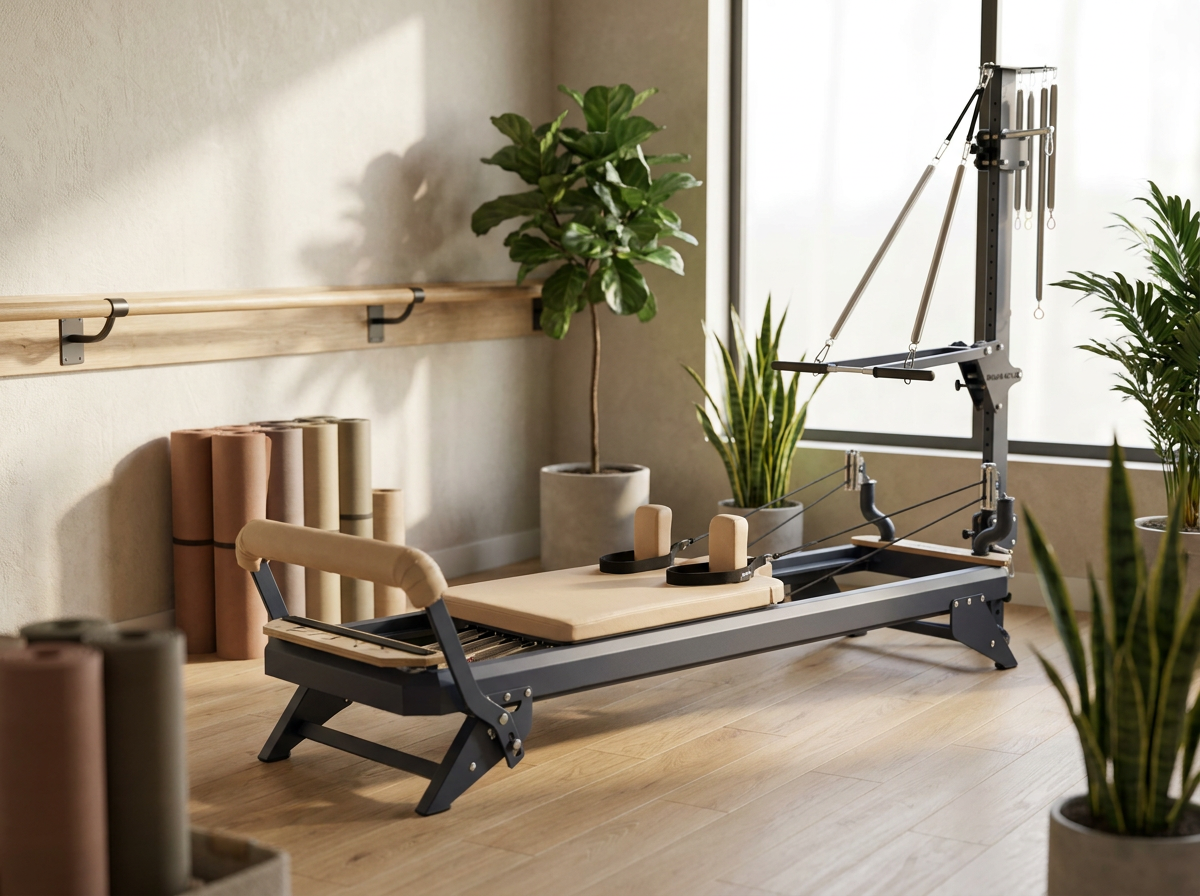
Hegren as a Studio Base: Recommended Models
For a studio that wants to permanently combine yoga and Pilates, we recommend Hegren reformers as a base. They are manufactured in Greece, feature a steel frame, and are designed for continuous operation in professional studios.
| Model | Brief Profile | Price from | Ideal for |
|---|---|---|---|
| Hegren TALMA 62 | Premium studio reformer, steel frame, 5-spring system, 245 cm | €3,500 | Studios looking for a durable standard base |
| TALMA 62 Black Elegance | Design variant of the TALMA 62 for premium studios | €3,100 | Boutique studios focusing on aesthetics |
| TALMA 62CT+ Combo | Reformer plus Convertible Tower in one system | €4,280 | Multi-format studios (yoga, standing Pilates, reformer) |
If you want maximum format variety in one area, the 62CT+ Combo is the economically smartest choice: it combines reformer and tower, turning one equipment spot into a multi-tool for various classes. For pure, high-quality reformer operation, the TALMA 62 is a solid base.
Buying Guide: How to Make Your Decision
Plan backward from your class schedule: Which formats do you want to offer in twelve months, how many spots do you need per hour, and how quickly must changes be made between exercises? This will determine the quantity and whether you need tower systems. Kraftathlet, as an authorized dealer with full manufacturer's warranty, advises you on studio planning, delivery, and setup – including 0% financing via Klarna, so the investment fits your cash flow. Browse the Hegren Pilates collection, an overview of all Pilates reformers and suitable Pilates accessories.
Common Mistakes When Combining Yoga and Pilates
- Format without equipment strategy. Hybrid classes fail if changes between exercises break the flow. Quick adjustability is a must.
- Only looking at the purchase price. A cheap reformer that breaks down after 18 months costs more in TCO than a durable steel unit.
- Underestimating versatility. Without a tower option, you're limited to a few formats and miss out on utilization.
- Relying entirely on screens. Purely screen-led concepts save on staff but increase churn. Community is built by people.
- Forgetting room acoustics and flooring. Yoga needs calm, Pilates needs stability – the room must provide both.
Frequently Asked Questions
Can yoga and Pilates really be effectively combined?
Yes. Pilates builds strength and control, while yoga adds mobility, breathing, and recovery. For clients, this creates a more complete offering, and for the studio, better utilization of space.
Do I need special equipment to combine them?
For pure yoga slots, mats are sufficient. As soon as you offer hybrid or reformer classes, equipment with quick adjustment and an optional tower is beneficial – allowing you to run multiple formats on one piece of equipment without long changeover breaks.
Why a steel frame instead of wood or aluminum?
For continuous operation, durability matters. Wood joints can loosen under constant load, and aluminum is less rigid. A steel frame like the Hegren TALMA 62 reduces downtime and thus empty class spots.
Which Hegren reformer is suitable for a multi-format studio?
The TALMA 62CT+ Combo, because it combines reformer and tower, enabling yoga, standing Pilates, and classic reformer formats in one equipment spot. For pure reformer operation, the TALMA 62 is a solid base.
Is the investment worthwhile for a small studio?
Especially there, because every square footage counts. A durable, versatile piece of equipment increases the number of formats that can be offered and utilization – both significantly improve revenue per square meter.
Conclusion: Concept First, Then Equipment
Combining yoga and Pilates is not a compromise, but an expansion of your offerings on the same floor space. Success depends on two things: a well-thought-out format and equipment that supports class flow and lasts for years. Those who opt for a durable steel reformer with a tower option lay the foundation for a multi-format studio with high utilization. Want to calculate your concept and the right number of units? Talk to our studio experts – we'll plan your setup together.
Sources: DSSV – Key Figures of the German Fitness Industry; Cochrane Review – Yoga for Chronic Low Back Pain.