

Summary
- Pilates is well-supported by science: A meta-analysis of 19 randomized studies with 1,108 patients (2023) shows significant improvements in chronic back pain and function.
- The effect is achieved through targeted core and deep muscle activation and controlled, joint-friendly movements – not through esotericism.
- For studios, equipment selection is crucial: steel frames, spring systems, and upgradeability determine durability, class size, and revenue per square meter.
- Our recommendation for professional studios is the Hegren TALMA 62 (steel frame, 5-spring system, Made in Greece) – durable and studio-ready.
Pilates Science: What Studies Really Show – and What Studios Should Look For
Pilates is not a wellness trend without substance: A 2023 meta-analysis, which evaluated 19 randomized controlled trials with 1,108 patients, found significant improvements in pain and physical function for individuals with chronic back pain. This makes Pilates one of the best-researched forms of exercise for core stability and back health. In this article, we separate evidence from myths – and show why the choice of reformer is a business decision for studios.
The method dates back to Joseph Pilates, who developed it as "Contrology" in the 1920s. His approach: movement from the body's center, precisely controlled and connected with breath. Today, a growing body of research supports it. Let's look at what this research specifically says.
What the Studies Show
Back Pain and Function
The strongest evidence lies in the area of chronic non-specific back pain. Several systematic reviews – including the aforementioned meta-analysis, accessible via PubMed – conclude that Pilates significantly reduces pain and disability compared to usual care. Pilates is at least as effective as other similarly dosed exercise programs and better than no exercise.
Core Strength and Deep Muscles
Pilates specifically activates the deep abdominal and back muscles – the so-called "Powerhouse." Studies using ultrasound measurements of muscle thickness show that Pilates effectively strengthens the core muscles. These deep muscles stabilize the spine in everyday life and during sports, acting like a natural corset.
Posture, Balance, and Flexibility
Further studies indicate improvements in balance, flexibility, and posture – particularly relevant for older adults and in rehabilitation. The reformer, with its resistance and spring system, allows for precisely adjustable, joint-friendly loading that is not possible on the mat.
Fascia and Mobility
A frequently mentioned term is "fascial Pilates." Fascia is the connective tissue network that surrounds muscles and organs. Slow, stretching, and rebounding movements – as enabled by the reformer – can support the gliding ability of this tissue and improve body awareness. Fascia research is newer than research on back pain, but Pilates' controlled, three-dimensional movement approach aligns well with what is considered fascia-friendly.
Myths vs. Evidence
| Claim | What Science Says |
|---|---|
| "Pilates burns a lot of calories" | Moderately – the benefit lies in strength, stability, and posture, not primarily in calorie expenditure. |
| "Pilates replaces strength training" | Complements it. For maximum hypertrophy, progressive strength training is superior. |
| "Pilates helps with back pain" | Well-proven – significant reduction in pain and disability. |
| "Reformer is only for professionals" | No – due to adjustable resistance, it is particularly beginner- and rehab-friendly. |
Who is Pilates particularly suitable for?
Precisely because the load can be so finely controlled, Pilates reaches a broad audience. People with back pain benefit from the targeted stabilization of the deep muscles. Office workers with tension and poor posture find a balance to their prolonged sitting. In rehabilitation after injuries, the reformer enables controlled, supported movements long before free training is possible. Pregnant women and older adults appreciate the joint-friendly execution. And even competitive athletes use Pilates as a supplement to improve core stability, body control, and flexibility. This breadth is economically attractive for studios because it addresses many target groups simultaneously.
From Effect to Studio: Why the Equipment Decides Success
If the effect is scientifically established, the decisive question for studio operators shifts: With which reformer can this effect be offered reliably, safely, and economically? From hundreds of conversations with studio and physio operators, five criteria emerge – deliberately formulated in a brand-neutral way.
1. Frame Material: Steel, Wood, or Aluminum
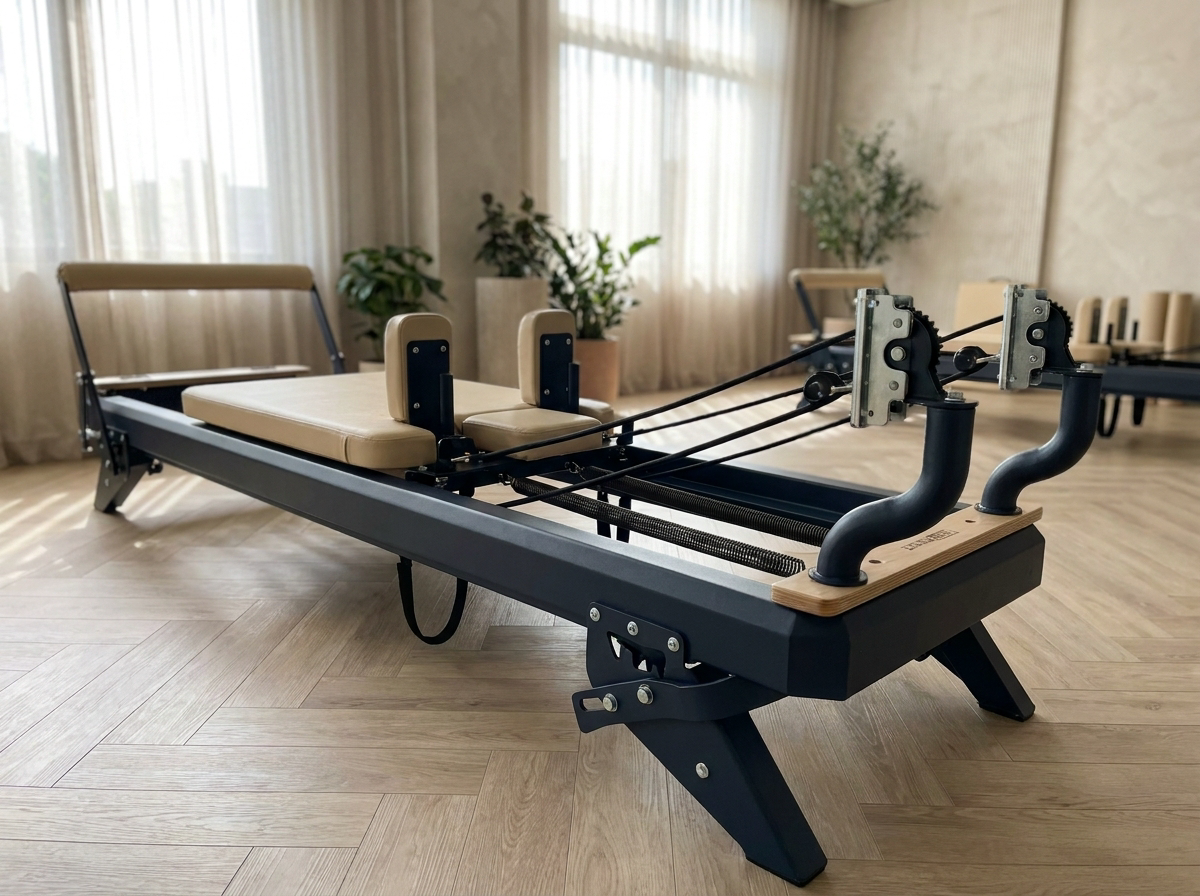
A reformer in studio operation is subjected to heavy daily use. Steel frames remain dimensionally stable for years. Wooden frames are optically popular, but their connections can loosen under continuous load; aluminum is light, but less stable under high load. For intensive class operation, a steel frame is the most robust choice.
2. Capacity & Revenue per Square Meter
A studio's profitability is directly linked to the number of spots per area. Separate reformers combined with wall-mounted or attachable towers can be arranged more flexibly than integrated monoblock solutions – this increases the possible class size and thus revenue per m².
3. Safety = Class Flow
Removable shoulder rests and quick rope and spring adjustments save seconds per transition – minutes over an entire class. This maintains flow and reduces the risk of injury during quick changes.
4. Screen-guided vs. Instructor-led
Fully automatic, screen-guided 24/7 concepts sound efficient but often lead to higher churn rates. Instructor-led classes build community and retention – the strongest lever against member churn.
5. Total Cost of Ownership (TCO)
A cheap reformer that breaks down after 18 months ultimately costs more than a durable steel reformer. Factor in not just the purchase price, but also downtime, repairs, and replacement costs.
Buyer's Guide: Our Recommendation for Professional Studios
Based on these criteria, we recommend the Hegren TALMA 62 for demanding studio operations: steel frame, 5-spring system, 245 cm length, A-class upholstery, Made in Greece. It is designed for continuous use and can be modularly expanded.
| Model | Special Feature | Price | Ideal For |
|---|---|---|---|
| Hegren TALMA 62 | Steel frame, 5-spring system, 245 cm | €3,500 | Studio standard, continuous operation |
| TALMA 62 Black Elegance | Black design variant | €3,100 | Boutique & Luxury Studios |
| TALMA 62CT+ Combo | Reformer + Convertible Tower | €4,280 | Maximum exercise variety in one area |
You can find the complete selection in our collection Hegren Pilates. If you want to compare models from different manufacturers, check out the overview of all Pilates Reformers; suitable boxes, straps, and springs are available in the Premium Pilates Accessories. We supply all equipment as an authorized dealer with full manufacturer's warranty – currently with an average customer rating of ★ 4.88/5.
Properly Dosing Reformer Training
The biggest advantage of the reformer over mat training is the finely graduated resistance control via the spring system. However, this is also an art: more springs do not automatically mean a harder workout. For some exercises, higher resistance supports the movement and makes it easier, while for others it makes it more difficult. Good instructors therefore adjust the spring configuration per exercise and per participant – another argument for a precise, quickly adjustable system like the TALMA 62. For beginners, it is advisable to start with controlled, clean technique at moderate resistance and gradually increase the intensity. This keeps the load joint-friendly, the training stimulus targets the deep muscles, and the risk of injury remains low. For studios, this in turn means that a device that can be adjusted in seconds keeps mixed classes with different performance levels flowing smoothly and safely.
Common Mistakes in Pilates & Reformer Selection
Only looking at the price. The cheapest reformer often becomes the most expensive decision in class operation. Lifespan and downtime count more.
Neglecting breathing and control. Pilates works through controlled, conscious movement. Those who rush lose the actual effect on the deep muscles.
Selling the reformer as a "strength training substitute." Both complement each other – honest communication creates more satisfied members.
Underestimating space requirements. Plan movement space around each piece of equipment, otherwise safety and class size will suffer.
Frequently Asked Questions
Is Pilates scientifically proven?
Yes. Especially for chronic back pain, the evidence is solid: A meta-analysis of 19 randomized studies with 1,108 patients showed significant improvements in pain and function. Positive findings also exist for core strength and balance.
Which reformer is best for a studio?
For continuous operation, we recommend a steel-frame reformer with a precise spring system and expansion options. The Hegren TALMA 62 (€3,500) meets these criteria and is designed for high utilization.
What is the difference between reformer and mat training?
The reformer offers adjustable resistance and support through its spring and carriage system. This makes exercises more joint-friendly, more precisely controllable, and often more rehab-friendly than pure mat training.
Is a reformer with a tower worth it?
For studios that need maximum exercise variety in a limited space, yes. A combo solution like the TALMA 62CT+ (€4,280) combines reformer and tower and increases the usable training variety per square meter.
How much space does a reformer need?
A TALMA 62 is 245 cm long. Plan enough movement space around it – as a rule of thumb, at least a good meter on the sides for safe entry and exit as well as transitions.
Conclusion
Pilates is more than a trend: The evidence for back health and core stability is robust, and its broad suitability – from rehab to office posture to competitive sports – makes it economically attractive for studios. For implementation, the decisive question thus shifts to the right equipment – and here, steel frames, spring systems, expandability, and total cost of ownership matter more than the pure purchase price. With a durable reformer like the Hegren TALMA 62, you build an offering that your members will feel and that will economically support your business.
Are you planning a studio or looking to upgrade? Speak to our team – we will advise you based on criteria for the right equipment for your space and concept.