

Abstract
- As a beginner, you'll build muscle the fastest if you train your entire body 2–3 times a week using basic exercises—not with a split routine.
- Focus on a few major exercises: squats, deadlifts, presses, and pulls. Form over weight.
- Progress comes from gradual increases —a few more reps or a little more weight each week.
- To get started, all you need are adjustable dumbbells, a weight bench, and some space. You don't need expensive equipment at first.
Strength Training for Beginners: A Complete Guide with a Workout Plan
As a beginner, you’ll make the most progress if you work out your entire body two to three times a week, focusing on just a few major compound exercises. It’s during those first few months that your body responds most strongly to the new stimulus—you’ll quickly become stronger, more coordinated, and visibly more defined, without complicated plans or expensive equipment.
This guide walks you through, step by step, how often you should work out, which exercises really make a difference, what your first workout plan should look like, and what equipment you’ll need to get started. It’s intentionally kept simple: Doing less, but doing it right, is better than any elaborate professional program when you’re just starting out.
Why Strength Training—Even for Complete Beginners
Strength training is no longer just for bodybuilders. In its physical activity guidelines for adults, the World Health Organization explicitly recommends muscle-strengthening activities at least two days a week —in addition to endurance exercise. The reason: Muscles support joints, keep the metabolism active, protect against back pain, and help maintain independence as we age.
For you as a beginner, this means you’re not just working out to look good, but to build a body that can handle the demands of everyday life. And because your nervous system adapts quickly at the beginning, you’ll often feel significantly stronger after just a few weeks—an effect that’s highly motivating and makes it easier to stick with it.
How many times a week should you work out as a beginner?
For beginners, two to three full-body workouts per week are the gold standard. This recommendation aligns with the guidelines of the American College of Sports Medicine (ACSM), which recommends full-body workouts for beginners with at least one rest day in between each session. The advantage over a split routine (where you train different body parts on different days) is that each muscle group receives two to three training stimuli per week instead of just one—and it is precisely this frequency that drives muscle growth in beginners.
Rest is important. There should be about 48 hours between two workouts targeting the same muscle group. A tried-and-true schedule is Monday, Wednesday, Friday—or, for two workouts, Tuesday and Friday. More isn’t better when you’re just starting out; muscles grow during rest, not during training.
| Training Days per Week | For whom | Structure |
|---|---|---|
| 2× Full-Body | Little time, a complete fresh start | e.g., Tue + Fri |
| 3× Full-Body | Standard Recommendation for Beginners | Mon + Wed + Fri |
| 4× Upper Body/Lower Body | It only makes sense after a few months | Split Later |
The Most Important Basic Exercises for Beginners
Your body doesn't recognize machines—only movement patterns. That's why you should structure your workout around six major movement patterns: squats (crouching), hip extensions (lifting), horizontal and vertical pushing, and horizontal and vertical pulling. These compound exercises work multiple muscle groups at once, burn a lot of energy, and give you the greatest return for every minute you invest.
| Exercise | Focuses primarily on | Beginner's Version |
|---|---|---|
| Squat | Legs, Buttocks, Torso | Goblet Squat with a Dumbbell |
| Deadlift / Hip Thrust | Back, Glutes, Hamstrings | Romanian Deadlift with Dumbbells |
| Bench Press / Push-ups | Chest, Shoulders, Triceps | Dumbbell Bench Press on a Weight Bench |
| Shoulder Press | Shoulders, Triceps | Seated Dumbbell Press |
| Rowing | Upper back, biceps | One-Arm Dumbbell Row |
| Pull-up / Lat Pull-down | Latissimus, Biceps | Assisted pull-ups or lat pulldowns |
When you're just starting out, proper form is more important than the weight. Choose a weight that allows you to perform 8 to 12 controlled repetitions, with the last one still being technically sound. Learning the movements correctly from the start helps prevent injuries and lays the foundation for everything that comes later.
Your First Workout Plan: Full-Body, 3 Times a Week
Keep the plan simple and repeat it on all three days: one squat variation, one hip extension variation, one pushing exercise, one pulling exercise, and one core exercise. Aim for three sets per exercise with 8 to 12 repetitions. Rest for one to two minutes between sets. You’ll find a detailed, ready-to-use template in our full-body workout plan for 3 times a week. If you want to increase the volume later on, a push-pull-legs plan is the logical next step.
Start each session with a five- to ten-minute light warm-up and one or two light warm-up sets of the first exercise. This will prepare your joints and nervous system and significantly reduce your risk of injury.
Progressive Overload: The Engine of Your Progress
The most important principle in strength training is progressive overload: Your body will only adapt if the stimulus increases over time. In practice, this means pushing yourself a little further each time—one more rep, half a kilo more, or a cleaner form than the week before. Keep track of your sets, reps, and weights so you can actually see this progress and manage it effectively.
We explain in detail how to do this systematically without overdoing it in the article “Progressive Overload Explained.” As a rule of thumb: If you can cleanly complete the upper end of your rep range on all sets, increase the weight slightly next time.
Gear for Beginners: What You Really Need
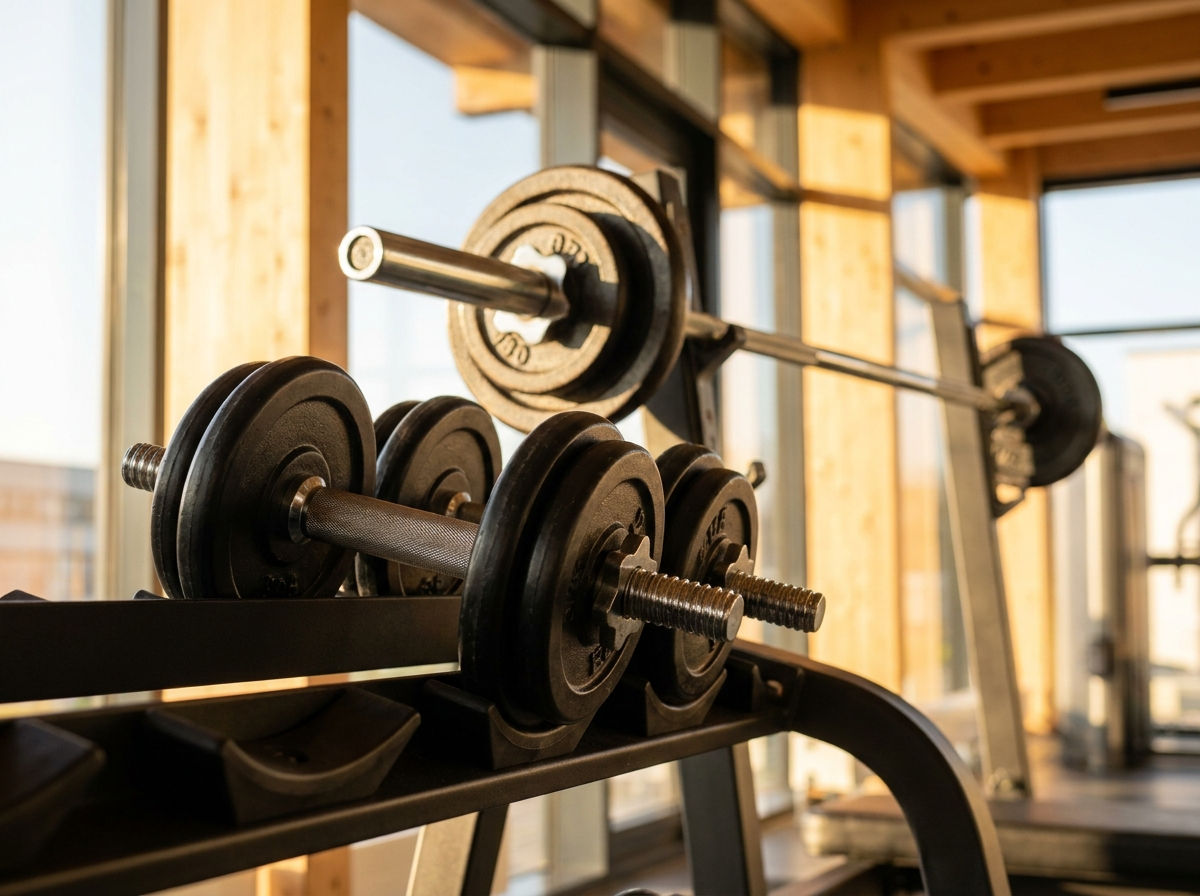
You can get started with surprisingly little. A pair of adjustable dumbbells, a sturdy weight bench, and some floor space are all you need to cover almost all the basic exercises. Adjustable dumbbells save space and grow with your strength—which is why they’re usually the best first investment for beginners. You’ll find an overview of suitable models in our Dumbbells and Barbells & Kettlebells collections; the entire lineup is available under Strength Training.
| Equipment | Priority | Why |
|---|---|---|
| Adjustable Dumbbells | High | Cover almost all basic exercises, grow with you |
| Adjustable Weight Bench | High | Makes push-up and rowing exercises possible in the first place |
| Pull-up bar / Resistance band | Medium | For vertical pulls and back exercises |
| Barbell & Rack | Later | This makes sense as you get heavier and more ambitious |
When making a purchase, prioritize stability and durable construction over the lowest price—good dumbbells and a sturdy bench will last you for years. At Kraftathlet , you can shop conveniently with installment payments via PayPal or leasing for business customers, and you’ll benefit from a 30-day return policy in case a piece of equipment doesn’t fit your space after all. Not sure what fits your space and budget? Our team will be happy to advise you personally.
Common Mistakes Made by Beginners
The biggest mistake is impatience: too much weight, too many exercises, too many training days—and after three weeks, you’ve lost your motivation or your back is acting up. Other common pitfalls:
- Skip the technical details: Master the movement pattern first, then add weight.
- No plan, no log: If you don't keep track, you can't improve, and you'll often end up going in circles.
- Underestimating recovery: Sleep and breaks are part of training, not the opposite of it.
- Forgot about nutrition? Without enough protein, your muscles lack the building blocks they need—you can find tips on this under “What to Eat After Strength Training.”
- Focus on isolation exercises: Bicep curls are fine, but the big compound exercises are what drive progress.
Frequently Asked Questions
How quickly can a beginner see results from strength training?
You’ll often start to notice an increase in strength after just two to four weeks, because your nervous system adapts first. Visible muscle growth usually takes a little longer, but with regular training and a healthy diet, it becomes noticeable after a few weeks to a few months.
As a beginner, should I train with machines or free weights?
Both work. Free weights, such as dumbbells, also help improve coordination and core stability, while machines guide the movement more precisely. For home use, adjustable dumbbells and a bench are the most flexible and space-saving solution.
How many sets and repetitions are recommended when you're just starting out?
Three sets per exercise with 8 to 12 repetitions is a proven starting point for building muscle. Choose a weight that makes the last few repetitions challenging but still technically sound.
Do I have to work out every day to make progress?
No. Two to three full-body workouts per week are more than enough for beginners. Muscles grow during rest periods—training the same way every day actually slows down your progress.
Is strength training still beneficial after age 40?
Absolutely. Especially after age 40, strength training helps maintain muscle mass and bone density. To learn how to get started at this age, check out our guide, “Strength Training After 40.”
Conclusion
Strength training for beginners is easier than it looks from the outside: Work out your whole body two to three times a week, focus on a few major compound exercises, increase your intensity in small steps, and give yourself time to truly recover. With a solid set of basic equipment—adjustable dumbbells and a sturdy bench—you’ll have everything you need at home for the first few months.
Want to know what gear is right for your space, goals, and budget? Contact our team —we'll help you get started with the right setup instead of buying expensive equipment that will just gather dust later on.