

Leg Workout: Exercises, Technique, and Muscles for Strong Legs
A good leg workout hinges on two basic exercises—the squat and a hip-dominant movement such as the deadlift or hip thrust—supplemented by targeted machines for the quadriceps, hamstrings, and calves. The legs are the largest muscle group in your body, and if you train them consistently, you’ll not only build visible muscle but also improve your strength, stability, and overall metabolism.
- The two basics—a knee-dominant exercise (squat) plus a hip-dominant exercise (Romanian deadlift or hip thrust)—cover most of the leg muscles.
- The quadriceps is the primary muscle involved in the squat and, according to EMG studies, reaches about 60–80% of its maximum activation; the deeper you go, the harder the glutes work as well.
- Machines such as the leg press, leg extension, and leg curl are ideal for safely and specifically targeting individual muscles—especially for beginners.
- Two well-planned leg workouts per week are enough for most people. Progress comes from gradually increasing the intensity, not from endless sets.
Why Leg Training Is the Foundation of Every Workout Plan
If you could only train one part of your body, it would be your legs. The thighs and glutes are among the strongest and most metabolically active muscles in the body. A well-designed leg workout improves your vertical jump, running efficiency, and stability in nearly every everyday and athletic movement. At the same time, heavy compound exercises for the legs provide a powerful growth stimulus for the entire body.
The mistake many exercisers make: They prioritize the chest, arms, and abs—and treat the legs as an afterthought. This leads to muscular imbalances, unstable knees, and an upper body that eventually becomes visually and functionally out of proportion. Those who take their legs seriously lay the foundation for long-term progress.
For gyms and fitness studios: Strength training machines for gyms.
Which Muscles Are Targeted During Leg Workouts
The leg muscles consist of several major groups that you should target specifically:
- Quadriceps (four-headed thigh extensor): extends the knee and is the primary muscle involved in squats, leg presses, and lunges. According to EMG studies, it reaches a large portion of its maximum activation during squats.
- Hamstrings (leg flexors): flex the knee and extend the hip. They are primarily engaged during hip-dominant exercises such as the Romanian deadlift and the lying leg curl.
- Gluteal muscles (gluteus): the strongest hip extensors. They are particularly engaged during deep squats, hip thrusts, and lunges.
- Adductors (inner side) and abductors (outer side): stabilize the pelvis and knee position—often underestimated, but important for proper technique.
- Calf muscles: extend the ankle joint and provide stability with every step. They benefit from targeted calf raises.
A balanced leg workout targets both the extensor and flexor chains. If you only do squats, you often don’t work your hamstrings enough—which is why you should always include a hip-dominant exercise.
An Overview of the Most Important Leg Exercises
These exercises form the backbone of any solid leg routine. You don't need to do them all at once—two to four well-chosen exercises per session are enough.
| Exercise | Primary muscle | Equipment | Level |
|---|---|---|---|
| Squat | Quadriceps, gluteus | Barbell, Rack | All |
| Romanian Deadlift | Hamstrings, Glutes | Barbell or dumbbells | Advanced |
| Leg Press | Quadriceps, gluteus | Machine | Beginners |
| Lunges | Quadriceps, gluteus | Dumbbells | All |
| Lying Leg Curl | Hamstring Muscles | Machine | Beginners |
| Calf Raises | Calf muscles | Machine or dumbbell | All |
Squats – the King of Leg Exercises
The squat is the most effective single exercise for the legs because it places a heavy load on both the quadriceps and glutes at the same time. If you’ve mastered the squat properly, you’ve already got the most important building block for strong legs. You can find detailed instructions in our guide to squat technique.
Here's how to do it
Stand with your feet hip- to shoulder-width apart, toes pointing slightly outward. Engage your core, push your hips back, and bend your knees and hips at the same time. Lower yourself until your thighs are at least parallel to the floor—deeper squats engage the glutes more intensely. Then push back up through your heels in a controlled manner. Keep your back straight the entire time, and let your knees point in the same direction as your toes.
Common Technical Errors
Your knees cave in, your heels lift off the ground, or your back rounds under the load. This is usually caused by using too much weight or a lack of flexibility. Reduce the weight until your form is correct—that’s always the fastest way to build strength.
Hip-Focused Exercises: Deadlifts and Hip Thrusts
To make sure you don’t neglect the backs of your legs, every workout plan should include a hip-dominant exercise. For the Romanian deadlift, push your hips far back, keep your knees only slightly bent, and lower the barbell close to your body until you feel a distinct stretch in the backs of your legs. The hip thrust, on the other hand, strongly isolates the glutes: With your upper back supported against a bench, powerfully push your pelvis upward.
Both exercises work the hamstrings and glutes—muscles that often don’t get enough stimulation during regular squats. This balance is crucial for strong, injury-resistant legs.
Leg Training Machines: Safe and Targeted
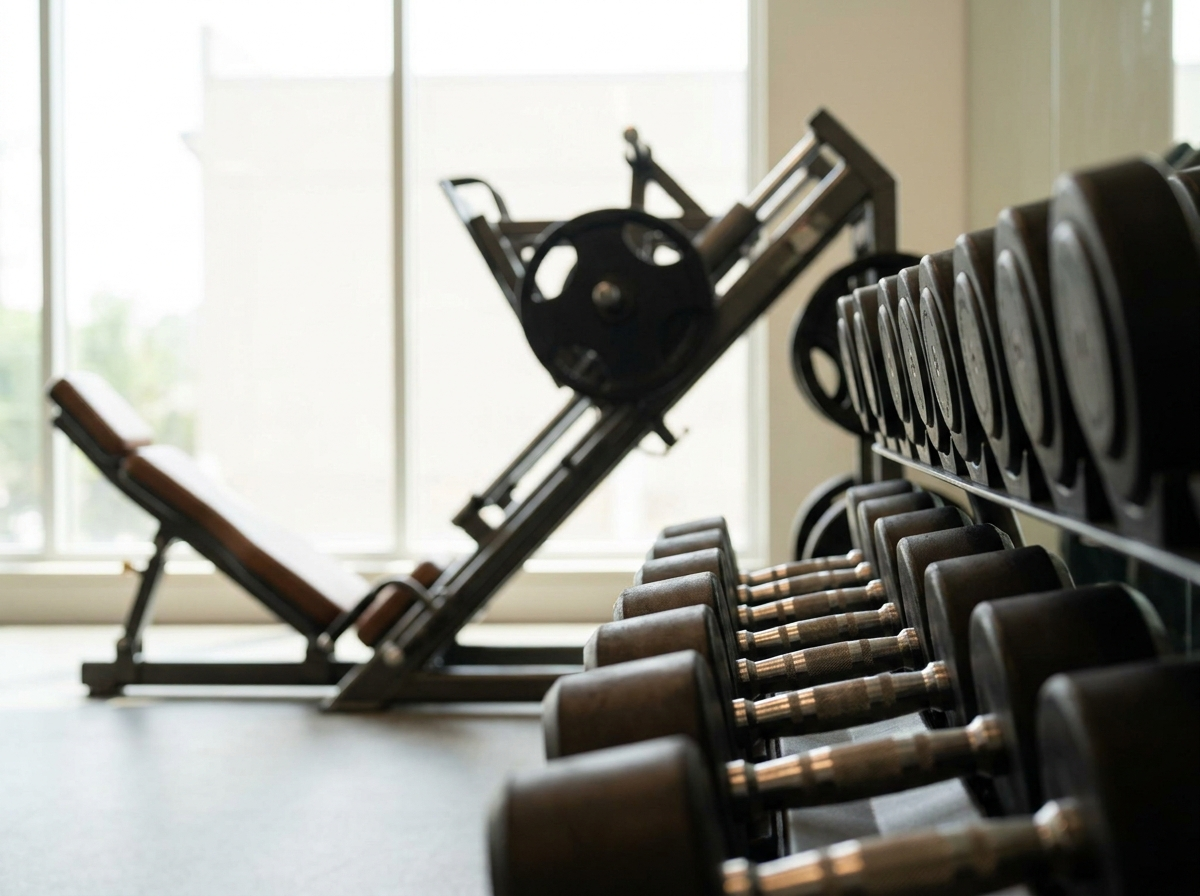
Free-weight exercises are the foundation, but machines have their place—especially for beginners and when building specific muscles. On the leg press, you can lift heavy weights with stable guidance without your core muscles limiting your movement. The leg extension machine isolates the quadriceps, while the leg curl machine targets the back of the thigh. You’ll find these machines in our selection of plate-loaded machines, whereas for free-weight exercises at home, you’ll mainly need dumbbells and a stable bench.
The advantage of machines: You can train in a controlled manner until exhaustion without your form suffering due to fatigue. For maximum stimulation, it’s best to combine both—heavy compound exercises first, then machines for targeted post-workout burning.
Sample Workout Plan for the Legs
Here's what an effective leg workout might look like. Increase the weight week by week in small increments—this principle of progressive overload is the real driving force behind your progress.
| Exercise | Sentences | Repetitions |
|---|---|---|
| Squat | 4 | 6–8 |
| Romanian Deadlift | 3 | 8–10 |
| Leg Press | 3 | 10–12 |
| Lying Leg Curl | 3 | 12–15 |
| Calf Raises | 4 | 15–20 |
According to the World Health Organization, adults should strengthen their muscles at least two days a week. For the legs, this means that two targeted workouts are enough, as long as you perform them with intensity and continuously increase the intensity.
Buying Guide: What You Need for an Effective Leg Workout
You don't need a dozen pieces of equipment for leg workouts at home or at the gym. The essentials are a sturdy squat rack with a barbell, a set of adjustable or fixed dumbbells, and—if space and budget allow—a leg press or a multi-gym with a leg curl function. You can find the complete selection in our Strength Training category.
As an authorized dealer offering a full manufacturer’s warranty and serving over 5,000 satisfied customers, we’ll give you honest advice on which setup best suits your goals and your space—instead of just trying to sell you the most expensive device. If you’re unsure, feel free to reach out to us via the Contact page.
Common Mistakes in Leg Training
- Not deep enough: Half squats don't provide enough muscle stimulation. Go as low as your flexibility allows you to do so with proper form.
- Neglecting the back of the legs: If you only do squats and leg extensions, you’ll develop imbalances. Always include a hip-dominant exercise.
- Ego Lifting: Too much weight ruins your form. Proper form trumps the numbers on the barbell.
- No Progression: Lifting the same weight all the time won't lead to progress. Systematically increase the weight, the number of reps, or the number of sets.
- Not often enough: One leg day every two weeks isn't enough. Make sure to include leg workouts in your routine just as consistently as you do for any other muscle group.
Frequently Asked Questions
How often should I work out my legs?
For most people, two leg workouts per week are ideal. This gives your muscles enough of a challenge while still allowing them enough time to recover. Beginners can start with one intense workout.
Can I do leg exercises without machines?
Yes. Squats, lunges, Romanian deadlifts, and calf raises with dumbbells or a barbell already cover all the leg muscles. Machines are a useful addition, but not a must.
Why is my muscle soreness so severe after a leg workout?
The leg muscles are large and are rarely subjected to as much strain in everyday life as they are during exercise. Severe muscle soreness is normal at first and subsides with regular exercise. It’s important to ensure proper recovery through sleep and nutrition.
Are squats bad for your knees?
When performed with proper form and at an appropriate weight, squats are safe for healthy knees and can even strengthen the structures surrounding the joint. If you have existing knee problems, you should consult a doctor before doing this exercise.
How quickly will my legs start to look more muscular?
With regular, progressive training and adequate protein intake, the first visible results usually become apparent after 8 to 12 weeks. Consistency is more important than any single workout.
Conclusion
You don’t build strong legs with dozens of exercises, but with just a few, properly executed movements: a squat, a hip-dominant exercise, and targeted machines for fine-tuning. Pay attention to form, increase the intensity systematically, and incorporate leg training into your routine as consistently as you do for any other muscle group. If you’re looking for the right equipment for your home gym or fitness center, our team will give you personalized advice —honest and tailored to your goals.