

Abstract
- For most people, an adjustable multi-bench is all you need: It handles flat, incline, and decline presses with a single piece of equipment, making it the most flexible choice for a home gym.
- The standard flat bench is the sturdiest and most affordable—ideal if you want to do heavy bench presses and don't need the incline feature.
- Pay attention to the standard class according to DIN EN ISO 20957: Class S = studio/commercial, Class H = home use only. Class S is required for studios.
- The key factors are load capacity (including one’s own body weight), fixed angle adjustment with no gaps, dense padding, and a stable base—not just the price.
Buying a Weight Bench: How to Choose the Right Flat Bench, Incline Bench, or Multi-Function Bench
For most exercisers, an adjustable multi-bench is the best choice because it allows you to perform flat, incline, and decline exercises with just one piece of equipment. On the other hand, if you want to bench press with maximum weight and don’t need the incline angles, you’re better off with a sturdy flat bench —it has fewer moving parts and wobbles the least under load.
A weight bench is the most unassuming yet most frequently used piece of equipment in the weight room: bench presses, shoulder presses, rowing, triceps, biceps—almost nothing works without a sturdy bench. That’s exactly why it’s worth taking a few minutes to consider the right criteria before making a purchase. This guide will show you the three main designs, the truly important technical features, and the mistakes most people make when buying a weight bench.
An Overview of the Three Designs
Flat Bench
The flat bench has no adjustment and therefore no gap between the seat and back cushions. This makes it the most stable and durable design—and usually the most affordable. It’s the right choice if you’re focusing on heavy flat bench presses, hip thrusts, or rowing. The downside is obvious: incline bench presses and negative exercises aren’t possible.
Incline bench (fixed or adjustable)
A fixed incline bench is set at a fixed angle, usually between 30 and 45 degrees. A moderate incline shifts the focus of the press exercise more toward the upper chest and the front of the shoulders. In practice, very few people buy a fixed-angle incline bench—the angle is simply too specific. The incline function only becomes useful when it’s part of an adjustable bench.
Adjustable Multi-Bench
The adjustable bench (also known as an FID bench: Flat, Incline, Decline) can be adjusted from a negative angle through a flat position to a steep incline and seated angle. This allows you to perform virtually all dumbbell and barbell exercises with a single piece of equipment. It’s the most flexible solution for a home gym and the standard choice in most gyms. The trade-off: more moving parts, a small gap between the pads, and—with cheaper models—a risk of wobbling under load.
| Design | Strength | Weakness | Who is this for? |
|---|---|---|---|
| Flat Bench | Maximum stability, affordable, low-maintenance | No oblique/negative angles | Powerlifting Focus, Heavy Bench Press |
| Fixed Incline Bench | Stable at a fixed angle | Just one angle, not very flexible | Specialists with a Clear Plan |
| Adjustable Multi-Bench (FID) | All angles, one tool for everything | More Mechanics—Quality Is Key | Home gyms, fitness centers, most users |
What Really Matters When Buying a Weight Bench
Price says little about suitability. These five criteria determine whether a bench will last for years or get kicked out of your home gym after just one winter.
1. Load Capacity—and How It Is Specified
The “maximum weight capacity” includes the weight of the dumbbells plus your body weight. So, a bench rated at 300 kg can support about 210 kg of additional weight if you weigh 90 kg. Reputable manufacturers often distinguish between “user weight” and “training load.” If you’re planning to work out at the gym or train with heavy weights, you should err on the side of caution.
2. Standard Class: DIN EN ISO 20957
The European safety standard DIN EN ISO 20957-1 classifies stationary exercise equipment into usage classes. Class H is for home use only, while Class S certifies a piece of equipment for professional use in gyms, hotels, clubs, and rehabilitation facilities. There is even a separate section of the standard for workout benches: DIN EN ISO 20957-4, “Strength Training Benches.” Anyone setting up a commercial facility should insist on Class S—a home bench cannot withstand the constant strain of a gym environment.
3. Upholstery and Covering
Dense foam (cold foam, high density) doesn’t give way under the barbell and supports your shoulder blades during presses. A pad that’s too soft will compromise your stability. The cover should be tear-resistant, sweat-resistant, and easy to wipe clean—a key factor for hygiene and durability in the gym.
4. Adjustment mechanism with no play
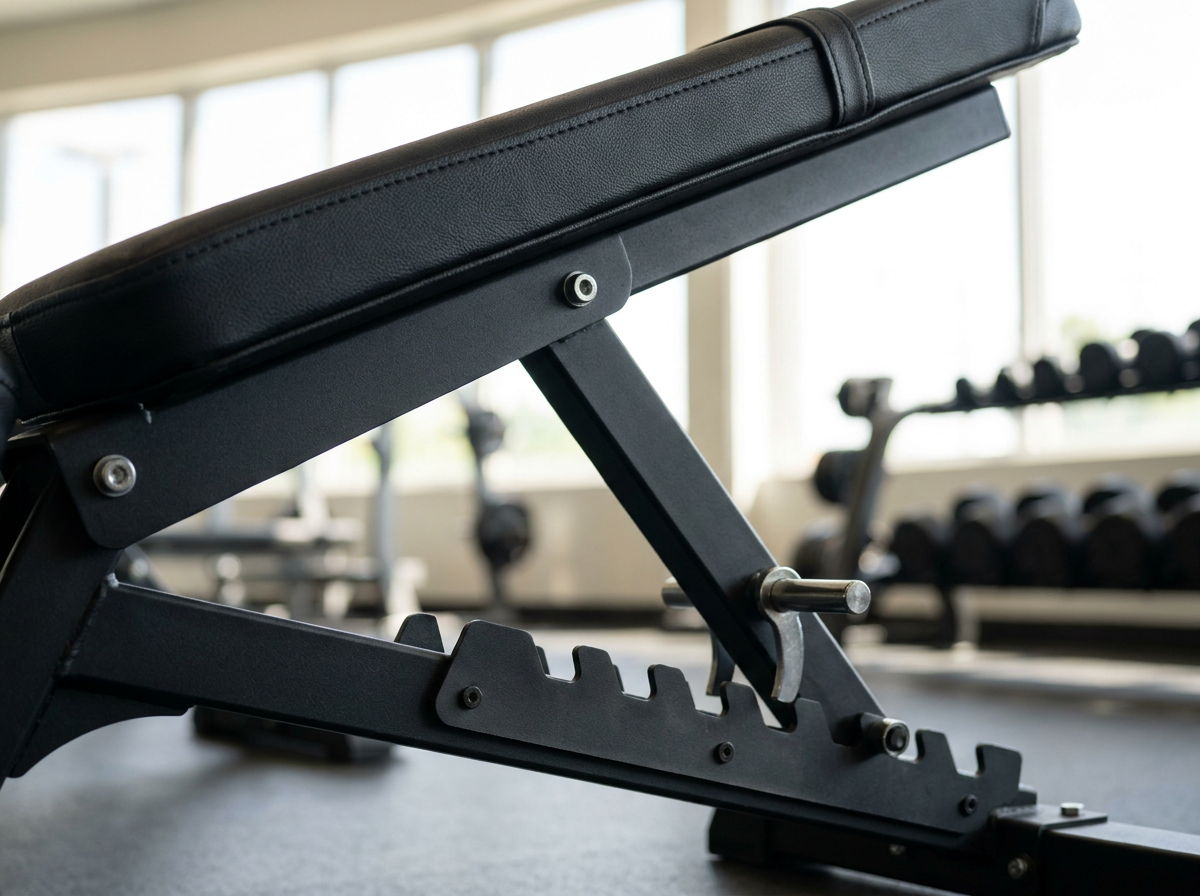
With adjustable benches, the locking mechanism is the weak point. Ideal features include a continuous grid of holes with precisely fitting bolts (ladder system) and a small but firm gap between the seat and backrest padding. If the backrest wobbles at the set angle, the bench is unsuitable for heavy pressing exercises.
5. Stability and Footprint
A wide base and non-slip feet prevent tipping, especially during one-sided exercises such as one-arm dumbbell rows. On hard floors, floor protection mats also protect both the equipment and the floor.
Home Gym or Fitness Center: Different Priorities
For a home gym, flexibility in a small space is key—this is where the adjustable multi-purpose bench, combined with a set of dumbbells and, optionally, a rack, comes out on top. In commercial strength training, on the other hand, durability, Class S certification, thick padding, and a low-maintenance mechanism are the top priorities, since the bench supports many users every day. A cheap home bench used in a gym ends up costing more in the long run because it breaks down faster.
Buying Guide: Which Bank Is Right for You?
Do you mostly work out at home and want maximum versatility? Then go for an adjustable multi-bench in Class H or—if you have the budget—Class S. Is your focus on heavy barbell bench presses? A solid flat bench is more stable and more affordable. Are you setting up a gym or a fitness studio? Then there’s no getting around Class S benches with high weight capacity and durable upholstery. You’ll find our selection all in one place in the Training Benches category.
Why choose Kraftathlet? As an authorized dealer offering a manufacturer's warranty, we'll provide you with personalized advice on the right bench—including 0% Klarna financing if you put together a bundle of multiple devices.
Common Mistakes When Buying a Weight Bench
- Don't just look at the price. A 60-euro bank that starts to falter after a few months is more expensive than a solid bank that lasts ten years.
- Forget about your body weight. The weight specified must account for your weight plus the weight of the dumbbells—not just the plates.
- Use Class H equipment in the studio. Home-use equipment is not designed for continuous operation and may void the warranty if used for commercial purposes.
- The padding is too soft. Comfortable when sitting on it, but unstable when supporting a barbell.
- Don't underestimate the space required. Before buying, measure how much space the bench will take up in its steepest position and with room for the dumbbell rack.
Frequently Asked Questions
A flat bench or an adjustable bench—which is better?
It depends on your goal. If you want to bench press heavy weights without compromise, the flat bench is more stable and more affordable. If you do a variety of exercises with dumbbells and want to work at incline and decline angles, the adjustable multi-bench is the more versatile choice.
What should be the weight capacity of a weight bench?
Add your body weight to your maximum training load and factor in a buffer. For ambitious home workouts, a total load of 300 kg is a good guideline; at the gym, it should be higher.
What does "Class S" mean for a weight bench?
Class S, as defined by DIN EN ISO 20957, designates devices that are also approved for professional and commercial use. Class H is intended exclusively for private, residential use.
What is the best angle of inclination?
For the upper chest and shoulders, a moderate angle of around 30 to 45 degrees is ideal. If the angle is steeper, the exercise quickly turns into a shoulder press. An adjustable bench allows you to switch between angles.
Do I need a bench with storage compartments?
For barbell bench presses without a rack, yes—in that case, you'll need built-in or separate rests with safety locks. If you only train with dumbbells or have a power rack, a simple bench will suffice.
Conclusion
For most people, the adjustable multi-bench is the best investment because it’s the most versatile; the flat bench stands out for its stability and price; in a gym, Class S certification is non-negotiable. More important than the brand name are load capacity (including your body weight), smooth, play-free adjustment, thick padding, and a stable, tip-resistant base. If you’re unsure which bench is right for your workout and space, get in touch with us —we’ll help you avoid making a bad purchase.