

Abstract
- For most people, a set of hexagonal rubber or PU fixed-weight dumbbells is the best choice: durable, non-slip, space-saving in the rack, and with minimal wear and tear.
- Short on space at home? Adjustable dumbbells can replace an entire set of dumbbells—but they're more expensive per pair and more delicate.
- Dumbbells engage more stabilizer muscles and the core than machines—unilateral exercises have been shown to increase core activation.
- Pay attention to the head shape (hexagon), handle diameter, and coating —these factors determine durability, floor protection, and grip.
If you could only buy one piece of strength training equipment, it would be dumbbells. For most beginners and intermediate lifters, a set of fixed-weight hexagonal rubber or polyurethane dumbbells is the right choice—they’re sturdy, non-slip, and stack neatly. If you have limited space at home, opt instead for adjustable dumbbells, which combine a complete set into a single pair. This guide walks you through material by material and weight level by weight level to show you what really matters when making a purchase.
Dumbbells are so popular because they target almost every muscle group, allow for a full range of motion, and reveal strength imbalances between the left and right sides. But that’s also what makes them challenging: Unlike a guided machine, you have to stabilize the weight yourself.
Why Dumbbells? An Overview of the Benefits
The major advantage of free dumbbells is the engagement of stabilizer muscles. Because each hand controls its own weight independently, the shoulder, forearm, and core muscles are activated more intensely than during bilateral machine exercises. An EMG study by Saeterbakken and Fimland (2013) published in the Journal of Strength and Conditioning Research showed that a free, unilateral shoulder press activates the core muscles significantly more than a guided, bilateral variation—and that deltoid muscle activation was higher with dumbbells than with a barbell.
There are also practical reasons: Dumbbells allow for a greater range of motion (for example, during the bench press); they are easier on the joints because the wrists and elbows can follow a natural path; and they are equally suitable for strength, muscle hypertrophy, endurance, and rehabilitation. For gyms, they are the backbone of the free-weight area; for home workouts, they are the most versatile piece of equipment there is.
Material Types: Cast Metal, Rubber, PU, Vinyl, and Chrome
Dumbbells differ primarily in their coating. This coating determines durability, floor protection, odor, and price. This overview categorizes the common types:
| Type | Strengths | Weaknesses | Ideal for |
|---|---|---|---|
| Cast iron (uncoated) | Affordable, very compact, durable | May rust, noisy, no floor protection | Budget Home Workout |
| Rubber | Durable, protects the floor, quiet | There may be a rubber smell at first | Studio & Home |
| Polyurethane (PU) | Low-odor, colorfast, highly abrasion-resistant | More Expensive Than Rubber | Commercial Studios |
| Vinyl | Colorful, lightweight, affordable | Only small weights; less durable | Aerobics, Rehabilitation, Light Classes |
| Chrome / Steel | Elegant appearance, precise feel in the hand | No soil protection, often more expensive | Lightweight, Appearance |
| Adjustable | Replaces an entire sentence, saves space | More expensive per pair, more delicate, bulkier | Home Workouts in a Small Space |
Hexagonal PU dumbbells have become the standard in busy gyms: Their hexagonal shape prevents them from rolling away, and the polyurethane coating remains odor-free and color-fast for years. For home use, rubber hex dumbbells offer the best value for the money. Vinyl and chrome dumbbells shine when used with light weights in exercise classes and during rehabilitation.
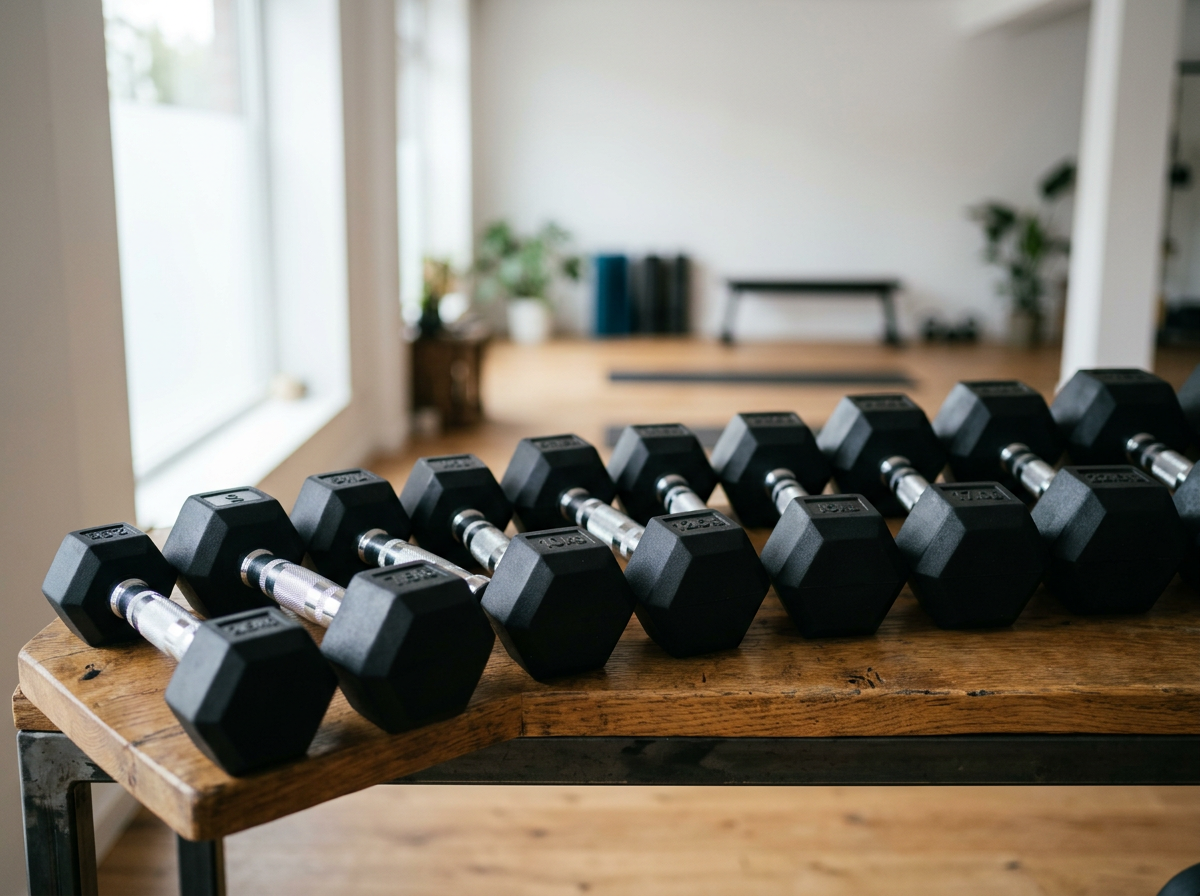
Fixed weight or adjustable? The fundamental decision
The most important decision to make before buying: fixed weights or an adjustable system. Both have clear use cases.
| Criterion | Fixed-Weight Dumbbells | Adjustable Dumbbells |
|---|---|---|
| Space requirements | High (entire set + rack) | Very few (a couple) |
| Weight Fluctuations | Right away—just grab it | Seconds, but an intermediate step |
| Robustness | Very high, hardly any mechanical components | More delicate; mechanical parts may wear out |
| Costs | Inexpensive per pair, but expensive as a complete set | High starting price, but one set |
| Suitability for Studio Use | Ideal – multiple users at the same time | Not suitable for high frequencies |
In short: For a gym or an ambitious home workout setup with plenty of space, fixed-weight dumbbells are the standard because multiple people can train at the same time and they don’t wear out. In a small apartment, a good pair of adjustable dumbbells beats everything else—they often replace 10 to 15 pairs of fixed-weight dumbbells while taking up the space of just one.
What weight classes do you really need?
A common mistake is buying weights that are too light or not properly graded. As a rule of thumb, smaller muscle groups (shoulders, arms) require smaller increments, while larger groups (chest, back, legs) require larger ones. This guideline will help you make your selection:
| Target Audience | Recommended Range | Grading |
|---|---|---|
| Beginner (Strength & Toning) | 2–15 kg | 2.5-kg increments |
| Advanced (Hypertrophy) | 5–30 kg | In increments of 2.5 to 5 kg |
| Weight Training / Gym | 2–50 kg (set) | Consecutive pairs of 2.5 kg |
| Rehabilitation / Classes | 0.5–5 kg | In 0.5- to 1-kg increments |
To get started at home, three to four pairs in appropriate increments are often enough. However, if you want to train progressively, you should leave some room for growth—based on the principle of progressive overload, you’ll need to move up to the next level regularly.
Ergonomics: Grip, Head Shape, and Balance
Three details determine how the workout feels. First, the grip diameter: if it’s too thin, it quickly tires the forearm; if it’s too thick, it compromises your grip during heavy sets—28 to 34 mm is a good gym standard, often with light knurling for grip. Second, the head shape: a hexagonal head prevents the dumbbell from rolling away and even allows for push-up variations; round heads look more elegant but do roll. Third, the balance: high-quality dumbbells feel firmly assembled, while cheap ones can loosen over time and “rattle.”
Buying Guide: How to Choose the Right Set
First, determine your needs. For a commercial gym, a complete set of hexagonal PU dumbbells paired with a sturdy dumbbell rack is a must—it can withstand heavy use and will look great for years to come. In our dumbbell collection, you’ll find both studio-grade PU and rubber dumbbells as well as entry-level options; for larger sets and kettlebells, check out the Dumbbells & Kettlebells collection. If you want to organize your free-weight area, add a matching dumbbell rack.
When it comes to working out at home, here’s the rule: if you have plenty of space, go for a compact set of rubber dumbbells; if space is limited, opt for an adjustable pair. As an authorized dealer offering a full manufacturer’s warranty, we at Kraftathlet exclusively supply certified brand-name products—a detail that makes all the difference over the years when dumbbells are subjected to constant use. Unsure about set size or gym equipment? Our team will provide personalized advice via our contact page.
Common Mistakes When Buying Dumbbells
It's too easy to buy. Many people underestimate their strength gains. If your heaviest pair feels too light after just a few weeks, it will hinder your progress. Plan for some leeway.
Don't let looks be the deciding factor. Chrome-plated dumbbells look classy, but they don't protect the floor and are rarely practical for heavy weights.
Ignore the coating. Bare cast iron in the living room means scratches on the floor and a risk of rust. For enclosed spaces, rubber or PU is almost always the better choice.
Forgot the dumbbell rack. A set without a place to put the dumbbells ends up being a tripping hazard. The right rack is part of the planning.
Don't just test the grip. If it's too thick or too smooth, it'll cost you reps. Pay attention to the diameter and grip profile.
Frequently Asked Questions
Which dumbbells are best for beginners?
For most beginners, hexagonal rubber dumbbells with fixed weights are ideal: affordable, durable, non-slip, and gentle on the floor. Start with weights ranging from 2 to 15 kg, and add heavier pairs as you get stronger.
Are adjustable dumbbells worth the money?
If you don't have much space at home, yes. A good set of adjustable dumbbells can replace an entire set of dumbbells and save a lot of space. For gyms or high-frequency training, fixed-weight dumbbells are more durable and practical because multiple people can train at the same time.
Which material is the most durable?
Polyurethane (PU) is considered the most durable coating: low-odor, colorfast, and highly abrasion-resistant—which is why it’s the standard in commercial gyms. Rubber offers excellent value for home use.
How heavy should my first dumbbells be?
Choose a weight that allows you to perform an exercise properly 8 to 12 times, with the last few repetitions being challenging. For shoulder and arm exercises, this is often 2 to 8 kg; for chest, back, and leg exercises, it’s significantly more.
Dumbbells or barbells—which is better?
The two complement each other. Dumbbells offer a greater range of motion, reveal imbalances between the left and right sides, and challenge the stabilizer muscles more. The barbell, on the other hand, allows for the heaviest total loads. For a well-rounded workout, it’s worth using both—but if you have to choose just one, dumbbells offer the most flexibility.
Conclusion
Dumbbells are the most versatile investment you can make for your workout. For most people, a set of fixed-weight hexagonal rubber or PU dumbbells is the best choice; if you have limited space at home, an adjustable pair is unbeatable. Look for practical weight increments, a floor-friendly coating, and a grip that fits your hand—then your set will last you for years. Want to equip a gym or unsure about the set size? Contact our team for personalized advice.
Sources: Saeterbakken & Fimland (2013), Journal of Strength and Conditioning Research (PubMed); Wikipedia: Dumbbell.