

Abstract
- The squat is the most effective basic exercise for the legs, glutes, and core—it builds more muscle mass in a single movement than almost any other exercise.
- Form trumps depth: Go as deep as you can while maintaining control and a neutral spine. When performed correctly, deep squats are safe and can even help protect your joints.
- Bending deeper (below parallel) provides a greater stimulus for the glutes and hamstrings—while quadriceps activity remains largely constant at around 90°.
- The most common mistakes: buckling knees, a rounded back, hips that shoot up, and putting too much weight on the bar too early.
How to Do Squats Correctly: Technique, Muscles, and Common Mistakes
The squat is the most important basic exercise in strength training because it works the thighs, glutes, and core simultaneously, engaging more muscle mass than almost any other movement. What matters isn’t how much weight you lift, but how cleanly you perform the movement—according to sports science literature, when done correctly, the deep squat isn’t a risk but rather a training method that protects the joints.
In this guide, you'll find a complete, step-by-step breakdown of the technique, a clear answer to the big question, a comparison of the most important variations, and the seven mistakes almost everyone makes when starting out. All presented in the order you need it.
Which muscles does the squat work?
The squat is a multi-joint exercise—the hips, knees, and ankles all work together. The main muscle involved is the quadriceps (front of the thigh), which is responsible for knee extension. The gluteus maximus stabilizes the hip and generates force from the bottom position. The posterior chain and core keep you upright and stable.
| Muscle group | Role in the squat | Stronger in … |
|---|---|---|
| Quadriceps | Knee Extension, Main Drive Upward | Upright Upper Body, High-Bar & Front Squat |
| Gluteus maximus | Hip Extension, Drive from Deep Within | Greater depth, low-bar squat |
| Adductors | Thigh Stabilization, Hip Extension | Wider stance, deep bend |
| Leg Curl & Back Extension | Stabilization, neutral spine | Low bar, heavier loads |
| Fuselage (Core) | keeps the upper body upright, protects the spine | Front Squat, Heavy Weights |
How to Do a Squat Correctly: Step-by-Step Technique
1. Setup & Stand
Set the barbell in the rack at about shoulder height. The bar should rest on your upper back (trapezius muscle), not on the back of your neck. Grip the bar slightly wider than shoulder-width apart, engage your upper back, and lift the barbell out of the rack with your legs straight. Take only one or two steps back. Your stance should be about shoulder-width apart, with your toes turned slightly outward (15–30°).
2. The Downward Movement
Breathe in, engage your core, and push your hips and knees back and down at the same time—as if you were sitting down on a low chair. Your knees should point in the same direction as your toes and may extend past them. Keep your weight over the center of your foot, your back neutral, and your chest upright.
3. Lowest Point & Upward Movement
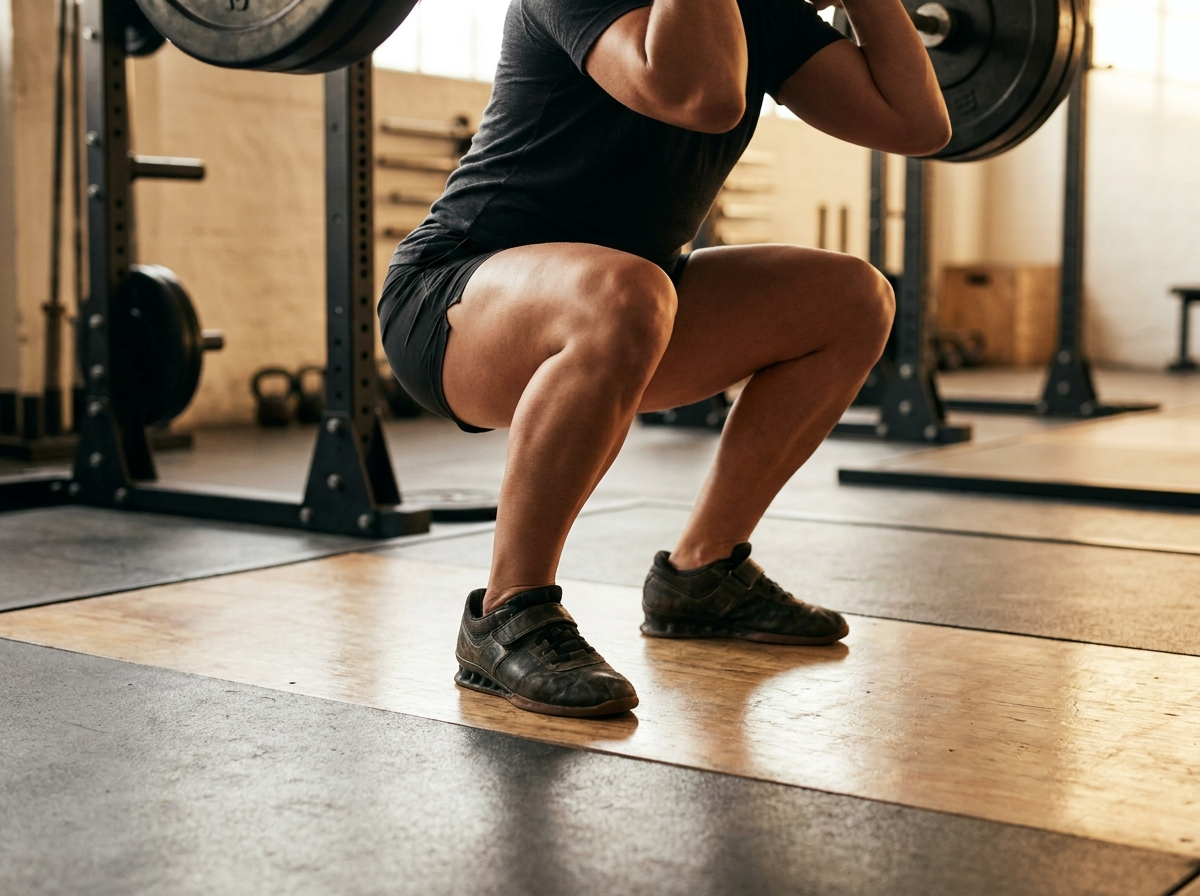
Lower yourself as far as you can while maintaining control and a neutral spine—ideally until your thighs are at least parallel to the floor. Then push up powerfully through the entire sole of your foot, push your hips forward, and exhale as you reach the top third of the movement. Your knees and hips extend together.
How Deep? The Truth About Squat Depth
The concern that deep squats are bad for the knees persists—but the evidence tells a different story. A review article in the Swiss Sports & Exercise Medicine Journal concludes that if the technique is learned properly under supervision and the load is increased gradually, deep squats do not pose an increased risk of injury to the passive structures—on the contrary, they tend to protect the joints.
For muscle building, depth matters: Deeper squats engage the glutes more and lead to greater quadriceps growth than half-reps. An interesting finding from EMG studies (including those by Schoenfeld and Escamilla) is that at approximately 90° of knee flexion, pure quadriceps activity no longer increases linearly—the additional stimulus from the deeper range of motion arises primarily from the greater range of motion and the greater involvement of the glutes and adductors.
Practical takeaway: Depth is a goal, not a dogma. Flexibility, pole height, and target also play a role. It’s better to execute the move cleanly up to the parallel position than to go deep with a rounded back.
A Comparison of Squat Variations
| Variant | Focus | Good for |
|---|---|---|
| High Bar | upright, emphasizing the quadriceps | Muscle Building, Beginners |
| Low Bar (low bar) | More Hip, Buttocks & Back Chain | Maximum Lifts, Powerlifting |
| Front Squat | Very upright, quadriceps & core | Mobility, Technology, Olympic Weightlifting |
| Goblet Squat | lightweight, tech-friendly | Getting Started, Warm-Up, Home |
Breathing, Core Pressure, and Foot Pressure: The Invisible Details
Three details determine stability and safety—and they’re barely visible from the outside. The first is breathing. For light sets, inhale at the top and exhale during the upper third of the upward movement. For heavy loads, many use the Valsalva maneuver: inhale deeply into the abdomen at the top and hold your breath during the downward movement and the first half of the lift. This pressure in the abdominal cavity stabilizes the spine like an internal belt.
The second detail is core tension: Actively tighten your abdomen as if you were expecting a light blow—tighten all around instead of pulling it in. The third is foot pressure. Distribute your weight across three points: the heel, the ball of your big toe, and the ball of your little toe. This “three-point stance” keeps you centered over your feet and ensures that your knees remain stable over your toes instead of caving in.
Squats for Beginners: The Right Form
If you're just starting out, learn the movement without weights first. A proven three-step progression: Start with bodyweight squats until you can lower yourself cleanly and in a controlled manner. Then move on to the goblet squat, where you hold a dumbbell or kettlebell in front of your chest—the counterweight helps you stay upright and go deeper. Only then should you move on to the barbell in the rack.
Build up gradually over weeks, not days. A typical starting point is three to four sets of eight to twelve clean repetitions. Don’t increase the weight until your form remains consistent throughout all repetitions. If you’re struggling with range of motion, incorporate a few minutes of targeted warm-up exercises for your ankles and hips before your workout—this often improves flexibility after just a few sessions. And always use the safety racks: when properly adjusted, they’ll catch the barbell if a rep fails.
The 7 Most Common Mistakes When Doing Squats
These mistakes slow your progress—and, in the long run, harm your joint health:
- Knees caving in: Your knees are turning inward. Actively push them outward, toward the tips of your toes.
- Rounded Back: The lower back rounds at its lowest point (“butt wink” caused by lack of mobility or excessive depth). Engage your core and adjust your depth to match your flexibility.
- Hips rise quickly: The hips rise faster than the shoulders—the exercise becomes a “Good Morning.” Lead with the chest while extending.
- Stand on your toes: Lift your heels off the ground. Keep your weight over the center of your foot; use weightlifting shoes if necessary.
- Not enough depth: Half reps with body weight. It’s better to use less weight but maintain a full range of motion.
- Bar on the back of the neck: Pressure on the cervical vertebrae. The bar should rest on the trapezius muscle.
- Too much, too soon: the burden of technique. Build up gradually—technique first, weight second.
Buying Guide: The Right Equipment for Safe Squats
For heavy squats, you need three things: a sturdy power rack with safety racks, a good barbell, and a firm footing. When choosing a rack, look for a high weight capacity, closely spaced holes in the lower section (for the correct bar placement height), and a rack that’s either set in concrete or bolted down for stability. Weightlifting shoes with a firm sole and a slightly raised heel can help if you have limited ankle mobility.
At Kraftathlet , you’ll find professional, gym-quality racks, barbells, and plate-loaded machines—as an authorized dealer, we offer a full manufacturer’s warranty and, upon request, 0% Klarna financing. Browse the Strength Training collection or check out the plate-loaded machines. If you want to improve your form, be sure to read our guide to deadlifts: technique, muscles, and common mistakes, as well as how to get stronger systematically using progressive overload.
Frequently Asked Questions About Squats
Are deep squats bad for your knees?
No. When performed with proper form and with a gradual increase in weight, deep squats are considered safe and can even help protect your joints. Pain is almost always caused by poor form or increasing the weight too quickly, not by the depth of the squat itself.
Can your knees go past your toes?
Yes. Your knees can and often should extend past your toes, especially in upright variations such as the front squat or high-bar squat. The key is to make sure your knees follow the direction of your toes and don't cave in.
How often should I do squats?
For most people, one or two squat sessions per week—with sufficient rest in between—are enough. More important than frequency is a steady increase in repetitions or weight over the weeks.
What is a good guideline for weight?
It really depends on the individual. At first, don't focus on a specific number of reps; instead, focus on performing clean reps through the full range of motion. A good benchmark for experienced lifters is the bodyweight squat with the barbell—but form always comes first.
Do I need a weightlifting belt?
Not for light to moderate loads. A belt can help support core pressure during heavy sets, but it never replaces active core engagement. First, learn to stay stable without a belt.
Conclusion
The squat rewards patience: proper form, a full range of motion, and a gradual increase in weight will help you build more muscle, gain more strength, and maintain healthy joints. Go as low as you can while maintaining control, avoid common mistakes—and push yourself further week after week. Looking for the right rack or a recommendation for your gym or home gym? Talk to our team —we’ll give you personalized advice.