

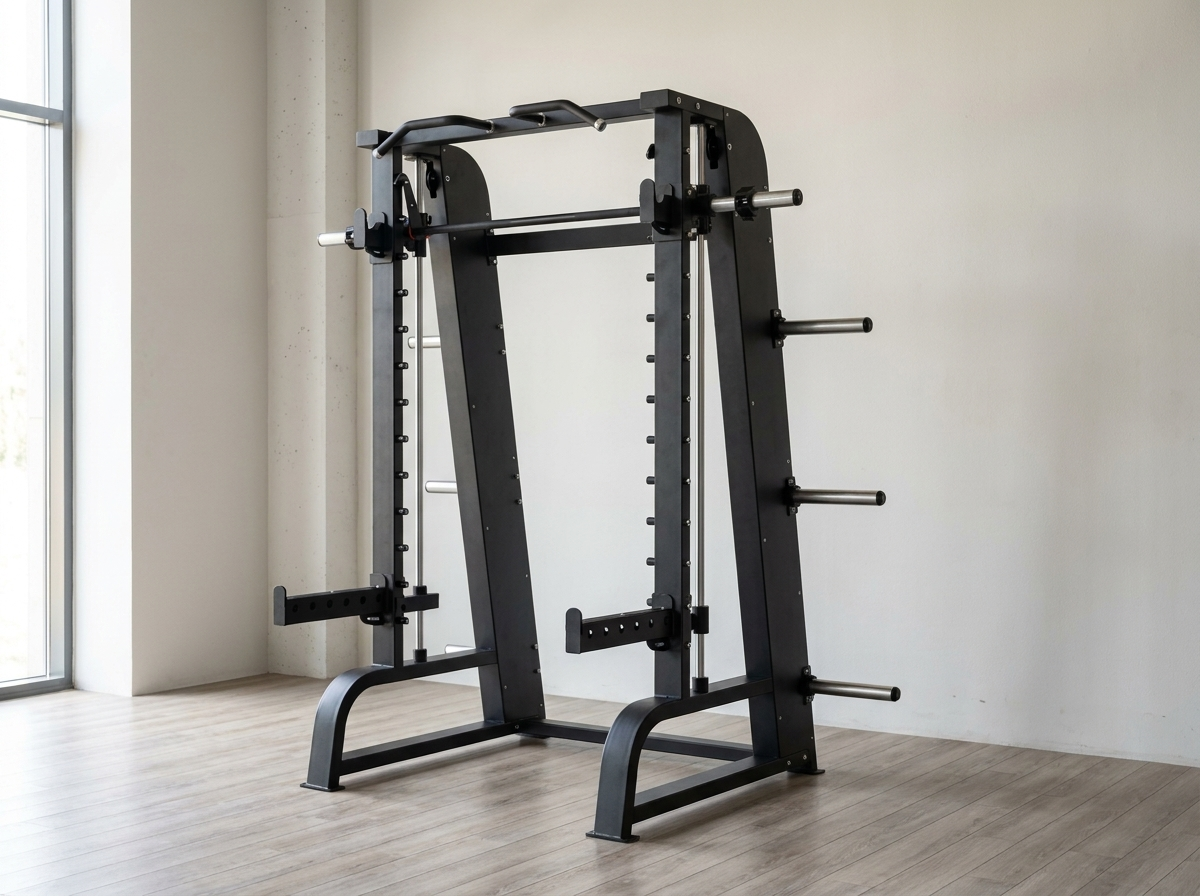
- A Smith machine (multi-press) guides the barbell vertically or at a slight angle along two fixed rails. This eliminates the need for lateral stabilization and makes heavy training safer without a spotter.
- In an EMG study, average muscle activation during free-weight squats was about 43% higher than during squats on the Smith machine. For maximum stimulation of the stabilizer muscles, free weights remain superior.
- The Smith Machine excels in safety, isolated muscle targeting, and guidance for beginners: it’s ideal as a supplement in the gym, but not as a sole replacement for a weight rack and free weights.
- Key factors for the studio: bearings (bushing vs. linear bearings), frame steel, safety hooks, and whether a cable pull is integrated. Models available at Kraftathlet ranging from 895 EUR to over 6,000 EUR.
Smith Machine: Technique, Benefits, and the Honest Gym Guide
A Smith machine is a barbell that runs along two fixed rails and can be hooked into place at various points—this ensures that the weight moves only along a strictly defined path. That’s exactly what makes it safe for heavy sets without a training partner, but it does come at the cost of some of the muscle activation you get from free weights.
So the question is never “Smith machine or free weights?” but rather: What are you using them for? This guide explains the technique, outlines the proven pros and cons, and helps you make the right choice—whether for a home gym or a commercial weight room.
How a Smith Machine Works Technically
The centerpiece is the guided barbell. It is securely attached to two vertical steel rails on the left and right and can move only up and down along this axis. Lateral tilting, leaning the bar forward or backward, or jerking it forward are mechanically prevented.
There are hooks on the bar that you can snap into safety notches with a slight twist. If you run out of strength on the last rep, just twist the bar in and it’ll lock securely into the next notch—without anyone having to stand there to help. High-quality studio models use a linear bearing instead of simple slide bushings: hardened shafts with ball or roller guides that run almost friction-free and with minimal vibration.
Vertical or diagonal?
There are two designs. In the vertical design, the bar runs exactly vertical—good for beginners and easy maintenance. In the angled design (tilted about 7 degrees forward or backward), the path follows the natural movement during bench presses and squats a little better. For most gym applications, the vertical design is perfectly adequate and more durable.
Smith Machine vs. Free Weights: What Do the Studies Say?
The most important difference is measurable. In the widely cited EMG study by Schwanbeck and colleagues (2009), researchers compared muscle activation during free-weight squats and Smith machine squats using the same 8-rep maximum. The result: on average across all measured muscles, activation during free-weight squats was about 43% higher. When considered individually, the vastus medialis (inner thigh) was about 49% higher, the calf muscles 34% higher, and the hamstrings 26% higher.
The reason: With free weights, your body has to stabilize the load in all directions. This stabilizing effort is largely eliminated when using a guided bar. Recent studies using textile EMG electrodes (Frontiers in Sports and Active Living, 2022) confirm this pattern: a fixed path of movement alters the activation patterns of the lower extremities compared to free barbell exercises.
| Criterion | Smith Machine | Free-weight barbell |
|---|---|---|
| Muscle Activation (Stabilizers) | Lower (fixed path) | Higher (approx. +43% on average) |
| Safety Without a Spotter | Very high (hook-on hook) | Lower (Spotter/Safety Required) |
| Learning Curve for Beginners | Flat (guided) | Steeper (requires technical skills) |
| Isolated exercise targeting individual muscles | Easy to control | More difficult to insulate |
| Application to Everyday Life/Sports | Limited | Higher (functionally) |
The Real Benefits of the Smith Machine
The lower stabilizer activation is not a disadvantage—it is precisely what makes the machine useful for certain purposes.
Safety When Training Alone. If you find it difficult to train without a workout partner, you can use the Smith Machine to push yourself to muscle failure in a controlled manner and hook the bar back in at any time. This significantly reduces the risk of injury during bench presses and squats.
Targeted isolation. Because the path of movement is fixed, you can apply tension more precisely to specific muscles—for example, during the incline shoulder press, lunges, or calf raises. This is valuable in the gym for clients focused on bodybuilding and rehabilitation.
Low barrier to entry. Beginners can get a feel for the movements without having to control their balance perfectly right away. In a commercial gym, this means more members are willing to try basic exercises.
The Smith Machine in a Commercial Gym: What Matters Most
In a studio setting, the machine is in use all day long. Here, durability and low-maintenance design matter more than the purchase price. Three factors are key:
1. Bearings. Linear bearings operate more quietly, with greater precision, and with less wear than simple sliding bushings—making them the longer-lasting choice at high frequencies.
2. Frame and Stability. Heavy-gauge steel (often 50×100-mm profiles), welded joints, and sufficient dead weight keep the structure stable even under maximum load.
3. Feature set. Many studio models combine the Smith machine with a power rack, dual cable machine, and storage shelves. This saves space and increases revenue per square meter—a key selling point in the B2B strength training sector.
Who can particularly benefit from the Smith Machine?
Those who train alone benefit the most: Anyone who does bench presses or squats without a spotter gains real confidence. Beginners and those returning to exercise can learn proper form without fear of the bar falling over. Gyms and rehabilitation centers value the guided track for supervised training and targeted exercise following injuries.
The machine is less suitable if your main goal is maximum functional strength for sports or Olympic weightlifting—in that case, there’s no getting around free weights. Even if you train with a partner anyway, you’ll often get more out of a classic power rack. So the honest answer is almost always: combine both in the gym instead of choosing one over the other. That way, you’ll cover safety, isolation, and functional training all at once.
Buying Guide: Which Smith Machine Is Right for You?
At Kraftathlet , in the Smith Machines & Multi-Gym section, you'll find models for every skill level. As a guide:
| Model | Type | Price starting at | Ideal for |
|---|---|---|---|
| Smith 160SC Linear Bearing (Titanium Strength) | Pure Smith Machine, Linear Bearings | 895 EUR | Getting Started, Home Studio |
| Smith Machine RM10 Evolution (Titanium Strength) | Smith + Integrated Rack | 995 EUR | Versatile Home Workout |
| Force USA G3 V2 All-in-One | Smith Machine + Rack + Dual Cable Pulley | 1.865 EUR | Complete Home Strength Training System |
| Elite Series Smith + Rack Selectorized | Smith with a weight stack | 2.195 EUR | Quick Gym Workout |
| Force USA G20 V2 Pro | 5-in-1 Studio Station | 6.695 EUR | Commercial Vehicle Sector |
As an authorized dealer offering a manufacturer's warranty, we provide expert advice with every model and, upon request, installation. If you're looking for space dedicated solely to machines, check out our plate-loaded machines; you can find the complete lineup under Strength Training.
Common Mistakes on the Smith Machine
Feet too far forward or too far back. Because the bar follows a fixed path, you have to adjust your foot position to the machine—not the other way around. An incorrect position puts undue strain on your knees or back.
Don't think of the machine as a substitute for everything. If you train exclusively on the Smith Machine, you'll neglect your stabilizer muscles. Combine it with free-weight exercises.
Ignore the safety hooks. The biggest advantage is lost if you don't set the stopper to the correct height. Do this before every heavy set.
Don't jerk the rod into the hook. Reel in the rod in a controlled manner, not with a sweeping motion—otherwise, your wrists and bearings will suffer.
Frequently Asked Questions
Is the Smith Machine worse than free weights?
Not worse, just different. For maximum stabilizer activation and functional strength, free weights are superior (approximately 43% more muscle activation in studies). For safe solo training, isolation exercises, and beginners, the Smith machine is the better choice. At the gym, the two complement each other.
Can I build muscle using the Smith Machine?
Yes. Building muscle requires, above all, sufficient tension, volume, and progressive overload—and the Smith Machine provides all of that. For a well-rounded program, however, you should combine it with free-weight exercises and other machines.
Why is the bar on the Smith Machine lighter?
Because the rails support part of the bar's weight and friction is minimal, the guided bar often feels lighter than a 20-kg barbell. The exact weight depends on the model—be sure to factor it in when comparing your loads.
Is a Smith machine worth it for a gym?
In most commercial gyms, yes: It reduces the risk of injury, is beginner-friendly, and is space-efficient when used in combination machines. Look for linear bearings, a heavy-duty steel frame, and, ideally, an integrated cable pull system for maximum revenue per square meter.
Vertical or diagonal—which is better?
For most users, the vertical guide is sturdy and perfectly adequate. Models with an angled guide follow the natural pressure path slightly better, but are more complex. When in doubt, go with the vertical guide.
Conclusion
The Smith Machine is not a substitute for free weights, but rather a standalone piece of equipment with clear strengths: safety, muscle isolation, and an easy learning curve. Those who view it as a supplement—not a replacement—will find it to be a versatile, durable piece of equipment, whether in a home gym or a commercial weight room. The key factors to consider are the bearings, the frame steel, and the range of functions.
Want to know which model is right for your space and budget? Talk to our team —we’ll give you personalized advice, from a home studio to a fully equipped studio.
Sources: Schwanbeck, Chilibeck & Binsted (2009), “A Comparison of Free Weight Squats to Smith Machine Squats Using Electromyography,” J Strength Cond Res; Frontiers in Sports and Active Living (2022), “Textile EMG electrodes reveal differences in lower limb muscle activation during loaded squats.”