

Abstract
- The most costly mistake when buying a Reformer is choosing a frame that can't withstand daily studio use —wooden and aluminum frames wear out faster under constant stress than a steel frame.
- Anyone planning capacity and revenue per square meter should consider modular systems (a reformer plus a stackable tower) over rigid monoblocks.
- Prioritize safety and the flow of the class: removable shoulder pads and quick spring/cable adjustments save you real minutes per class.
- Calculate based on total cost of ownership (TCO) over the product's lifespan, not just the purchase price. A cheap reformer that breaks down after 18 months ends up costing more in the long run.
Buying a Reformer for Your Gym: The Most Common Mistakes—and How to Avoid Them
The most common—and most expensive—mistake when buying a reformer is basing the decision solely on the purchase price, without considering the frame material, capacity, and operating costs. A reformer in a gym operates differently than one at home: it’s used for many hours a day, by different users, and requires constant adjustment. That’s exactly where sturdy equipment stands out from equipment that only seems inexpensive.
This guide compiles the five mistakes we most frequently encounter when consulting with gyms and physical therapy practices—and uses specific criteria to show what really matters instead. The TALMA 62 fromHegren , featuring a steel frame and a 5-spring system, serves as a reference for durable gym equipment construction, without disparaging other manufacturers.
Mistake 1: Cutting corners on the frame material
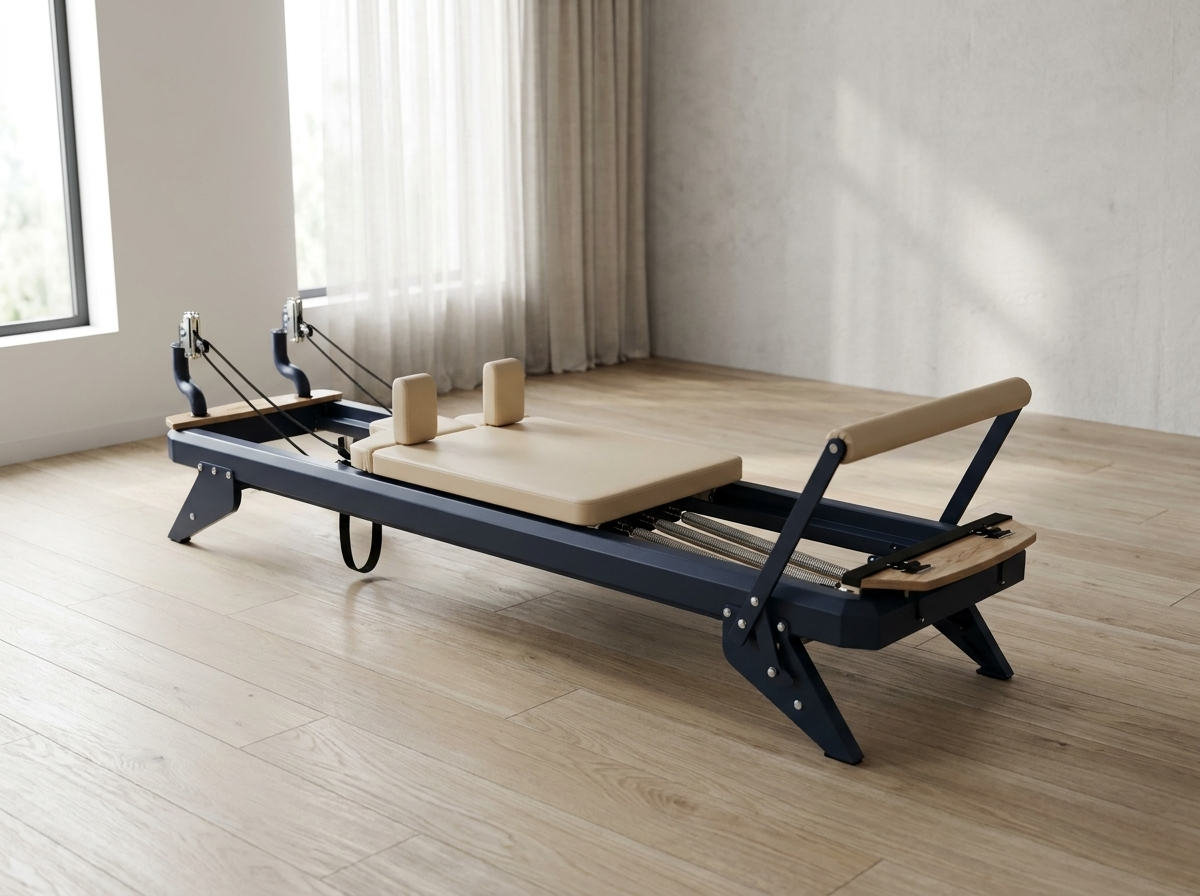
The frame determines the product’s service life. Wooden frames look elegant, but their joints can loosen under continuous load; aluminum is lightweight, but it is less durable under repeated stress than steel. A steel frame, such as the one on the Hegren TALMA 62 (245 cm, approximately 105 kg, manufactured in Greece), remains resistant to warping for years—a crucial factor when ten or more users work on it daily. For a gym, material quality is not a matter of aesthetics but of operational safety.
For Studios and Practices: Pilates Studio Equipment.
Mistake 2: Monoblock Instead of a Modular System
An integrated, one-piece tower reformer saves space but limits your class formats. If you want to accommodate larger groups and offer a variety of programs, modular solutions are the way to go: a separate reformer paired with a freestanding or wall-mounted tower. The TALMA 62CT Convertible Tower, for example, transforms the reformer into a full-fledged tower system when needed, without requiring the purchase of a second piece of equipment. This increases utilization per square meter—and thus your revenue potential per square meter.
Mistake 3: Underestimating Security and Class Flow
In a live class, every second counts. Removable shoulder pads, quick and intuitive spring adjustments, and easily adjustable ropes prevent delays and reduce the risk of user error. This is doubly important: It keeps the class flowing smoothly and lowers the risk of injury because participants spend less time fumbling with unclear mechanisms. A well-designed, robust spring-and-cable system is therefore not a luxury, but a matter of operational safety.
Mistake 4: Relying Solely on On-Screen Guidance
Screen-guided 24/7 workout programs promise to reduce staffing costs, but they shift your members’ loyalty away from the trainer and toward the app. In practice, this leads to higher churn because there’s no sense of community. Trainer-led classes using reliable equipment foster stronger member loyalty—the equipment should support the trainer, not replace them.
Mistake 5: Purchase Price Instead of Total Cost of Ownership (TCO)
The purchase price is just the beginning. Total lifetime costs include maintenance, spare parts availability, downtime, and how long a piece of equipment will actually last. A reformer that jams or breaks down after a year and a half will cost you lost class time and the expense of a replacement. A robust design with good spare parts and service support is almost always the more economical choice when calculated over five years.
| Criterion | A Typical Bad Purchase | A Rugged Choice for the Studio |
|---|---|---|
| Frame | Wood/aluminum, operates under continuous load | Steel frame, torsionally rigid |
| Construction Method | Rigid Monoblock | Modular: Reformer + Tower |
| Security | Fixed pads, cumbersome adjustment | Removable pads, quick spring/cable adjustment |
| Support | On-screen instructions only | Instructor-led, equipment-assisted |
| Cost Overview | Purchase price only | TCO over 5+ years, including service |
Why This Matters Right Now
The German fitness and health market remains large: According to DSSV key figures, millions of people work out at gyms, and Pilates programs are growing as a high-margin specialty format. Anyone setting up a Reformer studio is competing for space, class attendance, and member retention—three factors that depend directly on having the right equipment. You can find a concise overview of the method on Wikipedia under “Pilates.”
Buying Guide: How to Take a Structured Approach
First, determine your class format and floor space, then the frame material and modularity, followed by safety and service—and only finally, the price. You can find our studio reformers in the “Pilates Reformers ” category, and specifically the steel series at Hegren Pilates. If you’re planning a complete studio, our guide “Opening a Pilates Studio” will help you; for equipment selection alone, check out the “Reformer Studio Buying Guide.”
Why Kraftathlet? Over 5,000 satisfied customers and personalized studio consultations: We help you put together a combination of reformers, towers, and accessories that balances capacity, safety, and durability.
Quick Checklist Before You Buy
- Has the frame been inspected? Choose steel for continuous use.
- Modular and expandable? A tower option instead of a rigid monoblock.
- Safety on the course? Removable bumpers, quick adjustment.
- Service & Replacement Parts? Check availability before purchasing.
- Have you calculated the TCO? Look at the five-year perspective instead of just the purchase price.
Frequently Asked Questions
Which treadmill is best for the gym?
There is no single “best” reformer, but there are clear criteria: a torsionally rigid steel frame, modular expandability to include a tower, a safe and quickly adjustable spring-cable system, and reliable service and spare parts support. The Hegren TALMA 62 meets these criteria as a steel series.
Is a combo machine that combines a reformer and a tower worth it?
For many studios, yes, because it expands the exercise repertoire and makes better use of the space. It’s important that the tower can be neatly mounted on a stable Reformer—as with the TALMA 62CT—rather than being built into a rigid monoblock.
Why is a steel frame better than one made of wood or aluminum?
Steel remains durable and resistant to twisting under repeated, heavy loads. Wooden joints can loosen over time, while aluminum is lighter but less durable under continuous loads. In continuous studio use, this offers advantages in terms of durability and safety.
How many reformers do I need for my area?
That depends on the class format, staff-to-participant ratio, and average class size. Allow enough space for participants to enter and exit safely, and calculate the occupancy per class based on the available space. Our studio guide can help with capacity planning.
Are screen-guided reformers useful?
They can work as a supplement, but experience shows that when used as the sole approach, they tend to lead to higher attrition rates because there is a lack of connection to trainers and the community. For sustainable member retention, trainer-led workouts on reliable equipment provide a more stable foundation.
Conclusion
A good reformer purchase depends on the frame material, modularity, safety, and total cost—not the lowest price tag. If you avoid these four mistakes, you’ll set up a studio that combines capacity, class flow, and durability. Want to discuss your specific space and class format? Contact us —we’ll put together a suitable, durable configuration for you.