

Abstract
- Pilates is ideal for people 60 and older: it is easy on the joints and specifically targets strength, balance, and flexibility—key factors in preventing falls and muscle loss.
- Starting around age 30, the body continuously loses muscle mass; strength and balance training measurably counteracts this (the WHO recommends at least twice a week for people 65 and older).
- Start gently with mat or Reformer exercises; if you have any pre-existing medical conditions, consult a doctor, and focus on proper form rather than speed.
- For studios, the safety and stability of the equipment are the top priorities when it comes to older clients—robust steel-frame reformers like the Hegren TALMA 62 have an advantage here.
Pilates for Seniors: Gentle Exercise for People 60 and Older to Build Strength, Balance, and Flexibility
Pilates is one of the best forms of exercise for people 60 and older: It’s easy on the joints, can be tailored precisely to your individual level, and targets the very skills that become most important as we age—core strength, balance, and flexibility. Regular practice helps you remain independent longer, prevents falls, and actively counteracts natural muscle loss.
In this guide, you'll learn why Pilates is such a great fit for people 60 and older, which exercises are best for beginners, what you should keep in mind if you have pre-existing conditions—and what studios look for when providing safe and professional care to older clients.
Why Pilates Is Especially Beneficial for People Over 60
The body changes over the years: Starting around age 30, people continuously lose muscle mass unless they take steps to counteract it—a process that can accelerate with age (technical term: sarcopenia). At the same time, balance and flexibility decline. This is exactly where Pilates comes in: controlled movements, a strong core (the “powerhouse”), and mindful breathing improve posture, stability, and body awareness.
The World Health Organization (WHO) strongly recommends that people aged 65 and older do muscle-strengthening exercises at least two days a week and incorporate activities that improve balance—which is exactly what Pilates does in a way that is gentle on the joints. The major advantage over many other forms of exercise is that the intensity can be carefully adjusted, and most exercises can be performed safely even with physical limitations.
An Overview of the Key Benefits
- Fall Prevention: Better balance and stronger legs reduce the risk of falls—one of the most important factors for maintaining independence in old age.
- A strong back, good posture: Pilates strengthens the deep muscles around the spine and pelvis and helps prevent back pain.
- Greater Mobility: Gentle, controlled movements keep joints supple and make everyday activities—such as bending over or climbing stairs—easier.
- Gentle on the joints: No jumping, no impact—ideal even for those with osteoarthritis or recovering from injuries.
- Mind and Well-Being: Focusing on breathing and movement has a relaxing effect and promotes body awareness.
Mat Pilates or Reformer—which is best for beginners?
Both approaches work exceptionally well for people 60 and older. Mat Pilates can be done anywhere and is an affordable way to get started. The Reformer—a machine with a spring-loaded carriage—on the other hand, takes some of the strain off the body, guides the movement, and provides additional support. This is often more comfortable and safer, especially for older beginners, because many exercises are performed while lying down or sitting with support.
| Criterion | Mat Pilates | Reformer Pilates |
|---|---|---|
| Getting Started | Anywhere, affordable, just a mat required | At the studio, guided movement, better stability |
| Support | Body weight | Spring resistance absorbs the load and drives the motion |
| Joint Protection | High | Very high; many exercises done while lying down or sitting |
| Ideal for | Practicing on Your Own at Home | Supervised Training, Rehabilitation, Beginners with Physical Limitations |
Many beginners start with guided Reformer or mat classes at the studio and also practice at home on a mat. If you’d like to get some equipment for your home, you’ll find suitable props such as balls, bands, and rollers in our Premium Pilates Accessories category.
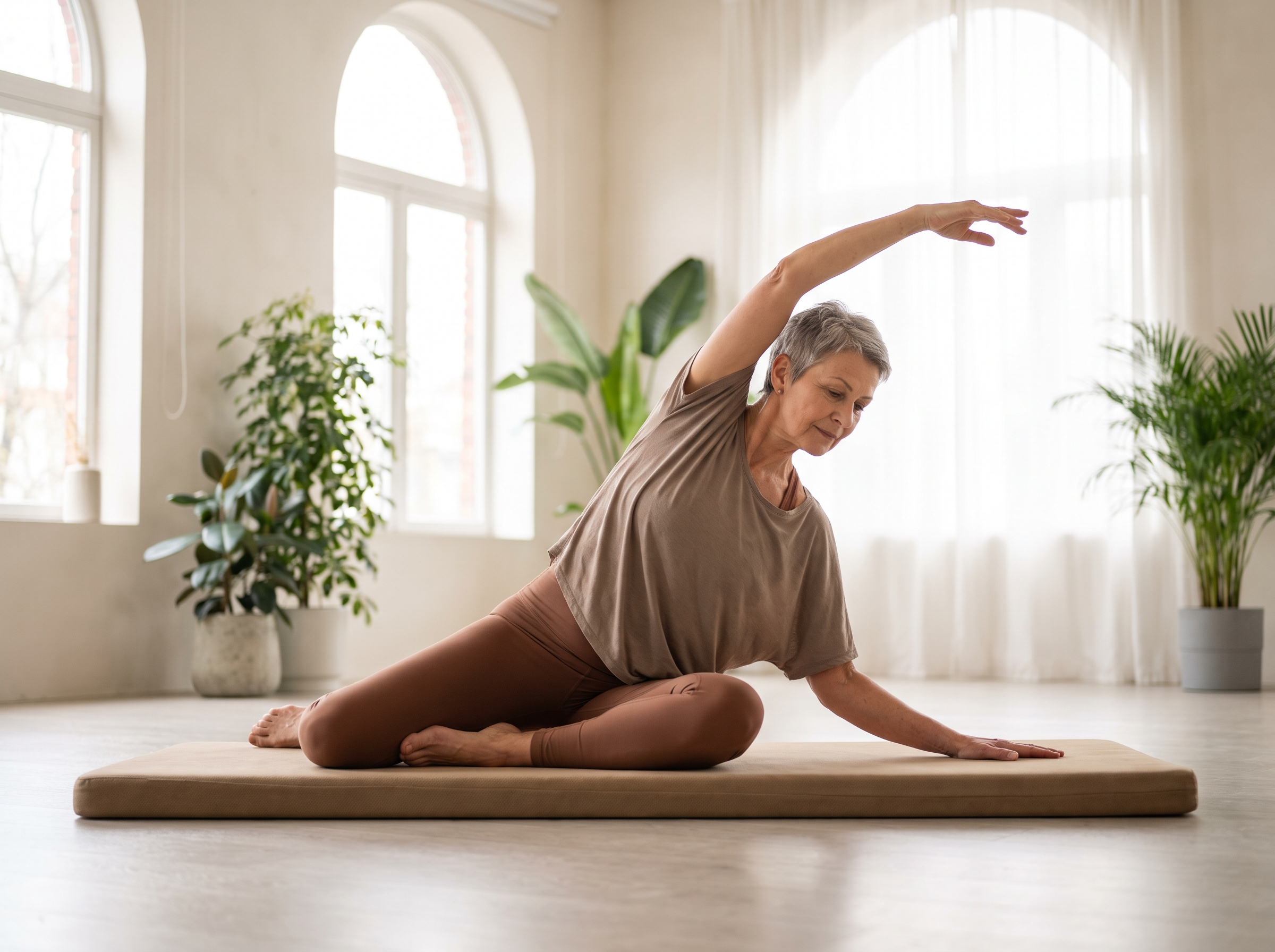
Gentle Exercises to Get You Started
These basic exercises are safe and effective. Important: Move slowly and in a controlled manner, keep breathing steadily, and stop immediately if you feel any pain.
Pelvic Tilt
Lie on your back with your knees bent: gently tilt your pelvis backward so that your lower back sinks toward the mat, then release. This mobilizes the lumbar spine and activates the deep abdominal muscles.
Shoulder Bridge (Bridging)
From the same position, slowly lift your pelvis, vertebra by vertebra, and lower it again. This strengthens the glutes and lower back and stabilizes the core.
Seated Spinal Rotation
Sitting upright in a chair, slowly turn your upper body to the side, following the movement with your gaze, then return to the center. This exercise promotes spinal flexibility—and is well-suited even for people with limited mobility.
Standing Balance at the Handrail
Hold onto the back of a chair and try to balance on one leg at a time. This exercise specifically targets balance—a key component of fall prevention.
Safety First: What You Should Keep in Mind After Age 60
- Consult a doctor: If you have cardiovascular disease, osteoporosis, have recently undergone surgery, or are experiencing severe joint pain, consult a doctor before use.
- Expert Guidance: Especially when you're just starting out, it's worth taking a class or working with a personal trainer who can tailor the exercises to your needs.
- Build up slowly: It's better to do a few clean repetitions than many frantic ones. Quality over quantity.
- Pay attention to your body: Mild exertion is normal, but pain is not. If you feel dizzy or experience pain, take a break.
- Safe environment: non-slip mat, someone nearby to provide support, and enough space.
If you have existing joint problems, take a look at our guide, “Pilates for Osteoarthritis”; if you have low bone density, the article “Pilates for Osteoporosis: Safe Exercises” can help.
For Gyms: Providing Safe Care for Older Clients
The 60+ demographic is economically attractive and growing for Pilates studios—but it places special demands on equipment and class structure. There are three key criteria by which equipment should be evaluated:
| Criterion | Why It Matters to Older Customers |
|---|---|
| Stability & Frame | A rigid, stable frame ensures safety when getting on and off. Steel frames maintain their dimensions even under continuous stress. |
| Easy adjustment | Springs and footrests that can be adjusted quickly and without tools help maintain the flow of the class and prevent delays. |
| Comfort & Accessibility | Comfortable padding, easily accessible handles, and a smooth glide make it easier for older participants to get started. |
Sturdy steel-frame reformers like the Hegren TALMA 62 (manufactured in Greece, 5-spring system, 245 cm) meet these criteria and are designed for daily studio use. Comparisons should always be based on specific criteria—stability, safety, and durability under continuous use are what matter, not the brand name. You can find an overview in the categories “Hegren ” “Pilates,” and “Pilates Reformers.”
Buying Guide: Are you planning to set up a Reformer area for older clients or for rehabilitation? As an authorized Hegren dealer with a manufacturer’s warranty, we’ll provide you with criteria-based advice on safety, stability, and features—with no pressure to buy. Get in touch via our contact page.
Common Mistakes in Pilates for People 60 and Older
- Too much, too fast: Starting exercises too quickly or without guidance. It’s better to start gently and build up slowly.
- Hold your breath: Breathing is part of the exercise. Avoid holding your breath; keep breathing calmly.
- Ignoring pain: A pulling sensation in the muscle is okay, but a stabbing pain isn't. If in doubt, stop.
- Without prior consultation if you have pre-existing conditions: If you have osteoporosis or a joint replacement, check in advance to see which exercises are appropriate.
- Irregularity: Two light workouts per week are more effective than one long, infrequent session.
Frequently Asked Questions
Is Pilates still a good idea even at age 70 or 80?
Yes. Pilates can be adapted to almost any age and fitness level. Many exercises can be done while sitting or lying down with support. It’s important to have good instruction and—if you have any pre-existing conditions—to consult your doctor.
How often should seniors do Pilates?
Two sessions per week is a good guideline and is in line with the WHO's recommendation for strength training for people 65 and older. If you'd like, you can supplement this with short daily exercises at home.
Does Pilates Help Relieve Back Pain in Older Adults?
Pilates strengthens the deep muscles around the spine and improves posture, which is beneficial for many people with back pain. If you experience acute or severe pain, consult a doctor first.
Do I need a Reformer, or is the mat enough?
The mat is enough to get started. The Reformer offers more support and guidance, which can make it more comfortable and safer—especially if you have physical limitations—and is ideal for supervised studio training.
Is Pilates suitable for people with osteoporosis or osteoarthritis?
Often, yes—but in a modified form. In cases of osteoporosis, certain bending movements are avoided; in cases of osteoarthritis, the focus is on controlled exercises that are gentle on the joints. Discuss the details with your doctor and experienced trainers.
Conclusion
Pilates for people 60 and older is one of the smartest investments you can make in your independence and quality of life: it’s easy on the joints, safely customizable, and specifically designed to build strength, balance, and flexibility. Start gently, get good instruction, and stick with it—two low-impact sessions a week are enough to see noticeable progress. For studios looking to serve older clients, our team provides criteria-based advice on suitable, safe equipment—simply reach out via the contact page.
Sources: WHO – Physical Activity (Recommendations for Adults Aged 65 and Older); Cruz-Jentoft et al. (2019), EWGSOP2 on Sarcopenia. This article is not a substitute for medical advice. If you have any pre-existing medical conditions, consult a doctor before beginning your workout.