

Abstract
- The best flooring for a Pilates studio is durable, slip-resistant, easy to clean, and slightly springy (point-elastic)—without allowing heavy reformers to sink into it.
- For movement spaces, standards such as DIN 18032-2 and DIN EN 14904 provide guidance on force absorption and deformation.
- Heavy steel-frame reformers rest on small feet: Pay attention to point loads and compressive strength, not just the appearance.
- Vinyl and rubber sports flooring is the practical standard; wood sports flooring looks more upscale but costs more to purchase and maintain.
Flooring for a Pilates Studio: The Right Floor for Reformers, Cadillacs, and Mats
The best flooring for a Pilates studio is durable, slip-resistant, hygienic, and slightly springy—firm enough that heavy Reformers don’t sink into it, and soft enough that mat and barefoot workouts remain gentle on the joints. It’s precisely this balance between stability for the equipment and elasticity for the body that determines the quality of your studio.
Many studio owners plan their floor plans, equipment, and marketing down to the last detail—but overlook the floor on which everything stands. Yet it’s the surface that sees the most use: every Reformer, every exercise, and every client puts strain on it every day. This guide shows you the different types of flooring available, what structural considerations you need to keep in mind when using heavy Reformers, and how to balance hygiene, slip resistance, and soundproofing.
Why the Floor Is Underestimated in Pilates Studios
In an exercise studio, the floor must fulfill several functions at once: It supports the weight of the equipment, cushions impacts during jumps and landings, prevents slipping during barefoot workouts, and must be able to be disinfected multiple times a day. A floor covering that merely looks good but becomes slippery when feet are wet or develops permanent indentations under the feet of the Reformer quickly becomes a safety and cost issue.
Then there’s the economic aspect: A high-quality floor will last for many years with daily studio use, whereas a residential floor that’s too thin will wear out prematurely and need to be replaced while the facility is in operation—resulting in closure days and lost revenue. The floor is therefore an investment in operational reliability, not just in aesthetics.
Point elasticity, surface elasticity, combined elasticity: the types of soil
Sports floors are classified based on their deformation behavior. The DIN 18032-2 standard (supplemented by DIN EN 14904 for resilient flooring) specifies how much impact force a floor should absorb. In simple terms, for exercise areas, the floor should absorb a significant portion of the applied force rather than transferring it back to the joints.
| Soil Type | Behavior | For Pilates Studios |
|---|---|---|
| Point-elastic | Yields only at the point of loading | Great for mat and barefoot training; provides stability under equipment |
| Area-elastic | Distributes the force over a larger area | More suitable for large sports arenas; less ideal for heavy point loads |
| Combined Elastic | Point-elastic surface on a surface-elastic substructure | A good compromise, but more time-consuming and expensive to set up |
For most Pilates studios, a point-elastic mat is the most practical choice: It remains stable under the Reformers and gives way where the body needs it during mat or Springboard training.
Structural Engineering and Floor Loads: The Impact of Heavy Reformers
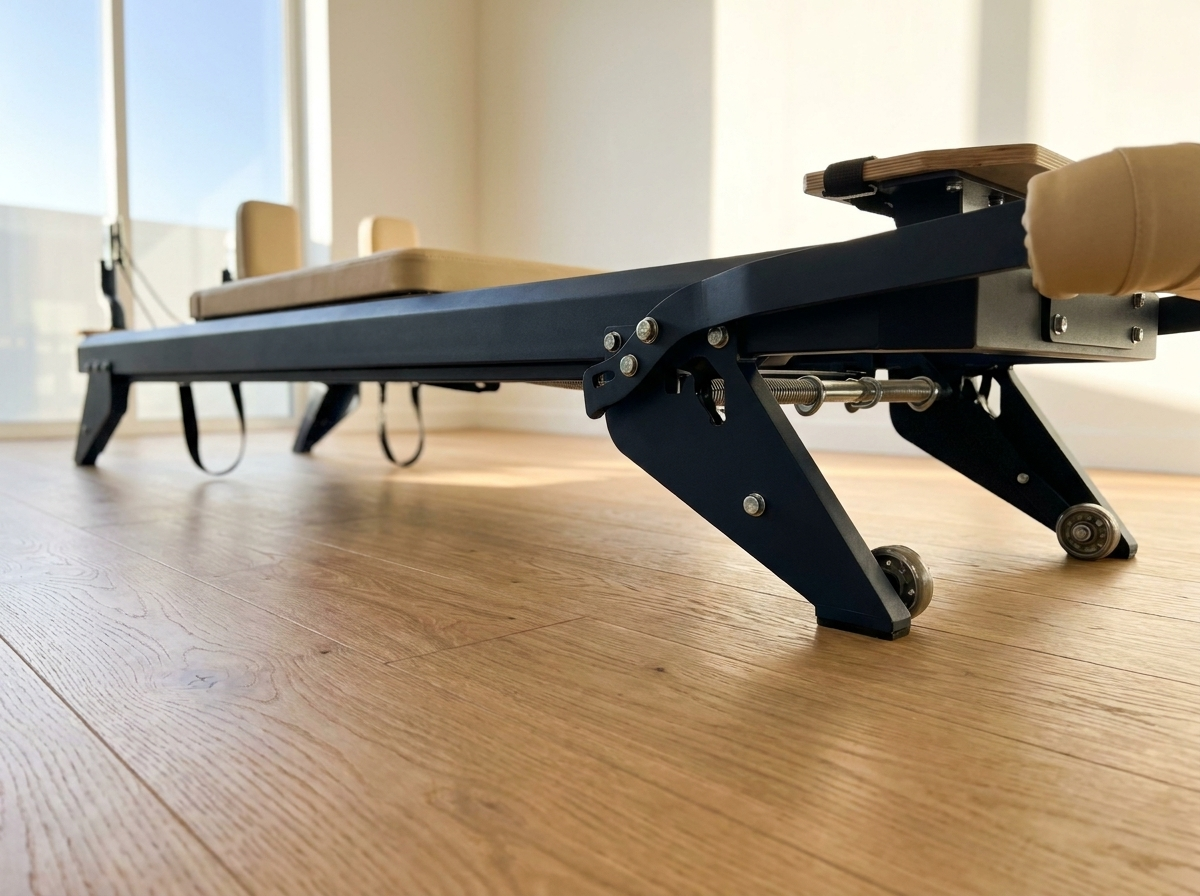
A professional studio reformer is no lightweight. A steel-frame reformer like the Hegren TALMA 62 weighs about 105 kilograms—distributed across just a few small feet. This concentrated load is exactly why the floor needs to do more than just look good: A surface that’s too soft will develop permanent dents at the contact points, while one that’s too hard—without impact sound insulation—will transmit every movement to adjacent rooms.
Criteria, not gut feelings: Check the compressive strength of the flooring (compression behavior under static load), the residual hardness after prolonged loading, and—in older buildings or on upper floors—the load-bearing capacity of the ceiling. Especially when multiple heavy machines, plus Cadillac or combo systems, are in one room, the weight really adds up. For Reformers with sturdy steel frames, even load distribution is an advantage because they are stable and won’t tip over; in turn, their small contact surfaces require a floor that can withstand pressure. Our guide to floor plans, layout, and capacity shows you how to plan your equipment and overall space.
Slip Resistance and Hygiene
Pilates is usually practiced barefoot or with non-slip socks, often on slightly damp skin. The floor therefore needs to have a specific level of slip resistance without being so rough that it’s difficult to clean. At the same time, it must be possible to disinfect it several times a day: seamless, low-joint surfaces such as welded vinyl or rubber prevent sweat and germs from collecting in crevices. In addition, clean mats should be placed under each training area—you’ll find suitable models in our Training Mats & Floor Protection collection.
The machines themselves also benefit from a hygienic environment: To learn how to keep your Reformers clean and ensure they last a long time, read the guide “Reformer Hygiene in the Studio.”
Soundproofing Between Rooms and Floors
Rolling reformer sleds, spring-loaded resistance bands, and music generate impact noise and structure-borne noise. In studios with multiple class rooms or on upper floors, the floor construction determines how much of this noise reaches neighboring units. Impact sound insulation installed beneath the finished floor covering noticeably reduces sound transmission and helps prevent conflicts with other tenants—an issue that is often considered too late in the planning phase and ends up being costly to address afterward.
Flooring Comparison for the Gym
| Surface | Strengths | Things to Consider |
|---|---|---|
| Vinyl Sports Flooring (Rolls) | Few joints, hygienic, good slip resistance, easy to maintain | Proper installation is required |
| Rubber flooring | Very durable, impact-resistant, good impact sound insulation | Higher price, often a darker appearance |
| Cork/Linoleum Flooring | Warm, natural feel; comfortable to walk on barefoot | More susceptible to point loads from heavy equipment |
| Wooden Sports Flooring | High-quality appearance, good elasticity | Expensive, high-maintenance, sensitive to moisture |
In practice, most gyms opt for a vinyl or rubber floor with few seams, defined slip resistance, and impact sound insulation—the best balance of hygiene, stability under equipment, and budget. Where design is a priority, a wood sports floor can enhance the premium feel, but it requires more maintenance.
Buying Guide: Consider Flooring and Appliances Together
Never plan the floor in isolation; always consider it together with the equipment that will be placed on it. If you know from the start which Reformers, Cadillacs, or Combos will be placed in the room, you can properly calculate the required load-bearing capacity and layout. As an authorized Hegren dealer with a manufacturer’s warranty, we advise you not only on the equipment but also on the floor requirements for a steel-frame Reformer in continuous use. You’ll find the right equipment in the Hegren Pilates and Pilates Reformers collections.
If you're setting up a new studio, it's worth checking out our comprehensive guide to opening a Pilates studio, which covers the concept, costs, and equipment.
Common Mistakes in Choosing Flooring
- Residential-grade flooring instead of commercial-grade flooring: Laminate or thin vinyl from the home improvement store can't withstand the daily wear and tear of a studio.
- Ignore point loads: The flooring is chosen based on appearance, not on its compressive strength under equipment feet.
- Forgot about impact noise: On upper floors, a lack of insulation leads to disputes with neighbors.
- Seams and Cracks: Hard-to-clean joints can become a hygiene hazard.
- Plan the flooring last: If you buy the appliances first and then the flooring, you'll often have to make adjustments.
Frequently Asked Questions
What is the best flooring for a Pilates studio?
For most studios, a vinyl or rubber sports floor with minimal seams, point elasticity, defined slip resistance, and impact sound insulation is the best choice. It remains stable under heavy reformers, is hygienic, and is comfortable for barefoot training.
Does a Pilates studio need a springy sports floor?
A light, point-elastic suspension is beneficial because it protects the joints during mat and floor exercises. However, the floor must not be so soft that heavy Reformers sink into it—which is why point elasticity is better than a deep, full-surface suspension.
Can a regular floor support the weight of a reformer?
A single reformer exerts a load of about 100 kilograms on small feet. A pressure-resistant floor can withstand this; if there are several heavy units on upper floors, the ceiling’s load-bearing capacity should also be checked.
How do I clean a studio floor hygienically?
Surfaces with few seams, such as welded vinyl or rubber, can be wiped down with a damp cloth and disinfected several times a day without germs accumulating in the cracks. It is important to use cleaners that are suitable for use in studios and compatible with the materials.
Is a wood floor a good choice for a Pilates studio?
A wood sports floor looks high-quality and offers a pleasant level of elasticity, but it is more expensive, requires more maintenance, and is more sensitive to moisture. It is particularly worthwhile for premium gyms that place a strong emphasis on aesthetics.
Conclusion
The floor is the quiet foundation of your studio: It supports the equipment, protects your clients’ joints, and plays a key role in hygiene and soundproofing. Choose a durable, point-elastic commercial-grade floor with certified slip resistance and impact sound insulation—and always plan it in conjunction with the Reformers that will be placed on it.
Are you planning a new studio or upgrading your existing one? Talk to our team —we’ll advise you on reformers and the appropriate flooring requirements so your studio runs safely and lasts for years, starting from day one.