

Abstract
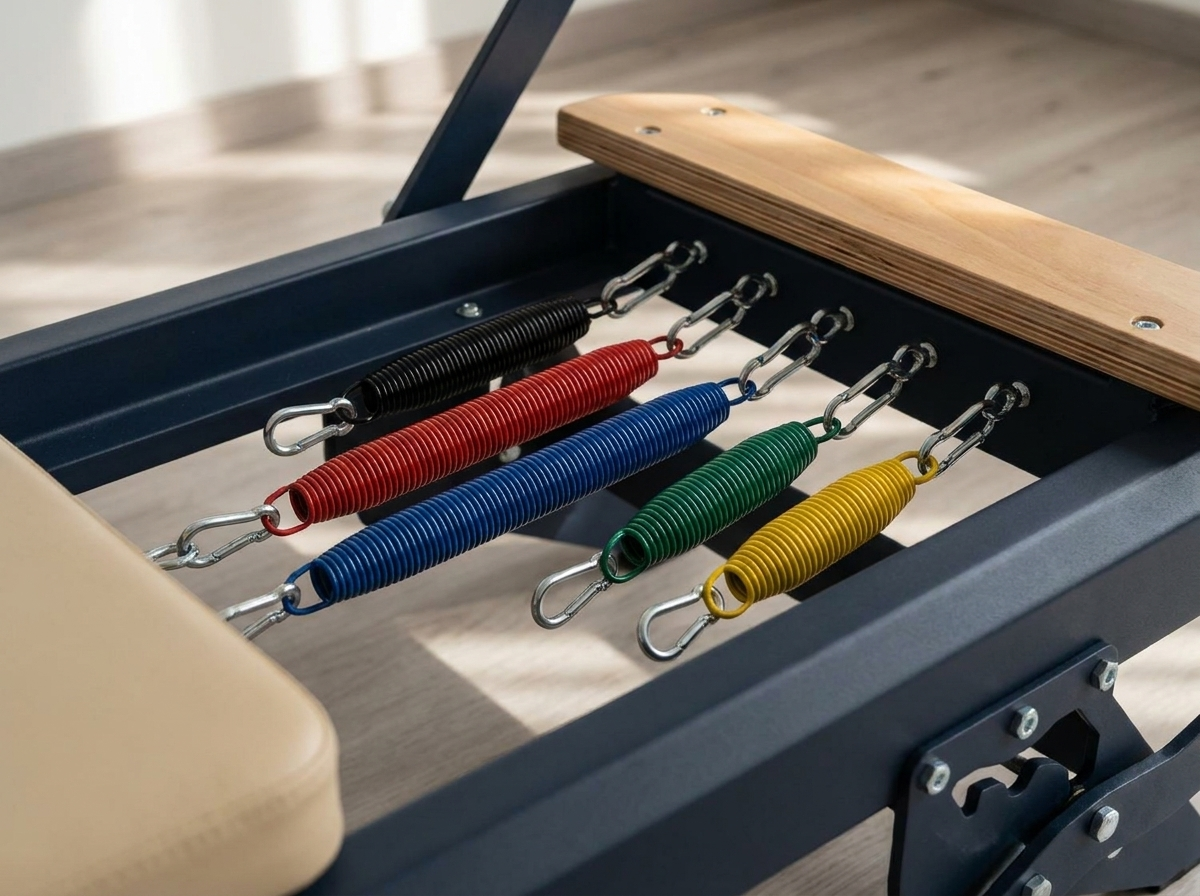
- The springs are the heart of every reformer: They determine the resistance and, therefore, how an exercise feels. Color-coded springs (light to heavy) are standard.
- Important and often misunderstood: Lightweight sleds are often harder to control because the torso must actively stabilize the sled (Kim et al., 2024, Healthcare).
- Springs are wear parts. Regular visual inspections, a defined replacement schedule, and appropriate replacement springs are all part of studio operations.
- For continuous use, frame stability and a well-engineered spring system are essential. The Hegren TALMA 62, with its steel frame and 5-spring system, sets a high standard in this regard.
Pilates Reformer Springs: Resistance, Colors, and the System Explained Simply
The springs on a Pilates Reformer provide the resistance against which you work out—they are the actual exercise equipment, while the frame and carriage serve as the platform. Unlike with dumbbells, the spring resistance does not increase linearly: the farther the carriage moves, the greater the tension becomes, which alters each exercise throughout its range of motion.
Anyone setting up a studio or looking to replace Reformer springs should understand the system: color coding, resistance logic, maintenance, and why “lighter” doesn’t automatically mean “easier.” This guide explains the spring system based on specific criteria and highlights what matters most for professional, continuous use.
How does spring resistance work?
A reformer uses several tension springs that connect the movable carriage to the frame. If you add more springs or stronger ones, the resistance increases; if you remove some, it decreases. This allows for a wide range of settings—from gentle rehabilitation resistance to intense resistance for advanced users.
The key factor is the spring’s nonlinear nature: At the start of the movement, the tension is low; at the end, it is high. This progressive characteristic is what makes Reformer training so versatile—and at the same time places high demands on the quality of the springs and the guidance of the carriage.
Spring Colors and Resistance: The Logic Behind Them
Most systems use colors to indicate resistance. The specific color-to-resistance correspondence varies by manufacturer—there is no global standard, so the manufacturer's specifications should always be followed in the studio. A typical pattern looks like this:
| Spring Type (Example) | Resistance | Typical Applications |
|---|---|---|
| Light (e.g., light/white) | low | Precision, Stability, Rehabilitation, Footwork |
| Medium (e.g., blue) | medium | many standard exercises |
| Heavy (e.g., red) | high | Footwork, powerful strokes, advanced level |
In practice, you combine springs to achieve intermediate levels of resistance. This is precisely what makes the Reformer so appealing: the ability to finely adjust the resistance for every exercise and every fitness level.
Why Light Feathers Are Often Heavier
A common misconception: Less spring resistance means an easier exercise. In fact, for many movements, the opposite is true. A study by Kim and colleagues, published in 2024 in the journal Healthcare, used electromyography to examine core muscle activity at different levels of spring resistance. The result: At lower resistance levels, the deep muscles must work harder to actively stabilize the moving sled because the spring provides less passive guidance.
In a studio setting, this means that light springs are ideal for developing control, stability, and body awareness—they aren’t just for “beginners.” Heavy springs, on the other hand, provide guidance and resistance. Good trainers choose the spring based on the training goal, not on the perceived level of difficulty.
Springs and Exercises: A Few Practical Examples
The right combination of springs depends on the exercise and your goal. Three typical patterns illustrate the principle:
- Footwork: Usually heavy resistance (multiple springs), because the powerful leg muscles are engaged and guidance is desired.
- Exercises performed while sitting or kneeling with resistance bands: Often moderate resistance to balance movement and stability.
- Stability and balance exercises (e.g., kneeling on the sled): Often involving light resistance—it is precisely this gentle pull that challenges the deep muscles the most.
These examples are meant as a guide, not a rule: The trainer adjusts the springs based on the individual, their current condition, and their goals. It is precisely this flexibility that is the Reformer’s strength.
Feather Material and Quality: What Matters Most
Not all springs are the same. During continuous use, the quality of the material determines the spring’s lifespan and how it feels during training:
- Constant resistance curve: High-quality springs provide reproducible resistance over thousands of cycles, rather than “wearing out” over time.
- Corrosion Protection: In studios with high humidity (near showers or saunas), protection against rust is essential.
- Clean hooks and eyelets: They help bear the load and must not bend out of shape.
- Fit: The spring length and mounting must match the device exactly—so do not mix in springs from other manufacturers.
One aspect that’s often underestimated is noise: High-quality springs run quietly and smoothly during exercise, while inexpensive springs may squeak or jerk. In a quiet studio environment, this isn’t just distracting—it’s also a sign of uneven tension and early wear and tear. If you listen and watch closely during a trial session, you can recognize quality before you’re asked to pay your first bill.
How many springs does a studio reformer need?
Most professional reformers use four or five springs, plus a differentiated color or resistance grading system. Five springs offer more possible combinations and thus finer resistance adjustment—an advantage when everyone from rehab clients to elite athletes trains at the studio. The Hegren TALMA 62, for example, features a 5-spring system that covers precisely this range. Ultimately, it’s not just the number that matters, but the combination of spring quality, clear coding, and stable guidance.
Springs Are Wear Parts: Maintenance at the Gym
In continuous commercial operation, Reformer springs are under load every day. They are wear parts and should be included in a defined maintenance schedule. Here’s what you should keep in mind:
- Visual inspection: Check regularly for rust, deformation, worn-out coils, and damaged hooks.
- Replacement cycle: Replace springs according to the manufacturer's specifications and frequency of use—don't wait until one breaks.
- Hooks and suspension: Also inspect the spring hooks (hangers) and fasteners; they help support the load.
- Keep spares on hand: Have the right replacement springs in stock so that a device never breaks down.
It’s a small but costly mistake to skimp on springs and suspensions. A spring failure in the middle of a class compromises safety, wastes time, and erodes trust. You can find the right springs and suspensions in the Pilates Springs & Suspensions category.
Buying Guide: What Really Matters When It Comes to Suspension Systems
The quality of the spring system depends entirely on the reformer’s overall construction. These criteria determine its durability and how it feels during a workout:
- Frame Stability: A stiff, torsion-resistant frame guides the sled smoothly—this protects the springs and ensures consistent resistance. Steel frames offer extra strength during continuous operation.
- Smooth carriage movement: Precise rollers and rails maintain consistent spring tension.
- Intuitive spring system: Clear coding, defined resistance levels, and easy replacement simplify classroom use and maintenance.
- Available Replacement Parts: A system is only as good as its supply of springs and accessories.
As a reliable benchmark for studio use, we highlight the Hegren TALMA 62: a studio reformer manufactured in Greece with a steel frame and a 5-spring system, designed for daily group classes. The sturdy frame guides the carriage precisely, and the multi-stage spring system allows for fine-tuned resistance adjustment. You can find the complete Hegren lineup—including reformers, towers, and accessories—in the Hegren Pilates Collection. Kraftathlet is an authorized dealer offering the manufacturer’s warranty and provides criteria-based advice tailored to your studio’s needs.
Common Mistakes Involving Reformer Springs
- Choose a spring based on “light = easy”: The resistance depends on your training goal, not on the label.
- Putting off maintenance: Waiting to replace springs until one breaks is a safety hazard.
- Mapping pen colors across manufacturers: There is no uniform standard—always use the manufacturer's designation.
- Don't just look at the spring: the frame, slide, and suspension also play a role in how the resistance feels.
- Don't keep spare parts on hand: A device failure during prime time costs revenue and trust.
Frequently Asked Questions
What do the colors of the Reformer springs mean?
The colors indicate resistance levels from light to heavy. However, there is no global standard—the color-to-resistance mapping varies by manufacturer. Therefore, in the studio, the manufacturer’s specifications for the specific machine always apply.
Are light springs easier?
Not necessarily. As a 2024 EMG study shows, when spring resistance is lower, the body must work harder to actively stabilize the sled. Light springs help develop control and stability and aren't just for beginners.
How often do you need to replace the springs on a Reformer?
That depends on the frequency of use and the manufacturer. In continuous commercial use, you should visually inspect the springs regularly and replace them according to the manufacturer's specifications—not only after a failure occurs.
Can I mix feathers from different manufacturers?
This is not recommended. The mounting, length, and spring constant are not compatible. Use only the original springs or approved replacement springs intended for your device.
Which reformer is suitable for continuous use in a studio?
For day-to-day classroom use, what matters most is frame stability, smooth sled operation, and a serviceable spring system with readily available replacement parts. The Hegren TALMA 62, with its steel frame and 5-spring system, is a reliable benchmark.
Conclusion
The springs are what make a reformer a reformer: They determine resistance, the feel of the workout, and safety. Anyone who understands the system—the nonlinear resistance curve, the manufacturer-specific color coding, and the fact that lighter springs often require more control—will make better decisions when working out and when purchasing. Just as important: Springs are wear-and-tear parts that should be included in a regular maintenance schedule.
Are you planning to open a studio, replacing springs, or looking for a reformer for continuous use? Talk to our team —we’ll provide criteria-based advice on spring systems, frames, and equipment.
Source: Kim et al. (2024), "Effect of Reformer Spring Resistance Modifications on Core Muscle Activity During Basic Core Muscle Exercises," Healthcare (MDPI) — MDPI Healthcare.