

Abstract
- Move the massage gun slowly over the muscle belly—never directly over bones, joints, the spine, or the front of the neck.
- For each muscle group, about 30 to 120 seconds of light to moderate pressure is sufficient; more is not better.
- Studies show that percussion therapy can improve mobility and relieve muscle soreness—but it does not increase strength.
- The right attachment makes all the difference: a ball for large muscles, a fork along the spine (not on it), and a flat head for broad areas.
How to Use a Massage Gun Properly: Attachments, Body Areas, and Common Mistakes
To use a massage gun correctly, slowly glide it over the muscle belly with light pressure, avoiding bones, joints, and the spine—about 30 to 120 seconds per area is sufficient. According to studies, percussion therapy can improve mobility and relieve muscle soreness; however, it has no proven effect on raw strength.
This guide will walk you through, step by step, which attachment is intended for what purpose, how to treat the most important areas of the body, when the best time is—and what mistakes you should definitely avoid.
What are the real benefits of a massage gun?
The evidence is solid but should be interpreted with caution. A randomized controlled trial (Frontiers in Public Health, 2025) found that percussive massage can acutely reduce delayed-onset muscle soreness (DOMS). A systematic review confirms consistent benefits for flexibility and perceived recovery. At the same time, the research reveals clear limitations: Compared to traditional stretching, the evidence is limited, and a massage gun does not improve muscle activation or maximum strength.
In short: The massage gun is a great tool for improving flexibility, promoting a sense of relaxation, and relieving muscle soreness—but it’s not a miracle cure, nor is it a substitute for exercise or sleep. To see how it stacks up against the foam roller in a direct comparison, check out the article “Massage Gun vs. Foam Roller.”
Basic Rules for Use
Before we move on to the individual body areas, there are five simple rules you should always keep in mind:
- Muscle belly, not bone: Treat the soft muscle tissue. Avoid bones, joints, the spine, and the front of the neck.
- Glide slowly: Move the device across the muscle at a speed of about 2–3 cm per second—do not hold it still in one spot.
- Light pressure: The device’s own weight is often enough. No pain, no “pressing in.”
- Short duration: 30 to 120 seconds per muscle group is more than enough.
- Start low: Begin at the lowest level and increase only as needed.
Which essay for which purpose?
Most devices come with several attachments. This overview will help you choose the right one.
| Essay | Scope of Application |
|---|---|
| Sphere (round) | Large muscle groups such as the thighs, glutes, and back |
| Flathead | Wide surfaces, general loosening, closer to the bone |
| Fork (U-shaped) | Along (not on) the spine, Achilles tendon, and the side of the neck |
| Cone / Bullet | Localized, deep tension, soles of the feet, forearms |
| Shock absorber / soft attachment | Sensitive areas, areas near the bones, beginners |
Treating Body Areas Properly
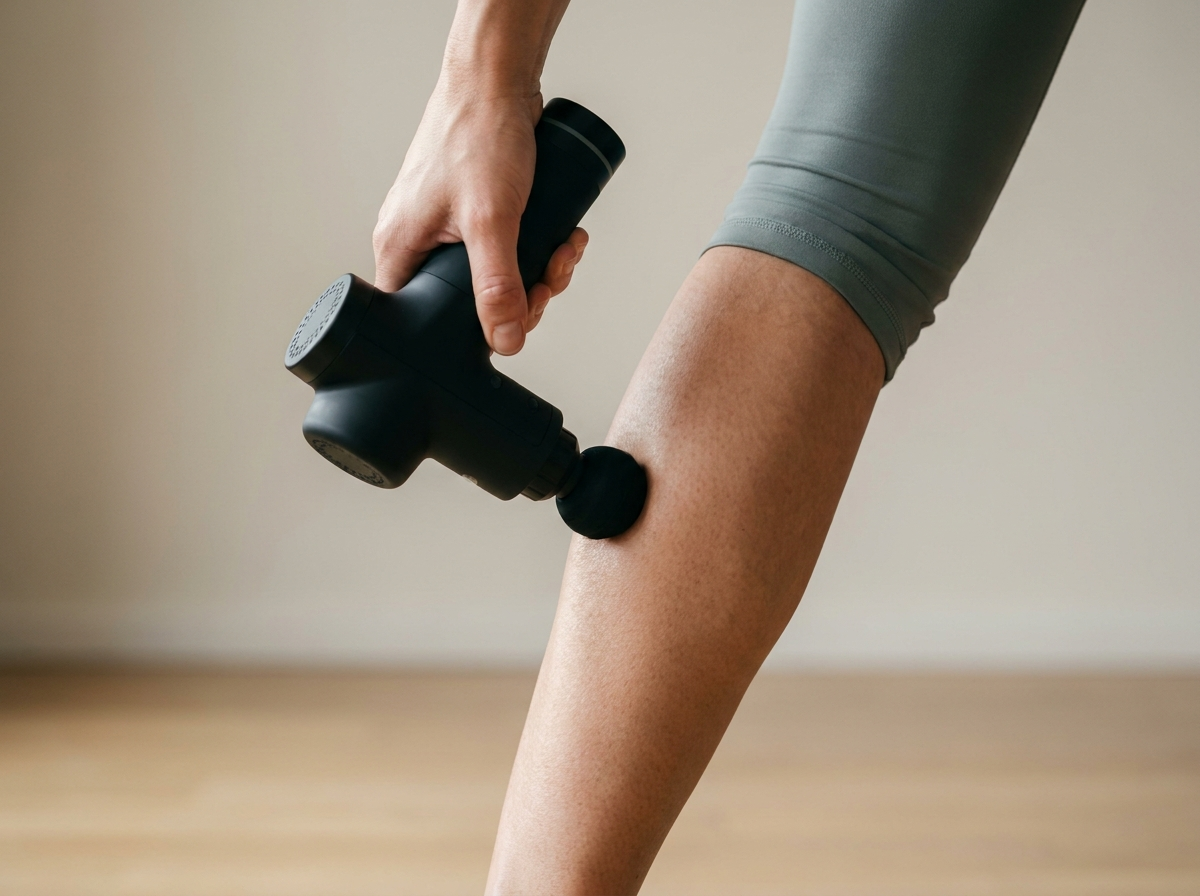
The most common areas of application for athletes are the legs, glutes, and back. For the calves and thighs, use the ball attachment and work from the bottom up toward the heart. The glutes can handle a bit more pressure; the ball is ideal for this. On the back, stay on the muscles to the side of the spine; the fork glides smoothly alongside the spinous processes. Take special care with the neck: use the soft attachment only on the lateral and upper shoulder muscles, never on the front of the neck.
Before or after your workout?
Both are possible, with different goals. Before your workout, you can use short 15–30-second pulses per muscle to improve flexibility as part of your warm-up. After your workout, use longer, gentle sessions (up to 2 minutes per area) to promote a sense of relaxation and support recovery. On rest days, you can target and loosen tight areas. Our fascia rolling guide shows how this fits into a complete recovery routine as a helpful supplement.
Common Mistakes
- Focusing on one point for too long: That can be irritating rather than helpful. Keep moving.
- Directly on bones or joints: the shinbone, kneecap, elbow, and spine are off-limits.
- Too much pressure: Pain isn't a sign of quality. It's better to go easier and longer.
- Regarding recent injuries or inflammation: Do not use the massage gun on acute injuries, inflammation, varicose veins, or blood clotting disorders—if in doubt, consult a doctor.
- On the front of the neck: There are sensitive structures in that area—be sure to avoid it.
Buying Guide: What to Look for in a Device
A good device offers multiple intensity levels, interchangeable attachments, a quiet brushless motor, and enough battery life for several sessions. A compact model is sufficient for beginners; those who use it daily will benefit from greater penetration depth and endurance. Browse our selection of massage guns or pair one with a foam roller for large-area relaxation. You can find detailed advice on models and prices in the article “Massage Gun – Effects & Buying Guide.”
You'll find all our recovery tools bundled together in our Recovery Collection. And if a product doesn't meet your expectations, Kraftathlet offers a 30-day return policy.
Frequently Asked Questions
How long should I use a massage gun on each muscle?
Typically 30 to 120 seconds per muscle group. Before a workout, short bursts of 15 to 30 seconds are sufficient for activation; after a workout, it can be a little longer.
Is a massage gun effective for treating sore muscles?
Studies suggest that percussive massage can provide immediate relief from muscle soreness. While it does not address the underlying cause, it can alleviate discomfort and improve mobility.
Can I use the massage gun every day?
Yes, when used correctly—with moderate pressure and for a short time—there’s no reason not to use it daily on tense areas. Listen to your body and avoid irritated areas.
Where should I not use the massage gun?
Do not apply to bones, joints, the spine, the front of the neck, or over injuries, inflamed areas, varicose veins, or in cases of blood clotting disorders. If in doubt, consult a doctor.
Massage gun or foam roller—which is better?
The two complement each other. The gun works in specific, deep spots, while the roller covers large areas. The gun is useful for targeted tensioning, and the roller is best for large surfaces.
Conclusion
When used correctly, a massage gun is a simple, effective tool for improving flexibility and relieving muscle soreness. The key lies in the technique: move slowly over the muscle belly, apply light pressure, keep sessions short, choose the right attachment, and avoid sensitive areas. That way, you’ll get the most out of it without hurting yourself.
Not sure which device or recovery combination is right for you? Talk to our team —we'll give you honest advice with no strings attached.