

Abstract
- Both tools help relieve tension and can alleviate muscle soreness (DOMS)—they do not replace recovery, but rather complement it.
- A meta-analysis by Wiewelhove et al. (2019, Frontiers in Physiology) shows that foam rolling reduces muscle pain in the short term and improves mobility.
- The foam roller uses your body weight (covers a large area, affordable, quiet); the massage gun provides targeted, adjustable percussion (fast, precise).
- For most people, this combination is ideal: a foam roller for large areas and warming up, and a trigger point gun for targeted trigger points.
Massage Gun vs. Foam Roller: Which Is Better for Recovery?
Massage guns and foam rollers share the same goal—relieving muscle tension, stimulating blood flow, and supporting recovery—but they achieve it in different ways. The foam roller works over a large area using your body weight, while the massage gun targets specific points with adjustable pulse settings. Which tool is “better” depends less on the device itself and more on your goal, your budget, and the situation.
This guide compares both tools using clear criteria, summarizes the research, and shows you when each tool is truly worth using.
How do foam rollers and massage guns work?
Both methods are forms of self-myofascial release (SMR). By applying pressure to muscles and connective tissue (fascia), they aim to reduce adhesions and tension, promote local blood flow, and improve mobility in the short term. The difference lies in the type of stimulation: The foam roller applies sustained, broad-area pressure, while the massage gun uses rapid, localized percussion (impact frequency and amplitude).
Important to note: Neither tool “repairs” muscle damage any faster. However, they can reduce pain and improve mobility—and thereby enhance the quality of your workout and your overall well-being.
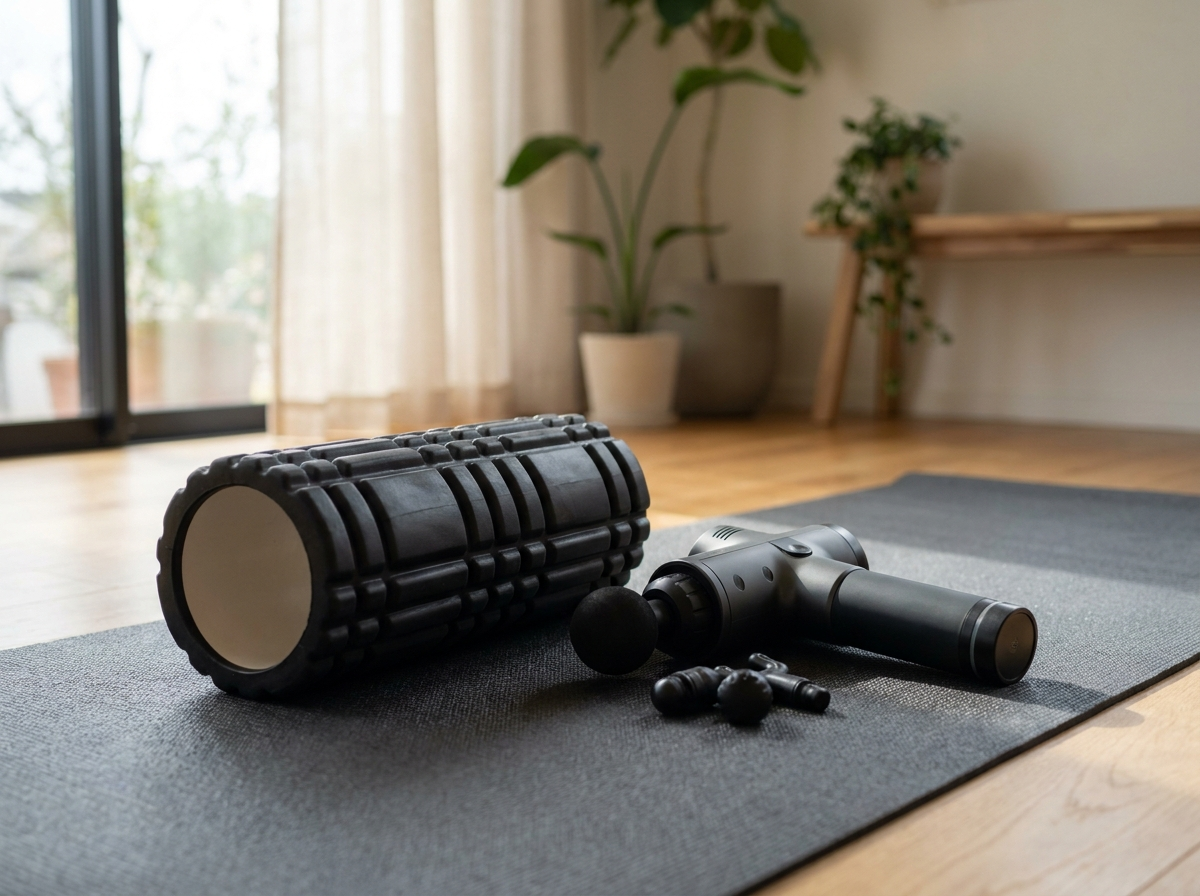
Fascia Roller: Benefits and Limitations
The foam roller is affordable, durable, quiet, and doesn’t require a battery. It’s ideal for large muscle groups such as the thighs, calves, back, and glutes. The research evidence here is relatively solid: A meta-analysis by Wiewelhove et al. (2019, Frontiers in Physiology) concludes that foam rolling improves flexibility in the short term and reduces muscle soreness after exercise—without impairing performance.
The Limitation: For specific, deep-seated trigger points, the roller is less precise, and the intensity can only be adjusted by changing your body position and the contact area—not at the push of a button.
Massage Gun: Strengths and Limitations
The massage gun (percussive therapy) stands out for its precision and speed: You can target specific muscles and trigger points, adjust the intensity via frequency and attachments, and be ready to go in seconds—even while standing or on the go. It’s ideal for localized tension, a quick warm-up, or targeted post-workout care for specific muscle groups.
The drawbacks: It costs more, requires a fully charged battery, and is louder. In addition, it’s important to use it correctly and with care—working on one spot for too long or applying too much pressure doesn’t provide any additional benefit.
A Direct Comparison
The following table compares the two tools based on the most important purchasing criteria.
| Criterion | Fascia Roller | Massage Gun |
|---|---|---|
| Active area | extensive | selective, targeted |
| Adjust the intensity | About Body Weight & Posture | Adjustable by frequency and attachment |
| Entry-Level Price | low | higher |
| Handling | Physical effort required | convenient, even with one hand |
| Portability | bulkier, but without a battery | Compact, requires a battery |
| Volume | quiet | audible |
| Ideal for | Major muscle groups, warm-up | Trigger Points, Targeted Follow-Up |
When to Use Which Tool? Specific Use Cases
- Warming up before a workout: Both methods work. The foam roller provides a broad-area warm-up, while the pistol squat targets specific areas—briefly and at moderate intensity.
- After your workout / cool-down: Gently rolling out large muscle groups feels good and improves flexibility.
- Targeted tension (e.g., neck, calf): This is where the massage gun really shows off its precision.
- On the Go & While Traveling: The compact massage gun is more convenient.
- Small Budget / Beginner: The foam roller offers the best value for your money.
The takeaway from this section: It’s rarely an “either/or” situation. If you train regularly, you’ll get the best results with both—the roller for the surface, the pistol for the point.
Buying Guide: What to Look For
When choosing a foam roller, consider the firmness (soft for beginners, firmer for advanced users), length (long rollers are also good for the back), and surface texture (smooth vs. textured). When choosing a massage gun, pay attention to amplitude (depth of penetration), adjustable frequency settings, battery life, weight, and the included attachments.
You can find suitable models in the Massage Guns and Foam Rollers & Massage Rollers categories. The Regeneration collection provides an overview of our entire recovery lineup—from compression to cold therapy. All products come with carbon-neutral shipping, and our customers have rated us ★4.88/5 based on over 5,000 reviews.
Common Mistakes in Use
- Holding a pose for too long: 30–60 seconds per muscle group is sufficient; “more” offers no additional benefit.
- About Bones and Joints: Never roll or pulse directly over the spine, knees, or bony prominences.
- Too much pressure: The sensation should be noticeable but not painful. Pain is not an indicator of quality.
- For acute injuries: In cases of inflammation, fresh strains, or bruises, do not apply a roll or a pistol to the affected area.
- If you want to replace recovery: Sleep, nutrition, and training management remain the foundation—both tools are complementary.
Frequently Asked Questions
Massage gun or foam roller—which is better?
Both work in similar ways, but they’re different: The roller covers a large area, is affordable, and is quiet; the gun is precise, adjustable, and fast. For most people, the combination is ideal—the roller for large areas, the gun for targeted trigger points.
What does science say about the fascia roller?
The meta-analysis by Wiewelhove et al. (2019) found that foam rolling improves flexibility in the short term and reduces muscle soreness after exercise—without impairing performance.
Does a massage gun help with muscle soreness?
It can relieve the pain associated with delayed onset muscle soreness (DOMS) and improve blood circulation. It does not accelerate the actual repair process—like the foam roller, it primarily provides symptomatic relief.
How often can I use the tools?
You can do this every day, as long as you keep the intensity moderate (30–60 seconds per set, noticeable but not painful). Start with a short, invigorating session before your workout, and end with a gentler one afterward.
Which tool is best for whom?
Beginners and budget-conscious users are best off starting with a foam roller. Those who work out frequently, want to target specific muscles, or need flexibility while on the go will also benefit from a massage gun.
How to Use a Foam Roller Correctly
Place the target muscle on the foam roller and support yourself with your arms or legs to control the pressure. Roll slowly—about two to three seconds per pass—along the entire length of the muscle, never over joints or bones. If you find a particularly tender spot, hold it gently for a few seconds and breathe out consciously until the tension subsides. Thirty to sixty seconds per muscle group is sufficient. Common areas include the front and back of the thighs, calves, glutes, and upper back.
How to Use a Massage Gun Correctly
Place the massage gun on the relaxed muscle without applying any additional pressure, and let the device do the work. Move it slowly over the muscle area, holding it on each spot for 15–30 seconds, and avoid bones, joints, and the cervical spine. Start with a low frequency setting and a soft attachment; only increase the intensity once the muscle has adjusted. Before your workout, use it briefly and vigorously; after your workout, use it gently and for a little longer.
Example of a Simple Recovery Routine
A routine suitable for everyday use might look like this: Before your workout, spend two to three minutes gently rolling out the major muscle groups and specifically targeting the areas you’ll be working. After your workout, take five minutes to gently roll out the muscles you’ve worked. On non-workout days or in the evening before bed, use the massage gun specifically on areas where you feel tension—such as your neck or calves. Consistency is key: short, regular sessions are more effective than infrequent, long ones.
What Neither Tool Can Do
As useful as massage rollers and guns may be, they are no substitute for the basics of recovery. Sleep is the most important recovery factor of all, followed by adequate protein and energy intake, as well as sensible training management that includes planned rest periods. Massage devices primarily affect pain perception and short-term mobility; they do not accelerate tissue healing. Those who understand this use both tools as a sensible complement—and don’t expect miracles that no tool can deliver.
The bottom line is this: If you have to choose just one tool, base your decision on your goals and budget. For a broad introduction, large muscle groups, and a tight budget, the foam roller is the most sensible choice—it’s durable, quiet, and doesn’t require a battery. If you want to target specific areas of tension, save time, and stay flexible on the go, go for a massage gun. And if you combine both, you’ll cover the entire spectrum of self-massage—from large areas to precise spots. In either case, make sure to look for good build quality and an intensity level that suits your needs, and your recovery tool will serve you well for years to come.
Conclusion
Massage guns and foam rollers aren’t competitors—they’re complementary tools. The foam roller provides broad-spectrum, scientifically proven benefits for mobility and pain relief at a low cost; the massage gun complements it with precision, speed, and comfort. If you work out regularly, combine both—and keep in mind that true recovery comes from sleep, nutrition, and smart training management. Not sure which tool is right for you? Ask our team —we’ll give you honest advice.