

- The cryosauna is an open-top single-person cabin, usually cooled with nitrogen—the head remains outside. The whole-body cryotherapy chamber (WBC) is a walk-in room, usually cooled electrically, in which the entire body, including the head, is exposed to the cold.
- The walk-in cryochamber is ideal for high throughput and multiple people per session; the cryosauna is ideal for small areas and quick individual sessions.
- Nitrogen operation requires a continuous gas supply and ventilation; electric chambers operate without a gas feed.
- The scientific evidence on recovery is mixed —the design determines how the device works and the user experience, not whether it offers a medical cure.
The difference in a nutshell: In a cryosauna, you stand in an open-top single cabin, while your head remains above the edge, outside the cold—usually cooled with liquid nitrogen. With a cold chamber (Whole-Body Cryotherapy, WBC), you enter a walk-in room—usually electrically cooled—where your entire body, including your head, is exposed to the cold. Both use very low temperatures (below −100 °C) and short sessions lasting two to four minutes—the practical difference lies in their design, operation, and throughput.
This guide is intended for studios, spas, rehabilitation centers, and longevity facilities that are deciding between the two types of equipment. We compare them based on criteria that reflect the factors that truly matter in day-to-day operations and provide an honest assessment of the evidence. Medical indications and contraindications should be determined by a physician—this article is not a substitute for medical advice.
Cryosauna: The Open Single Cabin
The cryosauna—technically known as partial-body cryotherapy —is a cylindrical chamber in which the user stands on a platform. The head protrudes from the top and remains at room temperature, which reduces the feeling of confinement. Cooling is typically achieved using vaporizing nitrogen, which allows very low temperatures to be reached quickly. Operational advantages include a compact footprint, short warm-up time, and fast individual sessions. Factors to consider include the continuous nitrogen supply, requirements for room ventilation and oxygen monitoring, as well as supervision, since the user should not be left alone during the treatment.
Cold Chamber (WBC): the walk-in room
A walk-in cold chamber consists of one or more rooms that you can enter and move around in freely. Your entire body—including your head—is exposed to the cold, dry air. Modern chambers are often electrically powered and therefore do not require any consumable gas. This simplifies operation and regulatory approval and often allows multiple people to be treated simultaneously or in quick succession. Studies suggest that electric systems can even achieve uniformly cold temperatures in many areas of the body. The trade-off: more floor space, higher power consumption, and greater construction costs.
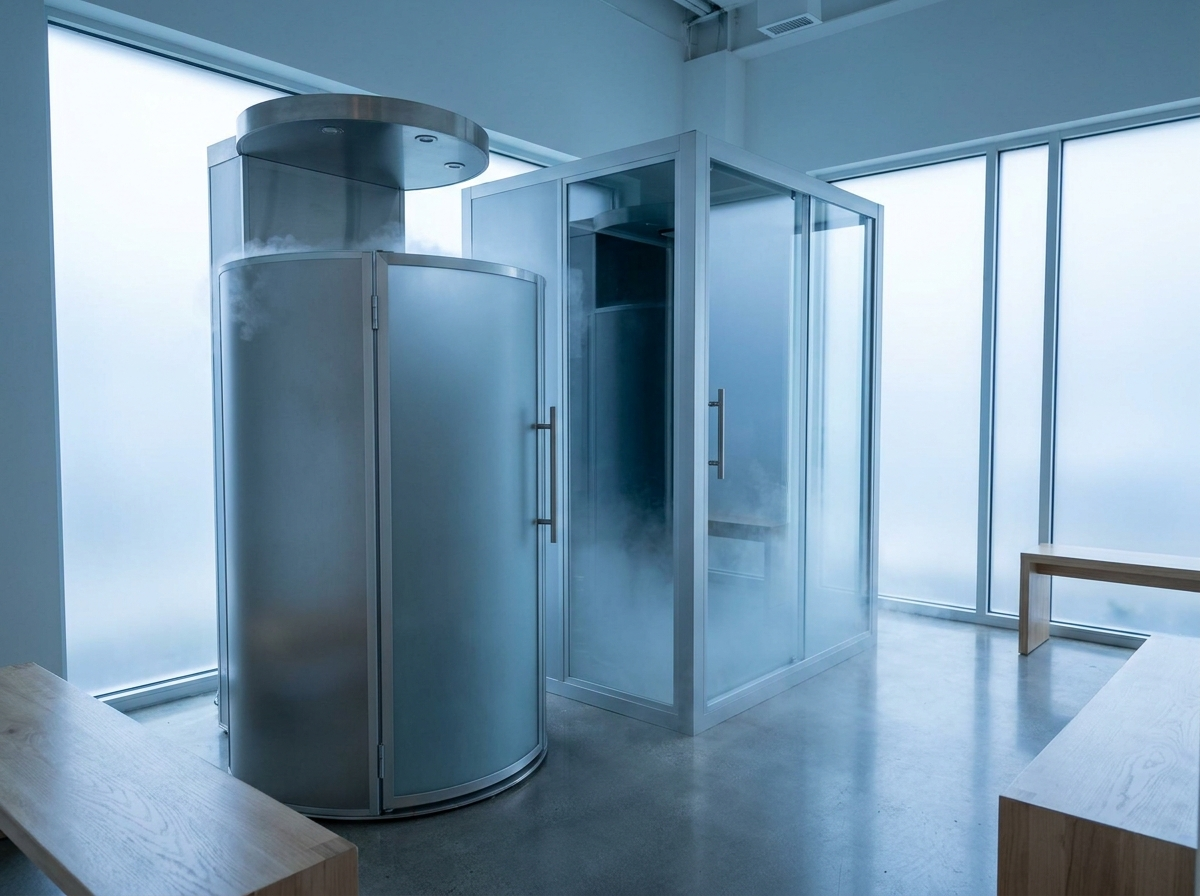
A Direct Comparison
| Criterion | Cryosauna (N2, open) | Cold Chamber / WBC (electric, walk-in) |
|---|---|---|
| Head Exposure | Keep your head out of it | Entire body, including the head |
| Cooling | Mostly liquid nitrogen | Mostly electric, with no fuel consumption |
| Capacity | Individual | Multiple people are possible |
| Footprint | Compact | Larger, walk-in room |
| Operating Expenses | Gas Supply, Ventilation, O₂ Monitoring | Electricity, higher connected load |
| Ideal for | Small areas, fast single-unit operation | High Throughput, Groups, Premium Experience |
For a comprehensive buying guide on cryotherapy technology—nitrogen versus electric in detail—see our guide “Buying a Cryotherapy Chamber: N2 or Electric?” To learn how a walk-in cryotherapy chamber differs from a traditional ice bath, read “Cryotherapy Chamber or Ice Bath?”
What does the evidence show?
To be honest: The body of research on whole-body cold therapy is mixed and inconsistent. A Cochrane review on its effects on post-exercise muscle soreness (Costello et al., 2015, CD010789) concluded that the available evidence is insufficient to clearly recommend WBC for the prevention or treatment of muscle soreness. In contrast, an updated review article in *Frontiers in Physiology* (2017) describes plausible physiological effects—such as on inflammatory markers and the autonomic nervous system—but also emphasizes the limited quality of the data and the fact that more cost-effective methods, such as cold-water immersion, can achieve comparable effects.
For you as an operator, this means: Position whole-body cold therapy as a wellness and recovery service, not as a medical treatment. Avoid making claims about curing illnesses or providing medical cures in your communications, and refer customers to doctors or professional medical associations for medical questions. This will ensure you remain legally compliant and credible.
Which design is right for your business?
- Compact studio, limited space, individual sessions: The cryosauna is space-saving and quick for single-session use.
- High throughput, groups, premium positioning: The walk-in cold chamber accommodates more people per time slot and offers a high-quality experience.
- No need to handle consumable gas: Electric chambers eliminate the need for nitrogen logistics and the associated ventilation and monitoring requirements.
- Addition to an existing recovery area: Consider whether a compact cryosauna would be a useful addition to your offerings without requiring major renovations.
Buying Guide: ProReset- Refrigeration Technology as a Project Solution
In practice, we support you across the entire spectrum with the cryotherapy equipment line from ProReset : The CryoPro e-Chill is an electric multi-user cryochamber designed for high throughput; the CryoPro Sauna and the space-saving CryoPro Mini are nitrogen-based cryosaunas for single-user operation; for targeted applications, the CryoPro Skin handheld device rounds out the portfolio. All systems are turnkey solutions that include consultation, delivery, and installation, and are priced individually upon request —specific prices are provided in your personalized quote. You can find the complete manufacturer overview in the “ProReset Recovery Technology” category.
As an authorized ProReset partner offering consulting, delivery, and installation throughout Europe, we design the system to suit your floor space, throughput, and technical requirements—from power consumption to ventilation.
Common Mistakes When Making a Selection
- Don't just look at the purchase price: Operating costs such as nitrogen, electricity, and maintenance are what determine cost-effectiveness over the years.
- Underestimating ventilation and safety: Nitrogen operations require oxygen monitoring and appropriate building systems.
- Miscalculating throughput: A single booth limits your capacity during peak hours—plan realistically.
- Communicating claims of a cure: prohibited and damaging to your reputation. Stick to statements about recovery and wellness.
- Order without a site survey: The connected load, ceiling height, and supply air must be determined in advance.
Frequently Asked Questions
What is the main difference between a cryosauna and a cold chamber?
In a cryosauna, the head remains outside the cold chamber, and nitrogen is typically used for cooling. The walk-in cold chamber (WBC) exposes the entire body, including the head, to the cold and is often electrically powered.
Which design has the higher throughput?
Typically, the walk-in cryochamber, because several people can be treated there at the same time or in quick succession. The cryosauna is designed for single-person use.
Does an electric cold chamber require nitrogen?
No. Electric chambers operate without a fuel gas. This reduces logistics, ventilation, and monitoring requirements, but requires a higher connected load.
Is whole-body cold therapy medically proven?
The evidence is mixed. A Cochrane review found insufficient evidence of its effectiveness in relieving muscle soreness. Position this service as a recovery and wellness offering, and refer customers to doctors or professional associations for medical questions.
How much does a cryosauna or cold chamber cost?
These systems are turnkey solutions that include consulting and installation. We calculate the price on a case-by-case basis upon request—depending on the design, location, and features.
Conclusion
Cryosaunas and cold chambers operate on the same principle but differ significantly in how they are used: The open cryosauna offers a compact footprint and quick single-session use, while the walk-in cold chamber provides high throughput, group use, and—when using electric cooling—no need for consumable gas. Make your decision based on your available space, throughput, and technical requirements; clearly position it as a recovery service; and plan the location before making a purchase.
Are you wondering which model is right for your studio? Contact us for a personalized consultation and a custom quote. Scientific background: Cochrane Review on whole-body cold therapy.