

Abstract
- Both cool—but in different ways: a cold chamber with dry air (~−110 °C, 2–3 min), and an ice bath with water (~10–15 °C, 5–15 min).
- Surprising: "Warmer" water lowers muscle temperature more significantly—water conducts heat much better than air.
- Ice baths have been studied more extensively and are more affordable; cold chambers are faster, dry, and offer high throughput for gyms.
- Rule of thumb: At home/for athletes → ice bath. Gym/clinic with high patient volume → cold chamber as an investment.
Cold Chamber or Ice Bath? An Honest Comparison for Your Recovery
In short: Both cool the body, but in different ways—and one isn’t necessarily “better” than the other. The cold chamber uses extremely cold, dry air (around −110 °C for 2 to 3 minutes), while the ice bath uses water at 10 to 15 °C. Ironically, the “warmer” water actually lowers muscle temperature more effectively because water conducts heat far better than air (Costello et al., NCBI).
Which cold therapy is right for you or your studio depends on your goals, budget, and client volume. This comparison provides an honest look at how both work, what the studies actually show, how much they cost—and which option is best for whom.
How Cold Chambers and Ice Baths Work
The Cold Chamber (Whole-Body Cryotherapy, WBC)
In a whole-body cryotherapy chamber, you stand in extremely cold, dry air for 2 to 3 minutes. Professional systems typically operate in two stages: a pre-chamber at around −60 °C and a main chamber in the range of −110 to −160 °C. The treatment involves an intense cold shock to the skin, which triggers a strong vascular and nervous system response—all within a relatively short treatment duration and in a dry, easily controllable environment.
The Ice Bath (Cold Water Immersion, CWI)
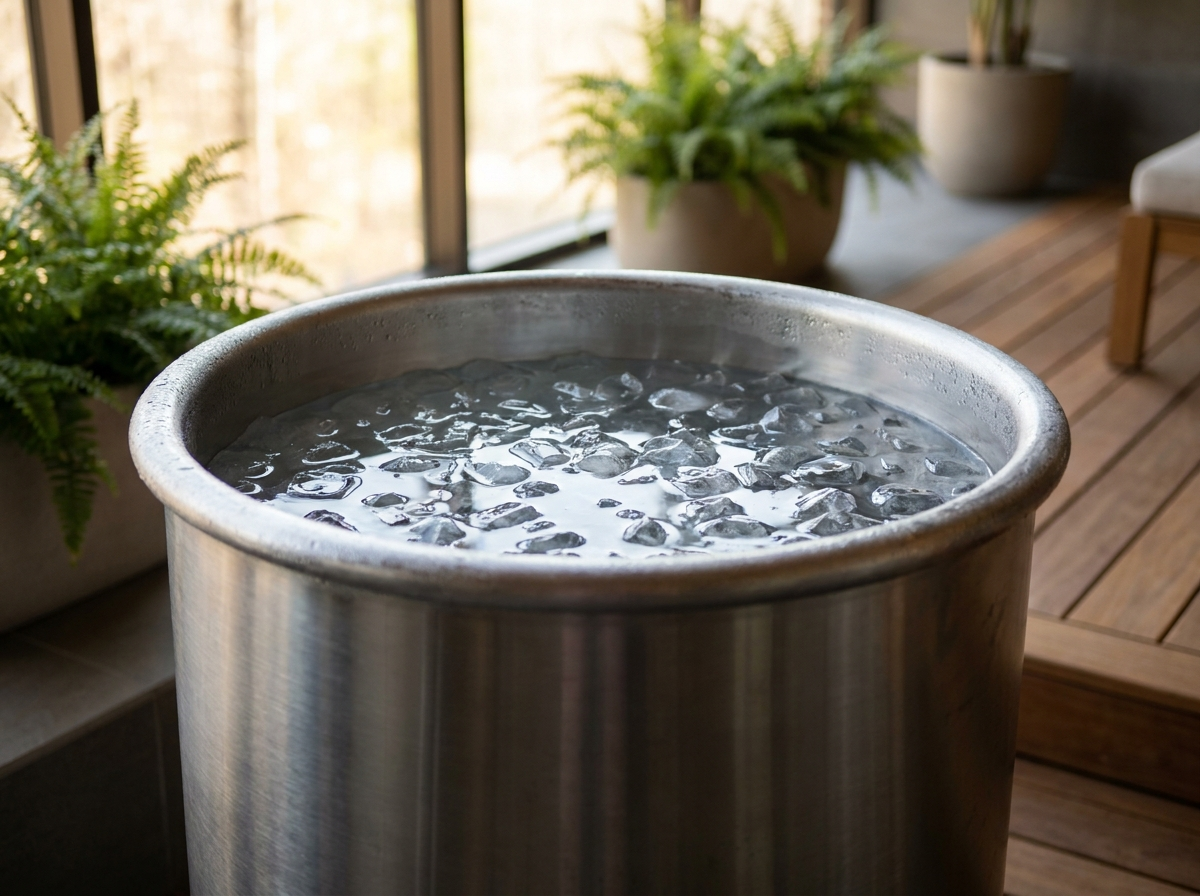
During an ice bath, you immerse yourself in water at a temperature of about 10 to 15 °C for about 5 to 15 minutes. Because water directly surrounds the body and efficiently draws heat away, it cools the tissue more deeply and for a longer duration than air of the same perceived intensity. That’s exactly what makes the ice bath a classic recovery method—simple, effective, and well-researched.
The physical reason for this lies in thermal conductivity: Water conducts heat about 20 to 25 times better than air. That is why 12 °C water feels significantly colder than 12 °C air—and draws heat from the underlying tissue more quickly and more deeply. The very low air temperature in the cold chamber is therefore not a direct measure of the actual cooling effect on the muscle. Those seeking the maximum penetration depth of the cold will find water to be the better option; those who prefer a brief, intense skin stimulus combined with dry comfort will find the chamber to be the better choice.
What's the point of cold, anyway? The mechanism
Before we compare the two, it’s worth taking a look at what cold does to the body—because the effect is similar in both methods. The cold stimulus causes the blood vessels to constrict (vasoconstriction). This temporarily reduces blood flow to the affected tissue, which can limit swelling and the spread of inflammatory reactions. After the stimulus, as the body warms up again, the blood vessels dilate—a “pump” effect designed to aid in the removal of metabolic waste products.
Added to this is a direct pain-relieving effect: Cold slows nerve conduction and raises the pain threshold, which is why muscle soreness feels subjectively less intense after a treatment. The mental effect should not be underestimated either—many users report a pronounced feeling of freshness and alertness. Cold is therefore a useful tool for acute recovery after intense exercise; however, it is not a “miracle cure” for improved performance. That is precisely why it’s worth making a sober comparison of the two approaches.
What the Studies Really Show
In this case, honesty is more valuable than marketing. Three findings are well-documented:
- Water provides deeper cooling: A comparative study showed that 8 °C water lowers muscle temperature more effectively than −110 °C cold air—despite the much lower air temperature (Costello et al.).
- Short-term performance: A meta-analysis found that whole-body cold exposure restored vertical jump height slightly better than an ice bath within 24 hours—however, after 48 hours, the difference was no longer significant (Systematic Review & Meta-Analysis, NCBI).
- Inflammation: There is some evidence that cold chambers can reduce inflammatory markers; however, the body of research is smaller than that for ice baths.
Bottom line: Both reduce muscle soreness and support immediate recovery. The ice bath has been more extensively studied and cools more deeply, while the cold chamber may offer a slight short-term advantage and is significantly more comfortable to use. So far, there is no conclusive, long-term evidence proving the chamber’s superiority.
Cold Chamber vs. Ice Bath: A Direct Comparison
| Criterion | Ice Bath (CWI) | Cold Chamber (WBC) |
|---|---|---|
| Temperature | ~10–15 °C water | ~−110 to −140 °C air |
| Duration | 5–15 minutes | 2–3 minutes |
| Tissue Cooling | deep & lasting | shallow but intense, shorter |
| Comfort | wet, cold, challenging | dry, short, pleasant |
| Research Literature | extensive | smaller, growing |
| Investment | low–medium | high (capital investment) |
| Ongoing Costs | minimal (water, cooling) | higher (electricity/cooling, maintenance) |
| Studio Throughput | limited (cleaning, water changes) | high (short sessions) |
Costs & Cost-Effectiveness
An ice bath is a practical way to get started: it’s an affordable purchase, has low running costs, and is ready to use quickly. For home use, small studios, and individual athletes, it’s almost always the more economical choice. You can find premium ice baths with cooling units and filtration systems in our Ice Bath Collection.
The cold chamber is a capital investment. It pays off in settings where large numbers of people are processed quickly—such as in larger studios, performance centers, or high-throughput rehabilitation facilities. The short sessions (2–3 minutes) allow for more treatments per hour, and the dry, “premium” experience can be positioned as a paid service. This is offset by higher purchase, energy, and maintenance costs. We showcase professional cryotherapy systems in our Cryotherapy collection.
Who stands to benefit from what?
Home & Individual Athletes → Ice Bath
If you want to recover on your own, an ice bath is almost always the right choice: affordable, effective, and deeply cooling. You can find out how to use it properly (temperature, duration, frequency) in our ice bath buying guide.
Studio, Performance Center & Clinic → Cold Chamber (or both)
Businesses that serve many customers in a short amount of time and market recovery as a premium service benefit from the chamber’s throughput and convenience. Many top studios offer both and combine them with other recovery methods, such as compression boots and fascia tools.
Important: Timing & Safety
An often-overlooked point: If your primary goal is to build muscle, you should not use cold therapy immediately after every strength training session—research suggests that intense cold immediately after strength training can inhibit muscle-building adaptations. On pure recovery days or after endurance training or competition, however, cold therapy is beneficial. Both methods also have contraindications (e.g., certain cardiovascular conditions). If in doubt, consult a doctor and start with short, moderate sessions.
A simple starting protocol: For an ice bath, start at about 12 to 15 °C for two to three minutes, and gradually work your way up to colder temperatures or longer durations over time. In the cold chamber, the 2 to 3 minutes specified by the operator are sufficient—longer isn’t better. More important than the exact temperature is consistency and calm, controlled breathing during the session. Those who use cold therapy specifically after a competition or intense endurance exercise will reap the greatest benefits.
Buying Guide
Die ehrliche Empfehlung: Triff die Entscheidung nach Ziel und Durchsatz, nicht nach Hype. Fürs eigene Training oder ein kleines Studio ist ein gutes Eisbad meist die wirtschaftlichste, am besten belegte Lösung. Erst bei hohem Durchsatz und Premium-Positionierung wird die Kältekammer zum sinnvollen Invest. Kraftathlet führt beide Welten, über 5.000 zufriedene Kunden vertrauen uns, und du kaufst mit 30 Tagen Rückgaberecht. Für eine Empfehlung zu Modell, Größe und Aufstellung beraten wir dich über unser Kontaktformular.
Common Mistakes in Cold Therapy
- Too cold, too long: Colder isn't necessarily better. Moderate temperatures and short durations are enough to achieve the recovery effect.
- Exposure to cold immediately after every strength training session: Can slow down muscle growth — Pay attention to timing.
- Confusing chamber temperature with its effect: Air at −110 °C sounds more extreme, but it doesn't cool the tissue as deeply as cold water.
- Investment Without Throughput: A cold room that isn't utilized sufficiently isn't cost-effective.
- Ignore contraindications: If you have a pre-existing cardiovascular condition, consult a doctor beforehand.
Frequently Asked Questions
Which is better, a cold chamber or an ice bath?
For deep tissue cooling and optimal recovery, choose the ice bath. For short, dry, high-throughput applications, choose the cold chamber. Both are equally effective for acute recovery—the choice comes down to budget, comfort, and throughput.
Why does air at −110 °C cool less effectively than water at 10 °C?
Because water conducts heat much more efficiently than air. It completely surrounds the body and carries heat away more quickly, causing the muscle temperature to drop more sharply despite the higher ambient temperature.
How long should you stay in the cold chamber or ice bath?
Typically 2 to 3 minutes in the cold chamber, and about 5 to 15 minutes in an ice bath at 10 to 15 °C.
Is a cold chamber worth it for a small studio?
Usually not. Without high throughput, the initial purchase and ongoing costs are difficult to justify. A high-quality ice bath is generally more cost-effective for small studios.
Does Cold Slow Down Muscle Growth?
Immediately after strength training, exposure to extreme cold can hinder the body’s adaptation. On rest days or after endurance training or competition, however, it is beneficial.
Conclusion
Choosing between a cold chamber and an ice bath isn’t a matter of personal preference, but rather a calculation based on your goals, budget, and throughput. The ice bath cools you down more deeply, has better utilization, and is more affordable—ideal for home use, athletes, and small studios. The cold chamber excels in speed, comfort, and throughput and is a worthwhile premium investment when utilization is high. Offering both options covers the entire recovery spectrum.
Get advice on the right cold therapy now → We’ll help you with selection, sizing, and setup—from ice baths to cold chambers.