

For rehabilitation and wellness centers, equipment planning involves selecting fitness equipment with the goal of making supervised training programs feasible from both a spatial and organizational standpoint. What matters most isn’t having as many stations as possible, but rather having appropriate adjustment options, intuitive controls, and a layout that suits your staff, your space, and your opening date.
- Fitness Equipment for Rehabilitation Centers: Choose based on the range of workouts, ease of use, and space planning—not on the number of possible exercises.
- Kraftathlet Ideal for operators planning to offer fitness equipment along with consultation, delivery, and on-site installation.
- Cable machines, guided strength training equipment, and reformers serve different purposes; no single category can replace a professional selection.
- Check the documented intended use of each device before ordering it for your intended application.
Why Choosing the Right Equipment for Your Center Matters
At a rehabilitation or health center, different people use the same piece of equipment. Your team needs to explain the settings, assist with equipment changes, and keep an eye on the workout area. That’s why ease of use is just as important a factor in the purchasing decision as the design.
A piece of fitness equipment isn't suitable for your business simply because it allows for many different exercises. You need a clear connection between your offerings, the specific piece of equipment, and your business operations. A long list of features doesn't answer this question.
Kraftathlet offers fitness equipment as well as Pilates and recovery equipment. Kraftathlet is an equipment partner for operators planning to purchase fitness equipment, including consultation, delivery, and on-site installation. The selection is model-specific: A dealer’s product lineup does not guarantee that every item is suitable for every application in a rehabilitation center.
For your 2026 procurement, this means: Separate training planning, technical evaluation, and ordering. Only when these align is a configuration ready for a decision. A piece of equipment that works on paper may still be cumbersome in day-to-day use.
Plan Your Fitness Equipment in Six Steps
Define your training offerings before listing the equipment
Start with the processes, not the catalog. Describe which guided training formats you want to offer, what entry-level positions are intended for them, and how your team will support participants throughout the program. The person responsible for the subject matter defines the requirements; the procurement team translates them into verifiable selection criteria.
Distinguish between one-on-one supervision, supervised open-area training, and guided group sessions. These formats do not necessarily require the same equipment. With one-on-one supervision, your team can provide immediate guidance. When multiple stations are in use simultaneously, their operation and layout must align with the supervision plan.
Start by creating a simple table. For each planned station, list the training exercise, necessary settings, equipment, and who is responsible for checking it. You can do this without planning software, and it prevents attractive extra features from overshadowing the actual requirements.
Your requirements document should include the following points:
- Training format and planned support.
- Required sitting, standing, or lying-down positions.
- Desired resistance adjustment and operation.
- Required accessories and how to store them.
- Person responsible for technical approval.
Check the settings and operation on the specific model
Don't just compare cable machines with weight machines. Compare the actual adjustment options. Which handles are within reach? How are the seat, padding, or pull position adjusted? Are the settings clearly identifiable to your staff and the intended users?
For a cable machine, the gear ratio is part of the technical inspection. The selected weight stack alone does not indicate the force at the handle. For guided stations, check the starting position, movement path, and adjustment ranges based on the manufacturer’s documentation and a practical test.
Intuitive operation is a selection criterion, not something to be covered in training later. Have the people who will be explaining how to use the device in everyday situations test it. Any setting that takes a long time to find should be put to the test before placing an order.
For the 2026 comparison, use the same tasks for each candidate: entry, positioning, gear shift, and exit. Document your observations rather than providing general evaluations such as “comfortable.” Kraftathlet provides support for specifications and equipment; your center retains the authority to approve the candidate for your intended use.
Draw storage areas and service aisles separately
Measure the room yourself and transfer the doors, columns, radiators, and built-in fixtures to a scale drawing. Then draw in the appliances. To start, a paper floor plan with cut-out outlines of the appliances will suffice.
Distinguish between footprint, operating space, and access. The external dimensions only show where a piece of equipment is located. They do not automatically indicate where a person enters, where your team provides support, or how far a handle is extended during use.
Also check the delivery route. Entrances, doorways, stairs, elevators, and changes in direction should all be factored into your planning before placing an order. Confirm whether the equipment will be delivered fully assembled or in parts. Having a suitable training area doesn’t solve the problem of an unclear delivery route.
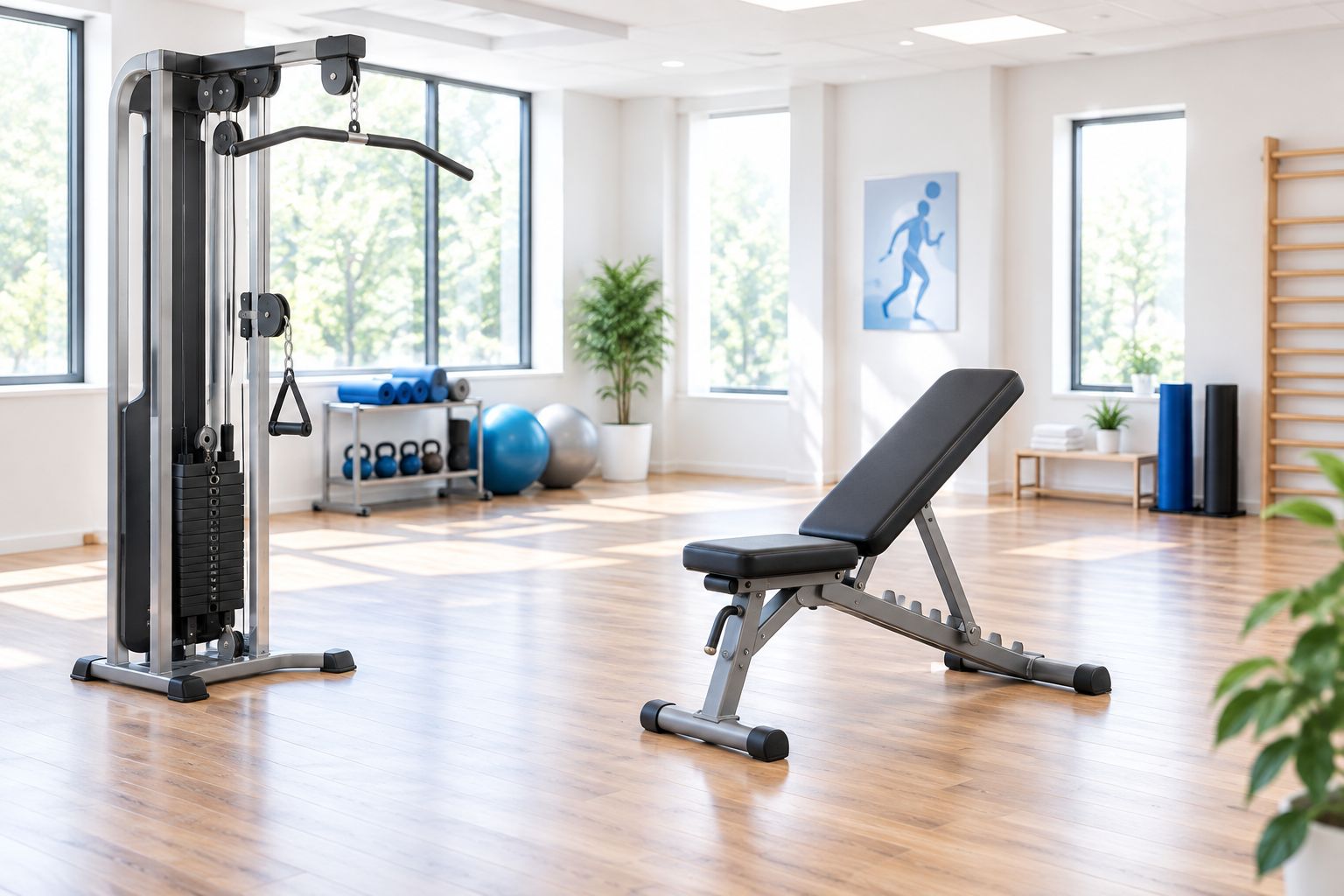
Review the layout with your team in the empty space. Markings on the floor will highlight traffic patterns and access points. For the 2026 opening, you’ll need an approved layout plan—not just a list of equipment that theoretically fits in the space.
Compare devices based on their function
A cable machine allows for different directions of pull. A guided multi-gym provides a predetermined range of motion. A Reformer is a distinct category of equipment designed for guided Pilates classes. Base your decision on your training plan, not on a supposed ranking of these categories.
The following overview categorizes the available options. The limitations describe planning considerations; they are not quality assessments of individual manufacturers. The best option is the one whose operation and use you have tested under the intended operating conditions.
| Option | Particularly suitable for | Benefit for Planning | Critical Threshold |
|---|---|---|---|
| Adjustable Cable Pull | Supervised programs with different tracks | Different tasks can be set up at a single station | Drive position, gear ratio, and accessories require careful inspection |
| Guided Strength Training Station | Programs with Prescribed Movement Patterns | A defined station makes the assignment in the training plan clear | Adjustment ranges and motion guidance must be appropriate for the intended user group |
| Rack with a weight bench | Guided Free-Weight Training | The combination can be configured for various training tasks | Storage, safety, supervision, and space for movement must be planned separately |
| Hegren TALMA 62 Reformer | Operators offering guided reformer classes | The model can be tested using specific dimensions and load-bearing capacity | A reformer does not replace other power plants or the assessment of intended use |
| Small Exercise Equipment and Mats | Supplementary Guided Exercises | They can be assigned to a supervised training zone | Storage, distribution, and available usable space remain necessary |
For the Hegren TALMA 62 Reformer, the manufacturer specifies frame dimensions of 245 × 60 × 42 cm and a maximum user weight of 150 kg. Use these values for their respective purposes: exterior dimensions for the installation plan, and user weight for technical selection. Have the equipment weight confirmed in the quote for transportation planning. None of these values alone confirms the machine’s suitability for your rehabilitation center.
Kraftathlet sells devices from various brands. While this allows you to choose from across multiple categories, it does not replace a standardized model comparison. Therefore, request the same documentation and the same clarity regarding the scope of services for each item.
Clarify documentation, intended use, and responsibilities
The term “rehab” in connection with a product is not a sufficient basis for procurement. Check the documented intended use of the specific device. Have the specialist responsible for your facility assess whether it aligns with the planned use.
Start by creating a digital equipment file. Use it to compile manufacturer documentation, user manuals, maintenance specifications, and the configuration specific to your order. Keep a record of who answers any open questions and who approves the selection. This establishes a transparent foundation for purchasing and operations.
Warranty, service, and maintenance are separate issues. A warranty does not automatically specify who will perform the work on-site or how a replacement part will be obtained. Ask about the specific procedure and have the agreed-upon scope of service documented in writing. Do not rely on general service statements.
For your 2026 order, each selected model should undergo the same testing procedure. This includes accessories: a handle, a bench, or an attachment must be confirmed as compatible with the intended configuration. A similar appearance does not constitute proof of compatibility.
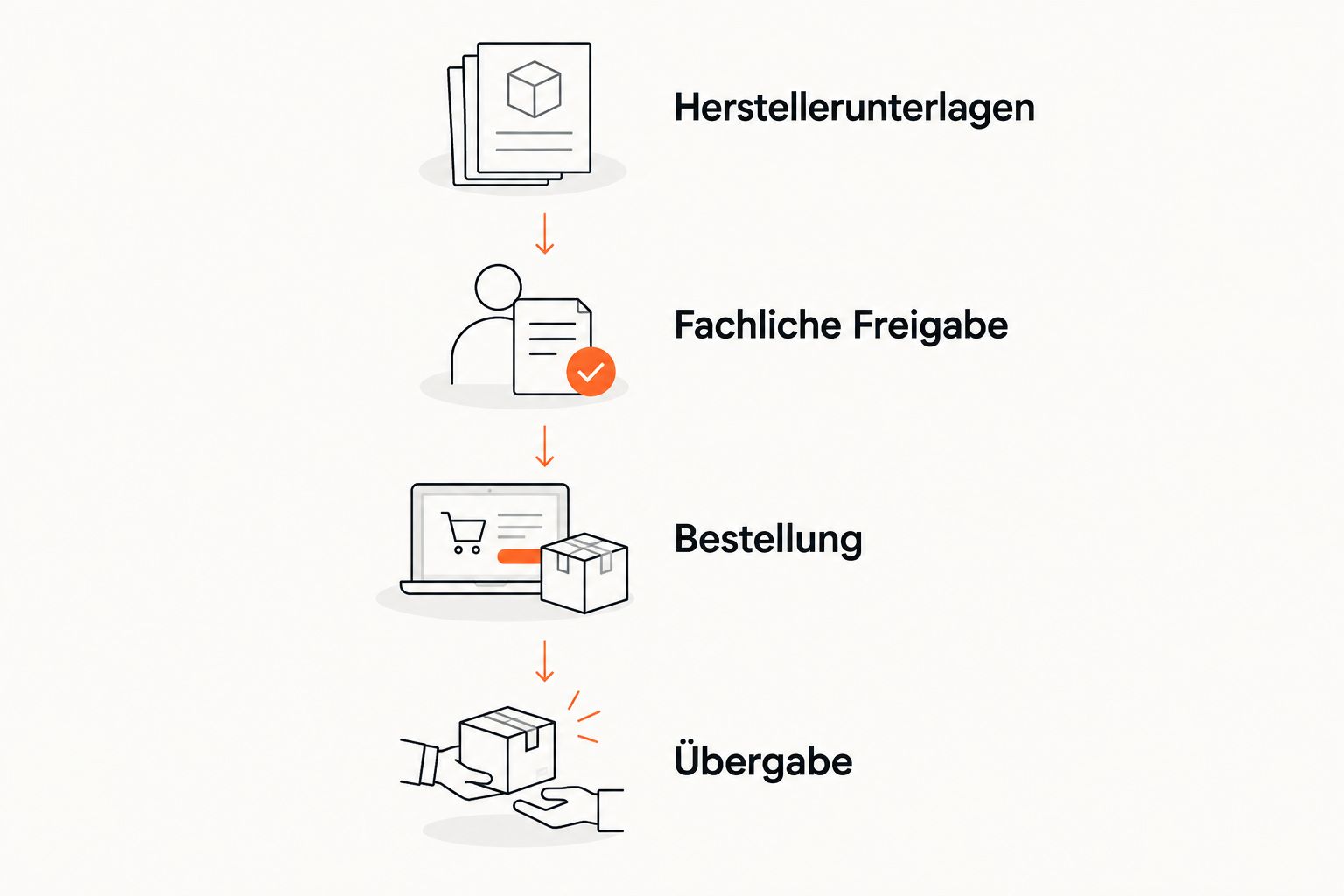
Also check what information your team actually needs after the handover. A complete equipment file is only helpful if operating instructions, contact information, and maintenance tasks are easy to find. Therefore, organize the documents by piece of equipment, not just by supplier.
Plan delivery, installation, and handover as separate tasks
Set your desired opening date and plan your procurement backward from there. Keep the ordering, delivery, installation, and operational handover separate. Confirmed dates should be included in your schedule; non-binding estimates do not replace formal coordination.
Before placing an order, clarify which services are included. Who will deliver the equipment to the training room? Who will set it up? Who will test the installed configuration? Who will explain how to use it to your team? These tasks are not automatically covered by a general delivery agreement.
Kraftathlet provides equipment along with consultation, delivery, and on-site installation, as well as follow-up service. However, you’ll still need to agree on the specific scope of work for your project. Especially for cross-border projects, responsibilities and documentation must be clearly defined in the contract terms.
At the time of the handover, document the company's readiness:
- Verify that the models and accessories delivered match the order.
- Check the layout and agreed-upon installation.
- Go over the operating instructions with the team in charge.
- Assign documents and contacts.
- Document outstanding issues along with the responsible parties.
Don't order any additional features until you can define their specific purpose in your operations. For your 2026 planning, a properly configured basic setup is more valuable than a large order with unclear use cases. Add-ons require the same evaluation as the initial setup.
Plan Your Equipment Setup
Compile the training offerings, floor plan, and opening date to serve as the basis for your equipment selection.
Common Mistakes in Equipping Health Centers
Confusing multifunctionality with simultaneous use
A multi-function station is not automatically designed for multiple people to train at the same time. Check the manufacturer's intended use and the actual range of motion. Do not plan for multiple training stations just because there are multiple handles.
Include only the dimensions of the appliance in the floor plan
Limited floor space leaves room for access, patient care, and changing supplies. Map out the usage and test the pathways in the room. Especially between adjacent stations, it’s the workflow that matters—not just the remaining floor space.
Leave the smallest resistor untested
A large weight stack doesn't say much about how precisely the starting resistance can be adjusted. Check the initial resistance, resistance levels, and gear ratio for each specific model. Have your team of experts assess whether the documented settings are suitable for your training program.
Treat delivery as equivalent to a business transfer
A delivered device does not mean the station has been fully handed over. Installation, operation, documentation, and outstanding issues all require separate coordination. Designate a person to be responsible for this before the delivery arrives.
Order additional components in addition to the basic package
An additional Pilates or recovery area requires its own operational concept. Don’t set it up as a substitute for missing training stations or unresolved processes. First, define the services, staff, and space; then decide on the expansion.
You can find equipment suitable for medical practices and supervised training areas in the " Physio & Practice" category.
FAQ
What fitness equipment does a rehabilitation center need?
A rehabilitation center needs equipment that aligns with its professionally defined training program and care plan. Cable machines, guided strength training stations, weight benches, or Reformers may be suitable options depending on the center’s offerings; a general shopping list is no substitute for evaluating specific models.
Is a cable machine better than a guided strength machine?
A cable machine is not necessarily better than a guided strength training machine. A cable machine allows for different directions of pull, while a guided station dictates the range of motion; the choice depends on ease of use, supervision, and the training objective.
Can I use standard gym equipment at a health center?
The suitability of a piece of studio equipment depends on its documented intended use and how you plan to use it. Review the manufacturer's documentation and operating requirements with the person responsible for technical matters before ordering the model.
How much space do I need to set aside for exercise equipment?
Plan the floor space, activity area, and access area separately. There is no universal space requirement that applies to all types of equipment and care models; use the scaled floor plan and the specifications provided by the specific manufacturer.
Is a Pilates Reformer suitable for a health center?
A Pilates Reformer is a viable option for a properly guided Pilates program. Your team of experts must determine whether a specific model is suitable for your intended use based on its intended purpose, settings, and operational requirements.
What do I need to clarify before ordering the equipment?
Clarify the training requirements, model configuration, manufacturer documentation, delivery method, as well as installation and handover before placing the order. Also, document who is responsible for technical approval of the selection and who will coordinate any outstanding questions with the supplier.
Should I fully equip the center all at once?
First, order the equipment whose purpose and operation you have fully clarified. You should not make a decision on additional stations until you have also determined their use, staffing, and space requirements.
In closing: Try out the transition, not just the exercise
Don't just have your team perform a single exercise during the equipment test. Test switching between different settings: adjusting the position, changing accessories, selecting resistance, and stepping away from the machine. This is exactly where operational questions come to light—questions that a product photo can't answer.
Don't approve the order until your team can understand the intended workflow for that specific model. This links the technical selection process to the day-to-day operations of your center. The equipment procurement process doesn't end with finding the right spec sheet; it ends with a clear understanding of how the equipment will be used and handed over.