

For a home cold chamber, an electrically cooled whole-body chamber is the first design to consider if you are planning a permanently installed cold room. An open nitrogen chamber requires a separate technical assessment; a cold plunge tub is an alternative for water-based cold therapy, but it is not a cold chamber.
- Home cold chamber: First check the design, installation space, and manufacturer approval, not the lowest temperature.
- Electric whole-body chambers are suitable for planning a permanently installed cold room with professionally assessed infrastructure.
- Open nitrogen chambers require a separate assessment of the gas supply, room ventilation, and safety concept.
- Cold plunge tubs are water-based alternatives and are not an equivalent substitute for a whole-body chamber.
- Kraftathlet accompanies professional recovery equipment with specifications, delivery, installation, and a dedicated contact person.
Why design comes before model
A home cold chamber is not an ordinary piece of furniture. You are planning a technical installation with installation requirements, operating procedures, and maintenance. Therefore, the first thing that matters for your 2026 purchasing decision is whether the system is suitable for the building and its intended use.
This also applies to a private wellness room within a larger studio, hotel, or real estate project. A compact equipment design alone does not answer either the question of connection or the question of safe operation. What matters is the specific design, including the manufacturer's documentation.
Kraftathlet is an equipment partner for studio and wellness operators planning recovery equipment, including delivery, installation, and support. At Kraftathlet, the focus is on equipping a usable area, not just the individual machine. For your planning, this means that the building, access, and operational organization should be included in the same request as the equipment.
This comparison categorizes designs according to their use. The order is a decision-making aid for planning, not a ranking based on temperature or claimed effects.
What makes a suitable home cold chamber
Evaluate every cold chamber offered against the same criteria. This will help you identify differences that remain invisible in a product image.
- Intended use: The manufacturer's documentation must cover your planned private or commercial use.
- Room and delivery: Equipment dimensions, service areas, door openings, and the transport route must all fit together.
- Technical infrastructure: Check the power supply, heat output, ventilation, and, if applicable, gas supply based on the specific installation.
- Safety concept: Request clear information on access, exit, monitoring, instruction, and procedures in the event of a malfunction.
- Service and operating procedures: Clarify maintenance, cleaning, spare parts, responsibilities, and the resumption of operation after an interruption.
A complete data sheet does not replace an assessment of the installation site. Conversely, a suitable room does not automatically make every model suitable. Both aspects must be considered together before ordering.
For a 2026 purchase, the supplier should explain what information about the building is required and what services are included in the installation. A general statement such as "home use" is not sufficient for this coordination.
Design overview
| Design | Suitable for | Key difference | Advantage | Limitation |
|---|---|---|---|---|
| Electric whole-body chamber | Permanently installed cold room | Chamber air cooled via an electric refrigeration system | No external nitrogen supply for cooling | Connections, heat output, and installation requirements remain project-specific |
| Open nitrogen chamber | Projects with professionally planned gas supply | Body area in the chamber, head outside | Self-contained chamber concept without a fully enclosed head area | Gas supply and safety concept are additional planning points |
| Cold plunge tubs for home | Water-based cold therapy instead of an air chamber | Immersion in water | Alternative equipment type if an air chamber is not desired | Water maintenance, entry, and drainage must be planned separately |
The table deliberately separates air-based applications from water-based applications. A cold plunge tub should only be included in your selection if you are prepared to change the usage concept. It is not a smaller model of the same chamber technology.
1. Electric whole-body chamber: for a permanent cold room
An electric whole-body chamber cools the air within an enclosed usage area. The body, including the head area, is inside the chamber; the exact design is determined by the manufacturer. Cooling is provided by an electric refrigeration system rather than an external nitrogen supply.
Suitable for: A permanently installed room whose technical requirements are assessed before purchase. This design is the first option to consider if you are specifically looking for a whole-body application in cold air.
Electric whole-body chamber: Advantages
The electric whole-body chamber does not require nitrogen deliveries for cooling. This removes the organization of this gas supply from the operating concept. In addition, the desired installation can be planned as a permanent building project together with the power supply, installation space, and service access.
Another advantage is the clear definition of the usage concept: You are choosing an air chamber rather than a water tub. This makes coordination between the operator, planner, and supplier easier because everyone involved is specifying the same type of equipment.
Electric whole-body chamber: Limitations
Electric cooling does not mean that any living space is suitable. Connection power, heat output, noise levels, and installation requirements must be specified in the documentation for the particular system. The accessibility of technical components must also be included in the room plan.
You must also clarify how operation, access, and monitoring are planned. The designation "for home" is not an approval for unsupervised use. The operating instructions and the intended use of the respective installation are decisive.
What to consider when choosing
Ask to see the space required in an operational state, not just the external dimensions of the chamber. This includes all components the manufacturer provides for installation and maintenance. A layout that does not show the technical area is not sufficient as an installation plan.
For your 2026 selection, you should also discuss the procedure for an operational interruption. Who checks the installation after a malfunction, and what conditions apply to restarting it? These answers are part of the decision-making process before you commit to a specific design.
Our assessment: check carefully. The electric whole-body chamber is the right starting point for a permanent cold room, provided that manufacturer approval and the building assessment support the planned use.
2. Open nitrogen chamber: for professionally planned gas supply
In an open nitrogen chamber, the head remains outside the cooled body area. Nitrogen is used for cooling; how the gas and cooled air are managed depends on the system. This design is therefore not equivalent to a fully enclosed whole-body chamber.
Suitable for: Projects in which gas supply, installation, and operation are professionally planned. For a private wellness area, the chamber design alone is not a sufficient selection criterion.
Open nitrogen chamber: Advantages
The open nitrogen chamber offers a different usage concept than an enclosed chamber. The head area remains outside the chamber. If this design is specifically desired, it can be specified as a separate option and compared with the manufacturer's requirements.
The supply is also made visible as a separate process: nitrogen storage, provision, and handling must be clarified. For a professionally organized project, this separation creates clear responsibilities between the equipment supplier, professional planning, and gas supply.
Open nitrogen chamber: Limitations
Nitrogen can displace oxygen from the room air. Therefore, room ventilation, gas management, and the monitoring measures provided for the specific system are central safety issues. An open head area does not replace a tested room concept.
In addition, the organization of the gas supply must be considered. Containers, transport routes, handling, and responsibilities are not minor details of the order. You need a transparent operational organization that also works during staff changes or extended periods of non-use.
What to consider when choosing
Have the installation space requirements assessed by qualified individuals. Request a clear description of the gas supply and the necessary safety measures. General marketing claims about ease of use do not replace this documentation.
If you are planning a nitrogen chamber in 2026, also determine who will operate the installation and who will check its operational readiness. Private use and infrequent use do not remove these tasks from the concept.
Our assessment: wait until the gas supply and safety concept are clarified. The open nitrogen chamber is not a supposedly uncomplicated home solution that should be at the beginning of your selection.
3. Cold plunge tub: for a water-based concept
A cold plunge tub uses water instead of cooled air. You step into the tub; water management, cooling, and maintenance depend on the respective design. This makes the cold plunge tub a separate type of equipment and not a cold chamber.
Suitable for: A private or commercial wellness area that is deliberately designed for water-based cold therapy. Someone looking for an air chamber will not receive an equivalent usage concept.
Cold plunge tub: Advantages
A cold plunge tub allows you to rebuild your selection independently of an air chamber. You are planning a wet area with entry, water maintenance, and drainage. If this exact application is desired, it is the appropriate equipment category.
Operation of a cold plunge tub can also be clearly described: Who prepares the water, who checks the installation, and how is it cleaned? These tasks can be defined together with the room planning before purchase.
Cold plunge tub: Limitations
A cold plunge tub brings water into the installation area. The floor, access, cleaning, and handling of escaping water must therefore be included in the planning. Filling and draining must fit the actual building situation.
With multiple users, water maintenance is also a separate operating process. A cover does not replace either the manufacturer's instructions or a suitable cleaning concept. The specific requirements depend on the tub, technology, and use.
What to consider when choosing
Check whether the tub and, if applicable, separate cooling technology fit together in the room. Keep the entry and access points clear. A floor area that only accounts for the container is not yet a complete operating plan.
Our assessment: consider as an alternative, not as a cold chamber. The cold plunge tub is suitable if you specifically want to use water instead of cold air.
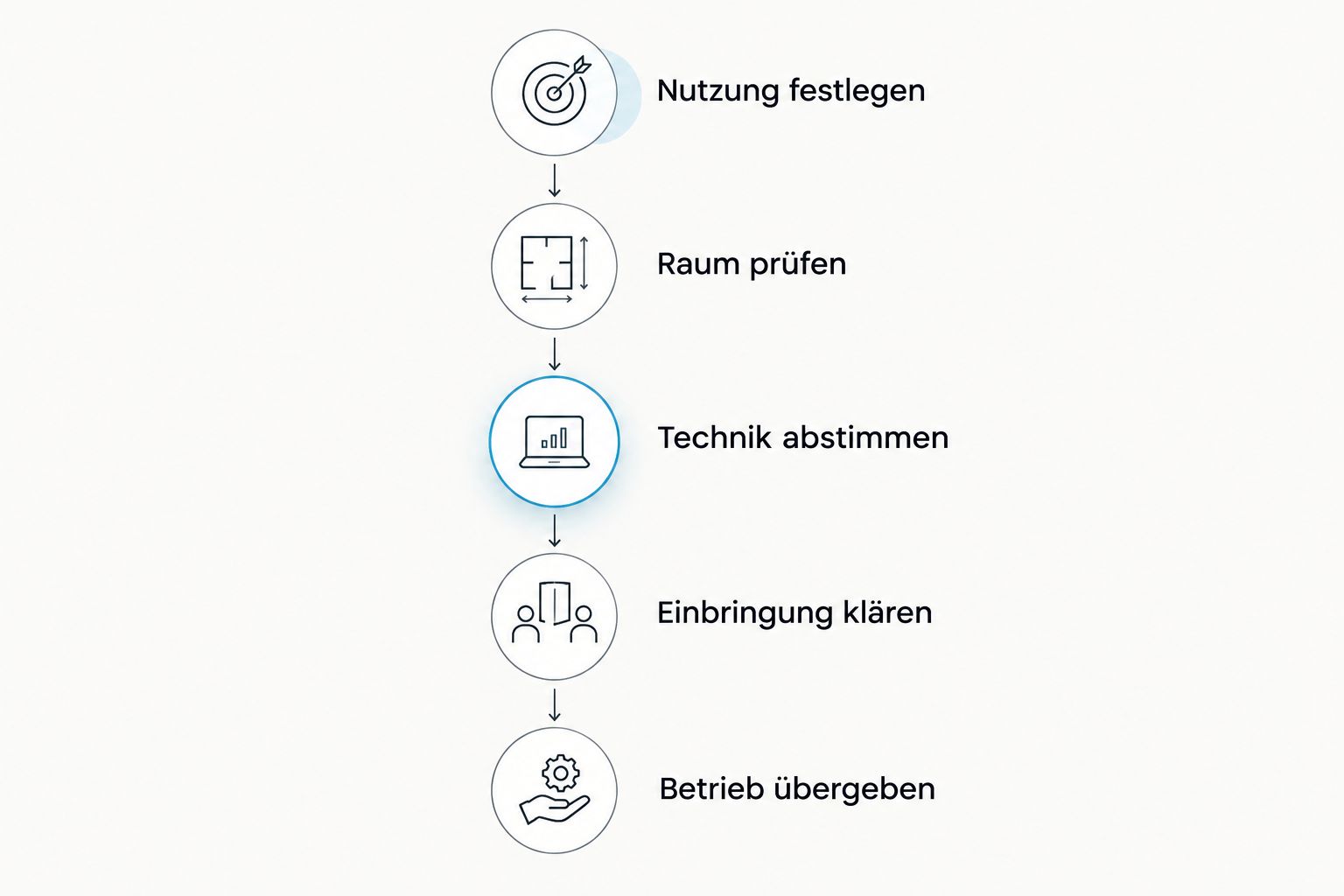
How to check the installation site before ordering
Define usage
First describe who uses the installation and who is responsible for its operation. Separate private use from an offer for guests or studio clients. The intended use must match the manufacturer's documentation.
Check the room
Record the installation area, ceiling height, access points, and existing connections. Add the area that you must keep clear for operation and maintenance. Equipment area and usable operating space are not the same.
Coordinate technology
Pass the room data on to the equipment supplier and professional planner. Have the connection requirements, ventilation, and heat output, or water or gas supply, reviewed together. Individual assurances without a coordinated overall plan are not sufficient to approve the order.
Clarify delivery
Track the transport route from the delivery point to the final location. Doors, stairs, elevators, and changes in direction are part of this. Clarify which components will be assembled on site and who will perform the installation.
Hand over operation
Request documented instruction and clear contact persons. Determine where the operating instructions, maintenance documentation, and malfunction information are located. The handover is only complete when the responsible persons know the intended procedure.
This is why the order is justified
The categorization is based on use, infrastructure, and operational organization. For a specifically desired air chamber, the electric whole-body chamber is the first option to consider. The nitrogen chamber follows as a separate concept with gas supply; the cold plunge tub is outside the actual chamber category.
There is therefore no single winner for every home. The right cold chamber is the installation whose intended operation fully suits your building and organization. An exceptionally low temperature does not replace any of this evidence.
Which cold chamber should you choose?
If you are setting up a permanent cold room in 2026, start with the electric whole-body chamber and a technical room check. Only decide on a model after installation, use, and service have been clarified. This is the standard recommendation for further selection, not a blanket purchasing commitment.
A nitrogen chamber comes into consideration if you want exactly this chamber concept and the gas supply is professionally organized. A cold plunge tub is the alternative if you deliberately switch your plan to water. Do not compare these options based solely on their external size.
For a project request to Kraftathlet, the room plan, location, intended use, and desired commissioning date are the relevant starting points. Request a configuration. A concrete specification is more helpful than asking about the strongest cooling.
You can find all cold chambers and cryosaunas with dimensions and prices in the Cold Chambers & Cryosaunas category.
FAQ
Which cold chamber for home should I check first?
First check an electric whole-body chamber if you are planning a permanently installed room for cold therapy in air. The selection assumes that manufacturer approval, the room, and the technical connections suit your use.
Is an open nitrogen chamber the same as a whole-body chamber?
No, in an open nitrogen chamber, the head remains outside the cooled body area. A closed full-body chamber also encloses the head area; the respective version must be checked using the manufacturer's documentation.
Can I put a cold chamber in a regular living space?
A regular living space is not automatically suitable as a location. Check the specific system's requirements for connections, heat output, ventilation, access, and service areas before ordering.
Is a cold pool an alternative to a cold chamber?
A cold pool is an alternative for water-based cold applications, but not a cold chamber. It requires its own concept for entry, water maintenance, cleaning, and emptying.
Can I use a cold chamber at home unsupervised?
The designation for home use does not imply permission for unsupervised use. The intended use, operating instructions, and safety concept of the specific system are decisive.
What documents do I need before buying a cold chamber?
You need the manufacturer's documentation on use, installation, connections, safety, and maintenance, as well as a corresponding floor plan. Delivery, bringing into the premises, assembly, and instruction should be clearly described in the offer.
What should I state in a cold chamber inquiry to Kraftathlet?
State the location, floor plan, access route, intended use, and desired commissioning date. This information forms the basis for coordinating the recovery equipment, delivery, and assembly.
One final planning tip
When considering a cold chamber for your home, check not only whether it fits, but also how the technical components can later be serviced or replaced. A clearly defined service area makes a suitable floor space into a suitable location.
Draw the maintenance access into the floor plan before ordering. For your 2026 project, this is a concrete decision aid: The room must accommodate the system during operation, not just on the day of delivery.