

Summary
- The strength training area is the most economically important space in your gym: Plan it in the order target group → equipment mix → space → budget, not the other way around.
- The industry is booming: 12.36 million members, €6.25 billion in revenue, and an average of €83,000 in investments per facility per year (DSSV Key Data 2026) – those planning now are planning for a growth market.
- As a rule of thumb, you need 4–6 m² per plate-loaded machine including user area, 8–10 m² per power rack station – plus at least 1.5 m wide walkways.
- For commercial use, you need equipment of class S according to DIN EN ISO 20957 – home fitness equipment is neither permitted nor durable in a gym.
Planning a Gym Strength Area: Space, Equipment, and Profitability for Your Fitness Studio
You plan a strength area in four steps: First, define your target group and positioning, then the equipment mix of free weights, plate-loaded, and selectorized machines. This determines the space requirements – and only at the end, the budget. The market for this is stronger than ever: According to the DSSV Key Data of the German Fitness Industry 2026, 12.36 million members train in 9,647 German facilities, and industry revenue increased by 7.4 percent to 6.25 billion euros. This guide takes you through all four steps – with space rules of thumb, equipment comparison, budget frameworks, and the most expensive mistakes in practice.
Why the Strength Area Determines Your Gym's Success
Strength training is no longer a niche for bodybuilders; it's the core of member business. According to DSSV, the market penetration of the fitness industry has reached 14.8 percent of the total population – and a growing number of these members specifically come for heavy compound exercises, guided machines, and structured training plans. At the same time, the industry is investing heavily: Around 798 million euros net flowed into facilities and infrastructure in 2025, an average of 83,000 euros per facility. Approximately 80 percent of operators plan to invest again in 2026.
What this means for you: Your members compare your strength area not with its condition in 2020, but with the freshly equipped competitor two streets away. A well-designed strength area directly impacts the two most important metrics – member acquisition (visible quality during trial training) and member retention (no waiting times, no broken equipment). With an average monthly contribution of 48.55 euros, each retained member accounts for almost 600 euros in annual revenue.
Step 1: Define Target Group and Positioning
Before you select a single piece of equipment, you need a clear answer to the question: Who is this strength area for? The DSSV figures show how differently segments are priced – and thus, how different the expectations for equipment are:
| Segment | Average Monthly Fee (DSSV 2026) | Expectation for the Strength Area |
|---|---|---|
| Chain facilities (discount to mid-range) | €40.54 | High equipment density, robust standard machines, self-explanatory |
| Independent facilities (owner-managed) | €59.24 | Quality and support, mix of machines and well-equipped free weight area |
| Special-interest studios | €80.02 | Specialization: Plate-loaded lines, powerlifting zone, premium brands |
The underlying rule: The higher your fee, the more your strength area must support your unique selling proposition. A premium studio with two old multi-presses will lose exactly the members who would be willing to pay 80 euros a month.
Step 2: Space Planning – How Much Space You Really Need
The Four Zones of a Strength Area
A functional strength area is divided into four zones that you should consciously separate: the free weight area (racks, benches, dumbbells), the plate-loaded zone for guided heavy training, the selectorized zone for beginners and circuits – and a free functional area for warm-ups and accessory training. The separation is not an end in itself: it manages traffic flow, reduces the risk of accidents, and ensures that beginners do not feel lost among heavy weights.
Space Rules of Thumb from Equipment Practice
Exact values depend on the equipment – these practical values, including user area and safety distance, have proven effective in planning:
| Station | Space Requirement (incl. user area) | Note |
|---|---|---|
| Power Rack with Barbell Station | approx. 8–10 m² | Include weight plate storage and plate racks; ceiling height min. 2.6 m for overhead pressing |
| Plate-Loaded Machine | approx. 4–6 m² | Plus plate racks within reach – otherwise plates will wander through the gym |
| Selectorized Machine | approx. 3–5 m² | More compact, as no plate handling is required |
| Dumbbell Station (bench + mirror) | approx. 6–8 m² | Keep dumbbell rack at least 50 cm away from the training area |
| Walkways | min. 1.5 m width | Main walkways more spacious; never lead through the free weight area |
In addition, there's the static load: a loaded power rack with weight plates can quickly concentrate several hundred kilograms on a few square meters. On the ground floor with a slab foundation, this is rarely a problem – above the first floor or in older buildings, a structural engineer should be involved in the planning before you order. High-quality subfloor protection made of rubber granulate is mandatory in any case, 20–40 mm thick in the free weight area.
Step 3: The Right Equipment Mix
The most important strategic decision in the strength area is the ratio of free weights, plate-loaded, and selectorized machines. All three have clear strengths:
| Criterion | Free Weight Area | Plate-Loaded | Selectorized |
|---|---|---|---|
| Target Group | Advanced, athletes | Ambitious + rehab after instruction | Beginners, circuit training |
| Durability / Maintenance | Very high / minimal | Very high – few cables, few wear parts | Medium – cables, pulleys, upholstery wear out |
| Beginner-friendly | Low (instruction needed) | Medium | Very high |
| Space Requirement per Station | High | Medium to high | Medium |
| Acquisition Cost per Station | Medium | Medium | Medium to high |
| Market Differentiation | High | Very high – visible quality signal | Low (standard everywhere) |
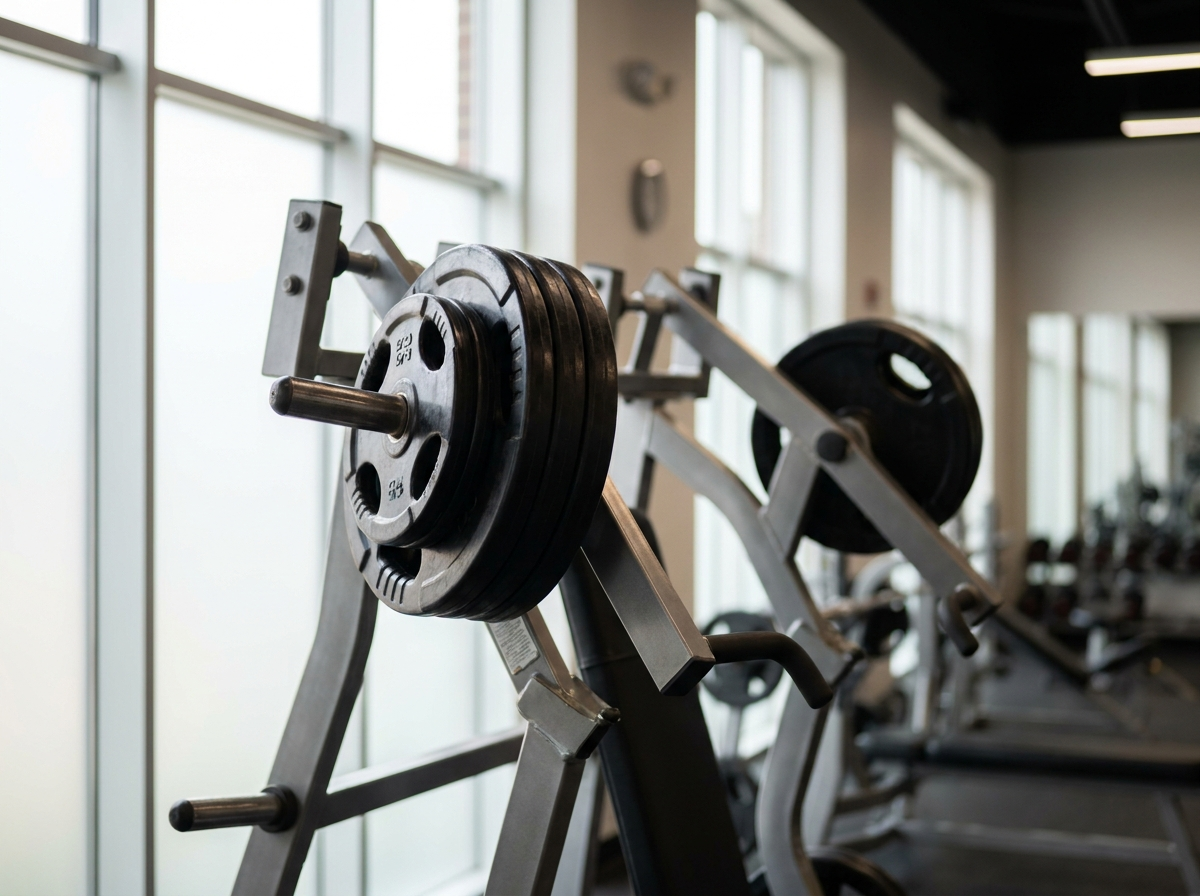
In practice, a mix of roughly one-third per zone proves effective for independent facilities, adjusted according to positioning: a performance studio emphasizes free weights and plate-loaded machines more, while a health-oriented studio emphasizes guided selectorized equipment. Plate-loaded lines are the strongest differentiating signal: they combine the feeling of free weights with guided safety, require almost no wear parts, and stand for serious training – exactly what high-paying members are looking for.
Step 4: Budget and Profitability
For orientation: In 2025, the industry invested an average of 83,000 euros net per facility (DSSV) – across all facility types and investment occasions. For the initial setup of a strength area, these magnitudes have proven to be realistic frameworks:
| Expansion Stage | Scope (Example) | Budget Framework (net) |
|---|---|---|
| Compact (Boutique/Micro Studio) | 2 racks, dumbbell set, 4–6 machines | approx. €30,000–€60,000 |
| Medium Independent Facility | 3–4 racks, full free weight area, 10–15 machines | approx. €60,000–€150,000 |
| Premium / Performance | Complete plate-loaded line, powerlifting zone, specialized equipment | from €150,000 |
Always calculate the investment against the member value: At an average contribution of 48.55 euros, one member generates about 583 euros in revenue per year. A strength area for 100,000 euros does not have to pay for itself over decades – it refinances itself if it permanently retains or gains 60–70 additional members over three years. The Total Cost of Ownership is crucial: a cheap piece of equipment that breaks down after 18 months of continuous operation costs more in downtime, repairs, and member frustration than a solid premium piece of equipment – downtime is a revenue killer in a gym because it affects the most active members.
Safety and Standards: What Applies in Commercial Operation
For gyms, the rule is: exercise equipment must be designed for commercial use. The DIN EN ISO 20957 standard distinguishes between equipment classes – for gym use, class S (professional/commercial use) is intended; home fitness equipment (class H) has no place in member operations. In addition, there are operator obligations: regular, documented maintenance and visual inspection, instruction for new members, and flooring that dampens shocks and keeps equipment non-slip. Those who work in a documented manner here protect not only members but also themselves in case of liability.
Buying Guide: How to Assemble Your Strength Area
Start with the anchor equipment that supports your positioning – racks and the plate-loaded line – then systematically add. A proven sequence: first the basic exercise stations (squat, bench press, deadlift, pull-up), then the large muscle groups via plate-loaded machines (leg press, rowing, chest press, lat pulldown), and finally isolation and comfort equipment. The complete range for the commercial sector can be found in our strength training collection – and how to approach the overall studio project, in the comprehensive guide to setting up a fitness studio.
As an authorized dealer with manufacturer's warranty, we at Kraftathlet support studio projects from space planning to delivery – over 5,000 customers trust this advice. For liquidity planning, acquisitions can be financed flexibly; just talk to us about it.
Common Mistakes in Strength Area Planning
Buying equipment before concept. Those who order first and then plan end up with a patchwork of equipment instead of an area with a clear signature – and realize too late that space or structural capacity is insufficient.
Underestimating walkways. On paper, 25 pieces of equipment fit, but in operation, members squeeze past each other. Plan pathways first, equipment second.
Saving on flooring. Damaged screed or worn flooring will later cost many times more than rubber flooring – not to mention noise conflicts with neighbors.
Using home equipment in the gym. Class H equipment cannot withstand continuous operation and is not used as intended in commercial settings – a warranty and liability risk.
Not factoring in maintenance. Cables, upholstery, and pulleys are wear parts. Those who do not plan a maintenance routine plan for downtime.
Frequently Asked Questions
How much space does a strength area need in a fitness studio?
As a rule of thumb: 4–6 m² per plate-loaded machine, 8–10 m² per power rack station, 3–5 m² per selectorized machine – each including user area, plus at least 1.5 m wide walkways. A strength area with 15 stations realistically requires 100–150 m².
What does it cost to equip a gym strength area?
Compact concepts start at around €30,000–€60,000 net, medium-sized independent facilities are around €60,000–€150,000, and premium equipment is above that. For context: According to DSSV, the industry invested an average of €83,000 net per facility in 2025.
Plate-loaded or selectorized – which is better for a gym?
Both have their place: selectorized machines are beginner-friendly and suitable for circuits, while plate-loaded machines are more robust, require less maintenance, and provide a stronger quality signal for ambitious members. Your gym's positioning determines the ratio – it's not an either-or question.
Which standard applies to commercial fitness equipment?
DIN EN ISO 20957 is decisive: For gym use, you need equipment of class S (commercial use). In addition, there are operator obligations such as documented maintenance and member instruction.
Is used equipment worthwhile for the strength area?
Selectively, yes – for example, with weight plates or benches. With machines, caution is advised: without a warranty, with an unclear maintenance history, and potential spare parts issues, the supposed bargain price quickly becomes the most expensive option. Always calculate total costs over five years.
Conclusion
A strength area is not a cost center, but your most important selling point on the floor. Plan in the order of target group, equipment mix, space, budget – with commercial-grade equipment, honestly calculated walkways, and a plate-loaded zone as a visible quality anchor. The market is growing, and so are member expectations. Are you planning a strength area or want to modernize an existing space? Talk to our B2B team – we will plan the space, equipment mix, and budget together with you.