

Executive Summary
- Plan your home gym in this order: Space → Structural Engineering/Floor Load → Flooring & Climate → Budget → Equipment. Starting with equipment means planning backward.
- Realistically, you can train freely with about 6 m²; a full rack setup requires more like 8–12 m² and at least 2.30–2.50 m ceiling height for overhead exercises.
- The most underestimated point is floor load capacity: According to Eurocode 1, living spaces are often designed for a live load of only around 1.5 kN/m² (≈150 kg/m²) – for heavy setups on upper floors, consult a structural engineer beforehand.
- Calculate in budget stages: Beginner from ~€800, solid setup €2,500–€5,000, Premium from €6,000. Always factor in flooring and soundproofing.
Planning a Home Gym in 2026: Correctly Calculating Space, Structural Engineering, and Budget
A functional home gym doesn't start with dumbbells, but with three numbers: your area in square meters, the permissible floor load, and your budget. Anyone who clarifies these three before the first purchase will save themselves mispurchases, returns, and, in the worst case, damage to the building. Demand for training remains unbroken: According to the DSSV key figures for the German fitness industry, German fitness and health facilities had around 12.36 million members at the end of 2025 – a new record high. More and more people are consequently moving this training home, where travel, waiting times, and monthly fees are eliminated.
This guide leads you through the planning in five steps – from room to equipment – with a special focus on the point that most guides skip: structural engineering.
Why Planning Decides Between Success and Frustration
The most common cause of a dead home gym is not a lack of motivation, but a space that isn't suitable for training. A ceiling that's too low makes overhead pressing impossible. A floor that's too soft will ruin your weight plates and your relationship with your neighbors. A setup that blocks half the room ensures you never even start. Good planning therefore means: You first think about the room and its limitations and only then choose the equipment.
The second reason is economic. Those who plan buy correctly once instead of three times. Premium equipment isn't expensive because it wants to be, but because it lasts for decades – while cheap goods often need to be replaced after 12–24 months. Over five years, a durable rack is almost always cheaper. So, plan not only the space but also the lifespan.
Step 1: Realistically Assess Space and Room
Before ordering anything, measure the room – length, width, and especially the ceiling height. This is most often forgotten and is simultaneously the strongest knockout factor.
How much space does a home gym really need?
A small, focused setup with an adjustable weight bench and dumbbells can work on about 4 m². You can move freely and comfortably with around 6 m². As soon as a power rack or a multi-gym comes into play, realistically plan for 8–12 m² – not just for the equipment itself, but for the safety area around it: you need to be able to put down a barbell, perform a deadlift cleanly, and step aside if necessary.
Don't Underestimate Ceiling Height
For overhead exercises like shoulder presses or pull-ups, you need clearance. A rule of thumb is: Your height plus about 50 cm, but at least 2.30 m, preferably 2.50 m. A power rack is often around 2.10–2.30 m high – if it's in a basement room with 2.20 m, the pull-up bar won't fit. Measure twice rather than once.
Step 2: Structural Engineering and Floor Load – The Most Underestimated Point
This is where serious planning separates from gut feeling. A multi-gym with weights, a set of weight plates, and yourself quickly add up to several hundred kilograms – concentrated on a few square centimeters of footprint. The crucial question is: Can your floor handle it?
Living spaces in Germany are usually designed according to Eurocode 1 (DIN EN 1991-1-1) for a live load (traffic load) of around 1.5 kN/m² – which roughly corresponds to 150 kg per square meter, evenly distributed. A solid ground floor or basement slab generally supports significantly more. It becomes critical with wooden beam ceilings in old buildings and on upper floors, where reserves are smaller and the load acts primarily point-wise and dynamically (due to falling weights).
Practical Consequences for Your Planning
You should keep three things in mind. First: Distribute heavy equipment over a larger area instead of putting everything in one spot – a continuous floor platform under the rack distributes the load. Second: Place heavy stations as close to load-bearing walls as possible, not in the middle of the room where ceilings sag the most. Third, and this is the most important rule: For heavy setups (rack plus barbell plus 150 kg plates) on an upper floor or in an old building, consult a structural engineer or building expert before ordering. This consultation costs a fraction of what damage would cost.
Step 3: Flooring, Noise, and Climate
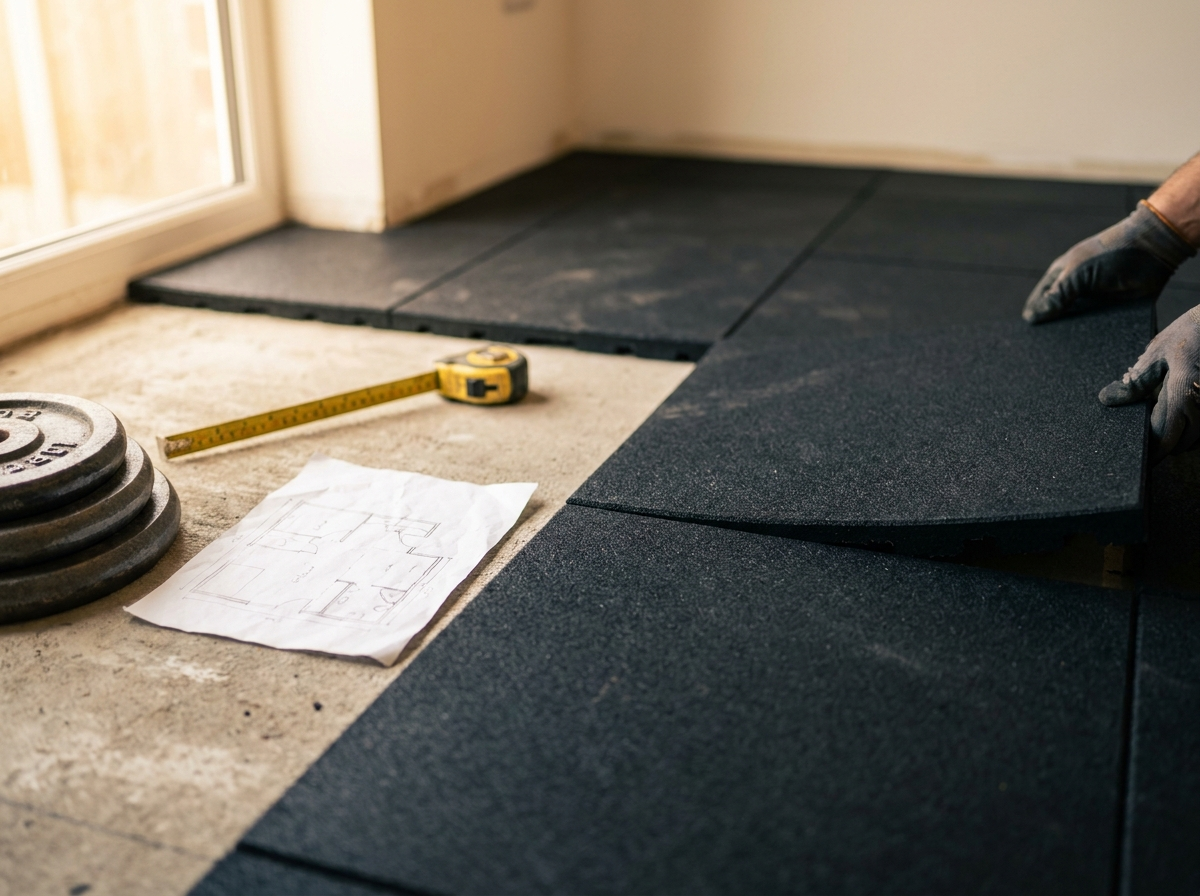
The floor is not a detail – it protects your equipment, your subfloor, and your relationship with your neighbors. Rubber mats or interlocking floor tiles are the most popular choice because they are shock-absorbing, durable, and sound-reducing. On delicate parquet, lay an additional protective layer underneath. Always plan the flooring before the equipment arrives – retrofitting under an assembled rack is tedious.
When it comes to noise: In buildings with thin walls, damping determines whether you can train in the morning and evening. A multi-layered platform under the barbell's resting area absorbs impact much better than a thin mat. Also, pay attention to ventilation – a room where you sweat needs fresh air, otherwise equipment and walls will suffer from moisture.
Step 4: Plan Budget in Stages
A budget without structure leads either to penny-pinching in the wrong places (a cheap, shaky rack) or to waste (a professional machine you never fully utilize). Therefore, plan in three stages and assign a clear training goal to each stage.
| Budget Stage | Guide Price | Typical Equipment | Suitable For |
|---|---|---|---|
| Beginner | approx. €800–€1,500 | Adjustable weight bench, set of adjustable dumbbells, floor mats, pull-up bar | Full-body training in a small space, first entry |
| Solid Setup | approx. €2,500–€5,000 | Power Rack or Smith Machine, barbell + plates, bench, floor platform | Ambitious strength training with basic exercises |
| Premium / All-in-One | from approx. €6,000 | Multifunctional multi-gym with cable pull, high-quality dumbbell selection, recovery tools | Long-term complete solution, multiple users |
Important: Always include flooring, soundproofing, and some accessories – these items typically account for 10–20% of the total budget and are often forgotten. And factor in the lifespan: A rack you use for ten years costs ridiculously little per year of training.
Step 5: Choose Equipment Based on Training Goal
Only now, when the room, floor, and budget are set, do you choose the equipment – and you do so based on your goal, not on aesthetics. The World Health Organization (WHO) recommends that adults perform muscle-strengthening exercises for all major muscle groups on at least two days per week. For this, you don't need ten machines, but a few that you master.
The Proven Basic Equipment
For 90% of all home athletes, a compact selection is sufficient: a stable power rack or a Smith machine as a safety and exercise center, an adjustable bench, a barbell with plates, and a flexible set of dumbbells or kettlebells. Those with limited space or who want to bundle several exercises into one piece of equipment are often better off with a multi-functional multi-gym than with five individual pieces of equipment.
Buying Guide: What to Look for in Equipment
Three criteria determine quality: frame strength and material (solid steel instead of thin-walled profiles), tested load capacity (clear manufacturer specifications for maximum load), and serviceability (spare parts, warranty, German-language support). At Kraftathlet, as an authorized dealer with full manufacturer warranty, you get tested equipment, advice on room and equipment planning, and, if desired, financing with 0% via Klarna. This turns planning into a setup that lasts.
Browse the relevant categories for your setup: Smith Machines & Multi-gyms, Multi-trainers & All-in-One Systems, Dumbbells & Kettlebells and the appropriate Floor Protection.
Common Mistakes in Home Gym Planning
These pitfalls cost the most money and nerves:
- Ignoring ceiling height. The rack fits, but the pull-up bar doesn't. Always check height including equipment.
- Installing flooring retrospectively. Those who build first and then consider the floor have to dismantle everything again.
- Assuming structural integrity instead of checking it. Heavy setups on upper floors without consultation are a real risk.
- Too much equipment, too little used. Three pieces of equipment you master beat ten that gather dust.
- Skimping on the frame. A wobbly, cheap rack is not only annoying but dangerous.
Frequently Asked Questions
How much space does a home gym need at a minimum?
A focused setup with a bench and dumbbells can work with about 4 m². You can move freely with around 6 m². As soon as a power rack is added, realistically plan for 8–12 m² including safety area and at least 2.30 m ceiling height.
Can my floor support a power rack with weights?
On the ground floor or in a basement on a concrete slab, usually yes. On upper floors and in old buildings with wooden beam ceilings, reserves are smaller – living spaces are often designed according to Eurocode 1 for only about 1.5 kN/m² (≈150 kg/m²). Distribute the load over a platform, place heavy items near load-bearing walls, and consult a structural engineer beforehand for large setups.
What does a good home gym cost?
A solid beginner setup starts at about €800. An ambitious rack setup with a barbell costs €2,500–€5,000, a premium complete solution from around €6,000. Add 10–20% for flooring, soundproofing, and accessories.
Basement or living space – which is better?
The basement scores points for structural integrity and noise, but often lacks ceiling height, light, and ventilation. A bright, well-ventilated room is more motivating and gets used more frequently. Weigh both against each other – the best choice is the room you genuinely enjoy going to.
Is a home gym worth it compared to a commercial gym?
From about two to three training sessions per week, good equipment amortizes over the years compared to ongoing gym memberships – plus saved travel time and full availability around the clock. What's crucial is that you use it; that's why planning comes first.
Conclusion: Plan First, Then Buy
A home gym that provides years of enjoyment is not a coincidence, but the result of a clear sequence: space, structural engineering, flooring, budget, equipment. Those who go through these five steps meticulously will avoid expensive mistakes and build a setup that fits their space, body, and goals. Do you want to discuss your specific situation – layout, floor load, or equipment choice? Contact our experts and plan your home gym with us before the first weight is delivered.
Sources: DSSV – Key figures of the German fitness industry; WHO – Physical activity.