

- A second (or third) Reformer is worth it as soon as your classes are consistently more than 80% full and you have waiting lists or rejected bookings.
- Don't think in terms of "equipment costs," but rather in terms of revenue per square meter: Every additional reformer spot increases the number of participants per class—with the same instructor and the same rent.
- Purchase models that are identical in design to the existing fleet: identical springs, ride height, and settings save time per run and reduce the risk of errors.
- Durability and reliability are key—an inexpensive device that breaks down after 18 months will cost you canceled classes and damage your reputation.
A second Reformer is worth the investment as soon as your Reformer classes are consistently at over 80 percent capacity for several weeks and you’re regularly turning away bookings or maintaining waiting lists. In that case, the expansion isn’t an expense but an investment with clear leverage: more participant spots per class hour with the same instructor, the same rent, and the same fixed-cost base. That’s exactly why the question of capacity is one of the most important growth decisions for any Pilates studio.
Demand is working in your favor: According to the ClassPass 2025 Look Back Report, Reformer Pilates bookings rose by about 71 percent in 2025 compared to the previous year, and Pilates was the most-booked workout worldwide for the third year in a row. In short: Reformer spots are in higher demand than ever. In this guide, we’ll show you when expanding your fleet becomes profitable, how to crunch the numbers, and what to keep in mind when expanding your fleet.
The Right Time: These Signals Matter
Before you order another device, honestly consider these three factors:
- Capacity Utilization: Are your best class times (early morning, evening) fully booked for weeks in advance? A sustained capacity utilization rate above 80% is the clearest buy signal.
- Rejected Inquiries: Do you keep waiting lists, or are you losing potential customers because there are no openings? Every rejected booking is lost revenue.
- Class Format: Do you want to switch from personal training or one-on-one sessions to larger groups? If so, you'll need more spots per hour to become profitable.
If only a single peripheral class is full, adding a second instructor won't solve your problem—a better class schedule is more likely to help. Only when demand consistently exceeds your capacity does adding more instructors become the right solution.
For Studios and Practices: Pilates Studio Equipment.
The Calculation: Revenue per Square Meter Instead of Unit Price
The most common misconception is to view the Reformer as merely a purchase. From a business perspective, what counts is the contribution margin per class hour and per square meter. An additional Reformer station increases the number of participants in each class—while your largest cost categories (instructor fees, room rent, and utilities) remain nearly constant. This means that the additional revenue translates into a disproportionately large contribution margin for your business.
| factor | A Reformer | Two Reformers |
|---|---|---|
| Number of participants per class period | 1 | 2 |
| Hourly coaching fees | unchanged | unchanged |
| Rent / Utilities | unchanged | unchanged |
| Hourly Revenue Potential | Basic | up to 2× |
To do your own calculation, you only need three figures: your class price per participant, the realistic number of additional spots you can sell per week, and your variable additional costs. The payback period is then calculated by dividing the purchase price by the monthly additional contribution margin. The best way to calculate your studio’s actual figures is to work with us—we’ll provide you with specific prices on an individual basis upon request. Our guide to Reformer financing and TCO shows you how to accurately calculate the total costs.
Space & Layout: Is there even room for another Reformer?
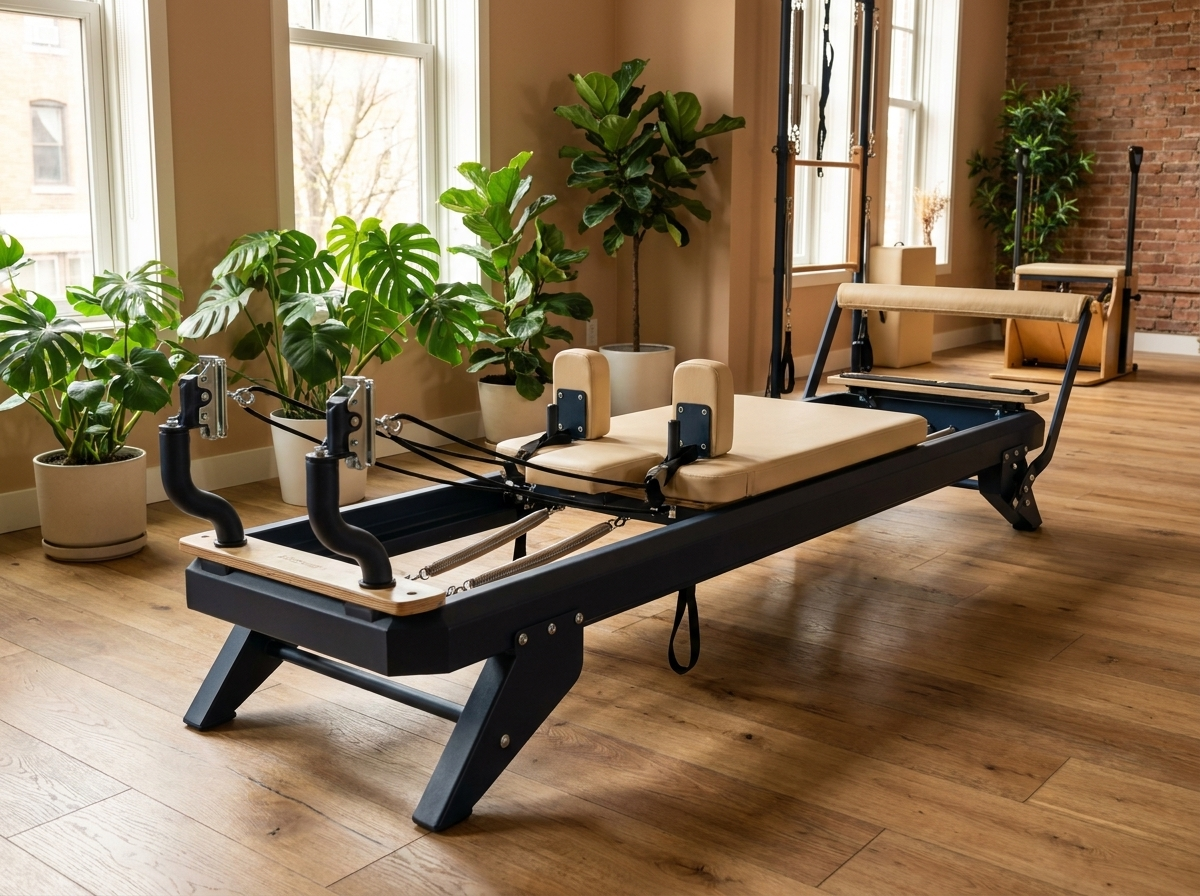
A reformer is about 245 cm long; to work safely, you’ll need space to move around it as well as a path for the instructor to walk. Realistically, plan for about 5 to 6 m² per additional piece of equipment, including clearance space. Before you order, check the floor plan, walkways, and emergency exits. You can find details on this in our guide “Planning a Pilates Studio: Floor Plan, Layout, and Capacity.” If you’re thinking through the entire setup from the ground up, our guide “Opening a Pilates Studio ” provides the big-picture perspective.
Why Consistency in Construction and Durability Are the Deciding Factors
As soon as you start using more than one machine, standardization becomes a key to success. If your second Reformer has different springs, a different carriage height, or a different cable system, you’ll waste time reconfiguring it during every class and create confusion among participants who switch between machines. Reformers of the same design, on the other hand, work together like a well-oiled team: same settings, same instructions, same routine.
Reliability is just as important. A reformer that becomes loose during continuous use or whose frame gives way leads to canceled classes—and, in the worst case, a safety incident in front of clients. That’s why, for studio use, we recommend the Hegren reformers from the TALMA-62 series based on specific criteria: They are designed for daily studio use and stand out with features that matter for a growing fleet:
- Steel frames instead of wood or aluminum—high dimensional stability under continuous load, less wear on joints.
- 5-spring system with clearly graded resistance—adjustable uniformly across the entire fleet.
- A 245-cm working length and well-designed adjustment features for safe, quick transitions between clients.
- Manufactured in Greece (EU) – quick turnaround for replacement parts and support.
- Variations such as the TALMA 62CT+ Combo (Reformer plus Tower) expand the exercise repertoire without requiring a second space.
You should evaluate these criteria—frame material, reliability, and after-sales service—equally for every supplier. The point isn’t to badmouth any brand, but to ask the right questions before expanding your fleet. To learn how to keep your existing equipment safe and in good condition for a long time, read the guide “Reformer Maintenance in the Studio.”
Buying Guide: How to Expand Your Fleet the Right Way
Measure first, then buy: Analyze two to four weeks of actual booking data before making a decision. Then purchase a model identical to the one you already have; plan the placement, including walkways, and arrange for delivery and setup in advance. You’ll find suitable equipment in our categories : “Hegren ” “Pilates,” and “Pilates Reformers.” As an authorized dealer with a manufacturer’s warranty, we provide cross-brand advice, deliver throughout the DACH region, and assist with setup and training—so your second Reformer starts generating revenue from the very first class.
Common Mistakes When Expanding Capacity
- Buying on a hunch: without utilization data, the expansion becomes a shot in the dark. Measure first, then order.
- Mixing brands: Different nibs and settings take time every hour and cause confusion.
- Cheap instead of durable: a device that starts malfunctioning early on leads to breakdowns, complaints, and damage to a company's reputation.
- Underestimating the space required: Setting up too close together compromises safety and the course experience.
- Forgot the schedule: extra equipment without appealing class times goes unused.
Frequently Asked Questions
At what level of utilization does it make sense to invest in a second reformer?
As a rule of thumb: If your classes are consistently more than 80% full over several weeks and you have to turn away bookings, expanding makes financial sense.
How much space does an additional reformer take up?
Allow about 5–6 m² per machine, including space for movement and walking paths. A Reformer is about 245 cm long; you’ll need space all around it to work safely and provide supervision.
Should the second reformer be identical in design to the first one?
Yes. Units of the same design share the same springs, carriage height, and settings. This saves setup time for each class, reduces errors, and ensures a consistent class experience.
Is a combo unit with a tower a better option instead?
If you want to expand your exercise repertoire but don't want to sacrifice a second spot, a combo system like the TALMA 62CT+ might be a good option. For pure capacity, a second classic reformer is usually the most straightforward solution.
How much does a studio reformer cost?
The price depends on the model, features, and quantity. We'll provide you with a customized quote upon request and work with you to calculate the payback period based on your utilization rates.
Conclusion
Adding a second Reformer isn’t a question of cost, but a decision about capacity: As soon as demand structurally exceeds your utilization rate, every additional spot increases your revenue per square meter without a corresponding increase in trainer and rent costs. Assess your utilization rate honestly, plan your space carefully, and invest in equipment that’s built to last—then your second Reformer will quickly pay for itself.
Want to know if a particular piece of equipment is right for your studio—and which one? Talk to us—we'll work with you to figure out the best fit based on your numbers.