

In short:
- Reformer Pilates is one of the hottest fitness trends of 2026. A dedicated Reformer zone can generate additional revenue from a small space and attract new member groups.
- Group classes on the Reformer generate high revenue per square meter—often more than a space of the same size equipped with cardio machines.
- When selecting equipment for continuous use, durability, safety, and quick adjustability are key factors. A steel-frame reformer like the Hegren TALMA 62 is designed for daily studio use.
- Instructor-led classes engage members more than purely screen-based formats—a key factor in customer retention.
Reformer Area at the Gym: Pilates as a Revenue Generator Per Square Meter
If you run a gym or fitness club, a Reformer Zone 2026 is one of the smartest ways to turn unused space into recurring revenue: Reformer Pilates is booming, and fitness chains across Germany are specifically setting up dedicated Pilates studios to meet the demand for group Reformer classes. According to ClassPass, Pilates bookings rose by about 66% between 2024 and 2025—a trend that virtually no gym owner should ignore. In this guide, you’ll learn why a Reformer Zone pays off, what to look for when selecting equipment, and how to optimize your space planning.
Why Reformer Pilates Belongs in the Gym
The traditional gym member and the Pilates client are increasingly overlapping. Reformer Pilates appeals to target groups that a gym focused solely on weights and cardio often fails to reach: people looking for joint-friendly, posture-focused training; women between the ages of 25 and 55; those returning to exercise; and members in post-rehab care. A Reformer zone therefore opens up a new member segment—without requiring you to give up your core space for strength and cardio.
Added to this is the retention effect: class formats with fixed schedules and personalized support create routine and a sense of community. This is precisely what lowers the churn rate—a key factor that determines profitability in the fitness market. According to industry data from the employers’ association DSSV, the German fitness market remains one of the largest in Europe in terms of membership, and differentiated offerings are a key competitive factor.
For Studios and Practices: Pilates Studio Equipment.
Revenue per square meter: the actual calculation
The key metric for any studio space is revenue per square meter. And this is where the Reformer really shines: A small group (typically 6–12 participants) trains simultaneously on Reformers set up side by side—each spot generates class revenue, whereas the same amount of space with individual cardio machines usually accommodates only one user per machine.
| factor | Reformer Group Zone | Classic Device Area |
|---|---|---|
| Usage per time slot | The entire group pays the course fee | One user per device (with the flat-rate plan) |
| Pricing | Course or package prices, additional revenue | Usually included in the basic membership |
| Member Retention | High (fixed rates, community) | Medium |
| Space Efficiency | Multiple exercisers in a compact space | One device = one user, more space |
The specific figures depend on rent, class prices, and utilization rates at your location—there are no reliable flat rates. The key principle is this: Well-attended group classes make the space profitable, not individual pieces of equipment. We’ll explore how to manage utilization and class scheduling in more detail in the article “Reformer Group Classes: Utilization & Revenue.”
Equipment Selection: What Matters When Choosing Studio Reformers
A Reformer at a gym is used daily by many members of varying builds and experience levels. It must therefore perform differently than a home machine. Evaluate Reformers for commercial use based on these criteria—regardless of the brand:
| Criterion | Why It Matters at the Gym |
|---|---|
| Frame Material | A steel frame is designed to withstand high, repeated loads and continuous operation; wood or aluminum frames have different material properties and maintenance requirements. |
| Spring System | Robust, clearly graded springs (e.g., a 5-spring system) allow for quick resistance changes during the workout. |
| Safety & Course Flow | Removable shoulder pads and quick-adjustable ropes save minutes per class and increase safety. |
| Hygiene | Wipeable, replaceable covers are a must when usage is frequent. |
| Service & Replacement Parts | Available replacement parts and the manufacturer's warranty minimize costly downtime. |
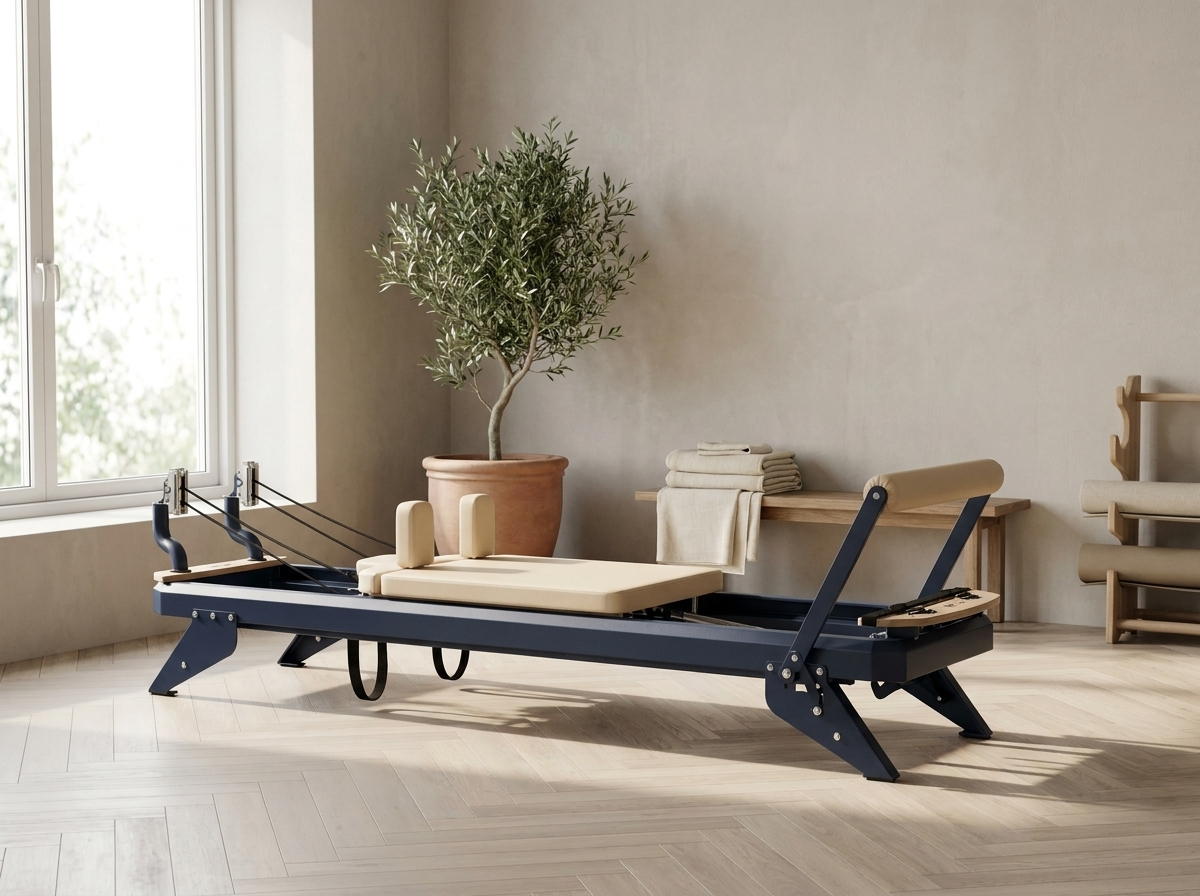
The TALMA 62 fromHegren is a particularly good example of a machine that meets these criteria: steel frame, 5-spring system, 245 cm long, manufactured in Greece, and designed for daily studio use. For studios that also want to offer Cadillac or Tower exercises, combo versions are available. You can find the entire selection in our “Hegren ” “Pilates,” and “Pilates Reformer” collections. If you’d like to compare frame materials in more detail, our article on steel, wood, and aluminum will help you.
Coach-led rather than screen-led
A trend that seems appealing at first glance: screen-guided 24/7 workout programs in which a video guides participants. For customer retention, this is a double-edged sword. Personal instruction corrects form, provides reassurance, and builds the kind of relationship that keeps members coming back over the long term. While purely screen-based formats save on staffing costs, they risk higher churn because they lack the social element. For most gyms, an instructor-led class model—supplemented by open workout hours—is the more sustainable approach.
Planning & Layout of the Reformer Zone
Allow enough space around each Reformer, including room to move, so that trainers can work safely between the machines. Make sure the floor is level and sturdy, that there is good ventilation, and that there is enough storage space for accessories. A well-thought-out layout is key to maximizing capacity and ensuring high-quality classes—you’ll find the details in our Floor Plan & Layout Guide and in our comprehensive guide to opening a Pilates studio.
Buying Guide: Your Introduction to the Reformer Zone
You don’t have to start with ten pieces of equipment. Many studios begin with a small number of Reformers, test the demand through a few class formats, and then scale up. What’s important is commercial-grade quality from the start—a cheap piece of equipment that breaks down after a short time under continuous use ends up costing more in downtime and replacement than a sturdy one does from the beginning.
Why choose Kraftathlet? We’re an authorized Hegren dealer offering a manufacturer’s warranty and carbon-neutral shipping. We’ll guide you every step of the way—from your first reformer to a fully equipped reformer zone.
Common Mistakes in the Reformer Zone
- Buying too cheap: Consumer-grade reformers aren't designed for continuous studio use—downtime eats into the savings.
- Planning for too little space: Without enough room to move between the equipment, safety and class quality suffer.
- Don't Rely Solely on Screens: Without Support, Churn Rises—Customer Loyalty Is Built Through People.
- Don't set prices arbitrarily: Without a target occupancy rate, the expensive space will remain unprofitable.
- Neglecting Service: Without a spare parts and maintenance plan, every repair becomes an operational risk.
Frequently Asked Questions
How many reformers do I need to get started?
Many studios start with 6–8 Reformers for their first group classes and expand as demand grows. What matters most is that the classes are well-attended, not the sheer number of machines.
Is a Reformer zone worth it even in a traditional gym?
Yes. It taps into a new member segment and generates additional revenue through class fees without replacing the existing strength and cardio areas.
Which reformer is suitable for commercial use?
A model designed for daily use—a sturdy frame (e.g., steel), a clearly graduated resistance system, quick adjustability, and readily available replacement parts. The Hegren TALMA 62 is an example of a machine that meets these studio requirements.
Do I need certified trainers?
Yes, for safe, high-quality classes. Qualified Reformer instructors are also the strongest factor in building loyalty compared to purely online offerings.
How much space does a reformer require?
Allow enough space for each piece of equipment to move through its full range of motion, plus space for the trainer to move around it. You can find exact measurements and layout information in our floor plan guide.
Conclusion
A Reformer zone turns floor space into recurring revenue, attracts new members, and strengthens customer loyalty—provided you invest in commercially viable equipment, instructor-led classes, and thoughtful planning. Reformer Pilates isn’t just a short-lived fad; it’s a growing segment. Those who get off to a solid start now will secure a head start.
Want to plan your Reformer zone? Talk to our team —we’ll advise you on equipment selection, layout, and setup to suit your studio.
Sources: Market data on Reformer Pilates and the DACH fitness market: DSSV – Employers’ Association of German Fitness and Health Facilities; Pilates booking trends according to ClassPass; Reformer market forecast: Business Research Insights. Equipment data: Manufacturer specifications Hegren.