

Abstract
- Pilates can help improve core strength, body awareness, and flexibility in people with scoliosis—but it is not a cure and should never replace medical or physical therapy care.
- A systematic review (10 studies, 359 participants) found positive effects on the Cobb angle, pain, and range of motion—with studies of average quality.
- Controlled exercises that are gentle on the spine and focus on symmetry and breathing are safe; uncontrolled end-range rotations and compression exercises should be performed under professional guidance.
- For studios and fitness centers, the most important features of a Reformer are finely graduated, reproducible resistance and a stable frame—criteria that the Hegren TALMA 62 meets.
Pilates for Scoliosis: Safe Exercises and What Studios Should Look For
Pilates can help people with scoliosis strengthen their core muscles, improve body awareness, and increase flexibility—but it cannot cure the lateral curvature of the spine. Any exercise program should be carried out in consultation with a doctor and physical therapist, as the severity and progression of the curvature (measured by the Cobb angle) determine which exercises are appropriate and which are risky.
In this article, we provide an honest assessment of the research literature, outline safe movement principles, and explain what gyms and physical therapy practices should keep in mind when integrating Reformer training into their scoliosis treatment programs.
What is scoliosis?
Scoliosis refers to a lateral curvature of the spine, which is usually accompanied by a rotation of individual vertebrae. The severity is determined by the so-called Cobb angle on an X-ray. A curvature of 10 degrees or more is considered scoliosis; for more severe cases, orthopedic interventions such as a brace or specialized physical therapy are used, depending on the patient’s age and the progression of the condition. Three-dimensional Schroth therapy is considered the established standard of physical therapy in German-speaking countries. Pilates is not a substitute for this therapy, but—when used in the right amount—it can be a valuable supplement.
Can Pilates Help with Scoliosis? What the Evidence Says
The evidence is cautiously positive. A systematic review that analyzed ten randomized controlled trials involving a total of 359 participants concluded that Pilates interventions can positively influence the Cobb angle, trunk rotation angle, and pain intensity, as well as improve trunk mobility and quality of life. It is important to put this into context: The methodological quality of the studies analyzed was average; therefore, the effects should be understood as supportive rather than curative.
For those affected, this means that Pilates can be a valuable tool for improving strength, posture, and flexibility, as well as for alleviating symptoms. However, it is not a substitute for medical follow-up care or for a specific scoliosis treatment such as the Schroth method. Anyone looking for a structured, spine-focused Reformer program can find more information in our article “Reformer Pilates in Physical Therapy Practice.”
Safe Movement Principles for Scoliosis
Whether it’s mat Pilates or Reformer Pilates: When it comes to scoliosis, the same basic principles apply as in any clinically oriented training—control before exertion, breathing before speed, symmetry before performance.
| More suitable | Use with caution / only under supervision |
|---|---|
| Controlled core activation (e.g., gentle pelvic tilts) | Extreme, uncontrolled rotations of the spine |
| Directing the breath toward the flattened side of the torso | Severe axial compression / high impact load |
| Elongation and Axial Alignment (Axial Elongation) | Maximum backward bend without core control |
| Asymmetrically tailored exercises based on the findings | Standardized programs without individual customization |
The key point: With scoliosis, a standard symmetrical exercise program is often not ideal because the two sides of the body function differently. Exercises that stretch the shortened, concave side and strengthen the weakened, convex side are beneficial—but this should be handled by qualified trainers and physical therapists who have assessed the condition. We also describe related safety principles in the article “Pilates for Osteoporosis.”
Why the Reformer Offers Advantages Here
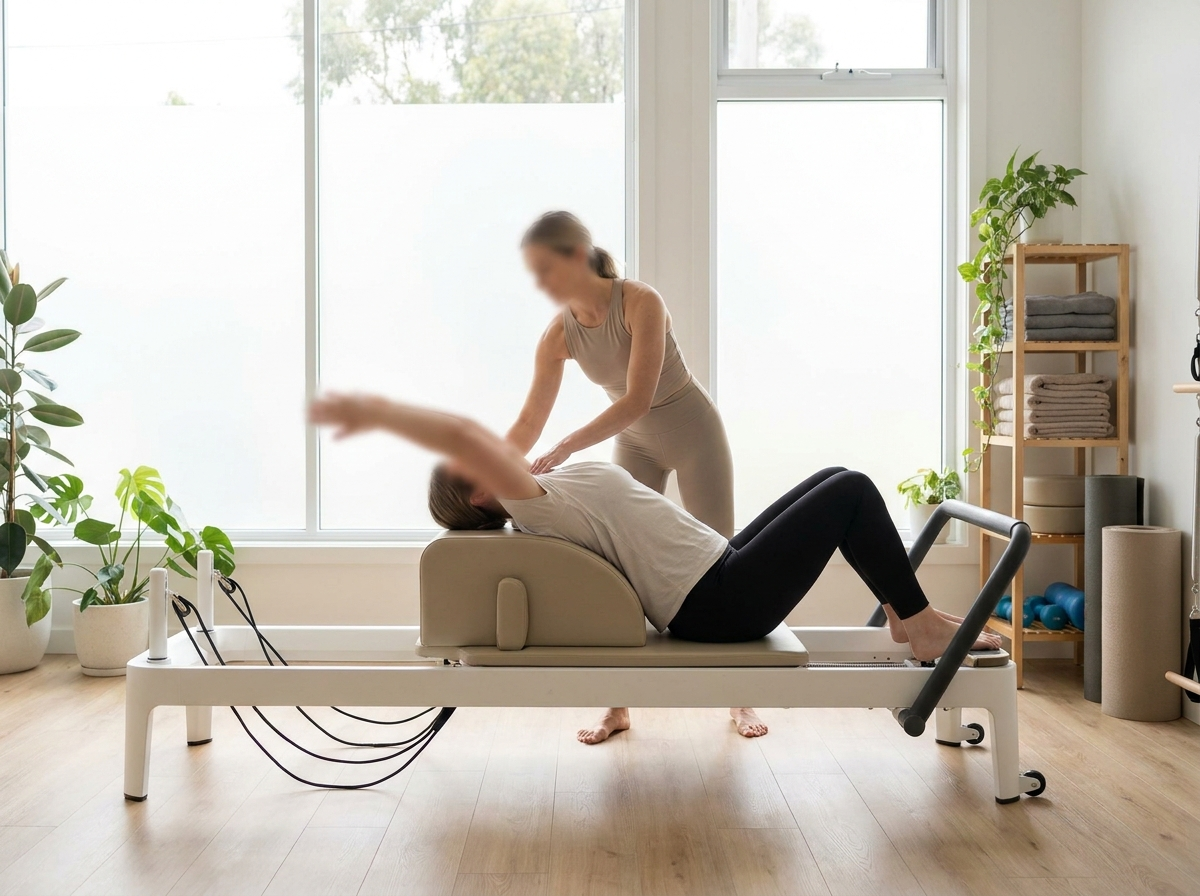
The Reformer provides exactly what matters most for scoliosis: finely adjustable, spring-assisted resistance that guides movements and applies graduated load. Unlike training on a mat alone, the spring system allows for precise control of the force exerted, so that the weaker side can be targeted in a consistent and reproducible manner without overloading the spine. The guided movement also takes the fear out of training—a factor that should not be underestimated for people with back pain.
For studios and practices, the quality of the equipment is key to safety and cost-effectiveness. Instead of pitting brands against each other, it’s worth focusing on clear criteria.
Buying Guide: What Studios and Practices Should Look for in a Reformer
When reformer training becomes part of a clinically oriented program, four criteria are particularly important:
- Finely Graduated Resistance: A sophisticated spring system allows for small, reproducible increments of resistance—essential for working asymmetrically and with minimal discomfort.
- Sturdy, durable frame: A steel frame retains its shape over thousands of classes and ensures consistent, safe movement.
- Safety & Class Flow: Quick-adjustable components and secure stops save time on each exercise and reduce the likelihood of errors.
- Spare Parts & Support: Available spare parts and an authorized dealer ensure operational readiness and protect your investment.
The TALMA 62 fromHegren meets these criteria: a steel frame, a 5-spring system for finely adjustable resistance, a length of 245 cm, and manufactured in Greece for professional studio use. Complementary premium Pilates accessories such as boxes, straps, and pads round out a setup tailored to your needs. Kraftathlet is an authorized Hegren dealer offering a manufacturer’s warranty —so you’re covered for maintenance and replacement parts as well.
Common Mistakes
- Starting without a medical evaluation: Without knowing the Cobb angle and the curvature pattern, it is not possible to develop a meaningful, side-specific exercise program.
- Apply the standard program 1:1: Symmetrical courses without adjustment ignore individual curvature.
- Too fast, too much: Speed and high resistance before a clean catch increase the risk.
- Viewing Pilates as a cure: Pilates is supportive, but it does not replace medical treatment or scoliosis-specific therapy.
- Neglecting breathing: Targeted breathing control is a key tool in the treatment of scoliosis—not just an afterthought.
Frequently Asked Questions
Is Pilates dangerous for people with scoliosis?
When properly guided, Pilates is generally well-suited for this purpose. It becomes risky, however, with uncontrolled, extreme rotations or high impact without core control. Therefore, the training should be based on a medical evaluation and supervised by qualified personnel.
Can Pilates improve the Cobb angle?
A systematic review found positive effects on the Cobb angle, although the average quality of the studies was moderate. Pilates can therefore be helpful, but it is not a guaranteed or sole means of correction. Regular medical follow-up remains crucial.
Mat or Reformer Pilates for Scoliosis?
Both can be useful. Thanks to its spring system, the Reformer provides finely adjustable, guided resistance that facilitates asymmetrical and safe exercise—especially in therapeutic or studio settings.
Does Pilates replace Schroth therapy?
No. Three-dimensional Schroth therapy is an established standard of care specifically for scoliosis. Pilates can complement it, but it cannot replace it. Always discuss any combinations with your treatment team.
What should my studio look for when purchasing a Reformer?
Finely graduated, consistent resistance; a stable frame for long-lasting motion guidance; a reliable adjustment mechanism for Class-Flow; and readily available replacement parts and authorized support.
Conclusion
Pilates is a valuable, supportive component for scoliosis: It can promote core strength, flexibility, and body awareness, and alleviate symptoms—provided it is based on a medical evaluation and tailored to the individual. The Reformer offers the advantage of finely adjustable, guided resistance. For studios and clinics, the key features of the equipment are reproducible resistance, a stable frame, and reliable support.
Are you planning to offer scoliosis or rehabilitation programs at your studio and wondering which Reformer configuration is right for you? Contact our team —we’ll provide you with expert advice, with no obligation.