

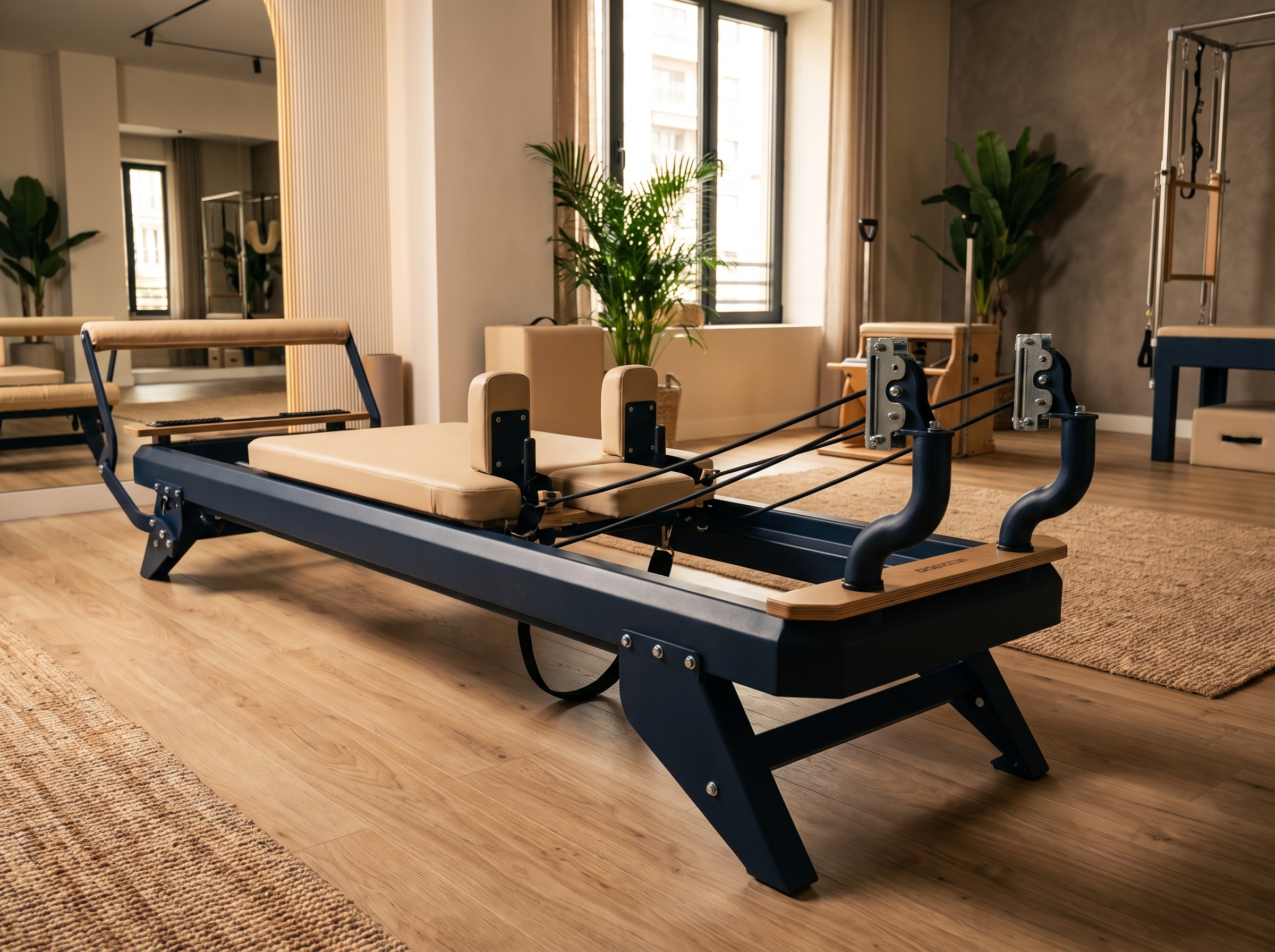
- The Hegren TALMA 62 is a studio reformer with a solid steel frame, a 5-spring system, and a length of 245 cm—designed for daily group classes.
- In a studio setting, it is not the purchase price that matters, but rather the total cost over the equipment's lifespan: frame material, maintenance, and downtime.
- A steel frame remains wobble-free even after thousands of workouts—that's exactly what sets a gym machine apart from a home machine.
- Price of the TALMA 62: €4,400, including a wide selection of colors for the frame and upholstery. Reformer Pilates is one of the fastest-growing boutique segments.
Hegren TALMA 62: The Steel-Frame Reformer for Continuous Studio Use
The Hegren TALMA 62 is a professional Pilates reformer with a steel frame, a 5-spring system, and a length of 245 cm, built for daily studio use. Anyone opening or expanding a studio should choose a reformer not based on the purchase price, but on the total cost over its lifetime—and that’s exactly where a rigid metal frame shows its advantage.
According to recent market analyses, Reformer Pilates is one of the fastest-growing boutique fitness segments, with double-digit growth. For studios, this means high utilization rates, many classes per week, and equipment that needs to last for years. This guide explains what matters most in a studio Reformer and where the TALMA 62 fits into the picture.
What Sets a Studio Reformer Apart from a Home Machine
A home Reformer is typically used three to five times a week. A studio Reformer often runs eight to twelve hours a day, with a rotating cast of users of varying body weights and strength levels. The strain is many times greater—and so are the demands placed on the frame, carriages, and spring mechanism. A machine that lasts for years in a living room can wear out in just a few months when used in a studio setting.
The key criteria can be summarized in four points:
1. Frame Stiffness and Material
The frame bears the entire load and determines whether the Reformer will still operate without play even after years of use. Materials available on the market range from wood to aluminum to steel. The TALMA 62 features a steel frame—the heaviest, but also the most dimensionally stable material. A rigid frame efficiently transfers the spring force into movement, rather than losing it to torsional distortion.
2. The car's smooth ride
The carriage must glide quietly and smoothly through thousands of repetitions. If it jerks, the quality of the workout suffers and participants notice it immediately—a common reason for complaints and cancellations at the gym.
3. Spring System and Resistance
The spring system determines the range of exercises and how quickly trainers can adjust the resistance during a class. The TALMA 62 uses a 5-spring system that allows for fine gradations from gentle to intense—which is important for coaching both beginners and advanced participants together in a mixed-level group. We explain how springs and color codes work in the Studio Guide to Reformer Springs.
4. Maintenance and Replacement Parts
Over the years, a studio reformer requires replaceable wear parts—springs, padding, and cables. Whether and how quickly these are available determines the amount of downtime. A machine for which replacement parts are hard to come by can, in the worst case, bring an entire series of classes to a standstill.
For Studios and Practices: Pilates Studio Equipment.
Frame Materials Compared: Steel, Wood, Aluminum
The choice of materials is the most important factor in the purchasing decision. The following overview compares the three most common frame types based on the criteria that matter in a studio setting—regardless of individual manufacturers:
| Criterion | Steel | Wood | Aluminum |
|---|---|---|---|
| Dimensional Stability During Continuous Operation | Very high | Connections can loosen over time | Medium; less stiff under heavy loads |
| Weight / Stability | Heavy, very stable | Medium | Lightweight, easy to move |
| Optics | Modern, high-tech | Warm, classic | Modern, lightweight |
| Ideal for | Studios with high occupancy rates | Design-oriented studios, homes | Mobile Use, Rehabilitation |
You can find a detailed comparison in our guide to reformer frame materials. In short: For a studio with many classes, dimensional stability is the most important factor—and that’s where steel really shines. A wooden reformer can be a great choice for a boutique studio with a classic design, while aluminum offers advantages for portable use and in rehabilitation.
Hegren 's TALMA 62 at a Glance
The TALMA 62 is Hegren's studio reformer from the TALMA series and is designed for professional group classes. Key specifications:
- Frame: Solid steel frame for maximum rigidity during continuous operation.
- Spring system: 5 springs for fine resistance adjustment and a wide range of exercises.
- Length: 245 cm – full studio length with plenty of space for sledding, even for tall participants.
- Customization: multiple frame colors (including silver, black, white, beige, ivory, and blue) and nine upholstery colors—for a cohesive studio design.
- Price: 4,400 €.
If you want to supplement your Reformer with a full-body workout program, you’ll find the right components in this series, such as the TALMA 62CH Pilates Chair (€2,083), as well as a wide range of accessories—from springs and jumpboards to cushion sets. The complete lineup is featured in the “Hegren ” Pilates collection.
Safety and Classroom Flow
In group classes, it’s not just durability that matters, but also how smoothly a class flows. Every second an instructor spends readjusting springs or straps takes away from the actual workout time—and with ten participants, that adds up quickly. A well-designed studio machine allows for quick, safe adjustments between exercises, so the class keeps flowing and the group doesn’t lose momentum.
Safety is also a hallmark of quality: easily accessible springs, clearly click-locking resistance levels, and sturdy loops help prevent operating errors. Our guide to Reformer safety in the studio shows you how to set up your studio safely overall.
Why Total Cost of Ownership (TCO) Matters Over the Product's Lifespan
The most common mistake when planning a gym is to focus solely on the purchase price. An inexpensive reformer that wears out or breaks down after 18 months of continuous use ends up costing more than a well-designed machine—due to repairs, replacements, and canceled classes. Here’s the math you should do:
| Cost factor | Beginner Reformer | Studio Reformer (Steel) |
|---|---|---|
| Purchase | lower | higher |
| Service life under continuous operation | shorter | significantly longer |
| Downtime / Class Cancellations | Higher risk | Lower risk |
| Spare Parts Availability | often unclear | predictable |
| Cost per course taken | may be higher | lower during periods of high utilization |
Our TCO and Financing Guide shows you how to apply this calculation to your utilization rate. The rule of thumb: The higher the utilization rate, the more cost-effective a durable piece of equipment becomes. A reformer used for 30 classes per week spreads its cost over thousands of class sessions per year—making the upfront purchase cost per class a minor consideration, as long as the equipment operates reliably.
Reformer Pilates as a Business Model
There’s a business reason behind the boom: Reformer classes can be sold at attractive prices, the equipment keeps members tied to a fixed class schedule, and the utilization rate per square meter is high. According to market observers, a single boutique studio with a manageable number of Reformers and several classes per day can generate a substantial five- to six-figure annual revenue. The prerequisite is that the equipment operates reliably and the experience is right—this is exactly where quality pays off.
If you're starting a new business, it's best to plan your equipment, space, and class offerings all at once. Our guide to opening a studio provides step-by-step guidance.
Buying Guide, Shipping & Warranty
The TALMA 62 is designed for studios, boutique fitness centers, and physical therapy practices that rely on years of continuous operation. You can find the Reformer itself on the TALMA 62 product page. As an authorized Hegren dealer offering a manufacturer’s warranty, we’ll advise you on model selection, colors, accessories, and delivery—and help you determine the right number of units for your projected usage.
When planning your grand opening, allow plenty of time for delivery and setup, and check in advance that there is adequate access and that doorways are wide enough—a studio reformer is heavy and bulky. Over 5,000 customers already trust our advice; upon request, we can put together a complete studio set for you, consisting of reformers and matching accessories.
Common Mistakes When Choosing a Reformer for the Gym
- Don't just look at the price. The purchase price is only part of the equation. What really matters is the cost per course taken over the product's lifespan.
- Using a home machine at the gym. Reformers designed for home use are not built to handle eight hours of continuous use and wear out more quickly.
- Don't overlook replacement parts. Before you buy, find out how quickly you can reorder springs, ropes, and padding—this will determine your downtime.
- Planning capacity incorrectly. Too few reformers will slow down your revenue, while too many will tie up capital. Plan based on your realistic class utilization.
- Don't underestimate the importance of design. The colors of the frames and upholstery shape the studio experience and the photos you use to promote your business on social media.
Frequently Asked Questions
Who would benefit from the TALMA 62 Hegren ?
For studios, boutique fitness centers, and physical therapy practices with high class attendance that are looking for a durable Reformer for daily use. The steel frame is designed to withstand years of intensive use.
Why a steel frame and not wood?
Wood has a warm, classic look and is a good choice for homes or design-oriented studios. However, for maximum dimensional stability under high, sustained loads, a steel frame offers the advantage of remaining free of play even after thousands of classes.
How much does the TALMA 62 cost?
The Hegren TALMA 62 costs €4,400 and is available in several frame colors and nine upholstery colors, so it will blend in with your studio's design.
What equipment do I need for the gym?
It’s a good idea to have spare springs, a jump board for cardio exercises, padding pads, and matching loops. You’ll find the complete range of accessories in the “ Hegren ” Pilates collection; we’ll put together a studio set for you upon request.
How many reformers do I need for a studio?
That depends on the size of the space and the planned class size. As a rough guide, many boutique studios plan for 6 to 12 pieces of equipment. We'll help you determine the right number based on your occupancy rate.
Conclusion
The Hegren TALMA 62 is a reformer built for what studios really need: high utilization, years of continuous operation, and a cohesive design. With a steel frame, 5-spring system, and a length of 245 cm, it meets the key studio criteria—and when considering the total cost of ownership, a durable machine under high utilization is usually the more economical choice. Are you planning to open a studio or looking to expand? Contact us —we’ll advise you on the model, features, and quantity.