

Summary
- The purchase price is only part of the equation. The total cost of ownership (TCO) over the entire service life is crucial for your studio.
- Three options: Purchase (full control, best long-term value), leasing (predictable installments, preserves liquidity), and rental (maximum flexibility, highest unit costs).
- A durable steel reformer like the Hegren TALMA 62 (€3,500) can be cheaper over 8 years than a less expensive model that needs to be replaced sooner – less downtime, lower follow-up costs.
- Calculate revenue per m² and utilization per reformer, not just the purchase price.
Financing Pilates Reformers: Leasing, Purchase, and Total Cost of Ownership (TCO) for Your Studio
The most important figure when acquiring a reformer is not the purchase price, but the total cost of ownership over its useful life – that is, acquisition plus maintenance, downtime, and lifespan divided by the years the equipment reliably generates revenue. Those who focus only on price often end up paying more.
This guide shows you the three financing options (purchase, leasing, rental), how to calculate the true total costs, a specific 8-year example, and which Hegren reformer suits which studio. The German fitness market is growing – according to the DSSV key figures for 2026, it will reach 12.36 million members and 9,647 facilities, with specialized and boutique studios averaging €80.02 in monthly fees. Pilates reformers excel precisely in this premium segment.
Buy, Lease, or Rent? The Three Options at a Glance
| Option | Advantage | Disadvantage | Suitable for |
|---|---|---|---|
| Purchase | full control, best long-term value, capital asset | ties up capital initially | established studios with equity |
| Leasing | predictable monthly rates, preserves liquidity, tax-deductible | more expensive in total than cash purchase, contractual commitment | start-ups & growth |
| Rental | maximum flexibility, short-term cancellable | highest unit costs, no asset building | pop-ups, tests, season |
Leasing and hire-purchase are common for studio equipment in Germany: The installments are tax-deductible as operating expenses, and you retain liquidity for marketing and personnel. A purchase is worthwhile if the equipment will be used for many years – and this is where material quality comes into play.
What a Reformer Really Costs: Total Cost of Ownership (TCO)
The Total Cost of Ownership (TCO) consists of several items that the pure purchase price conceals:
- Acquisition: the one-time purchase price per reformer.
- Maintenance & Wear Parts: springs, ropes, wheels, upholstery – how often do they need to be replaced?
- Downtime: Every day a reformer is under repair is a piece of equipment that doesn't provide a class spot or generate revenue.
- Lifespan: Will the frame last 10+ years or will it need to be replaced after a few years?
- Resale Value: High-quality equipment retains residual value.
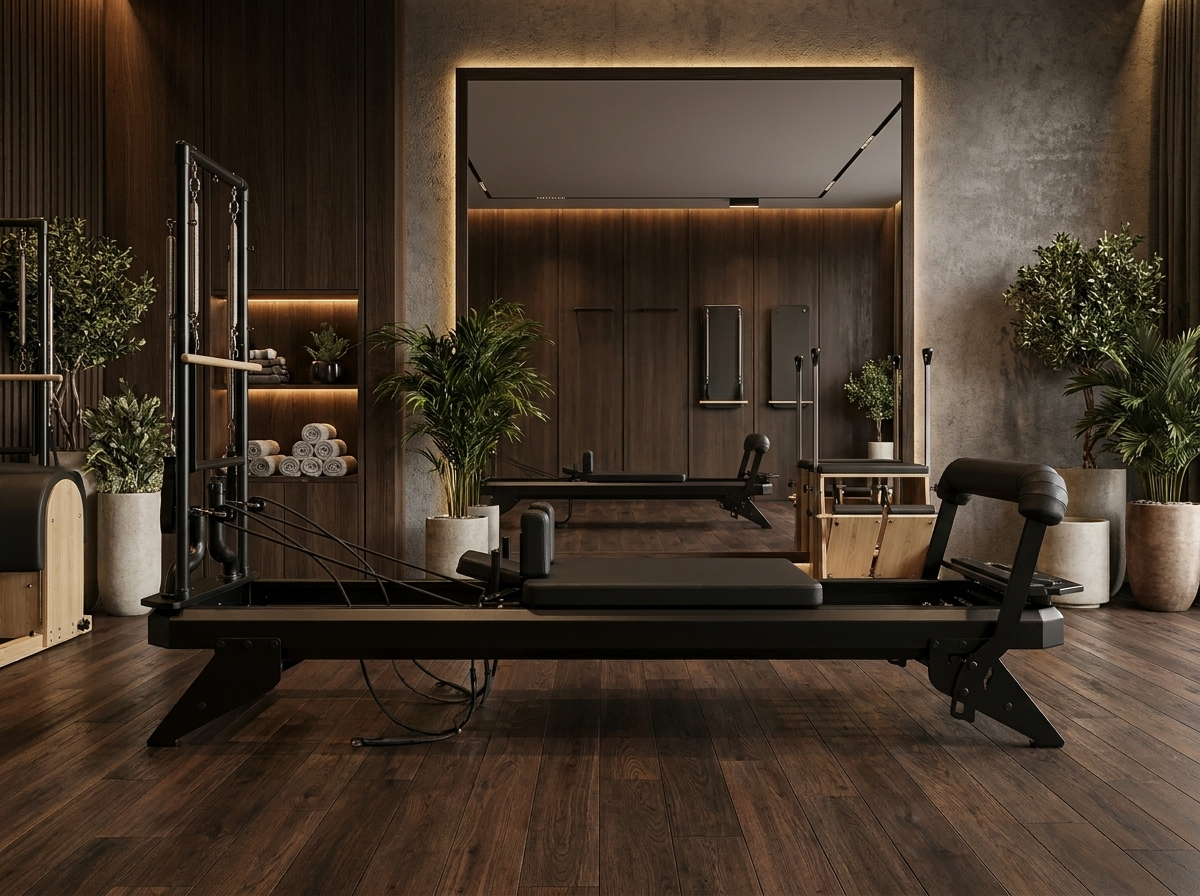
The frame determines the lifespan. A powder-coated steel reformer is significantly more torsionally rigid and long-term stable under continuous load than cheaper wooden or aluminum constructions, where connections can loosen over the years. The Hegren TALMA 62 focuses precisely on this: steel frame, 5-spring system, and 245 cm carriage length – built for continuous use in the studio. This is why a slightly higher purchase price can be cheaper over the total usage period.
Example Calculation: TCO over 8 years (illustrative)
The following calculation is a simplified example for illustration – not market statistics. It compares a durable steel reformer with a cheaper model that needs to be replaced once within the period, based on criteria.
| Item (8 years) | Durable Steel Reformer | Inexpensive Entry-Level Model |
|---|---|---|
| Acquisition | once (e.g., €3,500) | cheaper, but twice within the period |
| Replacement / New Purchase | none | one complete second purchase |
| Downtime / Repairs | low | higher, more class cancellations |
| Residual value after 8 years | present | close to zero |
| Overall Cost Trend | lower per year | higher per year |
The exact figures depend on your studio. The principle remains: a device that lasts twice as long and breaks down less often is often the cheaper choice per training year – even if the sticker price is higher.
Also include soft factors in your calculation: a high-quality reformer looks more professional in the studio, builds trust with demanding clients, and reduces the risk of a class being canceled due to faulty equipment. Such effects do not appear in any acquisition calculation but influence member retention and recommendations – and thus, in the long term, your revenue more than a small price difference at the time of purchase.
Which Hegren Reformer Suits Which Studio?
Hegren reformers are Made in Greece, with steel frames and a 5-spring system. The selection depends on the class format and space:
| Model | Approx. Price | Ideal for |
|---|---|---|
| TALMA 62 (Steel, 5-Spring, 245 cm) | €3,500 | the studio all-rounder for group classes |
| TALMA 62 Black Elegance | €3,100 | boutique studios with design aspirations |
| TALMA 62CT+ Combo (Reformer + Tower) | €4,280 | more exercise variety in the same space |
As an authorized Hegren dealer with ★ 4.88/5 from over 5,000 reviews, we advise you from model selection to financing. View the complete Hegren Pilates collection and all Pilates reformers. For the basics, read our Reformer Buying Guide for Studios, for equipment selection Reformer vs. Combo, and for space planning Floor Plan & Capacity.
Calculating Revenue per Reformer Correctly
A reformer is not an expense item, but a source of revenue – and you should evaluate it precisely that way. The crucial metric is revenue per machine: class price per spot × occupied spots × classes per week × active weeks per year. A reformer that is well-utilized during peak hours often repays its acquisition cost faster than the sticker price suggests.
This is precisely why reliability counts double: every day of downtime is not just a repair, but also lost class revenue. In the premium segment – according to DSSV, members in specialized and boutique studios pay an average of €80.02 per month – the willingness to pay justifies high-quality equipment. It is better to plan for enough reformers from the start so that you can run full classes during peak times, rather than turning away inquiries.
Leasing in Detail: Term, Residual Value, Hire-Purchase
If you lease, pay attention to three points. The term should match the expected useful life – for durable equipment, longer terms with lower rates are attractive. The residual value at the end of the contract determines whether you acquire the equipment cheaply or return it. And with hire-purchase, the equipment transfers to your ownership at the end, combining asset building with the liquidity preservation of leasing.
Always calculate the effective costs over the entire term, not just the monthly rate. A low rate with a high final payment can be more expensive than a slightly higher rate without a final payment. Before signing, ask for a complete breakdown and check what happens in case of early return or extension.
Plan for Wear Parts and Maintenance
Springs, ropes, wheels, and upholstery are wear parts. Ask about availability and price before purchasing – equipment whose spare parts are hard to come by will cause longer downtimes. Plan for regular visual inspections and a small maintenance stock. High-quality manufacturers keep spare parts in stock for a long time; this is an often underestimated part of the total cost.
Purchase or Leasing: The Simple Decision Aid
As a rule of thumb: If you have the capital and plan long-term with the same location, purchasing is usually the cheapest solution over the years – you build assets and benefit from the residual value. If you are in the middle of a startup or growth phase and need your liquidity for marketing, personnel, and rent, leasing gives you flexibility and makes costs predictable. Many studios combine both: purchasing the basic stock and leasing additional equipment for expansion. In both cases, it is crucial that the equipment runs reliably and is well utilized – this determines profitability, not the financing method alone.
Common Mistakes in Reformer Financing
- Only looking at the price: The cheapest equipment is rarely the cheapest over eight years.
- Ignoring downtime: A reformer under repair costs class spots – plan for reliability.
- Buying too small: Starting with too few machines hinders utilization during peak hours.
- Forgetting wear parts: Ask about the availability and price of springs, ropes, and upholstery before purchasing.
- Not calculating the leasing contract thoroughly: Effective costs, term, and residual value should be checked before signing.
Frequently Asked Questions
Should I buy or lease my first reformer?
For a new startup, leasing preserves liquidity and makes costs predictable. If you have equity and plan long-term, purchasing is usually cheaper over the years – especially for durable equipment with high residual value.
How long does a professional studio reformer last?
A high-quality reformer with a steel frame is designed for continuous use over many years. The actual lifespan depends on utilization, maintenance, and material quality – steel clearly has an advantage here over cheaper wooden or aluminum constructions.
How many reformers do I need for a group studio?
This depends on the room size and class size. Plan around 2.5 to 3 m² per reformer, including movement space, and calculate the number based on your planned class size and peak hour utilization. Our floor plan guide helps with the exact calculation.
Is a combo unit with a tower worth it?
Yes, if you want to offer more exercise variety in a limited space. A reformer with a tower significantly expands the repertoire without requiring you to purchase a second category of equipment. For pure reformer group classes, the classic reformer is often sufficient.
Conclusion
Finance your reformer based on total cost of ownership, not sticker price: a durable steel unit with high reliability pays off over the years through less downtime, lower follow-up costs, and better residual value. Whether buying or leasing – the key is that the equipment reliably generates revenue. Speak to our studio team – we'll calculate the right solution for your studio.