

University sports equipment planning involves selecting and arranging training stations with the goal of organizing a university’s training operations in a way that aligns with course offerings, supervision, and usage. For your 2026 plan, therefore, the number of pieces of equipment alone is not the deciding factor; rather, it is whether instruction, simultaneous training, and technical support are well-coordinated.
- University Sports Strength Training Equipment: Plan based on the number of training stations that can be used simultaneously, not on the number of possible exercises.
- Kraftathlet Ideal for colleges and universities looking to purchase strength training equipment that includes delivery, installation, and ongoing service.
- For power racks and cable machines, check the range of motion, approval for use, and maintenance access.
- In your resource planning, distinguish between scheduled classes and open practice sessions before comparing equipment.
Why Equipment Planning Matters in College Athletics
A college fitness center must be tailored to its actual operating model. Do you offer guided introductory classes, open training, or both? This decision determines which settings need to be clearly labeled, which stations require supervision, and where multiple people should be able to work out at the same time.
The right equipment is determined by the usage plan, not the other way around. From an organizational standpoint, a versatile multi-purpose machine does not automatically replace several separate training stations. If exercises share the same station, that station remains occupied while in use. For an initial layout plan, refer to the guide on equipment needs based on gym size.
University procurement also involves a variety of responsibilities: university athletics, purchasing, facilities management, and, if necessary, external planners. A piece of equipment may be suitable for the training program but still fail to be acquired due to an unresolved transportation issue or a lack of installation documentation. Clarify these points of coordination before selecting specific models.
For your 2026 project, you therefore need a common planning framework. This should include the course offerings, the approved space, the required training facilities, and the responsibilities leading up to the handover. An equipment catalog alone does not fulfill this purpose.
How to Plan Strength Training Equipment for Your University
1. Define class sessions and open practice separately
Start with the current offerings and the planned operating hours. Begin by using class schedules, booking data, and documented feedback from your instructors. For a new location, establish the planned procedures as assumptions and review them with the future managers. Make a clear distinction between observed demand and desired expansion.
Consider two operating modes: guided courses and open training. An introductory course requires a clear sequence of stations and space for explanations. In open training, it’s also important that users can adjust their settings independently and that frequently requested stations are available at the same time. Do not transfer these requirements from one operating model to the other without first verifying them.
Also, make a note of which exercises are part of your program. Start by describing the training objective, then the type of equipment that could be used. This way, you’ll avoid having a single, pre-selected model dictate the entire course structure.
To wrap up, consider the following: Which user groups should undergo training? Who will train them? Which stations need to operate simultaneously? Which requirements are essential at launch, and which are part of a later expansion?
2. Draw the usable space, including the transport route
Start by working with a to-scale floor plan and simple equipment templates. Include not only walls and doors, but also columns, windows, radiators, existing connections, and areas that must be kept clear. The footprint of a piece of equipment is not the same as the training space it requires.
For each station, check the entire range of motion. This includes extending cables, moving dumbbells, adjusting a bench, and accessing adjustment points. Use the dimensions and clearance specifications provided in the respective manufacturer’s documentation. Without this documentation, a specific installation approval cannot be reliably granted.
Start by dividing your design into three planning zones: machine training, free-weight training, and circulation areas. This is a working model, not a space requirement. Whether additional areas are needed depends on the services you offer. Have the load-bearing capacity, floor construction, soundproofing, and any necessary fastenings assessed by the appropriate specialized agencies.
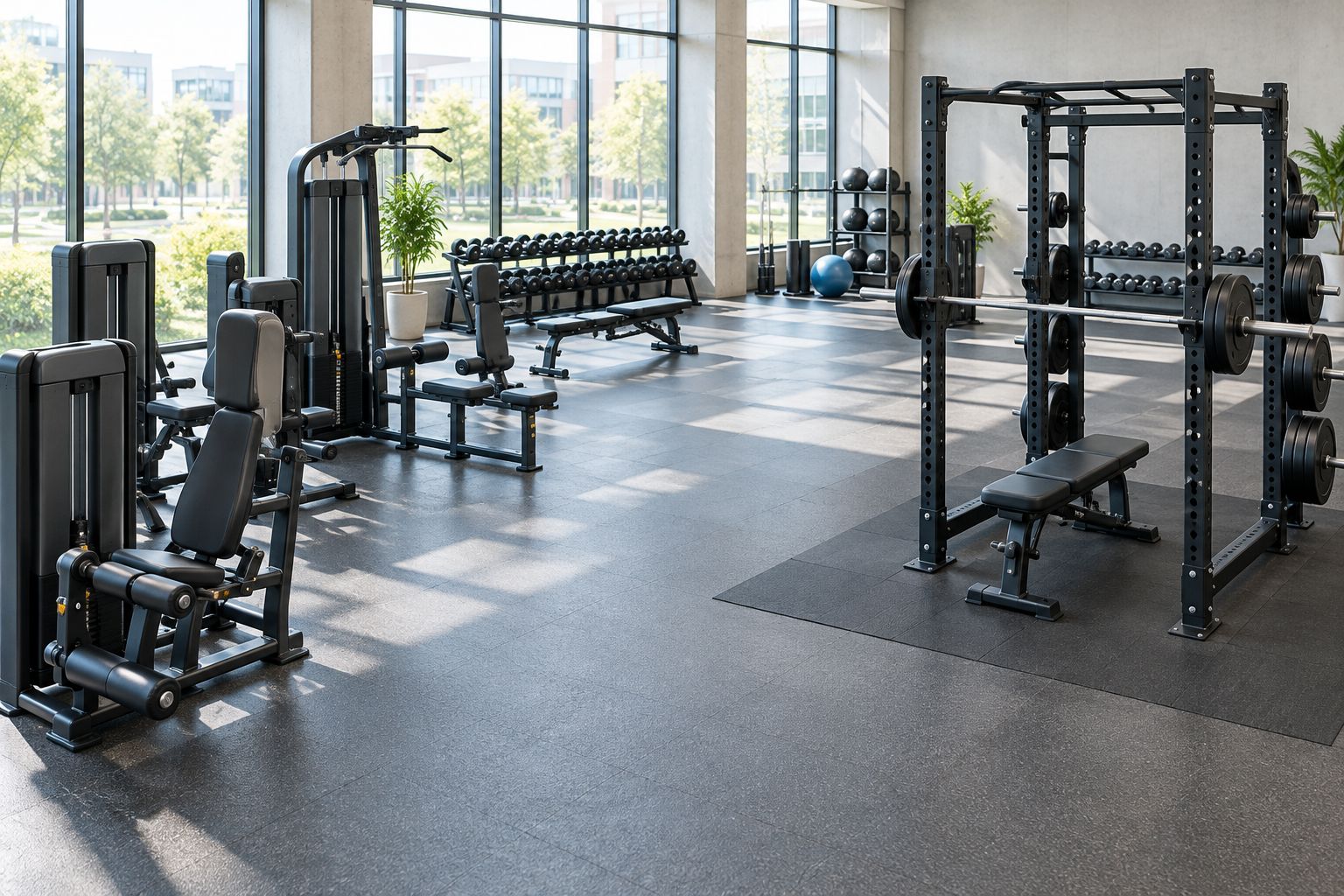
Next, check the delivery route from the unloading point to the installation site. Document any doorways, stairs, elevators, and necessary temporary storage areas. A well-planned layout won’t help if the ordered assembly can’t be moved to its intended location.
3. Base your equipment selection on training objectives
Start by creating a simple mapping: training exercise, appropriate equipment type, required accessories, and the area occupied during the exercise. You can do this in a spreadsheet without planning software. Be sure to highlight any overlaps—for example, when multiple exercises use the same bench or cable machine.
Next, compare separate stations with combined solutions. A power rack, a weight bench, and a cable machine offer different possibilities, but each requires appropriate instruction and organization. A combination does not automatically save usable space: what matters most is which functions are accessible at the same time and which ranges of motion overlap.
Kraftathlet This is ideal for universities that want to source strength training equipment—including delivery, installation, and ongoing service—from a single provider. With Kraftathlet you can align your equipment selection with these project requirements. However, you’ll still need to define your own requirements; a supplier cannot replace your usage plan or the technical approval of the building.
Conclude the preliminary selection with a brief job description:
- Describe the training tasks and the required concurrent use.
- Request approval for the intended use as well as the associated product documentation.
- Include accessories, storage, and adjustment options as part of the equipment.
- Separate mandatory requirements from future extensions.
4. Check the user experience and customer support before placing an order
Do not evaluate the intended equipment based solely on photos. Review the manufacturer’s documentation and, if possible, arrange for a hands-on operational test. Involve the trainers and the individuals who will later conduct the briefings. Their role is not to evaluate the design, but to review the planned training sequence.
Make sure the adjustment points are accessible, the markings are clear, and position changes are easy to follow. For an adjustable bench, check how the locking mechanism works; for a cable machine, check how to switch between handles and pull positions. The specific settings required depend on the model. Document any unanswered questions rather than assuming identical functions based on similar equipment.
As part of the 2026 university sports planning, the handoff between rotating instructors is also included. A training session must be reproducible. Therefore, document which materials should be available at the equipment and how you communicate changes to settings or accessories.
Complete the test by following a documented procedure: prepare the device, explain the settings, perform the exercise, and reset the station. If this procedure does not work during normal operation, change the selection or the care plan before placing the order.
5. Clearly define procurement and the scope of delivery
Convert the shortlist into a functional specifications document. Describe what the university sports equipment is expected to accomplish, and include the documented technical requirements. Coordinate the process with your designated procurement office. The specific formal requirements depend on your institution and the particular procurement project.
In the documentation, clearly distinguish between equipment, accessories, and project services. Delivery does not automatically include bringing the items into the room, assembly, removal of packaging, or instruction. Have each required component explicitly confirmed. This makes quotes comparable and prevents differing expectations regarding the finished training room.
Kraftathlet describes delivery, on-site installation, and follow-up service as part of its project support. Nevertheless, the specific scope of services, responsibilities, and schedule must be included in the respective proposal for your university. A general description of services does not replace a project-specific confirmation.
For the 2026 procurement, also coordinate payment terms and internal approvals well in advance. The website Kraftathlet lists “prepayment” as a payment method; verify that this is compatible with your university’s processes before approving the order.
Complete this step with a finalized document that clearly outlines the equipment, the full scope of project services, the confirmed transportation route, the agreed-upon scope of handover, and the designated responsible parties. Any outstanding issues should be resolved before the contract is awarded, not during the installation week.
6. Organize the acceptance testing and operations before the opening
Designate one department to be responsible for the equipment file. This is where product documentation, installation instructions, training records, and service contacts are all kept. Other parties may take on specific tasks; however, the documentation still needs a single, designated location and a designated person or department in charge.
Conduct the acceptance inspection based on the scope of the order. Verify that all equipment and accessories are present, that the installation matches the approved plan, and that the required documentation has been provided. Have the responsible personnel review the operation and the planned training procedure. A delivery does not constitute an operational handover.
Schedule maintenance and visual inspections according to the manufacturer's instructions and your facility's requirements. Do not set a one-size-fits-all schedule for all equipment. Also, establish a procedure for reporting abnormalities and determine who is responsible for taking a station out of service until the issue is resolved.
If you plan to launch in 2026, your handover report should cover at least the following points:
- Verification of the order, delivered devices, and accessories.
- Documentation of installation and agreed-upon training.
- Storage of operating and maintenance manuals.
- Responsibility for reporting, service, and operational approvals.
Which device option is best suited for which college program?
Compare device types based on their contribution to operation, not on the length of their feature list. The following table categorizes typical options. It does not replace checking a specific model for approval for use, dimensions, features, and suitability for your location.
| Option | Particularly suitable for | Strength in College Sports | Central Limit Theorem |
|---|---|---|---|
| Guided Power Machines | Programs with clearly defined individual exercises | Predefined motion paths and setpoints | Each station performs only its designated functions |
| Power Rack with Barbell | Supervised Free-Weight Training | Various barbell exercises at a workout station | Requires appropriate safety equipment, training, and sufficient space to move around |
| Adjustable weight bench with dumbbells | Supplementary training with varying exercises | Different bench positions can be incorporated into the training plan | The bench, dumbbells, and storage space must be planned together |
| Cable Pull Station | Products with different pull directions and handles | A variety of exercises thanks to adjustable pull positions | Features and simultaneous use depend on the model |
| Rack-Smith Cable Pull Combination | Rooms that serve multiple functions within a ward | Combines a variety of training options | Shared components and ranges of motion may limit simultaneous use |
For the first phase of expansion, select the options that cover your mandatory course and training offerings. Special stations will be added only once their role in operations has been determined. This ensures that the decision remains verifiable, even if additional departments or user groups later submit requests.
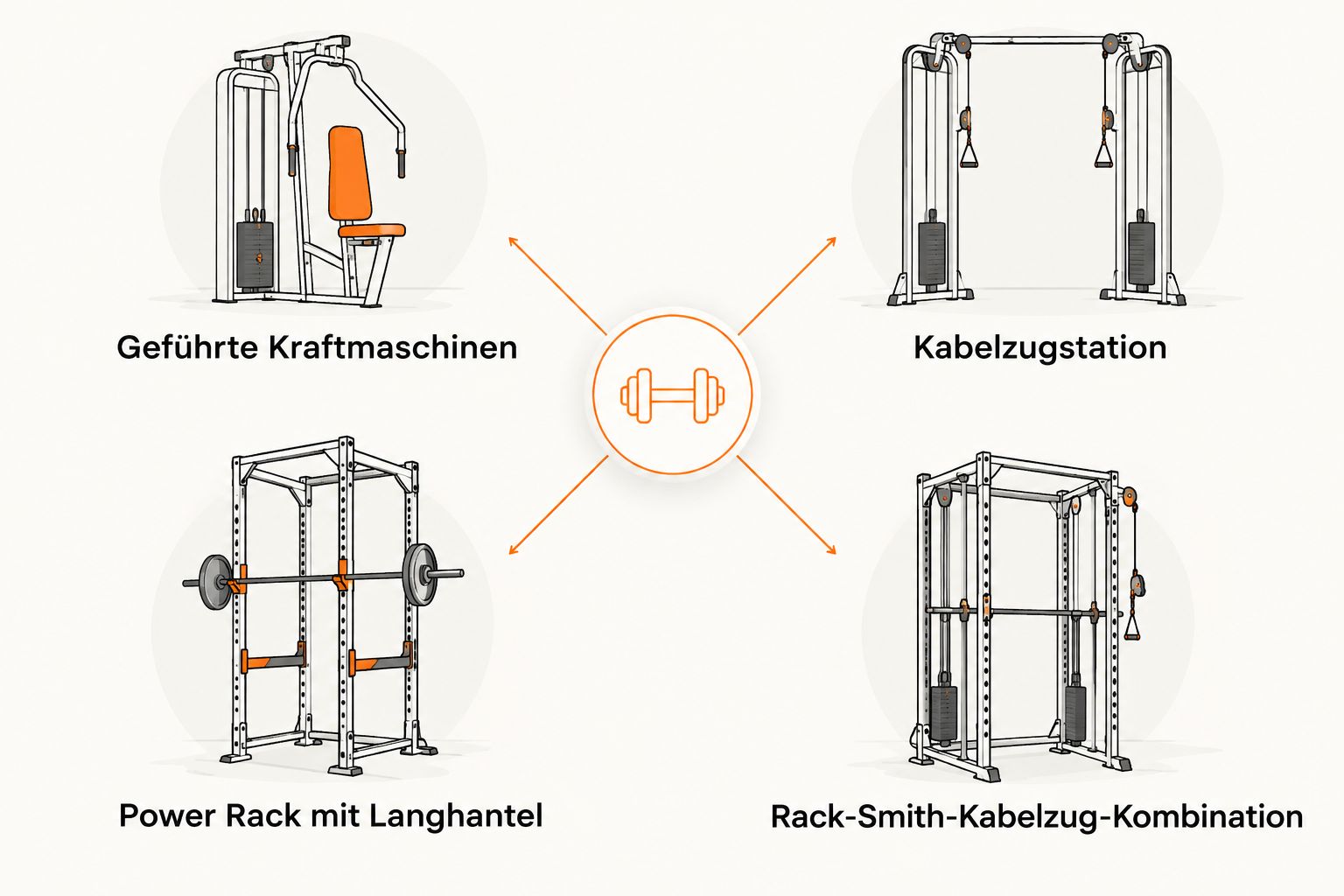
A combined station is therefore neither generally preferable nor generally out of the question. Based on your actual course schedule, determine which functions conflict with one another. If you opt for separate stations, check accordingly whether the additional space requirements and staffing needs are compatible with your operations.
Common Planning Mistakes in College Sports
Confusing a wide variety of equipment with training capacity
A piece of equipment with many functions does not automatically provide a corresponding number of simultaneous workout stations. Check the capacity based on specific exercises. If multiple workout stations require the same piece of equipment, you’ll need to adjust the sequence or redistribute the equipment.
Include only the physical education department in the selection process
A station designed for a specific purpose may have additional requirements regarding the floor, mounting, or transportation. Involve the facilities management and purchasing departments before making the final selection. This ensures that technical and organizational considerations are factored into the decision rather than becoming obstacles later on.
Setting the start of the semester without a confirmed project schedule
The desired start date is not yet a confirmed delivery and installation date. Plan backward from the date the system is to be handed over ready for operation. When doing so, take into account internal approvals, access to the building, installation, and training of the responsible personnel, without assuming any unconfirmed time frames.
Treat accessories and storage as a secondary concern
Handles, discs, and dumbbells need designated storage spaces. Without this planning, it results in extra walking distance and occupied space. Include storage and all accessories directly in the floor plan and bill of quantities.
FAQ
What strength training equipment does a college gym need?
A college fitness center needs equipment that supports its required course and training offerings. Base your selection on training objectives, simultaneous use, supervision, and space, rather than adopting a one-size-fits-all list of equipment.
Do combination units make sense for universities?
Combination appliances make sense if their functions fit your usage needs and simultaneous use is sufficient. For each model, check which components and ranges of motion are shared.
How much space do I need to set aside for strength training equipment?
The space requirements are determined by the equipment dimensions, movement zones, access for operation, and traffic areas that must be kept clear. Use the manufacturer's documentation and a customized floor plan for this purpose, rather than a blanket area value.
Can I use a home exercise machine in the university sports program?
Suitability for college sports must be confirmed for the specific piece of equipment and its intended use. A suitable size or familiar design does not prove this suitability.
What should be included in a request for university sports weight training equipment?
Your request must include the usage plan, the floor plan, the planned training areas, and the desired scope of services. Please also include transportation details, installation requirements, handover documentation, and your procurement terms.
How often do university weight machines need to be serviced?
Maintenance should be based on the manufacturer's specifications and the specific operational requirements. Document responsibilities, inspections, and service procedures for each station, rather than assigning the same maintenance interval to all devices.
Who should inspect the equipment before the opening?
Acceptance should be conducted by the individuals designated as responsible for procurement and operations, with technical input as needed. During this process, verify the scope of delivery, installation, documentation, and the agreed-upon scope of training.
One final step in the planning process
Test your final floor plan with a complete course layout on paper. Mark where participants wait, where the instructor gives instructions, and where equipment is stored. An empty space for equipment alone does not make for a functional training area.
For your 2026 approval, this workflow check is more useful than another device feature. It shows whether your equipment is suitable for the planned college sports program before you order it.