

Summary
- A full-body workout plan with 3 sessions per week trains each muscle group 3 times a week – the most efficient way to build muscle if your time is limited.
- The frequency meta-analysis by Schoenfeld and colleagues shows that at least 2 times per week per muscle group maximizes growth for the same volume.
- Focus on 6 basic exercises (squat, deadlift, bench press, row, overhead press, pull-up) and systematically increase the load.
- Protein guideline ~1.6 g per kg body weight/day (Morton et al.). For equipment, a multi-trainer or adjustable dumbbells with a bench are sufficient.
Full-Body Workout Plan: 3x Per Week for Predictable Muscle Growth
A full-body workout plan with three sessions per week is the most efficient way for most strength athletes to build muscle – because it works every major muscle group three times a week. This aligns perfectly with current research: according to the frequently cited meta-analysis by Schoenfeld, Grgic, and Krieger, large muscle groups should be trained at least twice a week with the same training volume to maximize muscle growth. Three full-body sessions easily meet this condition – and can also be planned alongside work and family commitments.
In this guide, you'll receive a complete 3-day full-body plan with specific exercises, sets, and repetitions, a clear progression strategy, and the most important nutrition and equipment tips. You can start immediately – whether in your home gym or at the studio.
Why 3x Per Week Full-Body Training Works So Well
The crucial lever for muscle growth isn't a single "magic" workout, but rather training frequency combined with weekly volume. If you only train each muscle group once a week (a classic "bro split"), you only stimulate each muscle on one out of seven days. With full-body training, you work the same muscles on Monday, Wednesday, and Friday – three times as often.
This makes physiological sense: muscle-building protein synthesis is elevated for only about 24 to 48 hours after a training session. If you train a muscle only once a week, this "anabolic phase" goes unused for the remaining days. Three stimuli spread throughout the week keep the muscle-building engine running continuously, without the need for excessively high volume per session.
Additionally, there's a learning effect: compound exercises like squats and deadlifts are technically demanding. Performing them three times a week improves movement execution faster than training them only once every seven days. More repetition of the technique leads to cleaner execution, more load – and thus more stimulus.
Who Is the 3-Day Full-Body Plan Ideal For?
The plan is particularly well-suited for three groups:
Beginners and Re-starters
Those starting anew benefit enormously from high frequency, as every repetition also serves as technique training. Three full-body based sessions quickly build a solid strength foundation.
Professionals with Limited Time
Three appointments per week are realistically plannable. You don't need five or six gym visits to make progress – on the contrary: consistency trumps complexity.
Advanced Athletes in a Strength Phase
Experienced athletes also use full-body plans, for example, to maintain muscle mass with high frequency and moderate volume during a diet. However, for those aiming for very high volumes per muscle group, a Push-Pull-Legs split is often better in the medium term – both approaches complement each other over the training year.
The Full-Body Workout Plan in Detail
The plan rotates through three slightly different sessions (A, B, C) to hit each muscle group from various angles. Train on three non-consecutive days, for example, Monday, Wednesday, and Friday. Before each session, include 5–10 minutes of general warm-up plus 1–2 light warm-up sets per compound exercise.
| Session | Exercise | Sets × Reps |
|---|---|---|
| Day A | Squat | 3 × 8–10 |
| Bench Press | 3 × 8–10 | |
| Barbell or Cable Row | 3 × 10–12 | |
| Overhead Press | 2 × 10–12 | |
| Bicep Curls | 2 × 12 | |
| Plank | 3 × 40 Sec. | |
| Day B | Deadlift | 3 × 5–6 |
| Incline Dumbbell Press | 3 × 10 | |
| Pull-up or Lat Pulldown | 3 × 8–10 | |
| Leg Press or Lunges | 3 × 12 | |
| Triceps Pushdown | 2 × 12 | |
| Crunches | 3 × 15 | |
| Day C | Front Squat or Goblet Squat | 3 × 10 |
| Standing Overhead Press | 3 × 8–10 | |
| Close-Grip Row / Pull-up | 3 × 8–10 | |
| Romanian Deadlift | 3 × 10 | |
| Calf Raises | 3 × 15 | |
| Face Pulls | 3 × 15 |
Choose a load such that the last 1–2 repetitions of each working set are significantly challenging, but you maintain clean technique. Rest for 2–3 minutes for compound exercises, and 60–90 seconds for isolation exercises.
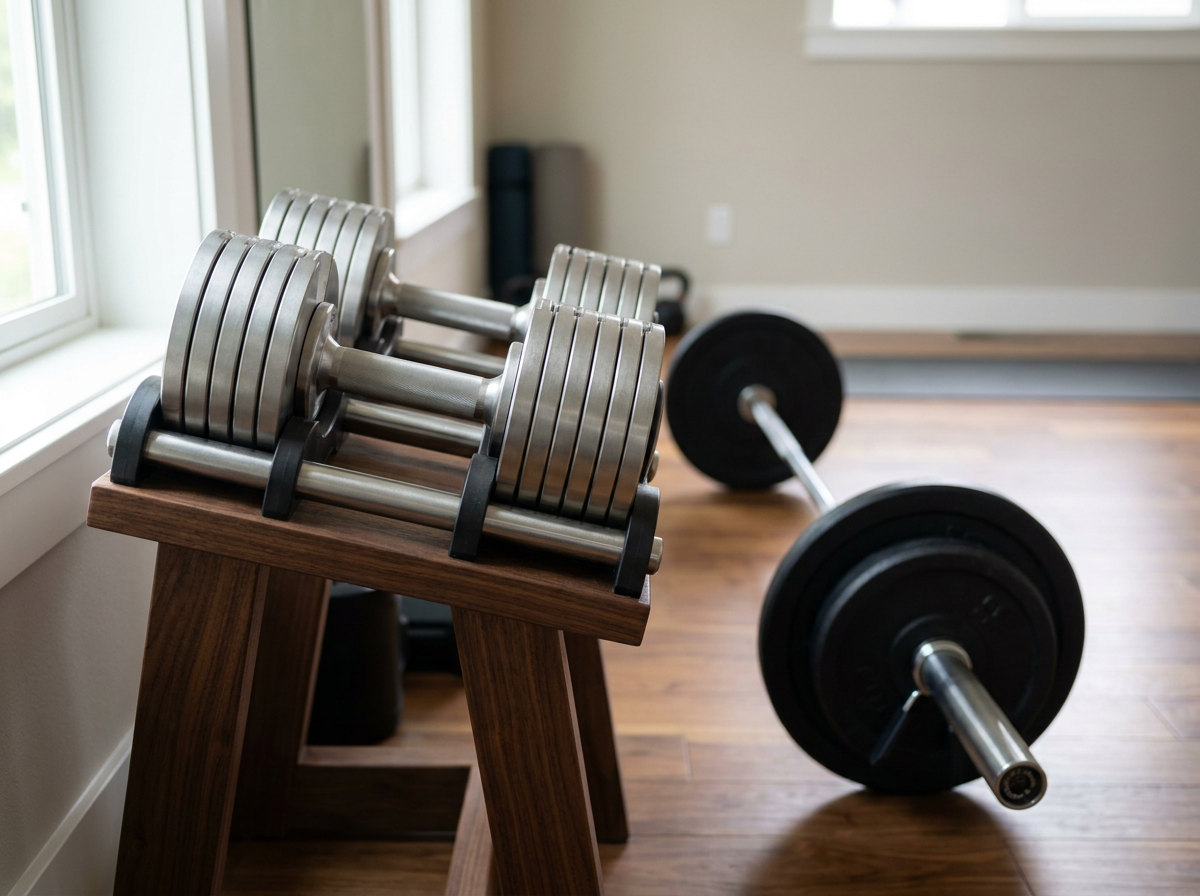
The 6 Compound Exercises as a Foundation
A good full-body plan is built on a few highly effective multi-joint exercises. They activate many muscles simultaneously, allow for heavy loads, and provide the greatest stimulus per training minute:
Squat
The squat trains your thighs, glutes, and core all at once. Ensure a stable, medium-width stance, a neutral spine, and depth at least to parallel.
Deadlift
Few exercises activate more muscle mass. Keep the barbell close to your body, brace your core, and push off the floor with your legs instead of pulling with your back.
Bench Press and Overhead Press
These two pressing exercises cover the chest, shoulders, and triceps. Alternating them throughout the week ensures balanced upper body loading.
Row and Pull-up
Pulling exercises are the counterbalance to pressing and protect against muscular imbalances and shoulder problems. Plan at least as much pulling volume as pressing volume per week.
Progression: No Growth Without Increase
The most important mechanism in strength training is progressive overload: your body only adapts if the stimulus increases over time. In practice, you have several levers:
First, increase the repetitions within your target range (e.g., from 3×8 to 3×10). If you can consistently hit the upper limit with good form, increase the load by the smallest possible increment (1.25–2.5 kg) and start again at the lower end of the rep range. Keep a simple training log – only by documenting your loads can you systematically increase them. Also, plan for a lighter deload week every 6–8 weeks, where you reduce volume and intensity to allow tendons, joints, and the nervous system to recover.
Nutrition: Get Protein and Calories Right
Training is the stimulus, nutrition is the building material. For muscle growth, you need a slight calorie surplus and sufficient protein. The dose-response meta-analysis by Morton and colleagues shows that additional muscle-building effects plateau at around 1.6 g of protein per kg of body weight per day – more won't hurt, but on average offers little additional muscle. Distribute your protein across 3–4 meals and combine it with sufficient carbohydrates around your workouts. If you want to lose weight, keep protein high and primarily reduce calories from fat and snacks.
Buyer's Guide: The Right Equipment for Your Full-Body Plan
The beauty of full-body training: you need surprisingly little equipment. Three setups cover almost all needs:
| Setup | Ideal For | Core Equipment |
|---|---|---|
| Minimalist | Small spaces, beginners | Adjustable dumbbells + bench |
| All-rounder | Home gym, entire family | Multi-trainer / all-in-one station |
| Complete | Ambitious, heavy loads | Power rack + barbell + weights |
For most people, a multi-trainer or an all-in-one station is the best compromise between versatility and space requirements – it allows you to perform pressing, pulling, and leg exercises safely and without a training partner. If you want to start flexibly and save space, a set of dumbbells and kettlebells plus a sturdy bench is an excellent choice. You can find a larger selection of stations, racks, and machines in our strength training category.
As an authorized dealer with full manufacturer warranty, we deliver CO₂-neutrally and, upon request, offer 0% financing via Klarna – making even a larger setup manageable. Over 5,000 customers already trust our advice.
Common Mistakes in Full-Body Training
Too many exercises per session. A full-body workout doesn't need twelve exercises. 5–6 focused movements are enough – otherwise, the intensity of important compound exercises will suffer.
No progression. If you lift the same weights week after week, you're not giving your body a reason to build muscle. Document and increase.
Too short breaks between training days. Three sessions on three consecutive days don't work – muscles need recovery. Plan at least one rest day in between.
Unbalanced pulling and pushing volume. Many people train too much chest and too little back. Maintain at least a 1:1 ratio to protect your posture.
Frequently Asked Questions
How often should I do full-body training per week?
Three sessions per week on non-consecutive days are the sweet spot for most. This way, each muscle group meets the scientifically recommended frequency of at least twice weekly – with some buffer on top.
Is full-body training better than a split?
For beginners and those with limited time, usually yes, because the frequency per muscle is higher. If you need very high volume per muscle group or train more than four times a week, you can switch to a split later. The decisive factor is not the scheme, but volume, frequency, and progression.
How long does a session last?
Around 60 minutes with warm-up. If you work quickly between sets and adhere to rest periods, you can complete the session in 45–55 minutes.
When will I see initial results?
You often feel strength gains after just 2–4 weeks, while visible muscle growth usually requires 8–12 weeks of consistent training with good nutrition. Patience and consistency are the true keys to success.
Can I implement the plan at home?
Yes. With adjustable dumbbells and a bench or a multi-trainer, you can cover all exercises. Heavy compound exercises like squats and deadlifts are best performed with a barbell and rack.
Conclusion
A full-body workout plan with three sessions per week is efficient, scientifically well-supported, and practical for everyday life. Focus on a few compound exercises, systematically increase the load, and support it all with sufficient protein – then muscle growth will begin predictably. Unsure which equipment suits your space and budget? Contact our team for personal, honest advice – we only recommend what you truly need.