

Abstract
- Mat Pilates is an affordable, location-independent way to get started; Reformer Pilates offers variable spring resistance, more precise progression, and higher revenue per participant.
- A randomized controlled trial published in 2025 found that Reformer Pilates improved pain intensity, sleep, and psychological distress in people with chronic pain.
- For studios, the question is rarely “which is better?” but rather: capacity per square meter, target audience, and budget.
- For a durable reformer base, we recommend the Hegren TALMA 62 (steel frame, 5-spring system, 245 cm, Made in Greece)—optionally available as a combo with an attachable tower.
Reformer Pilates vs. Mat Pilates: Which Is the Better Choice for a Gym?
Reformer Pilates and mat Pilates both focus on the same principles—core strength, control, breathing, and flexibility—but with very different levels of effort and return. In short: Mat Pilates is the affordable, flexible way to get started, while the Reformer, with its adjustable spring resistance, allows for greater progression, appeals to a wider range of participants, and generates higher revenue per participant.
For trainers and gym owners, the key question is therefore not “Which is better?” but “Which option is right for my space, my target audience, and my budget?” This guide answers exactly that—based on specific criteria and without marketing jargon.
Reformer vs. Mat: The Key Difference
In Mat Pilates, your body weight serves as resistance. You work on a mat using your own body weight, sometimes supplemented by small equipment such as rings, bands, or balls. In Reformer Pilates, you lie, sit, or stand on a movable carriage that runs on a spring system. By adjusting the number of springs engaged, you can precisely set the resistance—from light and supportive to challenging and heavy.
This adjustable resistance is the real game-changer: It allows for precisely controlled progression, supports beginners, and challenges advanced users—all on the same machine, in the same session.
Mat Pilates: Strengths and Limitations
Mat Pilates stands out for its low startup costs and maximum flexibility. An instructor can teach large groups, requires little storage space, and can teach virtually anywhere. For class formats with many participants and a tight budget, the mat is unbeatable.
The limitation: Progression and customization are limited. Resistance can only be adjusted using levers, pace, and small equipment—not as precisely as with a spring system. For rehabilitation, personal training, or small groups with deep pockets, mat-only Pilates reaches its limits more quickly.
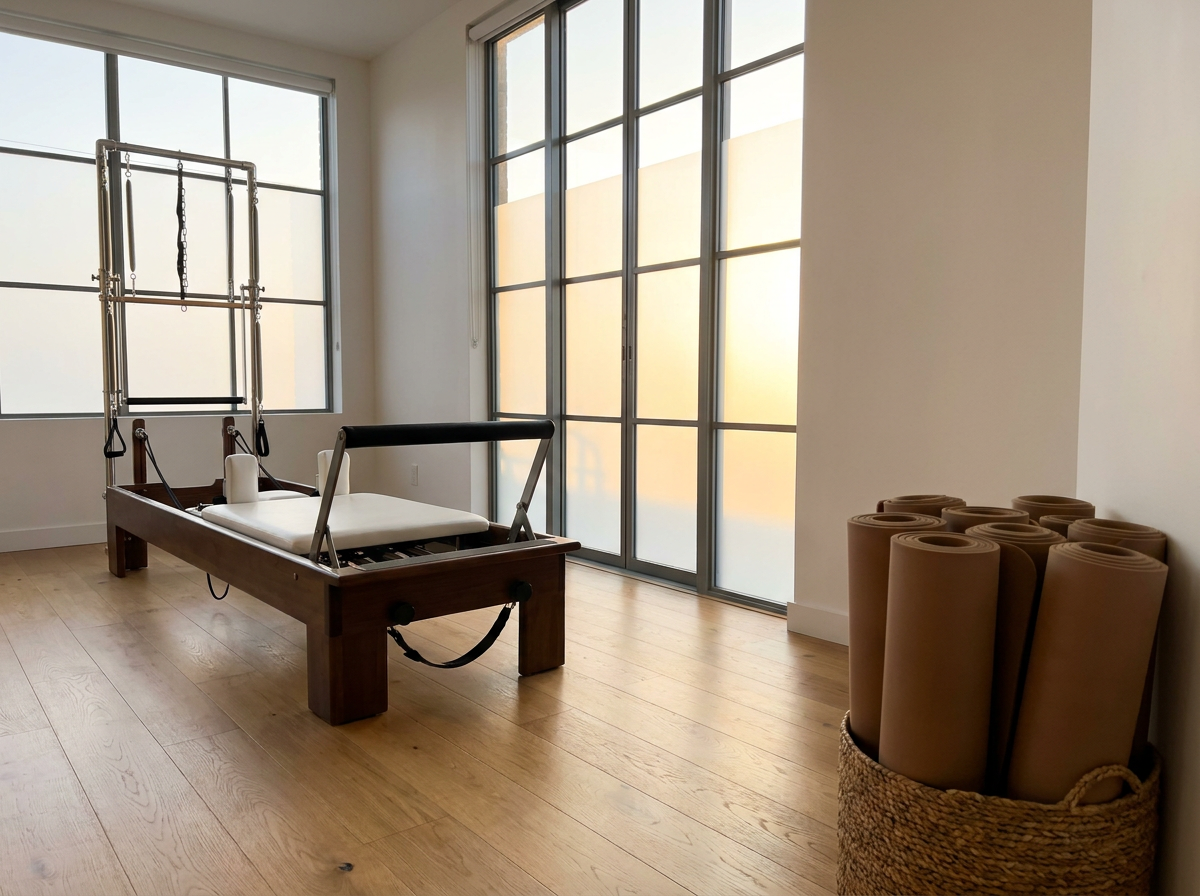
Reformer Pilates: Strengths and Limitations
The Reformer offers exactly what the mat lacks: finely adjustable resistance, hundreds of exercise variations, and guided movements that are safe even for rehabilitation and seniors. That is precisely why it justifies higher class prices and smaller, higher-quality groups.
The scientific evidence supports the therapeutic benefits: A randomized controlled trial published in 2025 on Reformer Pilates for chronic pain found improvements in pain intensity, sleep quality, and psychological distress. Controlled studies on the Pilates method have also shown positive effects on pain and function in cases of nonspecific back pain.
The main drawback of the Reformer is the investment: the purchase price, space requirements, and maintenance costs are higher than those of the mat. That is precisely why the quality of the equipment determines its cost-effectiveness.
The Studio Perspective: Capacity, Revenue, and Target Audiences
From a business perspective, mats and reformers are in different leagues. The following table summarizes the key criteria.
| Criterion | Mat Pilates | Reformer Pilates |
|---|---|---|
| Start-up costs | low | higher (equipment investment) |
| Resistance / Progression | About Leverage & Pace | finely adjustable via a spring system |
| Revenue per Participant | smaller, but with large groups | higher, smaller premium groups |
| Target Audiences | Recreational Sports, Classes | Rehabilitation, Seniors, Personal Training, Performance |
| Space per unit | low (matte) | Approx. 245 cm equipment length + clearance |
| Maintenance | minimal | Springs, rollers, padding (can be planned) |
The approach taken by many successful studios is therefore not “either/or,” but “both”: mat classes fill the space and lower the barrier to entry, while Reformer classes boost revenue per square meter and retain high-spending clients.
Why the Frame Determines the Service Life
When investing in a Reformer, the most important purchasing decision is the frame. A Reformer used in daily studio operations completes thousands of carriage strokes per week. Wooden or aluminum frames are more likely to develop play under this constant load; a steel frame remains torsionally rigid and stable for years. Less play means less maintenance, less downtime, and a safer, smoother movement for participants.
This is exactly where the Hegren TALMA 62 comes in: a premium studio reformer with a steel frame, a 5-spring system, and a length of 245 cm, manufactured in Greece and designed for daily use. For studios looking to expand their exercise repertoire, there’s the TALMA 62CT+ combo version with an attachable tower—two training worlds in one footprint.
Buying Guide: Choosing the Right Reformer
When buying a Reformer, consider four criteria: frame material (steel for continuous use), spring system (more spring levels = smoother progression), safety and class flow (removable shoulder supports; quick spring changes save minutes per hour), and total cost of ownership over the machine’s lifespan rather than just the purchase price.
In our Hegren Pilates collection, you’ll find the TALMA 62 (€4,400) as well as the combo version, the TALMA 62CT+ (€4,280). For a wider selection, check out the Pilates Reformer category; for mat-based exercises, take a look at our exercise mats and floor protection. As an authorized Hegren dealer offering a manufacturer’s warranty and serving over 5,000 satisfied customers, we’re here to assist you from product selection through delivery.
Common Mistakes in Studio Setup
- Focusing only on the purchase price: A cheap reformer that starts to wobble after 18 months will cost more over its lifetime than a durable machine.
- Ignore capacity per square meter: Those who plan only mat classes often miss out on the higher-revenue reformer segment.
- Underestimating the effort involved in changing springs: Cumbersome spring systems slow down the flow of classes and cost time in every lesson.
- Improper room planning: A Reformer requires about 245 cm plus space to move around it—this needs to be factored into the layout before purchasing.
- Target audience not defined: Rehabilitation, seniors, and performance each have different requirements for equipment and accessories.
Frequently Asked Questions
Is Reformer Pilates better than mat Pilates?
Not necessarily—both follow the same principles. The Reformer offers more nuanced progression, appeals to a wider range of participants, and generates higher revenue per participant; the mat, on the other hand, offers lower costs and greater flexibility. For studios, a combination of both is often the best option.
How much space does a reformer take up in a studio?
Allow for an equipment length of about 245 cm, plus space for movement at the ends and sides. For group activities, you should also factor in clearance and safety distances.
Is a reformer worth it for small studios?
Yes, often especially then. Reformer classes allow for higher class prices with smaller groups, thereby increasing revenue per square meter—an advantage when space is limited.
Why is a steel frame important?
In continuous operation, a steel frame remains torsionally rigid and develops less play than wood or aluminum. This means less maintenance, less downtime, and safer, smoother movement—criteria that the Hegren TALMA 62 meets.
Can you combine mat Pilates and Reformer Pilates?
Absolutely. Many studios use mat classes as an entry point and Reformer classes as a premium offering. This way, you can achieve both breadth and value at the same time.
Safety and Classroom Flow: The Underestimated Factor
In the day-to-day operations of a studio, success depends not only on the effectiveness of the workout but also on the smooth flow of a class. Details such as removable shoulder supports and quick, tool-free spring changes save valuable minutes in every session—and with multiple classes a day, that adds up to hours. A well-designed Reformer allows the instructor to keep the group together instead of wasting time on individual machines.
Another point concerns member retention: Formats that are entirely screen-based, in which participants follow instructions on a screen alone, lower the barrier to entry but often lead to higher dropout rates. In-person Reformer classes with instruction and a sense of community foster stronger member retention—an argument that is often underestimated when deciding on a format.
Which format is best for whom?
The target audience determines the equipment. Rehabilitation and physical therapy benefit from the Reformer’s guided, adjustable resistance, which allows for safe training even with limited physical capacity. Seniors appreciate the stable support and joint-friendly movements. Performance-oriented clients use the Reformer to improve core stability and flexibility as a complement to strength training. Recreational exercise groups, on the other hand, are well-suited to the mat—here, it’s the group that counts, not individualization.
Those who want to expand their offerings often start with a few high-quality reformers for premium classes and supplement them with mat classes in the studio. This allows them to build up their investment gradually and in a planned manner, without having to completely reconfigure the space right away.
Cost-Effectiveness: Total Cost of Ownership Matters
A reformer is a long-term investment, so it’s worth looking beyond the purchase price. Factor in maintenance, replacement parts (springs, rollers, padding), and potential downtime. A durable machine with readily available replacement parts and a sturdy frame usually pays for itself over its useful life better than a cheap entry-level model that needs to be replaced sooner. Calculate how many class hours each machine supports per week—this will give you a realistic return on investment that helps you make an objective purchasing decision.
Also take your location and clientele into account when making your decision: In an urban setting with a high-spending target audience, premium Reformer studios pay off more quickly, while in price-sensitive regions, the mat offers an easier entry point. The best equipment is always the one that suits your specific market—not the most expensive and not the cheapest.
Conclusion
Reformer Pilates and mat Pilates aren’t rivals, but rather two tools with different purposes. The mat lowers the barrier to entry; the Reformer enhances progression, target audiences, and revenue. Anyone investing in a Reformer should look for a durable steel frame and a well-designed spring system—then the investment will pay off for years to come. Are you planning your studio or considering adding Reformers? Talk to our team —we’ll provide honest, criteria-based advice.