

Abstract
- Kettlebell training combines strength, endurance, and coordination in explosive, full-body movements like the swing—one piece of equipment replaces half a gym.
- In a study by the American Council on Exercise (ACE), participants burned about 20.2 calories per minute while performing kettlebell snatches—comparable to a running pace of about 6 minutes per mile (approx. 3:45 min/km).
- Beginners usually start with 8 kg (women) or 12–16 kg (men). Proper form always takes precedence over weight.
- Cast-iron kettlebells are versatile all-arounders; competition kettlebells have standardized dimensions and are suitable for ambitious athletes.
Kettlebell Training: Exercises, Benefits, and Buying Guide
Kettlebell training is one of the most time-efficient forms of exercise there is: With a single cast-iron kettlebell, you can build strength, endurance, and coordination all at once. In a widely cited study by the American Council on Exercise (ACE), athletes burned an average of about 20.2 calories per minute performing the kettlebell snatch—a rate that, according to study leader Dr. John Porcari, is equivalent to running a mile in six minutes.
This guide shows you which exercises really make a difference, which benefits are backed by research, what weight you need to start with, and what to look for when buying—without marketing hype, but with clear criteria.
What is kettlebell training?
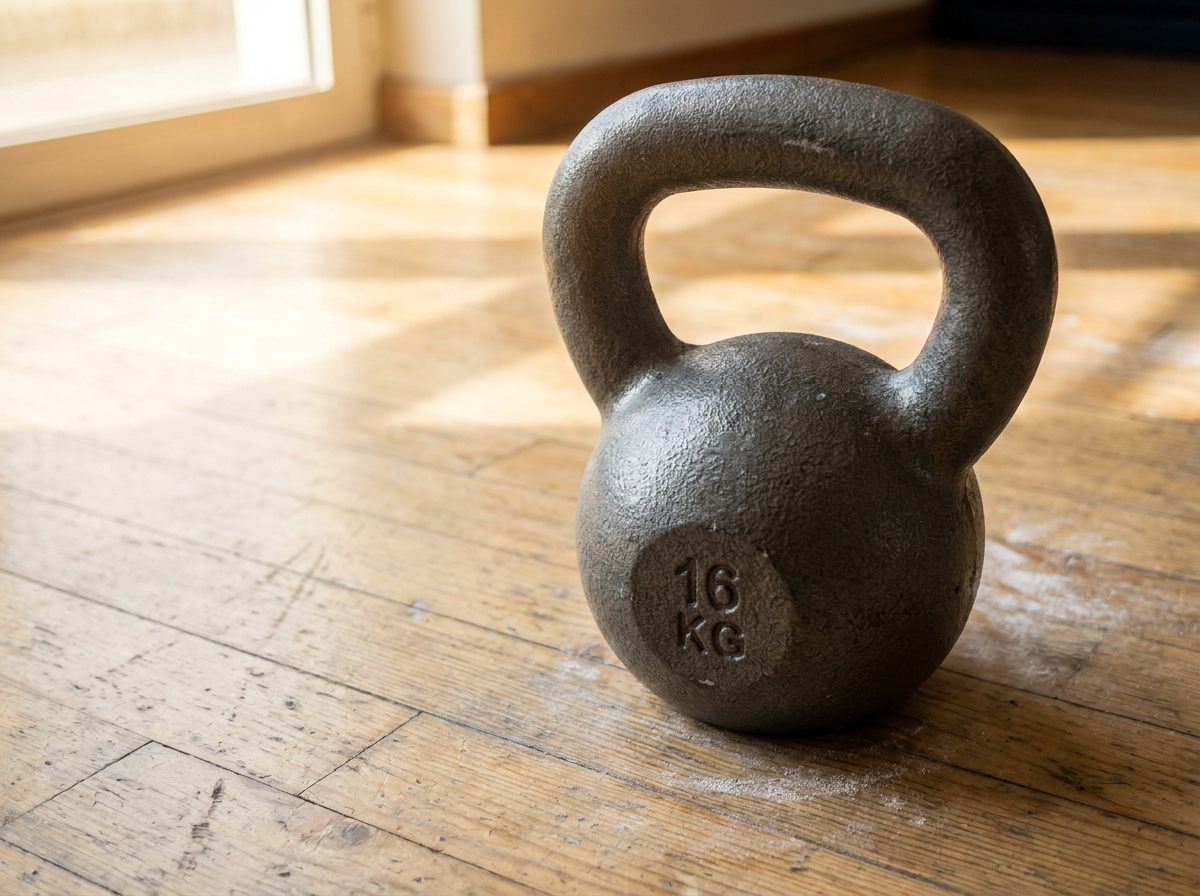
A kettlebell is a weight with a fixed handle. The center of gravity lies outside the handle—unlike with a dumbbell. This is precisely what creates the typical training stimulus: During dynamic movements, you must control, slow down, and stabilize the weight. This activates the core muscles, the posterior chain (glutes, hamstrings, back), and grip strength with every repetition.
Generally speaking, there are two types of exercises: ballistic exercises (swinging movements such as the swing, clean, and snatch) and grind exercises (slow, powerful movements such as the goblet squat, press, or Turkish get-up). Together, these two types make kettlebell training so versatile.
What are the benefits of kettlebell training?
The biggest advantage is time efficiency: Because ballistic exercises engage many muscle groups at once and challenge the cardiovascular system, you combine strength and endurance training in a single session. The ACE study mentioned above confirms the high energy expenditure; the interval-style workout explains why even 20 minutes can be intense.
Other documented or easily verifiable benefits:
- Strong posterior chain: The kettlebell swing provides explosive hip extension training—essential for jumping power, sprinting, and a healthy back.
- Grip strength and core stability: The offset center of gravity challenges the forearms and core with every repetition.
- Space-saving: One or two kettlebells can replace several pieces of equipment—ideal for a home gym or as a supplement at the gym.
- Relevant to everyday life: Movements such as lifting, carrying, and swinging directly translate to work and sports.
Health guidelines, such as those from the British NHS, recommend strength training for all major muscle groups at least twice a week—and a kettlebell makes it surprisingly easy to follow this recommendation.
The Most Important Kettlebell Exercises
1. Kettlebell Swing
The ultimate exercise. The swing is not a shoulder exercise, but an explosive hip extension: You lean your upper body forward with your back straight, swing the kettlebell between your legs, and then quickly drive your hips forward. The weight “flies” up to chest or eye level through the hip drive, not through your arms. The swing strengthens the posterior chain and serves as the foundation for all other swinging exercises.
2. Goblet Squat
Hold the kettlebell with both hands in front of your chest and lower into a squat. The goblet squat is the best beginner exercise for developing proper squat form: The weight in front of you keeps your upper body upright and engages your core.
3. Turkish Get-up
From a lying position to a standing position—with your arm extended and the kettlebell above your head. The get-up builds stability, mobility, and whole-body control like almost no other exercise. Be sure to start without any weight or with a light object.
4. Clean & Press
The Clean brings the kettlebell cleanly from the swing into the racking position on the shoulder; the Press pushes it in a controlled manner overhead. Together, they form a complete strength exercise for the legs, core, and shoulders.
5. Kettlebell Row
Forward-bend rowing for the upper back—ideal for balancing out all the pushing and swinging with a pulling exercise and improving posture.
What's the right kettlebell weight?
The most common beginner’s mistake is using a starting weight that’s too light or too heavy. For ballistic exercises like the swing, it’s fine to use a slightly heavier weight because the hip momentum provides power; for press and get-up exercises, start with a significantly lighter weight. The following table provides practical guidelines for beginners.
| Target Audience | Swing / Ballistic | Press / Get-up |
|---|---|---|
| Women, Beginners | 8 kg | 4–6 kg |
| Women, Advanced | 12–16 kg | 8–12 kg |
| Men, Beginners | 12–16 kg | 8–12 kg |
| Men, Advanced | 20–24 kg | 16–20 kg |
These numbers are starting points, not rules. If you perform an exercise with proper form and without compensatory movements, you can increase the weight. Many people get by with just two or three kettlebells for years.
Cast iron or competition kettlebell?
When it comes to material, you can choose between the classic cast-iron kettlebell and the steel competition kettlebell. The main difference: Competition kettlebells always have the same external dimensions and handle thickness regardless of weight, while cast-iron models increase in size as the weight increases.
| Criterion | Cast iron | Competition (Steel) |
|---|---|---|
| Dimensions | increase with weight | uniform (e.g., 33 cm high) |
| Handle | varies depending on weight | consistent grip strength |
| Ideal for | Beginners, Home Gym, All-Around | Competition, technical volume |
| Entry-Level Price | lower | higher |
Buying Guide: What to Look For
Four criteria determine quality and enjoyment during training:
- Handle Finish: The handle should be smooth, burr-free, and free of sharp casting edges—otherwise, your hands will suffer during swing exercises.
- Coating: A good powder coating provides a secure grip without chafing the skin. It’s the best option for chalk training.
- Standing surface: A wide, flat base provides stability and protects the floor during exercises such as renegade rows.
- Weight progression: Plan one or two jumps ahead so you can gradually increase the intensity.
In our selection, you’ll find both colorful kettlebells for beginners starting at around €25 and the sturdy RAW V2 cast iron series for ambitious workouts. If you’re planning to do your entire strength training routine at home, be sure to check out the Dumbbells & Kettlebells category and our complete strength training lineup. As an authorized retailer, we offer installment payments via PayPal or leasing for business customers, along with a 30-day return policy —so you can try out your starting weight at home at your own pace.
Common Mistakes in Kettlebell Training
- Don't swing from your arms: The swing comes from your hips. If you pull with your shoulders, you'll strain your lower back.
- Rounded Back: Keep your spine in a neutral position. The hip hinge (hip back, don't bend your knees) is essential for every swing.
- Too fast, too heavy: Focus on technique first. A clean 12-kg swing is better than a wobbly 20-kg swing.
- No warm-up: Hip stretches and spinal mobilization help prevent injuries.
- Incorrect racking position: During the clean, the shot "clatters" against your forearm if you swing it too far instead of keeping it close to your body.
Frequently Asked Questions
What kettlebell weight should a beginner use?
For swings, women usually start with 8 kg and men with 12–16 kg. For press and get-up exercises, choose a significantly lighter weight. The key is to perform the movement with proper technique and control.
How often should I train with kettlebells?
Two to three sessions per week are ideal for most people and meet the general recommendation of at least two strength training sessions per week. Be sure to schedule at least one recovery day between intense sessions.
Can you lose weight with kettlebell training?
Kettlebell training has a high energy expenditure (about 20.2 kcal/min during the snatch in the ACE study) and builds muscle, which increases your basal metabolic rate. When combined with a proper diet, it is a very effective tool for weight loss.
Is kettlebell training bad for your back?
No—if your form is correct, it actually strengthens your back. The swing works the posterior chain. This requires a neutral spine and a proper hip hinge. If you have any existing back issues, you should consult a doctor beforehand.
Should I buy a cast-iron kettlebell or a competition kettlebell?
For beginners and home gyms, cast iron is the best all-around choice. Steel competition kettlebells are worth it if you want to train with a consistent grip and size across multiple weights.
Here's what a simple beginner's workout looks like
You don't have to start with anything complicated. An effective full-body workout consists of just a few basic exercises that you combine in a circuit. Perform the following exercises one after another, rest briefly, and repeat the circuit two to four times—depending on your fitness level and how you're feeling that day.
- Kettlebell Swing: 10–15 repetitions for explosive hip extension.
- Goblet Squat: 8–12 repetitions for the legs and core.
- Kettlebell Row (per side): 8–10 repetitions for the upper back.
- Overhead Press (per side): 6–10 repetitions for the shoulders.
- Rest: 60–90 seconds, then start over.
Focus on proper form rather than speed. First, increase the number of repetitions or sets before increasing the weight. This progression—volume first, then load—protects against overtraining and ensures steady progress over the weeks.
Kettlebell or dumbbell—what's the difference?
Both are excellent free weights, but they complement each other rather than replacing one another. Thanks to its centered center of gravity, the dumbbell is ideal for controlled, isolated strength exercises such as curls or bench presses. The kettlebell, with its off-center center of gravity, excels at dynamic, ballistic movements and in conditioning training. If you own both, you’ll cover practically the entire free-weight spectrum—from pure maximum strength to endurance.
Conclusion
Kettlebell training is as effective as it is simple: one piece of equipment, countless exercises, and a proven high training stimulus. If you start with the right weight, prioritize form over load, and master the swing, goblet squat, and get-up, you’ll have a complete strength and endurance program right at home. Not sure about your starting weight or what equipment to get? Contact our team —we’ll give you personalized, honest advice.