

Abstract
- An adjustable weight bench is the best choice for most people because it combines flat, incline, and decline presses in a single piece of equipment.
- Pay particular attention to the weight capacity (user weight plus dumbbell weight), frame stability, cushion firmness, and the range of adjustment.
- According to Rodríguez-Ridao et al. (2020), an incline angle of 30° activates the upper chest the most—it’s worth adjusting the angle in small increments.
- For studios, other important factors include stability during continuous use, easy-to-clean covers, and non-slip feet.
Buying a Weight Bench: A Buying Guide for Flat Benches, Incline Benches, and Adjustable Benches
The right weight bench is the foundation for safe and effective training with free weights. If you’re looking to buy a weight bench, you should first consider its weight capacity, stability, and adjustability—not just the price. A wobbly, cheap bench quickly becomes a safety hazard and often needs to be replaced after only a short time.
In this buying guide, you'll learn about the different designs available, what to look for in frames, padding, and angles, how much weight a good bench should support, and what mistakes to avoid when buying one—whether for your home gym or the fitness center.
What types of designs are there?
Generally speaking, there are three types. Each has its merits, but for most users, one design is clearly superior.
Flat Bench
The flat bench is extremely stable because it has no moving parts. It's ideal for heavy bench presses, rowing exercises, and dumbbell workouts. The downside: It offers only one angle, which limits the variety of exercises you can do.
Incline Bench (Fixed)
A fixed-angle incline bench targets the upper chest and shoulders. It is stable but inflexible—for a varied workout, you’ll usually need a flat bench as well.
Adjustable Weight Bench
The adjustable bench combines flat, incline, and often even decline presses in a single piece of equipment. The backrest—and often the seat—can be locked into several different angles. For most exercisers, it is the most cost-effective choice because it replaces multiple benches and adapts as their training progresses.
The Most Important Purchase Criteria
These factors determine safety, comfort, and durability. Check them in exactly this order.
| Criterion | What to Look For | Why It's Important |
|---|---|---|
| Load capacity | Body weight plus dumbbell weight, with some leeway | Safety When Lifting Heavy Weights |
| Frame & Stability | Thick steel, wide feet, no wobbling | Stability under load |
| Adjustment Angle | Finely graduated, including the range around 30° | Targeted Muscle Stimulation |
| Upholstery | Sturdy, dimensionally stable, non-slip cover | Grip and Back Protection |
| Dimensions & Space | Foldable? How much space does it take up in the room? | Practicality at Home |
Calculating Load Capacity Correctly
The specified maximum load must cover your body weight plus the weight of the barbell you're lifting—with a safety margin. If you weigh 90 kg and are bench pressing 120 kg, you're placing a load of about 210 kg on the bench. A bench with a weight capacity of 300 kg or more provides the necessary safety margin in this case.
Why the adjustment angle is so important
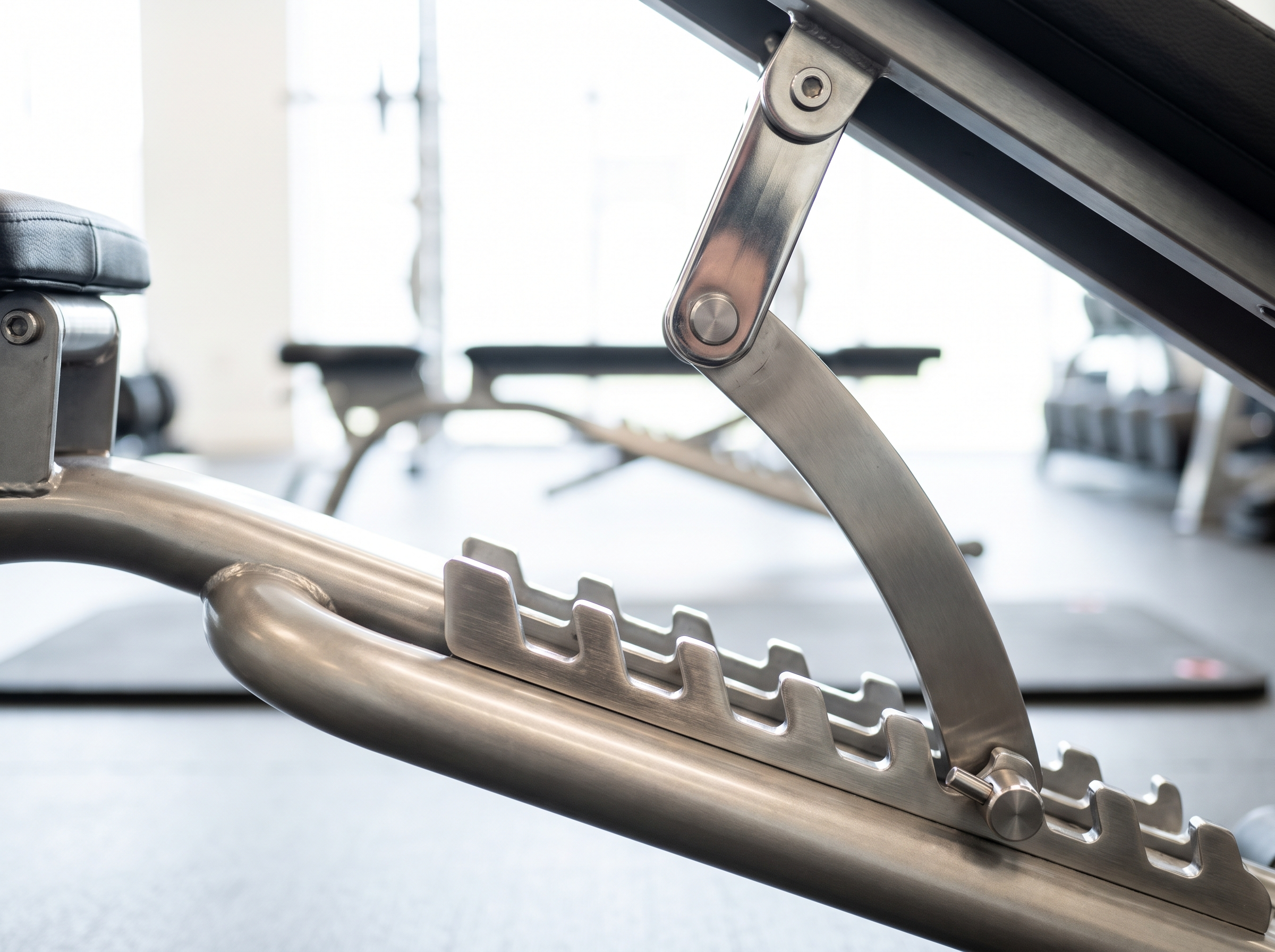
The angle determines which part of the muscle is engaged. In an EMG study by Rodríguez-Ridao et al. (2020) published in the *International Journal of Environmental Research and Public Health*, activation of the upper pectoral muscle was highest at a bench incline of about 30°, while the middle and lower portions were most active at 0° (flat bench). A bench with several finely graduated angles therefore allows you to specifically target different areas—a strong argument for an adjustable bench.
Home Gym or Fitness Center: Different Priorities
At home, the key factors are space requirements, a good folding mechanism, and solid load-bearing capacity. In a commercial gym, additional requirements include long-term durability, covers that are easy to clean and disinfect, and an especially sturdy frame construction, since the bench is used by many people every day. Non-slip feet that protect the floor and easy angle adjustment that doesn’t disrupt the flow of the class are also crucial here.
Buying Guide: Our Selection
As an authorized dealer offering a manufacturer's warranty, we focus on benches that can withstand continuous use—from compact home benches to professional-grade benches suitable for the gym. You'll find a curated selection in our categories:
- Workout benches —flat benches, incline benches, and adjustable models for home gyms and fitness centers.
- Strength Training – the right racks, barbells, and accessories for your complete setup.
- Dumbbells —the perfect complement for presses, rows, and isolation exercises on the bench.
Not sure which bench is right for your fitness goals, budget, and space? Our advice will help you find the right model—so you don't make a mistake.
Common Mistakes When Buying a Weight Bench
- Don't just look at the price: A cheap bench that falls apart after 18 months ends up costing more than a durable one. Sturdiness comes first.
- Miscalculating your weight capacity: Many people only add up the weight of the dumbbells and forget to include their own body weight. Add both together and add a little extra.
- Upholstery that's too soft: Soft upholstery gives way under heavy loads and robs you of stability when you press down. Firm is better than comfortable.
- Few angles: Having only two or three rough angles limits the variety of exercises. A fine gradation, including the 30° range, offers more possibilities.
- Underestimating space: First, measure how much space the bench takes up when it's set up and—if it's foldable—when it's stowed away.
Frequently Asked Questions
Which weight bench is best for beginners?
For most beginners, a sturdy, adjustable weight bench is the best choice. It allows for both flat and incline presses, adapts as you progress, and replaces several individual benches. Make sure it has a weight capacity with plenty of room to spare.
How much weight should a good weight bench be able to support?
The bench must support your body weight plus the heaviest dumbbell load—with a margin to spare. For serious home workouts, models with a weight capacity of around 300 kg or more provide a safe foundation. In a gym, the equipment can be correspondingly sturdier.
A flat bench or an adjustable bench—which is better?
The flat bench is extremely stable and ideal for heavy bench presses. The adjustable bench offers more exercise variety and is the more economical solution for most people. Those who lift very heavy weights and do only flat bench presses may want to opt for a dedicated flat bench.
What incline angle targets the upper chest?
According to Rodríguez-Ridao et al. (2020), a 30° angle activates the upper chest the most. Steeper angles increasingly shift the load to the front of the shoulder. That’s why a finely graduated adjustment is recommended. You can read more about proper form in our bench press technique guide.
Is a foldable weight bench worth it?
For small spaces, yes—as long as the folding mechanism locks securely and the weight capacity isn't compromised as a result. Make sure the bench stands securely even when folded and that the lock has no play.
Conclusion
When buying a weight bench, the build quality is key: a high weight capacity with room to spare, a sturdy steel frame, firm padding, and precisely adjustable angles make the difference between a piece of equipment that will last a lifetime and a quick, regrettable purchase. For most people, an adjustable bench is the best investment because it combines versatility, safety, and durability.
Looking for the right bench for your home gym or studio? Contact us for a personalized consultation. Scientific source: Rodríguez-Ridao et al., 2020, IJERPH.