

Abstract
- The springs control the resistance on the reformer—but more springs don't automatically mean "harder." It depends on the direction of movement.
- When pushing the sled away (using your legs), adding more springs makes the exercise harder. For many arm and core exercises, adding more springs provides greater stability—using fewer springs then makes the exercise more challenging.
- Color codes are not standardized: they vary by manufacturer. Rely on your device's instructions, not on the color alone.
- In everyday gym use, consistent resistance, secure spring hooks, and durability are key—and this is where material quality, such as that of the Hegren TALMA 62’s 5-spring system, really shines.
Understanding Reformer Springs: How Spring Resistance Really Works
The springs on the Pilates Reformer determine how difficult or easy an exercise is—but not always in the way you might think. More springs mean more resistance when you push the carriage away, but they can also make an exercise more stable—and therefore easier—when you’re working against the springs. Once you understand this principle, you’ll adjust the Reformer more consciously—and train more safely and effectively. This guide explains step by step how spring resistance works, what the colors mean, and what matters most at the studio.
How does the resistance of a Reformer spring work?
A Reformer spring is a tension spring: the more you stretch it, the stronger the pull. This is what fundamentally distinguishes it from a fixed weight. At the start of the movement, the resistance is lower; as the spring stretches further, the resistance increases. This is exactly what makes training on the Reformer so gentle on the joints and controlled—the resistance builds up progressively and can be finely adjusted.
Controlled return is important: The loaded sled must never snap back uncontrollably. You guide it back using muscle tension—this is the part of the movement that particularly trains strength and body control.
The biggest misconception: more springs = heavier?
This is where beginners and experienced trainers differ. Whether adding more springs makes an exercise harder or easier depends on the direction in which you're working against the sled:
- You push the sled away (e.g., footwork while lying down): More springs = more resistance = harder. The logic here is intuitive.
- If you're working against the sliding sled or using it for support (e.g., long stretch, plank, many core exercises), more springs provide more stability. Fewer springs = less support = more challenging for core control.
That’s why an old Pilates principle says, “Less is often harder.” So, instructors at the studio don’t choose the spring resistance based on “stronger = more springs,” but rather on the goal of each exercise.
Spring Load in Practice
This overview shows how the number of springs typically affects common exercises. The exact specifications vary depending on the equipment, spring set, and layout of your studio:
| Exercise Type | Typical spring load | Effect |
|---|---|---|
| Footwork While Lying Down | 3–4 feathers (heavy) | More springs = more resistance, a stable base for the legs |
| Rowing / Seated Pull Exercises | 1–2 springs (medium) | Balanced resistance for the back and arms |
| Arm Exercises While Lying Down | 1 spring (light) | Less resistance, more self-control needed |
| Long Stretch / Plank | 1–2 feathers | Fewer springs = less support = harder on the torso |
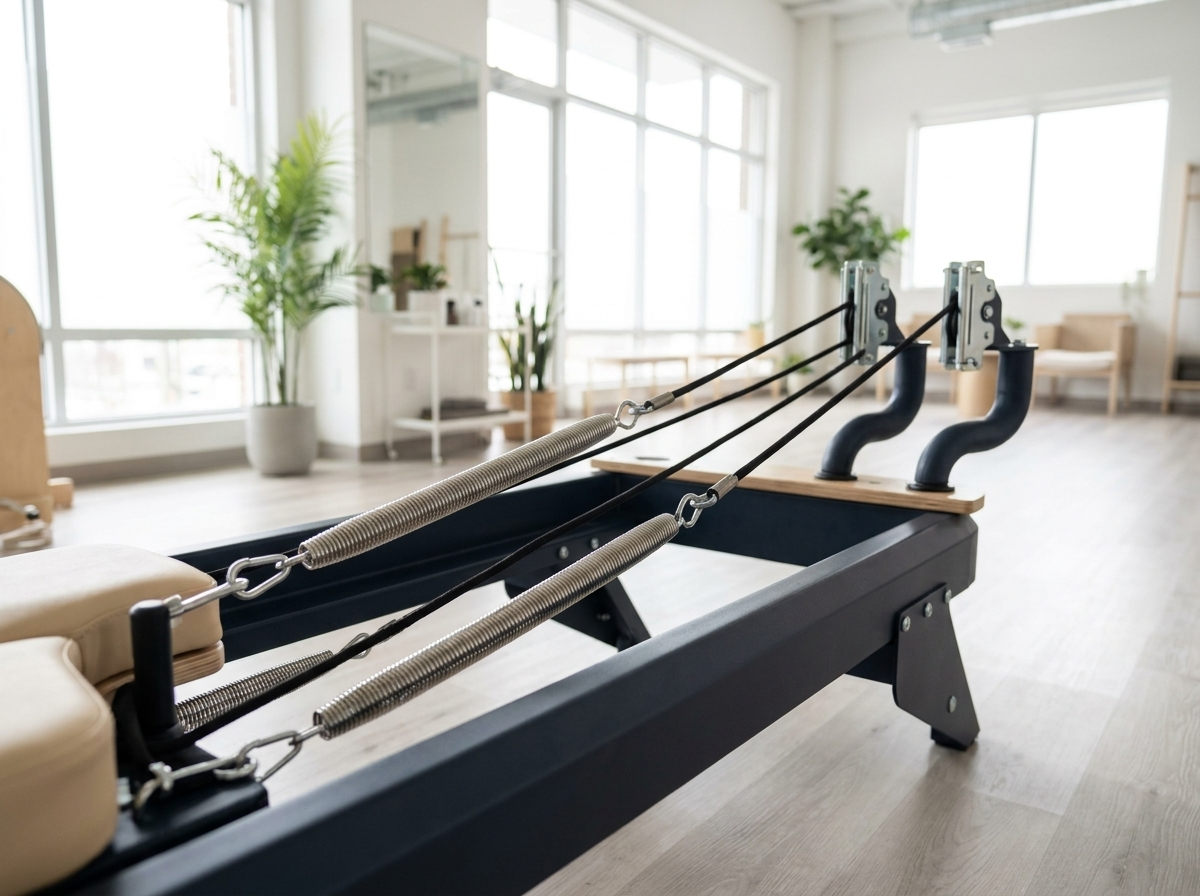
What do the colors of the Reformer springs mean?
Many exercise machines use colored springs to make resistance levels easily recognizable. Note: There is no standardized color code. One manufacturer might use green to indicate “high” resistance, while another might use red. Therefore, always refer to the instructions for your specific machine—not just the color.
With the Hegren spring set, the system is clearly tiered and serves as a good guide:
| Color (Hegren) | Resistance | Typical Applications |
|---|---|---|
| Blue | Light | Arm work, fine motor control, rehabilitation |
| Red | Medium | A versatile tool for many exercises |
| Green | Difficult | Leg and footwork, a strong foundation |
Hegren also offers the springs in different lengths (such as short and long). Shorter springs provide resistance earlier, while longer ones do so later—another tool for fine-tuning the progression.
Short or long springs—what's the difference?
In addition to tension, the length of the spring also plays a role. Shorter springs are under greater tension even in the starting position and begin to provide resistance sooner. Longer springs allow for more freedom of movement at the start and build up resistance later. In practice, this means that using springs of different lengths allows for finer adjustments to the same exercise without having to change the number of springs. This is a valuable tool, especially in rehabilitation and for delicate movements, to make the start of an exercise gentler or, conversely, more challenging as needed.
Spring Resistance in the Classroom: Managing Progression
For instructors, spring resistance is the most important tool for guiding the class. Proper progression doesn’t automatically mean “more springs,” but rather the right resistance level for the participants’ goals and skill levels. Beginners benefit from settings that provide enough stability to keep the movement controlled. Advanced participants deliberately reduce the number of springs during core exercises to challenge their core more intensely. Also, adjust the spring load as needed for each exercise throughout the hour—this keeps the class flowing smoothly and safely. Well-labeled springs with clearly distinguishable colors speed up these adjustments and reduce operational errors.
Caring for, Inspecting, and Storing Springs
To ensure that springs continue to function smoothly for a long time, they need a little care. Wipe them down regularly to remove sweat and moisture—this prevents corrosion. Before each use, check the hooks and suspension system to ensure they’re secure and free of visible damage. When not in use, it’s best to hang springs loosely on a spring holder rather than storing them in a permanently stretched state. This helps them retain their tension longer, and you’ll be able to tell in time when a spring needs to be replaced.
Safety & Durability: What Matters in the Studio
In daily studio operations, springs are loaded hundreds of times a day. Two things are crucial: The spring hooks must be securely and fully engaged before each exercise begins, and the material must provide consistent resistance even after years of use. This is exactly where quality shines through. Hegren springs are nickel-plated, making them resistant to corrosion and the sweat encountered in everyday gym use. Combined with the steel frame of the Hegren TALMA 62 and its 5-spring system, the result is a system designed for consistent performance over many years—a practical advantage you can’t take for granted with springs made from less expensive materials.
The Most Common Mistakes with Spring Resistors
- "More weights = harder workout": When it comes to core and stability exercises, the opposite is often true.
- Letting the sled snap back: You'll unwittingly throw away the most valuable part of the exercise and risk injury.
- Do not check the spring hook: A spring that is not fully engaged poses a safety hazard. Check before each exercise.
- The same spring load for everyone: resistance varies from person to person. What comes easily to some is too much for others to handle.
- Ignoring wear and tear: Springs wear out over time. Springs that are visibly overstretched or corroded must be replaced.
Buying Guide: Springs & Reformers
Whether you’re looking for individual Pilates springs as replacements or additions, or planning to set up a complete studio reformer —make sure to look for high-quality materials, consistent resistance, and a well-designed, safe spring system. For professional studios, the Hegren series, with its steel frame and 5-spring system, is a durable choice designed for continuous use.
As an authorized Hegren dealer offering a manufacturer's warranty, we provide honest, criteria-based advice—from the right spring set to a complete studio setup. Talk to our team if you're unsure about which option to choose.
Frequently Asked Questions
What do the colors of the Reformer springs mean?
The colors indicate resistance levels (light, medium, heavy), but they are not standardized and vary by manufacturer. For the Hegren spring set, blue = light, red = medium, and green = heavy. If in doubt, always check your device’s instructions.
Do more springs make an exercise harder?
No. When pushing the sled away (using your legs), more springs make the exercise harder. In many core and stability exercises, however, more springs provide stability—in those cases, less resistance is often more challenging.
How many springs does a reformer need?
Standard studio reformers use four to five springs of varying resistance, allowing almost any exercise to be adjusted accordingly. The Hegren TALMA 62’s 5-spring system covers the entire range from very light to heavy.
How often do you need to replace the springs on a Reformer?
That depends on usage and the quality of the materials. High-quality, corrosion-resistant springs will last several years in a studio setting. Replace springs as soon as they show visible signs of overstretching, corrosion, or a noticeable decrease in resistance.
What spring resistance is right for beginners?
For beginners, a medium resistance level is ideal, as it allows for control without being too overwhelming. More important than the number of springs is ensuring that the movement remains smooth and controlled. A good trainer adjusts the spring resistance individually for each exercise.
Conclusion
Reformer springs are more than just resistance adjusters: They determine whether an exercise provides support or a challenge. When you understand that adding more springs makes the movement easier or harder depending on the direction, you’ll train and teach with greater awareness. Make sure to use secure spring hooks, controlled return, and durable materials—that way, your Reformer will remain a reliable tool for years to come. Are you planning a studio or looking for the right spring set? We’d be happy to advise you and work with you to find the right solution for your training.