

Abstract
- Pull-ups primarily target the latissimus dorsi muscle, as well as the biceps, forearms, lower trapezius, and core—one of the most effective upper-body exercises that doesn't require a machine.
- An overhand grip (pull-up) targets the back and latissimus dorsi, while an underhand grip (chin-up) engages the biceps more. According to EMG research, the latissimus dorsi works intensely in both variations.
- Proper form trumps the number of repetitions: fully extend at the bottom, chest toward the bar, actively engage your shoulder blades, and avoid using momentum from your hips.
- Can't do a pull-up yet? Negative reps, resistance bands, and horizontal rowing will help you land your first clean pull-up in just a few weeks.
Pull-ups: Which Muscles Are Engaged and How to Master the Form
Pull-ups primarily target the latissimus dorsi, with support from the biceps, forearms, lower trapezius, and core muscles. This makes them one of the most effective basic exercises for building a strong, broad upper body—and all you need is a sturdy bar. Whether you’re just about to do your first pull-up or want to hit double-digit reps with proper form: This guide covers the technique, the muscle engagement, the most common mistakes, and a concrete progression plan.
Which muscles do you work when doing pull-ups?
The pull-up is a vertical pulling exercise. You lift your own body upward against gravity—this engages an entire muscle chain rather than just a single muscle. That’s exactly what makes it so valuable: Hardly any other exercise builds as much functional pulling strength with so little equipment.
The primary muscles involved
The focus is on the latissimus dorsi, the large back muscle that gives the upper body its V-shape. It pulls the upper arms from above toward the torso—exactly the movement of a pull-up. It is supported by the biceps brachii and the brachialis (arm flexors), the lower and middle trapezius, and the rhomboids, which bring the shoulder blades together. Also involved are the posterior deltoid, the forearm muscles (grip strength), and the core muscles, which keep your body stable during the pull.
Overhand grip or underhand grip—what's the difference?
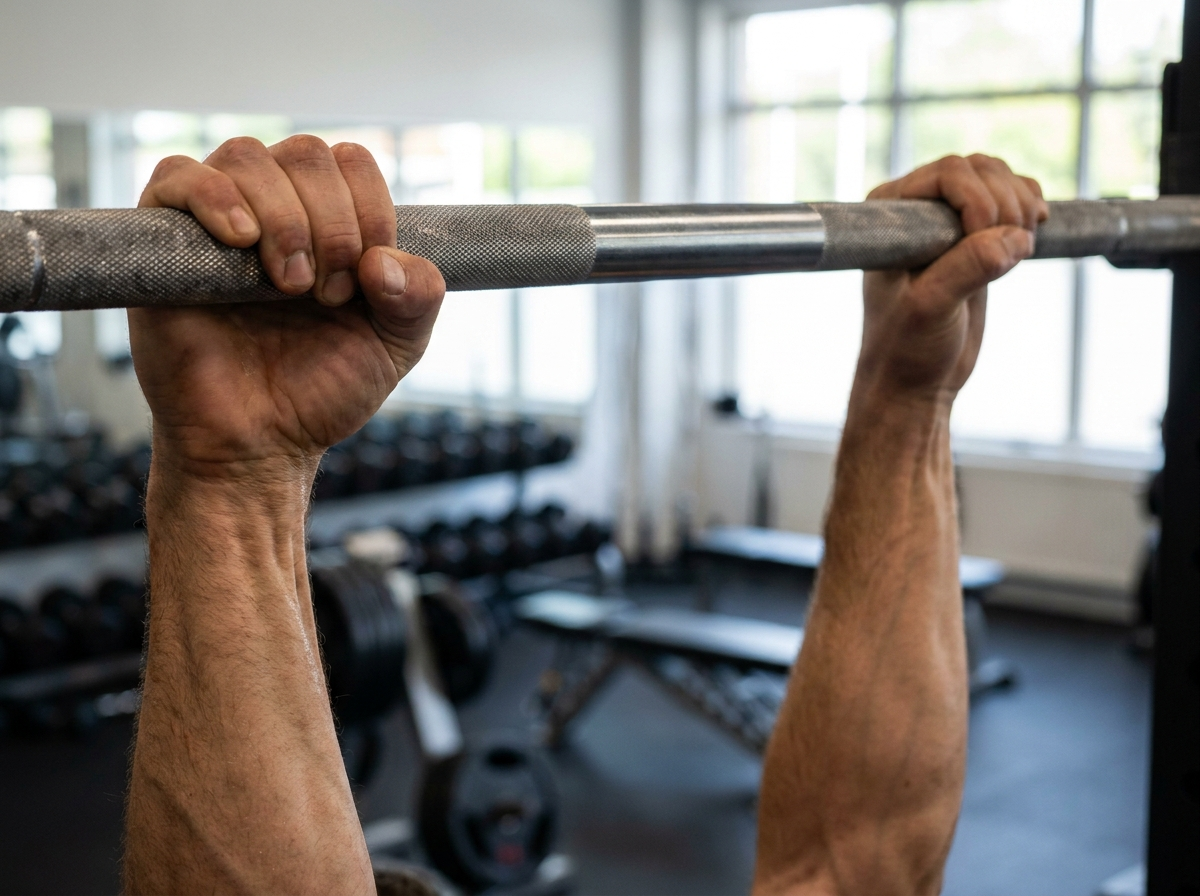
The grip type shifts the center of gravity, but it doesn’t turn the pull-up into a completely different exercise. With an overhand grip (backs of the hands facing you, “pull-up”), the focus is more on the latissimus dorsi and upper back. With an underhand grip (palms facing you, “chin-up”), the biceps are engaged much more, which is why this variation feels easier for many beginners. A frequently cited EMG study by Youdas and colleagues (2010) showed that latissimus activation is nearly the same for both overhand and underhand grips, while the biceps work measurably harder with the underhand grip. The decisive factor for back strain is less the grip direction than the grip width and proper form.
A Comparison of Handle Types
Each grip variation serves a specific purpose. This overview will help you choose the right one for your goal:
| Handle Option | Focus | Difficulty | Who is it suitable for? |
|---|---|---|---|
| Overhand grip, shoulder-width apart | Latissimus, upper back | Medium | Standard for Back Width |
| Underhand Grip (Chin-up) | Latissimus + Biceps | Lighter | Beginners, Arm Focus |
| Neutral grip (parallel) | Latissimus, Brachialis | Lighter | Easy on the shoulders |
| Wide top grip | Upper Latissimus, Width | Difficult | Advanced |
The Correct Procedure, Step by Step
A technically sound pull-up always follows the same sequence. Stick to these four phases, and you'll train effectively while protecting your shoulders:
- Starting Position (Dead Hang): Grip the bar at about shoulder width and hang with your arms straight. Engage your shoulder blades by pulling them slightly down and back—your shoulders should move away from your ears.
- Pull phase: Pull your elbows down and slightly back, bringing your chest toward the bar. Think "elbows in your hip pockets" instead of "chin over the bar."
- Final position: At the top, the chest is close to the bar, the collarbone is roughly level with the hands, and the gaze is straight ahead. Hold briefly without jutting the neck forward.
- Lowering (eccentric): Lower yourself in a controlled manner over 2–3 seconds until your arms are fully extended again. This part is especially effective for building strength—don't just let yourself fall.
The Most Common Mistakes When Doing Pull-Ups
These mistakes slow your progress and put unnecessary strain on your joints. Once you're aware of them, you'll correct them almost automatically:
- Swing from the hips (kipping): When you swing yourself up, you’re working on timing rather than strength. For building muscle, the controlled, “strict” pull-up is what counts.
- Half repetitions: Not extending all the way down or pulling only as far as the tip of your nose shortens the range of motion and reduces the intensity. Full extension at the bottom, chest to the bar at the top.
- Passive Shoulders: Pulling from completely drooping, “dead” shoulders without any initial tension puts strain on the joints. Activate your shoulder blades first, then pull.
- Pushing your neck forward: Sticking your chin out to get over the bar isn't a proper pull-up. Your upper body does the work, not your neck.
- Too much, too soon: If you keep going with fatigued arms, you'll lose your form. Finish the set while you're still performing the reps cleanly.
From Your First Pull-Up: Your Progression Plan
Can't do a single pull-up yet? That's normal and easy to fix. The key is to work on three components at the same time—two to three sessions a week are enough:
| Building block | What You Do | Scope |
|---|---|---|
| Negative Repetitions | Start at the top (jump/step), lower slowly for 3–5 seconds | 3–4 sets of 3–5 reps. |
| Pull-ups with a band | Resistance bands take some of the body weight off | 3–4 sets of 5–8 reps. |
| Horizontal Rowing | Australian Pull-ups / Rowing Exercise for the Pull Muscles | 3 sets of 8–12 reps each. |
| Scapular Pull-ups | Engage only the shoulder blades, without bending the arms | 2–3 sets of 8 reps each. |
The key is to increase the intensity gradually: Step by step, increase the number of repetitions, reduce the resistance band’s tension, and extend the hold times. With this progression, most beginners can complete their first clean pull-up within six to twelve weeks. After that, the same logic applies: more repetitions, then add weight to the belt.
Why Pull-Ups Are So Effective
Hardly any other exercise offers so many benefits with so little effort. Pull-ups work the entire posterior chain of the upper body in a single, natural movement, improve your grip strength, and engage your core as a stabilizer. Because you’re moving your own body weight, you also learn to coordinate strength and body tension—a skill that carries over to many other exercises and everyday movements. Pulling exercises like pull-ups are essential for an upright, strong upper body and healthy shoulders, especially as a counterbalance to prolonged sitting and forward-leaning postures.
How to Incorporate Pull-Ups into Your Workout
Pull-ups belong in every well-rounded workout plan as a counterpart to pushing exercises like the bench press or shoulder press. Two to three pull-up sessions per week are ideal for most people. To build strength, aim for 3–5 sets with as many clean reps as you can manage—or, if you can already do several, with one or two reps “in reserve.” Combine pull-ups with horizontal rowing: Vertical and horizontal pulling movements complement each other; one emphasizes back width, while the other targets density and the stabilizing muscles between the shoulder blades. Training both improves your physique, posture, and shoulder health in equal measure.
Pull-ups for Advanced Athletes: Increasing the Challenge
Once you can do 10 to 12 clean reps, bodyweight alone is often no longer enough to build strength. That’s when advanced methods come into play: adding weight via a dip belt, slowing down the pace (about three seconds up, three seconds down), taking short pauses at the bottom of the movement, or trying more challenging variations like the L-sit pull-up, where you hold your legs horizontal and your core works intensely. Technique remains key: adding weight is only worthwhile if you maintain the full range of motion. It’s better to do five clean, weighted reps than eight half-reps—that way, the pull-up will remain an exercise that truly helps you progress for years to come.
Pull-Up Bars & Equipment: Making the Right Choice
For pull-ups, you’ll need, above all, a sturdy, securely mounted bar with a comfortable grip diameter. For home use, pull-up bars and door pull-up bars are ideal because they’re quick to set up. If you plan to train regularly and also do squats or bench presses, a power rack with a built-in pull-up bar is a better long-term choice—one piece of equipment for multiple basic exercises. You can find our entire selection of strength-building equipment in the Strength Training category.
At Kraftathlet, you’ll enjoy a ★ 4.88/5 rating based on over 5,000 orders and a 30-day return policy —so you can take your time finding the bar or rack that fits your space and your goals. Not sure what’s right for your space? Our team will give you honest, equipment-agnostic advice.
Frequently Asked Questions
Which muscles do pull-ups work?
Primarily the latissimus dorsi (broad back muscle), as well as the biceps and brachialis, the lower and middle trapezius, the rhomboids, the rear deltoid, the forearms, and the core muscles. This makes pull-ups a true core upper-body exercise.
Are overhand or underhand pull-ups better?
Both are effective. The overhand grip emphasizes the back and width, while the underhand grip engages the biceps more and is easier for many beginners. The latissimus dorsi works hard in both—alternate between the two instead of sticking to just one.
How many pull-ups is a good goal?
As a guide: 1 clean pull-up is a milestone for beginners; 5–8 strict reps are considered a solid level of strength; 10+ are considered very good. Quality always trumps quantity—ten clean reps are worth more than fifteen sloppy ones.
How do I learn to do my first pull-up?
Combine negative repetitions, pull-ups with a resistance band, and horizontal rowing for two to three sessions per week. Slowly increase the number of repetitions and reduce the band assistance. Six to twelve weeks is a realistic timeframe.
How often should I do pull-ups?
Two to three sessions per week, with a rest day in between, are ideal. Your back recovers just like any other muscle—regular, moderate exercise is more effective than infrequent, high-intensity workouts.
Conclusion
Pull-ups are one of the most rewarding exercises there are: With minimal equipment, they build a strong, broad back while also developing grip and core strength. Focus on a full range of motion, engaging your shoulder blades, and a controlled descent—then you’ll make progress, whether you’re working on your first pull-up or aiming for a clean set of ten. If you’re looking for the right pull-up bar or a power rack for your workout, get in touch with us. We’ll help you find the right setup for your space.