

A studio needs kettlebell increments that suit its exercises and users: smaller weight jumps for controlled single-arm exercises, appropriate working weights for swings and squats, and matching weights for two-kettlebell exercises. For the 2026 equipment, the quantity per weight increment also matters, because a complete weight range does not replace multiple course weights needed at the same time.
- Kettlebell increments in a studio follow exercises, training level, and simultaneous use, not a generic weight range.
- For groups, you need multiple copies of working weights; for two-handed exercises, you need matching pairs.
- Smaller weight jumps make sense where the next increment prevents controlled execution.
- Kraftathlet targets professional operators with its studio equipment; the specific kettlebell requirements follow your training concept.
Why increments affect your studio operations
A weight range only answers what loads are available. It does not answer whether your class can train with them simultaneously or whether there is a useful transition between two weights. Therefore, plan weight increments and quantities separately.
Kraftathlet is a provider of studio equipment for operators who select professional fitness equipment. For your kettlebell planning, the rule is: first describe the intended use, then determine the inventory. You can find information about the remaining equipment at Kraftathlet.
What kettlebell increments does a studio need?
Your studio does not need a generic weight range, but a selection tailored to the operation. Start with the exercises you actually offer. Assign appropriate working weights to these exercises and then check where an intermediate increment, a second copy, or a complete pair is necessary.
Three questions are crucial: Can your users select a suitable weight? Can they move to the next increment without abandoning the intended execution? Is the inventory sufficient for simultaneous use?
| Equipment concept | Suitable for | Advantage | Limitation | Procurement decision |
|---|---|---|---|---|
| Individual weights across multiple increments | Supervised individual training and varied exercises | Covers different working weights | One weight is not available to multiple people at the same time | Determine the weight range based on the supervised exercises |
| Matching weights as pairs | Training with two kettlebells | Both hands can work with the same load | Pairs take up more storage space than individual copies | Only supplement in pairs for actually planned two-handed exercises |
| Multiple copies of the same increment | Groups with similar working weights | Multiple participants can use the same load simultaneously | A strong focus on individual increments limits the selection | Check course requirements and alternative weights together |
The concepts are not mutually exclusive. A studio with individual training and class operations needs a combination. The key is that every addition fulfills a stated need and does not just visually complete the range.
Individual training: Select increments by exercise
In supervised individual training, you can closely link the selection to the actual exercises. Check single-arm presses, rows, squats, carries, and swings separately. A weight that is suitable for one exercise is not automatically suitable for every other exercise for the same person.
When switching to the next higher kettlebell, execution is what matters. If the person has to change the intended movement pattern, the next increment is not yet suitable for this task. An intermediate increment is then a procurement question; it is not evidence that the entire weight range needs to be tighter.
For supervised individual training, a needs-based selection is more sensible than a range with identical jumps throughout. The advantage lies in the assignment to concrete exercises. The limitation: Without documented training tasks, even a large selection is difficult to justify.
For your 2026 planning, therefore, note which exercises are missing a transition. Procure an intermediate increment where it is needed, instead of adding every weight as a precaution.
Two-handed exercises: Provide matching working weights as pairs
If your program includes exercises with two equally heavy kettlebells, you need corresponding pairs. Two different weights do not replace this pair. An asymmetrical load is a different training task and should not arise from a missing second copy.
Therefore, first check which two-handed exercises your coaching team actually uses. For these exercises, determine the working weights and their simultaneous use. Only then decide which increments must be available in pairs.
For two-handed exercises, the complete pair is the relevant unit, not the individual kettlebell. This simplifies the assignment during training. At the same time, a paired setup requires additional storage space and ties inventory to exercises that you should also offer.
Do not automatically plan every available increment in duplicate. A broad individual range and specifically supplemented pairs fulfill different tasks; both do not need to have the same scope.
Group training: Check quantity before additional weight range
In class operations, asking about the lightest and heaviest weight is not enough. You need enough suitable copies for each intended exercise so that participants can work simultaneously. A rarely needed additional increment does not solve a bottleneck for the frequently used working weight.
For this, consider the class flow instead of just the number of participants. Do all use kettlebells simultaneously, does the group switch between stations, or are devices shared within a station? This decision determines how many copies are in use at the same time.
For the 2026 class equipment, you should also consider the weight change within a session. Anyone who needs a lighter kettlebell for an exercise needs an actually accessible alternative. A theoretically available weight does not help if it is completely occupied in parallel.
For group training, suitable quantities take precedence over the longest possible weight range. The limitation of this priority: Even multiple copies of weights must cover the different working loads of your participants.
Why the need for kettlebell increments varies
The appropriate selection arises from your training concept. You should note these factors before ordering:
- Exercise selection: Single-arm exercises, swings, squats, and carries require a separate check of the working weights.
- Training level: The intended users determine which entry weights and transitions you need in supervised training.
- Simultaneous use: Individual training, station training, and joint class phases create different quantities.
- Two-handed exercises: Exercises with two equally heavy kettlebells require complete pairs of the relevant increments.
- Operational flow: Parallel offers and jointly used storage areas must be considered in the same inventory plan.
None of these factors alone provides the right weight range. A group with different working weights, for example, needs both selection and sufficient quantities. Therefore, check every planned increment together with its function and its quantity.
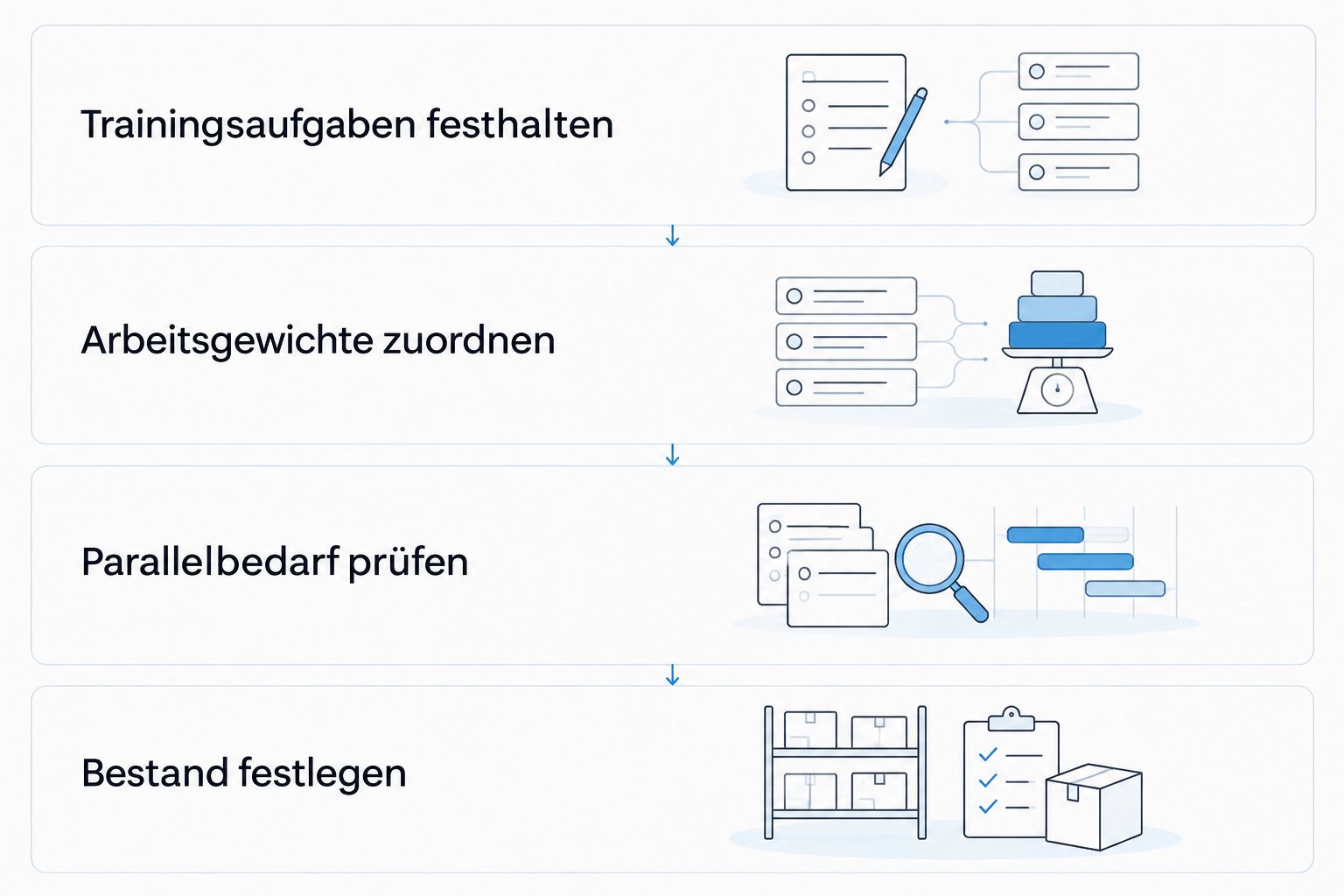
How to derive your inventory from the training plan
Document training tasks
Start with an exercise overview, not a shopping catalog. Write down which kettlebell exercises you want to offer in individual training, on the open floor, and in classes. Separate exercises with one kettlebell from exercises with two kettlebells.
Add whether a coach guides the selection or whether users select their weights themselves. For independent use, a clear arrangement and legible weight indications are part of the planning. A suitable increment is only practically useful if the desired weight can be clearly found.
The result of this phase is not a final order. It is a traceable description of what your inventory is intended to enable.
Assign working weights
Assign the required working weights to each training task. In an existing studio, you use the actually selected loads from supervised training for this. For a new opening, you check the planned exercises with your coaching team and the intended target group.
Do not derive the selection solely from generic categories such as beginner, advanced, or gender. These terms do not replace a check of the concrete task. The same person may need different weights for different exercises.
In addition to the working weight, document whether a lighter alternative weight is needed. This allows you to recognize whether an intermediate increment enables a concrete transition or would only be an additional position on the shopping list.
Check parallel requirements
Apply the working weights to your operational flow. Consider the class phase or training situation in which the most kettlebells are needed simultaneously. Also add parallel individual training if both areas use the same inventory.
Distinguish between occupied and merely available weights. A pair in individual training is not available for the class during this use. A shared storage area does not change this.
Also check whether a planned station change actually leaves time for return and selection. If your concept requires a fluid transition, the inventory plan must not assume a device change that the flow does not provide for.
Determine inventory
Now compile weights, quantities, and pairs in an inventory overview. Each line contains a weight increment, the required copies, and the intended use. Mark complete pairs so that an individual copy is not accidentally assessed as sufficient.
For the 2026 procurement, separate the initial inventory from later additions. The initial inventory includes the weights your defined program requires. Justify additions through additional offers, observed transitions, or actual bottlenecks.
Kraftathlet offers studio equipment for professional operators. For your kettlebell planning, the documented use remains the basis; extensive equipment is not an end in itself.
How do you check the grip, labeling, and storage before purchase?
A suitable weight increment is only one part of the selection. Check the grip design for the intended exercises, especially if both hands are to work on the grip. Also have your coaching team assess how the kettlebell can be picked up, held, and controlled back into place.
Weight indications should be clearly visible when picking up. If your organization additionally relies on colors, check the labeling for the specifically selected product range. Do not apply a color scheme to other kettlebells without checking.
For storage, the dimensions of the selected devices and the load capacity of the intended system matter. Use the respective manufacturer specifications for this. The number of storage spaces alone does not indicate whether the planned weight range can be safely accommodated.
Also think about the return. If pairs are stored separately or frequently used increments are difficult to access, this makes organization difficult regardless of the quality of the increments. Plan the storage together with the inventory, not afterwards.
Does your studio need every weight increment multiple times?
Your studio needs a weight increment multiple times if it is used multiple times simultaneously. This applies to class weights, two-handed exercises, and parallel training offers. The existence of an increment alone does not justify an additional copy.
Therefore, first check the bottleneck when considering an addition. If a suitable load is missing, you need a different increment; if a free copy is missing, you need more quantity. This distinction prevents you from answering the wrong problem with an additional purchase.
Are smaller weight jumps fundamentally better?
Smaller weight jumps make sense if they enable a required transition between working weights. They are not automatically required for every exercise and every increment. A tighter range requires additional copies and storage spaces without replacing a missing class inventory.
The concrete exercise is decisive. Check whether the next available kettlebell can be used in a controlled manner and whether an intermediate increment is actually used in the program. Supplement transitions specifically, instead of condensing the entire range without a usage context.
When should you supplement heavy kettlebells?
Heavy kettlebells belong in the inventory if your intended users and exercises require these working weights. An expansion at the upper end replaces neither entry weights nor missing intermediate increments. It answers a different need.
For an existing operation, the demand in training is the basis. For a new opening, you justify the selection with the defined offer and the check by the coaching team. Do not plan a heavy increment solely because it makes the assortment appear more complete.
You can find kettlebells in all common weight increments in the Kettlebells category.
FAQ
What kettlebell increments does my studio need for beginners?
Your studio needs the working weights for its planned exercises as well as suitable transitions and sufficient quantities. Determine this selection with the coaching team instead of adopting a generic weight range.
Do I need a pair of every kettlebell in the studio?
You need pairs where your training program provides for two equally heavy kettlebells. Individual increments do not automatically need to be available in duplicate.
How many kettlebells do I need for a group class?
The required quantity results from the simultaneous use per weight increment in the class flow. Also consider alternative weights and parallel offers that use the same inventory.
Should I always choose the lightest kettlebell for beginners?
The appropriate starting weight is selected based on the specific exercise and controlled execution. The designation "beginner" alone does not determine a working weight.
When is an additional intermediate step useful?
An intermediate step is useful if a truly necessary transition is missing between the available working weights. In doing so, check the exercise in question, not just the gap within the weight range.
Can I use different weights as a pair?
Different weights do not replace a pair for an exercise with equal load in both hands. Asymmetrical training is its own training task and should be deliberately planned.
How do I plan the kettlebell rack for my studio?
Plan the rack based on the dimensions, quantities, and total load of the selected kettlebells. Check the manufacturer's specifications for the rack system and clearly assign pairs as well as frequently used levels.
One last point: An occupied level is not a missing level
For your studio equipment 2026, this distinction is particularly useful: If a participant cannot find their appropriate weight, first check whether it is missing or already in use. Only in the first case is the weight range the problem. In the second case, examples are missing or there is no clear separation between areas used in parallel.
Note the exercise, the desired weight, and the simultaneous use for each such bottleneck. This will create a justified supplement list. Buy the weight that is missing in the training sequence, not the weight that does not yet have a place on the rack.