

Abstract
- An infrared sauna warms the body directly through radiant heat at a mild 45–60 °C—making it gentler on the circulatory system than a Finnish sauna, which reaches temperatures of 80–100 °C, and it runs on a standard 230-V outlet.
- Regular sauna use has been well studied scientifically: In the Finnish KIHD cohort, frequent sauna users (4–7 times per week) had a roughly 70% lower risk of cardiovascular death than those who used the sauna once a week.
- Electricity costs are manageable: At 0.35 €/kWh, a 2-kW cabin costs about 0.50–0.70 € per session—significantly less than a Finnish sauna heater with 6–9 kW.
- Key factors to consider when buying: heater type (ceramic, carbon panel, or full-spectrum), untreated wood, certified safety (TÜV/GS), and a retailer that offers genuine customer service.
Infrared Saunas for Home Use: Benefits, Costs, and an Honest Buying Guide for 2026
A home infrared sauna is a great choice for anyone who wants to enjoy regular heat therapy but can’t tolerate or doesn’t like high-voltage power connections, long warm-up times, or air temperatures of 90 °C. It operates using direct radiant heat at 45–60 °C, is ready for use in 10–15 minutes, and runs on any standard household outlet—which is exactly why the infrared cabin has become the most popular way to get started with home wellness. In this guide, you’ll get a straightforward overview: what research actually proves regarding its effects, what types of heaters are available, what the purchase and operating costs really are, and what you should look for when buying one.
How an Infrared Sauna Works—and How It Differs from a Finnish Sauna
Radiant heat instead of hot air
A Finnish sauna heats the air to 80–100 °C; your body warms up indirectly through the surrounding environment. An infrared cabin works the other way around: Infrared emitters give off long-wave thermal radiation that hits the skin directly and is converted there into deep heat. The air temperature remains moderate at 45–60 °C, but your body still breaks a sweat—just through a different mechanism.
The Differences in Everyday Life
In practical terms, this means: a shorter warm-up time (10–15 minutes instead of 30–45 minutes), lower power consumption (1.4–2.5 kW at 230 V instead of 6–9 kW at 400 V high-voltage power), and heat that many people find more pleasant and gentler on the circulatory system—especially beginners, older users, or athletes who want a gentle recovery session after a workout. Those who love the classic steam pour and the intense heat experience should stick with the Finnish sauna. You can find a detailed direct comparison in our guide “Buying a Sauna: Infrared vs. Finnish” —here, we’ll focus on everything that’s specifically important for a home infrared cabin.
What Are the Real Benefits of an Infrared Sauna? Here's What the Research Says
The best long-term evidence on sauna use comes from Finland: In the KIHD cohort study led by cardiologist Jari Laukkanen (1,688 participants, followed over several decades), people who took 4–7 sauna sessions per week had a roughly 70% lower risk of dying from cardiovascular disease than those who took only one sauna session per week; with 2–3 sessions per week, the risk reduction was still about 29%. A summary of the analysis by Laukkanen and Willeit has been published by the Medical University of Innsbruck. It’s important to note that these data come from the traditional Finnish sauna—they cannot be applied directly to infrared cabins.
For infrared therapy itself, the body of research is smaller but consistently positive in one area: the heart and blood vessels. Review articles on prevention report that regular infrared sessions (typically: 60 °C for 15 minutes plus a rest period) have short-term beneficial effects on blood pressure and vascular function; in Japan, mild infrared heat—known as “Waon therapy”—is even used as an adjunct treatment for patients with heart failure. The German Heart Foundation also classifies infrared cabins as a more tolerable alternative to hot saunas for many heart patients —with the usual recommendation to consult a doctor before use.
To be honest, there’s no solid evidence to back up the more spectacular marketing claims—“detox,” massive calorie burn, cellulite reduction. What you can realistically expect: noticeable muscle relaxation after your workout, improved subjective well-being, mild stimulation of circulation, and—for many users—an easier way to get started with a regular heat routine, since the barrier to entry per session is so low. According to current data, it is precisely this regularity that is the decisive factor—not the maximum temperature.
Ceramic, Carbon, or Full-Spectrum: A Comparison of the Three Types of Heaters
The radiators are the heart of every infrared cabin. The three common types differ in wavelength, perceived warmth, and price—here’s an overview:
| Spotlight Type | Heat characteristics | Who is it suitable for? | Price Level |
|---|---|---|---|
| Flat Radiator (Carbon) | Gentle, widely distributed heat (primarily infrared C), very even | Beginners, users sensitive to heat, long, relaxed sessions | € – the most affordable option |
| Ceramic Heater | Localized, more intense heat (infrared B/C), which can be directed specifically at the back | Users who want noticeably intense back warmth | €€ – Mid-range |
| Full-Spectrum Emitters (A/B/C) | Deep-penetrating heat, including infrared A; rapid heating without a long preheating time | Athletes (recovery), demanding users, therapeutic applications | €€€ – Premium |
In practice, certain combinations have proven effective: full-spectrum or ceramic heaters on the back, and panel heaters on the sides and calves. This provides deep heat where the muscles need it, along with even, gentle heat throughout the rest of the cabin.
How Much Does an Infrared Sauna Really Cost? Purchase and Operating Costs
Acquisition Costs by Class
The market is broadly divided into three segments: Entry-level saunas with all-carbon panel heaters start at around €1,000–2,000. Solid mid-range saunas with ceramic or combination heaters, higher-quality wood, and digital controls range from €2,000 to €4,000. Premium saunas with full-spectrum heaters, untreated cedar or hemlock wood, and high-quality craftsmanship start at €4,000 and can go well beyond that, depending on size. You can find our current selection in the “Buy a Sauna” collection.
Operating Costs: An Honest Sample Calculation
This is where the infrared cabin has a clear advantage over the Finnish sauna. Here’s a sample calculation based on an electricity price of 0.35 €/kWh:
| Cost | Infrared Sauna (2 kW) | Finnish Sauna (7-kW Stove) |
|---|---|---|
| Heating time | 10–15 min | 30–45 min |
| Energy per session (approx. 45–60 min, including warm-up) | ≈ 1.5–2 kWh | ≈ 5–7 kWh |
| Electricity costs per session | ≈ €0.50–0.70 | ≈ €1.75–2.45 |
| For 3 sessions per week throughout the year | ≈ 80–110 € | ≈ 270–380 € |
| Connection | 230-volt outlet | 400-V high-voltage power (electrician required) |
What’s more, the infrared cabin doesn’t require a high-voltage electrical installation (which can cost several hundred euros, depending on the work involved) or, as a rule, any structural modifications—just set it up, plug it in, and you’re done. The actual costs depend on the cabin’s size, the heater output, and your electricity rate; however, the infrared cabin is clearly more cost-effective.
Buying Guide: What to Look for in a Home Infrared Sauna
Space, Installation Location, and Connection
Check the dimensions before buying: A 1-person cabin requires a floor space of at least about 100 × 100 cm, and a 2-person cabin requires at least about 120 × 105 cm—plus a few centimeters of clearance from the wall for rear ventilation and sufficient ceiling height (cabins are usually 190–200 cm tall). The room should be dry and well-ventilated; a basement room, hobby room, or a corner of the bedroom works well. You don’t need a high-voltage power supply—a dedicated, non-overloaded 230-V outlet is sufficient.
Wood, Workmanship, and Safety
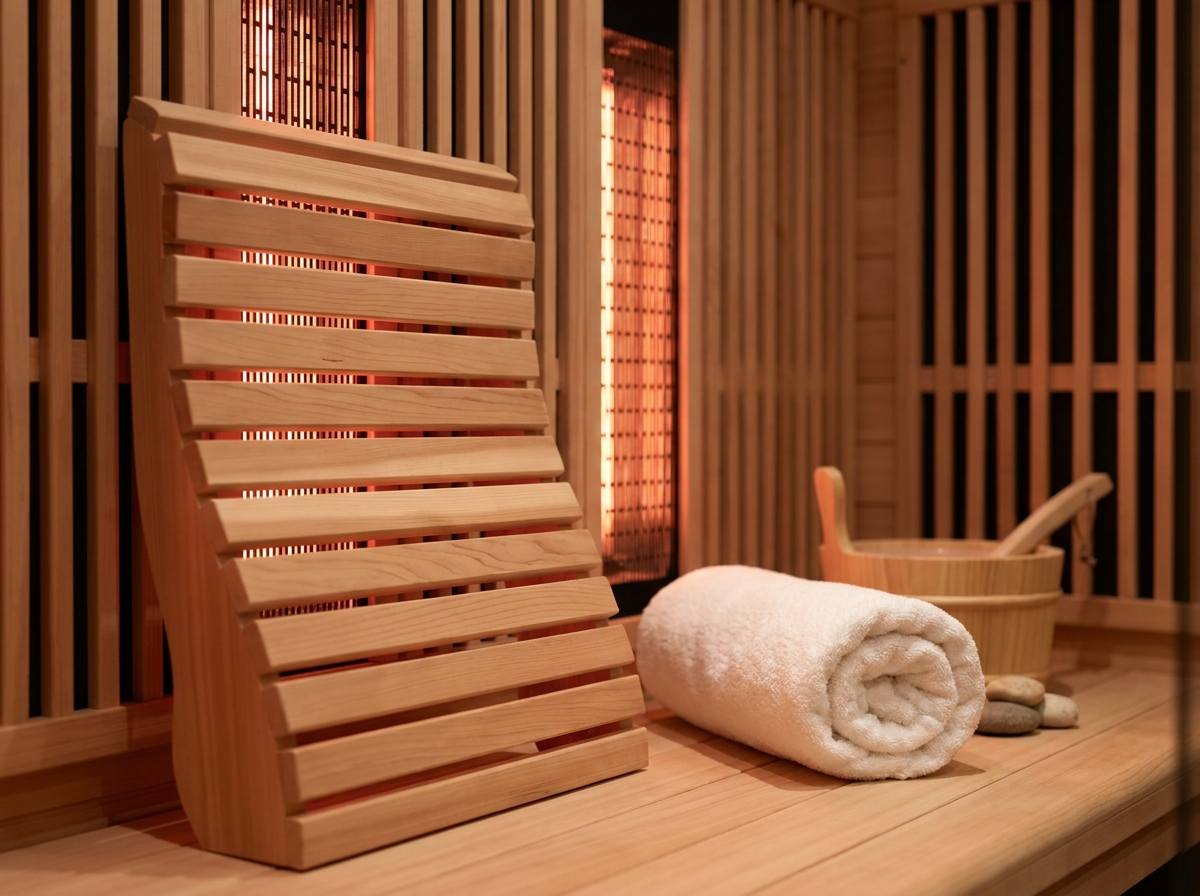
Look for untreated, formaldehyde-free wood—Canadian hemlock and cedar are tried-and-true options—as well as clean craftsmanship without sharp edges and sturdy glass doors (ESG safety glass). A TÜV/GS certification mark for the electrical system is required, and an automatic shut-off feature is standard. Ergonomic backrests make a bigger difference during 30-minute sessions than many people realize.
Controls and Features
Useful features: individually controllable lighting zones, an easy-to-read control panel inside and outside, and a timer. Nice extras, but not deal-breakers: colored lighting and Bluetooth speakers. The quality of the lights remains the deciding factor—spending an extra 200€ on better lights is a smarter investment than on any ambient lighting features.
Dealers, Warranty, and Service
Kauf bei einem Händler, der die Kabinen kennt, Ersatzteile (vor allem Strahler) liefern kann und bei Fragen erreichbar ist. Bei Kraftathlet bekommst du persönliche Beratung vor dem Kauf, CO₂-neutralen Versand und volle Herstellergarantie als autorisierter Händler – über 5.000 Kunden in der DACH-Region vertrauen darauf. Wenn du unsicher bist, welche Kabine zu deinem Raum und Budget passt, melde dich einfach bei uns. Und wenn du deine Regenerations-Ecke komplett denkst, findest du in der Kollektion Regeneration passende Ergänzungen von der Faszienrolle bis zum Massagegerät.
How to Use an Infrared Sauna Properly: Your Getting-Started Guide
A good sauna only truly shows its value when used as part of a smart routine. This approach has proven effective: Start with two 15–20-minute sessions at 45–50 °C during the first two weeks to allow your circulation to adjust to the radiant heat. After that, you can increase your sessions to 2–4 per week, each lasting 20–30 minutes at 50–60 °C—a higher temperature doesn’t automatically mean greater effectiveness; consistency over several months is what matters. Drink a large glass of water before and after each session, as even mild heat noticeably dehydrates the body. Athletes should ideally schedule their sessions on days off from training or several hours after a workout, as a deliberate recovery session for the strained muscles. Allow 10–15 minutes of rest after each session—the post-session sweating and cooling down are part of the process. You should avoid using the sauna if you have an acute infection with a fever, a recent injury with inflammation, or after consuming alcohol; as always, if you’re pregnant, have cardiovascular disease, or skin problems, consult a doctor beforehand.
Common Mistakes When Buying an Infrared Sauna
Don’t just look at the price: An €800 sauna with generic heaters and treated cheap wood is rarely a bargain—if a heater fails after two years and there are no replacement parts, you’ll end up paying twice as much. Ignoring the heater type: If you’re expecting intense, deep heat, you’ll be disappointed with a cabin that uses only carbon panel heaters—and vice versa. Failing to prepare the installation site: Insufficient clearance from the wall and an unventilated room lead to moisture problems. Buying too large a unit : A 3-person cabin sounds tempting, but it requires more space, more electricity, and in practice is usually used by just one person. Unrealistic expectations: An infrared cabin is a tool for relaxation, regeneration, and cardiovascular training—not a miracle medical device.
Frequently Asked Questions
How often should I use the infrared sauna?
For noticeable results, 2–4 sessions per week, each lasting 20–30 minutes, have proven effective. Finnish cohort data suggest that regularity is more important than intensity—it’s better to exercise moderately three times a week than extremely once a month.
Is an infrared sauna suitable for people with high blood pressure or heart problems?
The gentle heat is considered easier on the circulatory system than that of a Finnish sauna, and the German Heart Foundation considers infrared cabins to be well tolerated by many patients with stable heart conditions. Nevertheless, if you have an existing cardiovascular condition, you should consult a doctor before your first session.
How much electricity does an infrared sauna use?
Typical cabins draw 1.4–2.5 kW. Each session uses about 1.5–2 kWh, which comes to roughly €0.50–0.70 at an electricity rate of €0.35/kWh. Even with three sessions a week, your annual electricity costs will usually stay under €110.
Do you sweat just as much in an infrared cabin as you do in a sauna?
Yes, but it’s different: Due to direct radiant heat, sweating often begins as early as 50 °C, but it feels milder than in sauna air heated to 90 °C. As a result, many people find the session less strenuous and stay in longer.
Do I need a high-voltage power connection for the infrared sauna?
No. Virtually all home saunas rated up to 2.5 kW can be plugged into a standard 230-V outlet. The only important thing is that the circuit isn't overloaded in parallel by other high-power appliances.
Conclusion
An infrared sauna for your home is the easiest way to establish a consistent heat routine: no high-voltage power, minimal setup time, low operating costs, and a level of heat that even sauna skeptics can tolerate well. Research primarily supports the cardiovascular benefits of regular heat exposure—and that’s exactly where the infrared cabin shines: it makes consistency easy. If you want to know which cabin fits your space, your budget, and your goals, talk to us —we’ll give you honest advice, including whether a Finnish sauna might actually be the better choice for you.