

Hotel fitness room equipment differs from a classic gym: guests exercise unsupervised, usually for short periods and with varying fitness levels, yet the room must still accommodate serious training. This guide shows which equipment should be in a hotel fitness room in 2026, in what order to purchase it, and where operators most frequently fail in planning.
- Hotel fitness room equipment starts with a strength and cardio foundation, not wellness extras.
- A Force USA G3 All-in-One Trainer covers strength exercises for different groups of guests in a small area.
- A Hegren Reformer TALMA 62 appeals to wellness guests who are not looking for classic strength training.
- Recovery equipment comes only after the strength and mobility foundation, not before.
- Delivery time and on-site assembly more frequently determine the opening date in 2026 than the budget itself.
Why this matters when equipping a hotel fitness room
A hotel guest enters the fitness room without a trainer, often between two appointments, sometimes at 6 a.m. before breakfast. The equipment must be self-explanatory, function safely without supervision, and still be suitable for different fitness levels – from the business traveler who wants twenty minutes of cardio to the wellness guest seeking mobility training.
Kraftathlet supplies not only gyms and medical practices but also wellness hotels and spa operators who plan fitness rooms as part of their facilities. The requirements differ clearly from a boutique studio: less space per piece of equipment, more consideration for aesthetics and noise, and equipment that fits a spa or business hotel positioning in 2026 rather than the training program of a sports club.
Determine the space requirements and target group of your hotel
Before a piece of equipment is ordered, the question arises: Who uses the room, and how long do they stay on average? A business hotel with one-night stays needs a compact strength and cardio solution that allows for a complete workout in 20 to 30 minutes. A wellness resort with multi-day stays can justify a larger area with Pilates and mobility equipment because guests exercise repeatedly.
The room size directly determines how many equipment categories are realistic. A fitness room under 30 square meters rarely accommodates a complete strength, cardio, and Pilates setup at the same time – here, prioritization counts more than completeness.
Build the strength and cardio foundation
The basic equipment of a hotel fitness room consists of a strength station that covers several exercises in one piece of equipment, plus cardio equipment for endurance training. For hotels with limited space, a Force USA G3 All-in-One Trainer is a practical solution: cable crossover, squat rack, and bench press station in one frame, without guests having to switch between several pieces of equipment.
The strength and cardio foundation of a hotel fitness room typically includes:
- A combined strength station for cable crossover, squats, and bench press
- One to two pieces of cardio equipment, depending on the number of guests and room size
- Free weights in graduated increments for different strength levels
- A pull-up bar or comparable accessory for upper body training
- An adjustable dumbbell bench for bench press and additional exercises
A Smith machine with an integrated cable crossover can complement this foundation if more space is available and guests prefer guided movements with additional safety.
Set up a Pilates and mobility area
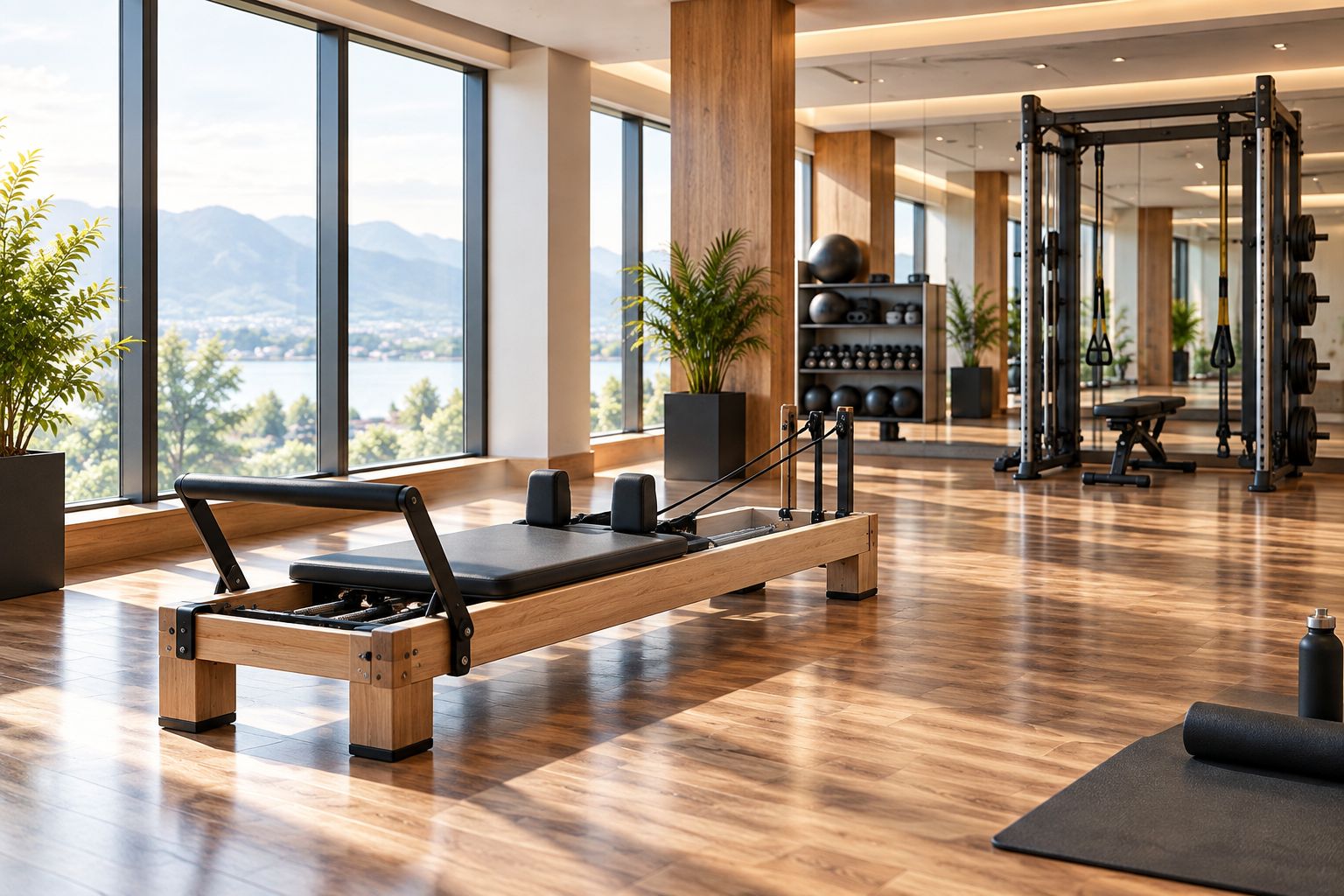
Wellness hotels are increasingly differentiating themselves in 2026 through mobility and Pilates offerings, which classic gyms rarely offer. A Hegren Reformer TALMA 62 fits into a quiet area of the fitness room or a separate spa room and appeals to guests who are looking for controlled movement training rather than strength training.
To effectively complement the reformer, little is often enough: mats, a Pilates ring, and non-slip surfaces cover the basic training without overcrowding the room. Clear instructions are important – a reformer without a brief explanation at the reception or via a posted sign will rarely be used correctly by inexperienced guests.
Add recovery and wellness equipment
Recovery equipment belongs in third place in the planning, not first. Compression systems, cold applications, and sauna solutions complement a functioning strength and mobility foundation, but do not replace it. For wellness hotels that want to integrate sauna or cold offerings into the fitness area, it is worth taking a look at the Sauna Selection for Wellness Hotels before making a purchasing decision.
Recovery equipment such as compression systems is described as training support, not medical treatment – the equipment supports recovery after training, it does not treat complaints. For 2026, many hotels are deliberately planning this category as a visible additional offering in the fitness room, not as a hidden niche.
Plan floors, ventilation, and safety
An unsupervised hotel fitness room needs different safety standards than a supervised studio. The floor must provide shock absorption for weights while being quiet enough not to disturb adjacent rooms or spa areas. Rubber granule floors with sufficient thickness are standard; thin carpet tiles are not.
Ventilation is often underestimated: A room without functioning ventilation feels unpleasant after the first training session of the day and affects the rating of the entire hotel. Safety instructions, emergency exits, and visible exercise instructions at every piece of equipment are not optional in unsupervised rooms, but mandatory.
Clarify delivery, assembly, and contact person
Equipment for hotel fitness rooms is generally delivered and assembled on site – this applies especially to larger strength stations and reformers, which should not be installed by the customer. Ask specifically about the delivery time before ordering and whether it fits the planned opening or renovation date.
A fixed contact person after assembly is more important for hotels than for individual buyers because a defective piece of equipment in the fitness room directly creates guest complaints. Clarify before purchase who is reachable for technical questions in 2026 and how a spare part will be organized in the event of a service issue.
Request a configuration for your hotel fitness room
Tell us the room size and guest profile – we will put together the right equipment.
Calculate the budget and timeline until opening
The budget for a hotel fitness room depends on more factors than the pure number of pieces of equipment. Room size, chosen equipment level, delivery time, and location in Germany, Austria, or Switzerland influence both costs and planning lead time. Anyone who wants to open on a fixed date in 2026 should initiate the equipment purchase at least two to three months before the deadline to properly plan the delivery time and assembly date.
Which equipment level is right for your hotel
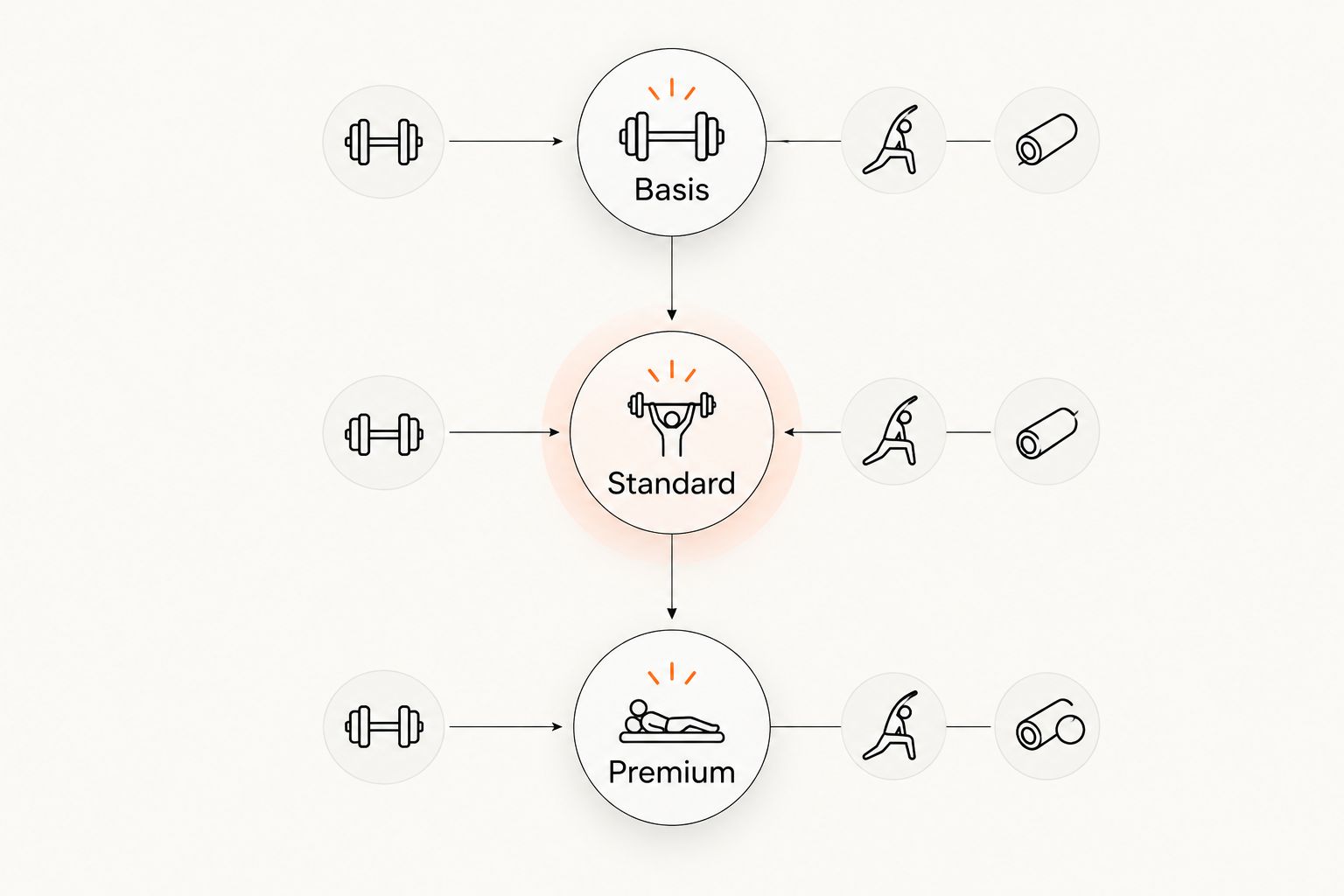
Not every hotel needs the same depth of equipment. The following overview organizes three common levels by target group and shows where each level reaches its limit.
| Equipment level | Best for | Most important limitation |
|---|---|---|
| Basic (Strength + Cardio) | Business hotels with short stays | No differentiation through wellness positioning |
| Standard (Strength + Cardio + Mobility) | Hotels with fitness as a fixed additional offering | Greater space requirement for the mat and Pilates area |
| Premium (Strength + Pilates + Recovery) | Wellness hotels and resorts with a spa focus | Higher coordination effort when delivering multiple equipment categories |
Our assessment: For most hotels with limited space, the Standard level is the most economical entry in 2026 – the Premium level is worth it primarily if wellness is already part of the brand positioning.
Common mistakes when equipping hotel fitness rooms
Selecting equipment based on appearance rather than use. A piece of equipment that impresses in the showroom but is difficult to use without a trainer will remain unused in the hotel operation.
No time buffer before the opening date. Delivery times for strength stations and reformers are regularly calculated more tightly than the actual on-site assembly requires.
Purchasing recovery equipment before the strength foundation. A fitness room with a cold or compression offering, but without a functioning strength station, seems incomplete to trained guests.
Planning too little space for strength and Pilates at the same time. If a reformer is squeezed into an already full strength room afterwards, the usability of both areas suffers.
No contact person for service after assembly clarified. Especially in unsupervised rooms, a defective piece of equipment without quick contact leads directly to guest complaints.
You can find equipment for hotel fitness rooms, spa, and recovery collectively in the Hotel & Spa category.
FAQ
What basic equipment does a hotel fitness room need in 2026?
The foundation consists of a combined strength station, one to two pieces of cardio equipment, and free weights in graduated increments. Mobility and recovery equipment complement this foundation only in a second step.
Is a Pilates reformer worth it in the hotel fitness room?
A reformer like the Hegren TALMA 62 is worth it primarily for wellness hotels that want to differentiate themselves through mobility training. For pure business hotels with short stays, a strength and cardio foundation is usually sufficient.
How big does a fitness room in the hotel need to be?
Under 30 square meters, usually only one category – strength, cardio, or mobility – can be fully equipped. From about 40 to 50 square meters, a strength and Pilates area can be realistically accommodated at the same time.
How long does the delivery of fitness equipment for a hotel take?
Delivery times depend on the equipment category and location and should be inquired directly with the supplier before ordering. For strength stations and reformers, a planning lead time of at least two to three months before the opening is realistic.
Does a hotel fitness room need supervision?
Most hotel fitness rooms operate unsupervised, which is why equipment must be self-explanatory and usable safely without instructions. Visible exercise instructions at every piece of equipment significantly reduce misuse.
How much does equipping a hotel fitness room cost?
The costs depend on room size, chosen equipment level, and location, and can only be reliably estimated through an individual configuration. A flat rate without knowledge of the room data is hardly reliable.
What is the difference between fitness room equipment for hotels and for companies?
Company fitness rooms are usually used by known employees at fixed times, while hotel guests exercise unsupervised and with varying fitness experience. This shifts the priority for hotels more towards safety and self-explanability.
One last thing
The fitness room is often the hotel area that guests enter earliest in the morning and without staff – a single loud or confusingly operated machine shapes the first impression of the day more than the lobby the evening before. Anyone planning for 2026 should therefore treat the fitness room like a standalone guest area, not like a byproduct of the spa facilities.