

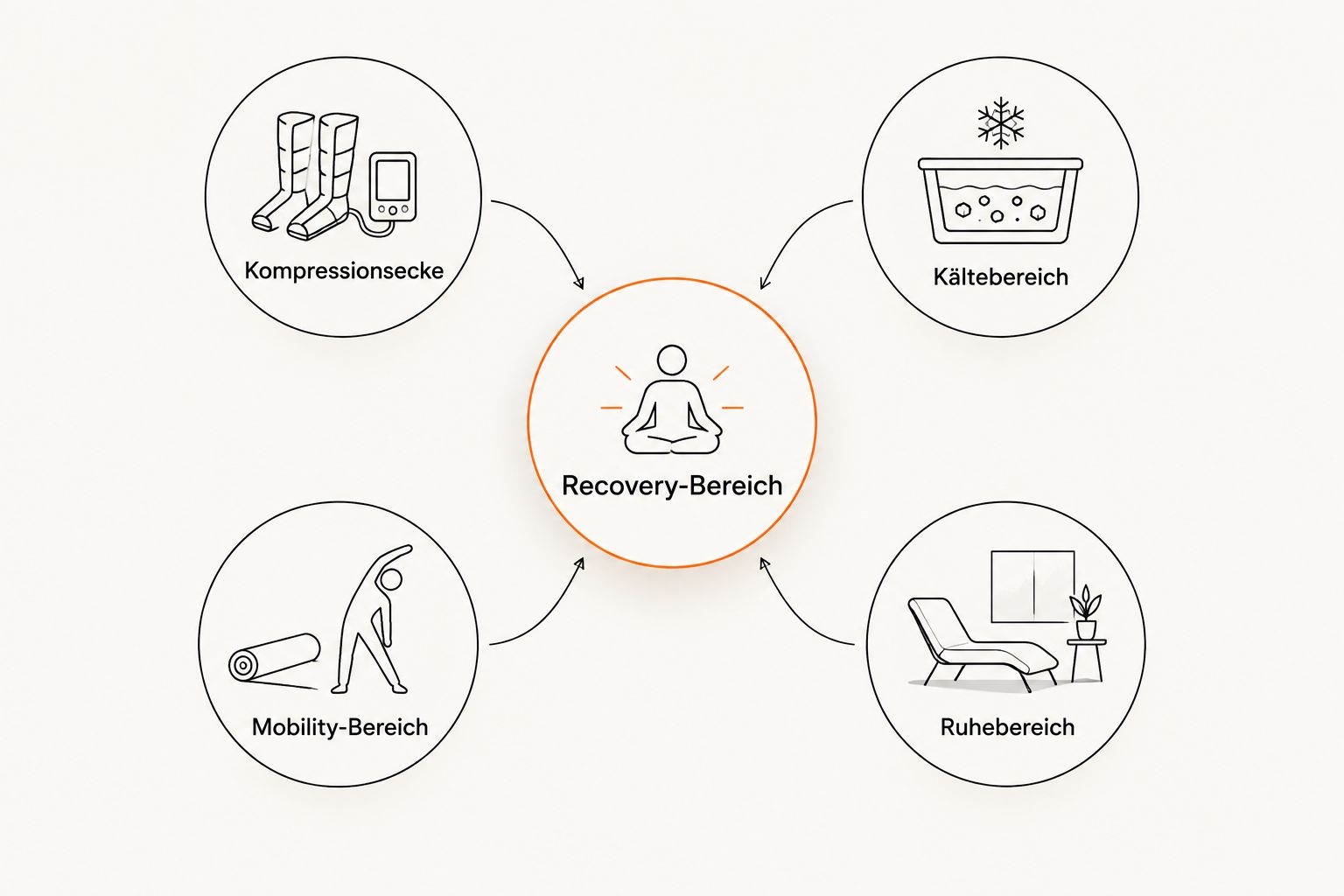
A recovery area for sports clubs includes compression therapy, cold therapy, and a quiet area that athletes use to recover after training and competitions. Unlike in a private studio, you need to plan for rotating training groups, multiple sports, and a budget that the board itself must be responsible for.
- Equipment for a sports club recovery area starts with compression boots and a cold therapy source, not a full wellness area.
- The Aerify Charge delivers up to 240 mmHg and 16 pressure levels for multiple training groups per evening.
- Physically separate the compression and cold therapy areas to avoid wait times between teams.
- Kraftathlet supplies and installs recovery equipment for sports clubs in Germany and Austria.
Why a recovery area for sports clubs is planned differently
A sports club rarely has only one training group. The youth team, first team, and rehab group often use the recovery area one after another on the same evening – this changes how many devices you need and how robust they must be. A single compression device is enough for a home studio, but not for 20 or 25 players after a match.
Compression boots differ greatly in the number of chambers and pressure range, as shown in the comparison of recovery boots for clubs. For club operations, what matters most is how quickly a device can be cleaned and reset between two users – not just how high the maximum pressure is.
Club budgets rarely come from a single source. Membership fees, sponsorship, and sometimes municipal sports funding jointly finance the purchase, which makes planning for 2026 different from a commercial studio with an investor.
Determine user groups and training times
Before you order a single device, count how many people use the area per training evening and at what time. A football department with five teams needs a different time-slot concept than an athletics club with two training days per week.
Note whether rehab athletes, teenagers under 16, and adults use the same area at the same time. This determines whether you need two smaller compression stations or one larger one with shorter session times per person.
Plan the space and room concept
A recovery area does not need its own hall, but it does need separate zones. Compression, cold therapy, and a quiet area for debriefing should not get in each other's way, otherwise exactly the wait times will arise that make the area unattractive in practice.
A fixed area in the locker room or an adjacent room next to the hall is enough to get started. An accessible power outlet for corded compression devices and a waterproof floor are important if a cold water bath is also included.
Select compression therapy for club operations
Compression boots are the most practical entry into recovery equipment for most clubs: no water connection, no cooling unit, quick to set up. The Aerify Charge system, for example, operates wirelessly with up to 240 mmHg, 16 pressure levels, and a 5,000 mAh battery for around 3 hours of runtime – sufficient for multiple users per evening without a power outlet nearby.
What to look for when choosing for club operations:
- Battery life or mains operation in relation to the number of training evenings per week
- Number of air chambers, because more chambers allow for more targeted pressure distribution
- Cleaning effort between two users, especially when shared by multiple teams
- Availability of spare parts such as hoses, if a device is in continuous operation
- Size adjustment, so that youth and adult squads can use the same device
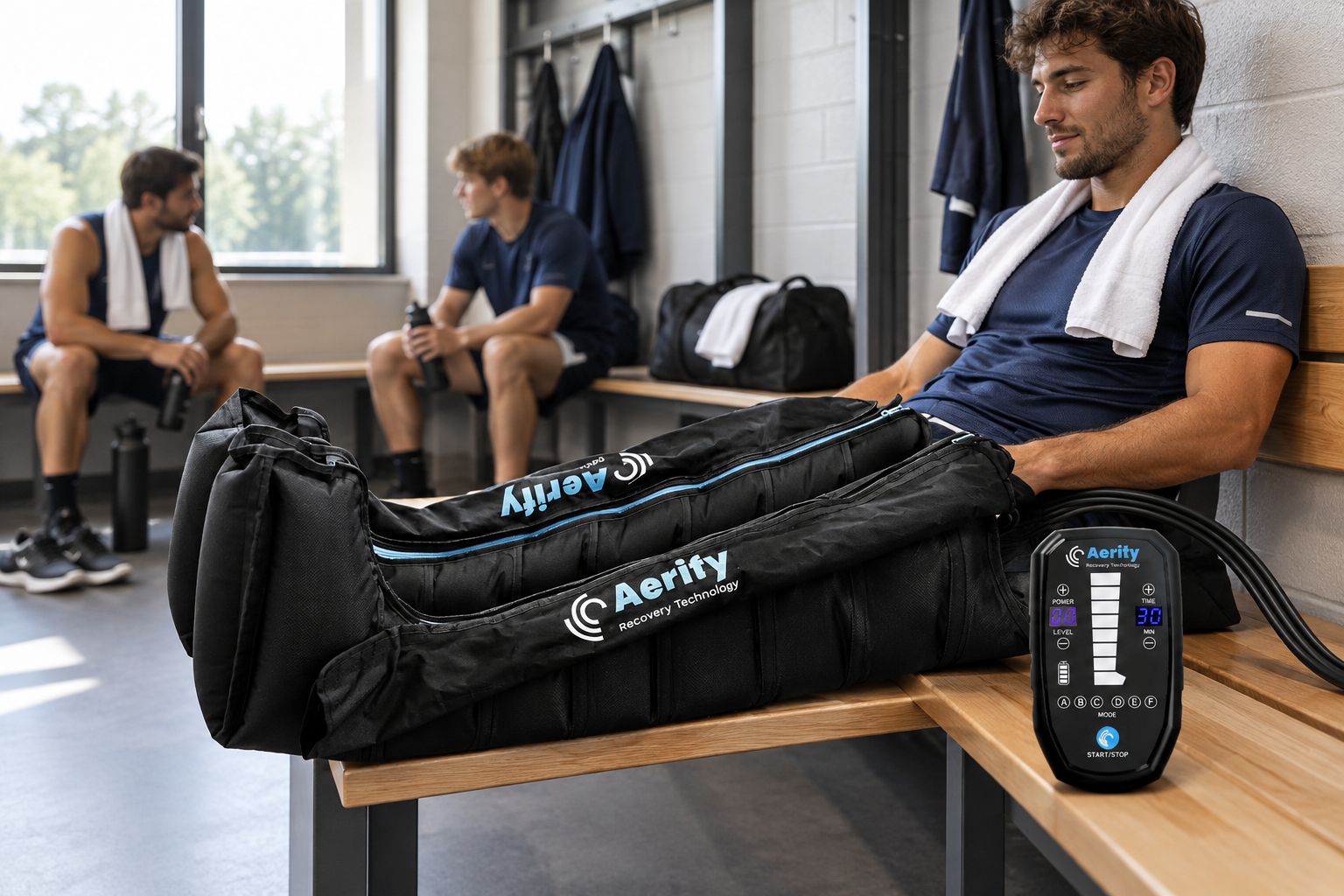
For clubs with a smaller budget, there are tiered entry-level devices, while for clubs with high utilization, a wireless system with longer battery life is worth it. The following selection covers both cases.


Plan cold therapy and ice baths
A cold water bath complements compression with a second recovery routine, but requires more planning: space for the bath, water changes or filtration, and an area where players do not wait directly next to the compression station. The Cold-Plunge Options Overview shows which models are designed for permanent club use instead of occasional home use.
Points that are often overlooked when planning cold therapy in a club:
- Water treatment and cleaning intervals with multiple users per week
- Floor drainage or covering if the bath is not permanently installed
- Time slots separate from the compression station to avoid wait times
- Supervision or clear usage rules for youth teams
Clarify budget and funding
Clubs rarely finance recovery equipment from a single budget item. Membership fees, sponsorship, and sometimes subsidies from the state sports association or municipality come together – the application deadlines for this are usually months before the actual purchase, so plan accordingly early for the 2026/2027 season.
Stagger the purchase if the budget for 2026 is tight: a compression system first, a cold therapy area the following year. This spreads the costs over two fiscal years and reduces the risk that the equipment remains unused because the staff has not yet been trained.
Organize operation, hygiene, and training
A device without a designated contact person in the club will quickly gather dust in a corner. Appoint one person – often the equipment manager, physiotherapist, or coach – who is responsible for cleaning, scheduling, and minor repairs.
Training is more important for shared devices than for private use at home: Incorrect pressure settings or sessions that are too long without guidance lead more quickly to complaints among multiple users than with a single person who knows their own device.
Options comparison
| Option | Best for | Limitation |
|---|---|---|
| Compression boots (e.g. Aerify) | Quick recovery rounds, multiple users per evening | Cleaning between users required, battery life limited on wireless models |
| Cold water bath / Ice bath | Teams after intense competitions, permanent installation | Space requirements and water treatment must be planned |
| Foam roller and fascia accessories | Warm-up and cool-down routines in the hall, low budget | Does not replace active compression or cold therapy |
| Infrared/red light cabin | Clubs with a fixed location and wellness focus | Higher space and installation requirements, no replacement for medical treatment |
Typical mistakes in planning a recovery area in a sports club
Only thinking about the first team. If you plan equipment for 15 players but have six teams in the club, you buy too little capacity and the area becomes a bottleneck.
Compression and cold therapy in the same room without separation. Without separate zones, wait times arise that make the area unattractive – players then simply go straight home.
No hygiene concept for shared devices. A club with 30 weekly users needs clear cleaning intervals, otherwise acceptance will quickly drop.
Budget only for purchase, not for maintenance. Replacement hoses or spare parts arise in continuous operation – if this is not planned for 2026, you will be left without a functional device the following year.
You can find compression systems, cold baths, and other recovery equipment in the Recovery & Regeneration category.
FAQ
What belongs in a recovery area for sports clubs?
A compression system like Aerify Charge, a cold therapy source like a cold water bath, and a quiet area for debriefing form the basic equipment. Fascia accessories and infrared cabins complement the area, but are no replacement for the first two elements.
How big does a recovery area in a club need to be?
A fixed side room or area in the locker room is enough to get started, the separation of the compression and cold zone is crucial. The exact area depends on the number of teams and training times.
How much does equipping a recovery area for a sports club cost?
The costs depend on the number of devices, the compression system, and whether a cold water bath is also included. For a concrete calculation for 2026, it is recommended to make an inquiry directly with the supplier.
Is compression therapy useful for all sports in the club?
Compression boots are used in many sports after intense training sessions, from football to athletics. For very small departments with low training frequency, the purchase often only pays off in the medium term.
Ice bath or compression boots – which is more sensible for sports clubs?
Compression boots are the easier entry point because no water connection is required and multiple users can cycle through more quickly. An ice bath complements this well, but requires more space and maintenance.
How often should athletes use the club's recovery area?
This depends on the training schedule and the training intensity of the respective team. Many clubs set fixed time slots after intense sessions or competition days instead of free use.
Does a sports club need a permit for a recovery area?
For compression devices, no special permit is usually required, but for permanently installed cold water pools, it is worth consulting the hall's landlord. Internal club usage rules are sensible regardless.
How do you maintain recovery equipment in a club setting?
Fixed cleaning intervals between users and a contact person for minor repairs such as replacement hoses keep the devices ready for use over several training seasons. Without a designated person responsible, jointly used equipment wears out significantly faster.
One more thing
Spare parts are needed more frequently in clubs than by individual users – a replacement hose for a compression system with 30 weekly users is more likely a matter of months than years. If you plan for this right at the time of purchase in 2026, you won't suddenly be left without functional equipment during the season.